Green Jersey Tour de France Explained: Points, Consistency and Sprinting
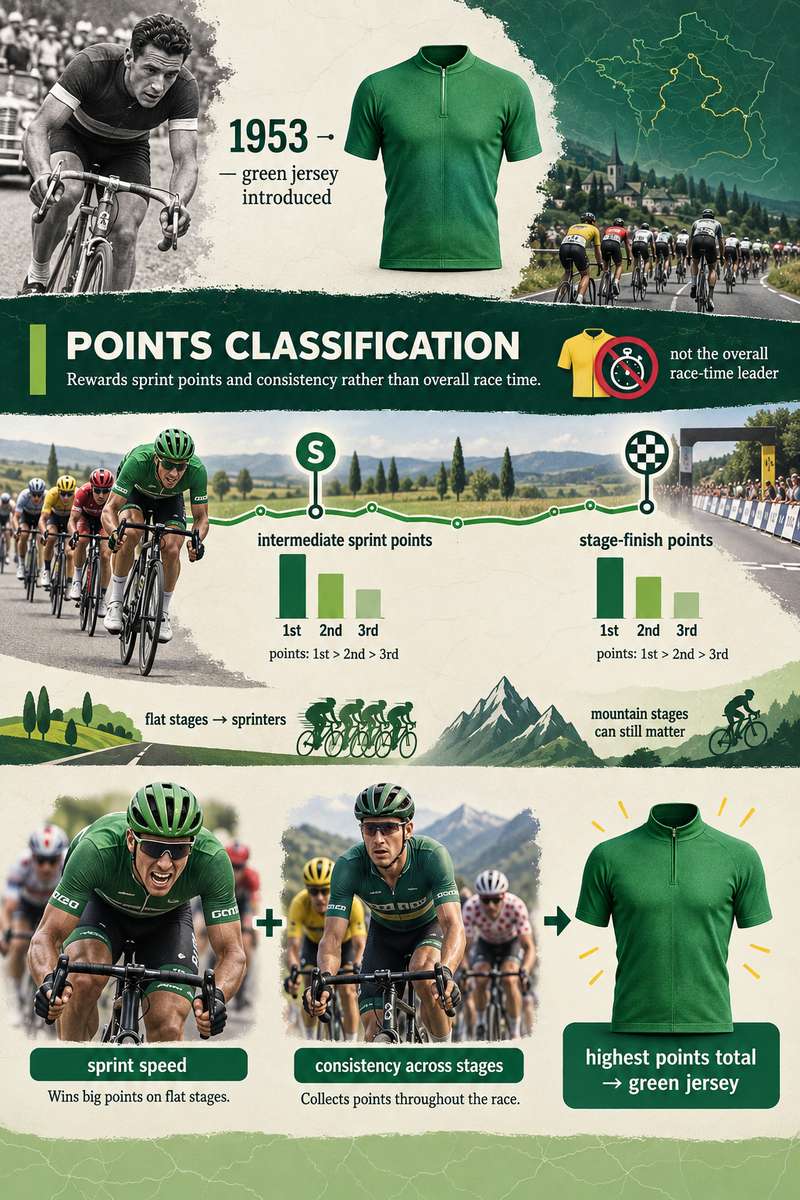
The green jersey (maillot vert) is the visual prize for the leader of the Tour de France points classification. Created for the 1953 Tour de France to mark the race’s 50th anniversary, the green jersey rewards consistent high placings and success in intermediate sprints rather than cumulative time. That combination explains why the maillot vert is commonly described as the sprinters’ jersey.
The green jersey was introduced in 1953 to identify the points leader. Points come from stage placings and intermediate sprints. The system rewards consistency across stages, which tends to favour fast finishers who can also survive harder days.
Definition • How it works • History • Tactics • Closing
CLEAR DEFINITION
The green jersey designates the rider leading the Tour de France points classification. Unlike the yellow jersey, which is awarded for lowest cumulative time, the green jersey is given daily to the rider who has accumulated the most points from stage finishes and intermediate sprints. For beginners: think of it as a reward for being repeatedly near the front on sprint opportunities and for contesting the race at many moments.
HOW IT WORKS
The points classification is calculated from points awarded for high placings at the end of stages and at designated intermediate sprint locations during stages. The exact points scale and the distribution between stage types can change over time; historically, organisers have adjusted the scale to balance opportunities between pure sprinters and other riders. The key principle is consistent scoring: a rider who regularly finishes near the front or contests intermediate sprints will accumulate points even if they never lead the general classification.
WHY IT MATTERS IN CYCLING
The green jersey creates a second, parallel race inside the Tour. It gives sprinters and their teams a season-long objective distinct from the overall victory. For teams it offers tactical value: chasing intermediate sprints, organising lead-outs, and protecting a points leader affects race shape, uses domestiques’ energy, and can force rival teams to react. For viewers, the maillot vert highlights recurring battles that play out across many stages rather than a single winning move.
TOUR DE FRANCE CONTEXT & HISTORY
The maillot vert was introduced in 1953 on the Tour’s 50th anniversary to designate the leader of the points classification. The green colour is historically linked to the classification’s original sponsor at the time of introduction; sources attribute the choice to period commercial links such as the retailer often cited in historical accounts. The green colour has been used as the identifier for the points leader since 1953, with only brief sponsor-driven exceptions in later years.
TACTICS AND TEAM STRATEGY
Because flat stages and intermediate sprints typically offer the most points, teams with top sprinters build sprint trains and control the peloton on sprint days to deliver their fast-finisher to the line. A points classification campaign needs both sprint speed and consistency: riders must place highly on sprint stages and contest intermediate sprints, but they also must survive hillier or longer stages and finish inside time limits to remain in contention. Teams allocate domestiques to chase breakaways, position the sprinter, and protect the points leader—decisions that shape stage tempo and energy expenditure over three weeks.
RIDER ROLES AND PHYSICAL DEMANDS
Specialist sprinters often target the green jersey because their explosive speed wins the high-point flat finishes; however, a successful points campaign requires durability. A points leader must avoid time cuts on harder days and be mobile enough to contest intermediate sprints. That combination means rouleurs and strong all-round domestiques are important support, supplying positioning, shelter from wind, and a controlled lead-in to sprints.
CLASSIFICATION AND EVOLUTION
The points classification format has evolved: organisers have periodically changed points scales and the weighting of stage types to influence which rider profiles can compete for the jersey. These adjustments reflect an ongoing balance between rewarding pure sprint wins and recognising consistent high placings across varied terrain. Despite evolution in detail, the underlying idea—rewarding points and consistency instead of total time—remains the same.
CLOSING INTERPRETATION
The green jersey reveals a fundamental truth about stage racing: there are multiple races inside the race. By rewarding consistent speed and opportunism rather than elapsed time, the points classification celebrates a different skill set—repeatable high performance, teamwork in the sprint train, and survival across varied terrain. Knowing how the maillot vert is scored helps viewers spot the quieter, persistent battles that shape the Tour across three weeks.
Author: Alex R.