
Cycling slipstream explained: why following a wheel saves energy and how teams…
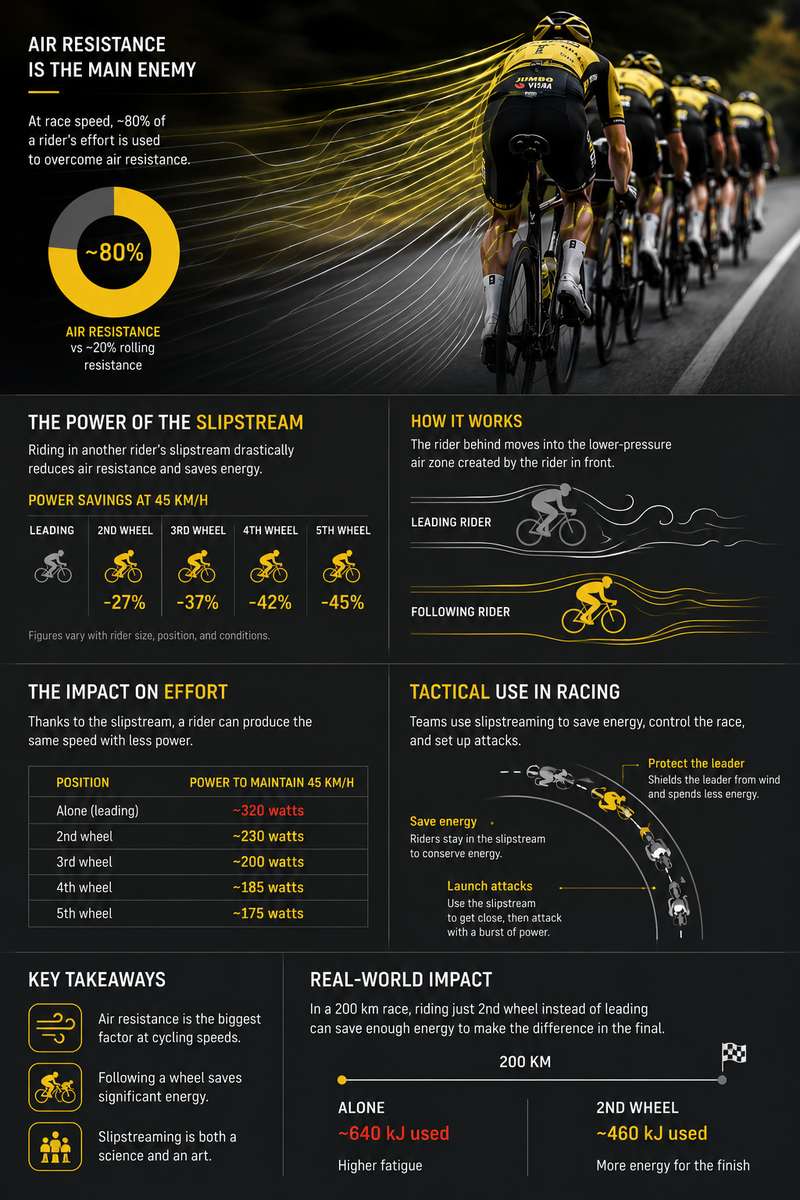
Slipstreaming — usually called drafting in cycling — is the single most important aerodynamic trick on the road. At race speeds on flat roads most resistive force comes from the air, so riding in another rider's reduced-resistance zone saves real power and changes how teams and riders race the Tour de France and other stage races.
CLEAR DEFINITION
Slipstreaming (drafting) in cycling means riding in the reduced-air-resistance zone behind or beside another rider so the following rider experiences less aerodynamic drag. The follower is sheltered from oncoming air and therefore needs less power to hold the same speed.
HOW IT WORKS
At typical road speeds on flat terrain aerodynamic resistance is the dominant resistive force — reputable sources estimate roughly 80–90% of resistive forces are aerodynamic at race speeds. The lead rider pushes through the air and creates a lower-pressure wake behind them; a rider positioned in that wake encounters less clean airflow.
Measured and modelled studies report substantial drag and power reductions for trailing riders. Commonly cited energy or power savings fall in the tens of percent — often around 20–40% — but the exact figure depends on rider spacing, relative size and position, speed, wind direction, and the number of riders sheltering.
Benefits fall as speed drops: on steep climbs where speed is lower, air resistance becomes a smaller share of total resistance, so drafting advantage declines. Conversely, on fast flats and descents the aerodynamic gain from slipstreaming is largest.
WHY IT MATTERS IN CYCLING
Drafting changes what is physically possible in a race. When the peloton stays together, riders save a lot of energy compared with trying to ride solo. That conserved energy is central to three-week races like the Tour de France because small seconds add up across stages and fatigue accumulates.
Because drafting offers measurable power savings, teams and riders organise themselves to maximise shelter, to time attacks when shelter ends, and to force rivals to pay the energetic price of being off the back or in the wind.
TACTICS AND TEAM STRATEGY
Teams use slipstreaming as a tactical tool in several established ways. In pacelines riders rotate 'pulls' at the front so the effort of cutting the air is shared; each rider spends a short time facing full drag before drifting back into the shelter of the line.
In crosswinds the beneficial shelter geometry shifts diagonally behind the lead rider. That produces an echelon formation, which teams exploit to split the peloton and create time gaps: riders tucked into the echelon save energy while those caught in exposed positions must chase at higher cost.
Leadouts for sprints are another deliberate use of drafting: a sequence of teammates shelter the team's sprinter until the last hundred metres, conserving the sprinter's energy and delivering them to the line at high speed.
Breakaways also depend on drafting dynamics. A small group that works well together can share pulls and stay away, while a lone attacker faces much higher aerodynamic cost and is easier to reel in when the chasing group forms an efficient paceline.
RIDER ROLES AND PHYSICAL EFFORT
Different rider types experience drafting differently. Rouleurs and domestiques often do long, hard pulls at the front; their role is to create speed and shelter the leader. Climbers gain less from drafting on steep gradients, so they focus more on sustained power and pacing. Sprinters rely heavily on teammates’ shelter until the final surge where raw speed and positioning decide the finish.
Because drafting changes required power so markedly, team strategy often revolves around who will spend energy pulling and who will be protected. Over a multi-stage race conserving energy on transition stages can be decisive for late-week performance.
BIKE AND EQUIPMENT
Aerodynamics matter for both riders and equipment. Wheels, frames, clothing and rider position all change how much clean air a rider presents and how large the wake is behind them. Equipment choices influence the absolute size of the aerodynamic gains from drafting, but the core sheltering effect comes from relative position, not just kit.
SAFETY, RISK AND VEHICLE SLIPSTREAMS
Riding close for aerodynamic benefit raises safety issues: tight spacing at high speed increases crash risk, especially in crosswinds or on technical descents. Another contentious area is the influence of motorbikes or team cars: using a vehicle's slipstream can alter a race and has been the subject of investigative reporting in professional cycling.
FAN VIEWING GUIDE
Watching for formations tells you a lot. A long single-file paceline usually means teams are trying to chase efficiently; a visible diagonal echelon in crosswind shows a deliberate attempt to split the race. In sprint finales, look for the ramping pace of leadout trains and how the sprinter is kept sheltered until the last possible moment.
CLOSING INTERPRETATION
Slipstreaming is more than a physics trick; it is the strategic currency of road racing. Understanding how drafting shapes effort, formation and timing helps explain why races fragment, why teams sacrifice riders to protect leaders, and how seconds can be won or lost without an obvious attack. For fans, recognising pacelines, echelons and leadouts makes the race easier to read and shows how teamwork and aerodynamics combine to decide outcomes.
Author: Cynthia D.