Peloton meaning in cycling: why the bunch is more than a pack
The peloton in road bicycle racing is the main group or pack of riders — the largest group in a race. Understanding the peloton meaning in cycling explains more than who’s together on the road: it reveals how riders save energy, why teams cooperate and compete inside the bunch, and how the peloton’s shape and pace determine whether breakaways live or die.
The peloton is the largest group of riders in a race. Drafting inside it reduces air resistance and energy cost, and the group behaves as a cooperative‑competitive system whose formations and decisions shape stage and overall outcomes.
Definition·Drafting & energy savings·Tactics & team strategy
CLEAR DEFINITION
In road bicycle racing the peloton is the main group or pack of riders — the largest group in a race. This is the standard term used in race reports and cycling literature: the peloton is not a random bunch but the organised mass that usually contains most teams and contenders.
HOW DRAFTING WORKS: AERODYNAMICS AND ENERGY SAVINGS
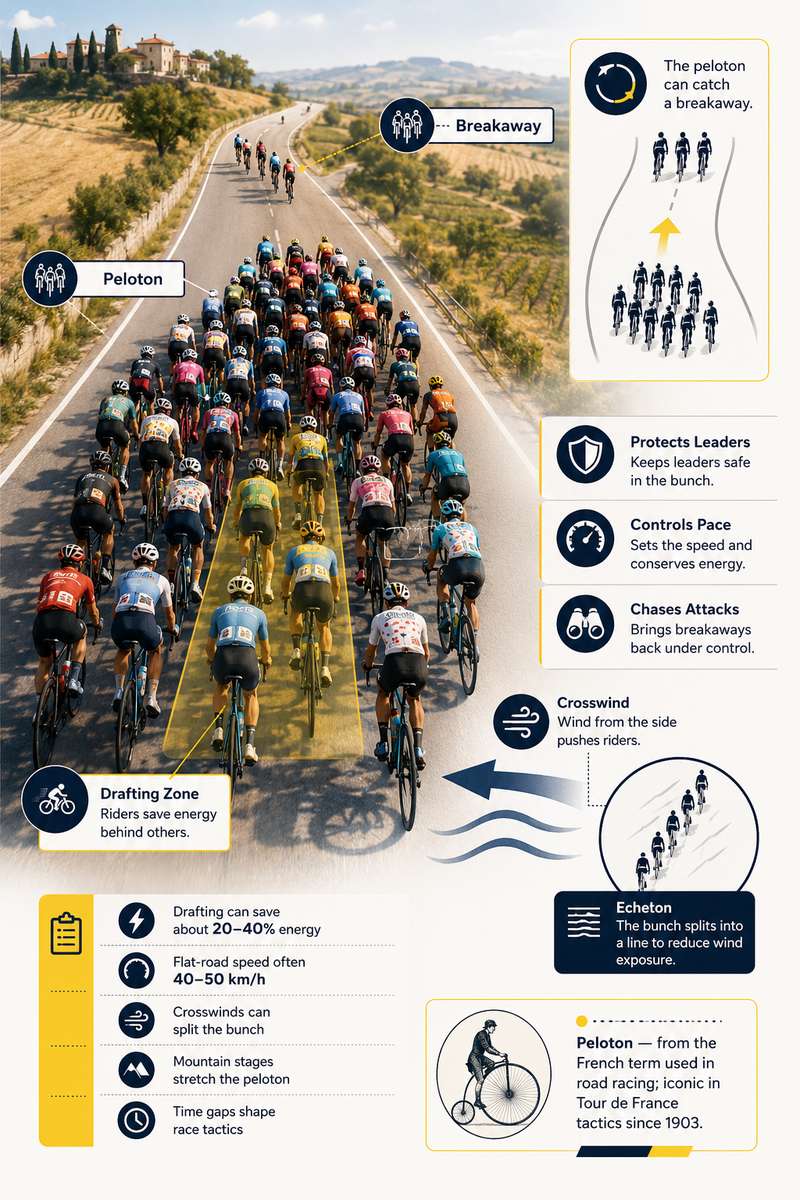
Riders positioned behind others experience reduced air resistance, a phenomenon known as drafting. When a rider tucks into the wake of another, the lead rider breaks the wind and those behind need less power to maintain the same speed.
Scientific and experimental work shows substantial reductions in drag and oxygen consumption for riders in group formations. The effect grows with larger groups and with favourable formations: a compact peloton or lateral formations such as echelons in crosswinds amplify the aerodynamic benefit.
THE PELOTON IS MORE THAN A GROUP
Beyond physics the peloton functions as a cooperative and competitive social‑strategic system. Teams and riders share drafting benefits but also pursue opposing goals: protecting a leader, setting up a sprint, or allowing a breakaway time to develop. Roles such as domestiques, leaders, sprinters and rouleurs are assigned inside the peloton to manage energy and position.
That shared-but-competitive logic explains why the peloton will sometimes slow to allow a non‑threatening breakaway, or why several teams will refuse to chase an escape — decisions that combine aerodynamic advantage with tactical calculation.
TACTICS AND TEAM STRATEGY
The peloton’s pace, formation and willingness to chase determine many tactical outcomes. An organised chase by multiple teams can reel in a breakaway; conversely, disorganisation or strategic refusal to work often lets escapes succeed. Teams use the peloton to protect GC contenders, launch lead‑outs for sprinters, or force echelons in crosswinds to split the field.
Formation matters: a compact pack concentrates drafting gains and makes it harder for a lone rider or small group to stay away, while echelons spread riders laterally to exploit crosswind advantage and create selection.
TERRAIN, WIND AND FORMATION VARIATION
The peloton changes shape with terrain and conditions. On flat stages the bunch often remains compact to maximise drafting, enabling high speeds and setting up bunch sprints. In crosswinds the peloton can break into echelons, redistributing aerodynamic benefit laterally and producing splits. On steep climbs the benefit of drafting is reduced and the peloton often thins into smaller groups or single‑file lines.
PHYSICAL AND MATHEMATICAL PERSPECTIVES
Academic models of peloton dynamics describe phase states and thresholds for breakaway success. These studies use aerodynamic and energetic parameters to show when a breakaway can escape the collective advantage of the peloton, and how information and positional resources inside the group influence behaviour.
FAN VIEWING GUIDE AND COMMON MISUNDERSTANDINGS
Watching the peloton with the peloton meaning in cycling in mind clarifies broadcast moments: a tightly grouped peloton isn’t passive — it is conserving energy and calculating. When teams move to the front, they are not merely showing off: they are committing domestiques to pace, protect leaders, or chase. Conversely, a slow peloton may be a sign that teams are conserving energy while a break builds a lead.
Beginners sometimes assume the peloton always chases every escape; in reality the decision to chase depends on who is in the break, which teams are represented, and whether the peloton’s collective energy budget justifies the work.
CLOSING INTERPRETATION
Understanding the peloton meaning in cycling transforms how you read a race. The peloton is simultaneously an aerodynamic machine and a tactical marketplace: its geometry saves energy, its social rules distribute effort, and its movement determines whether stages end in a sprint, a solo victory, or a reshuffle of the general classification. Recognising those layers makes both live viewing and historical races easier to interpret.
Author: Cynthia D.