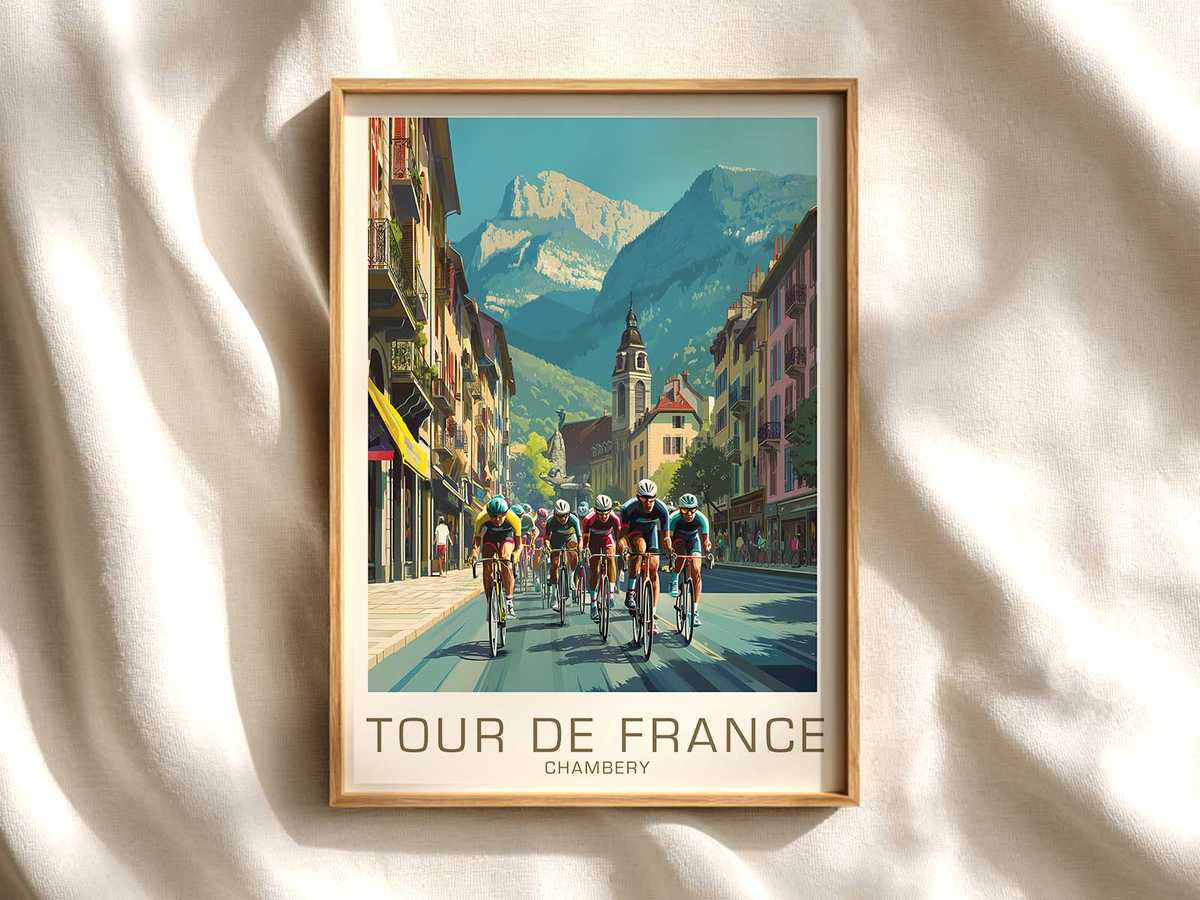
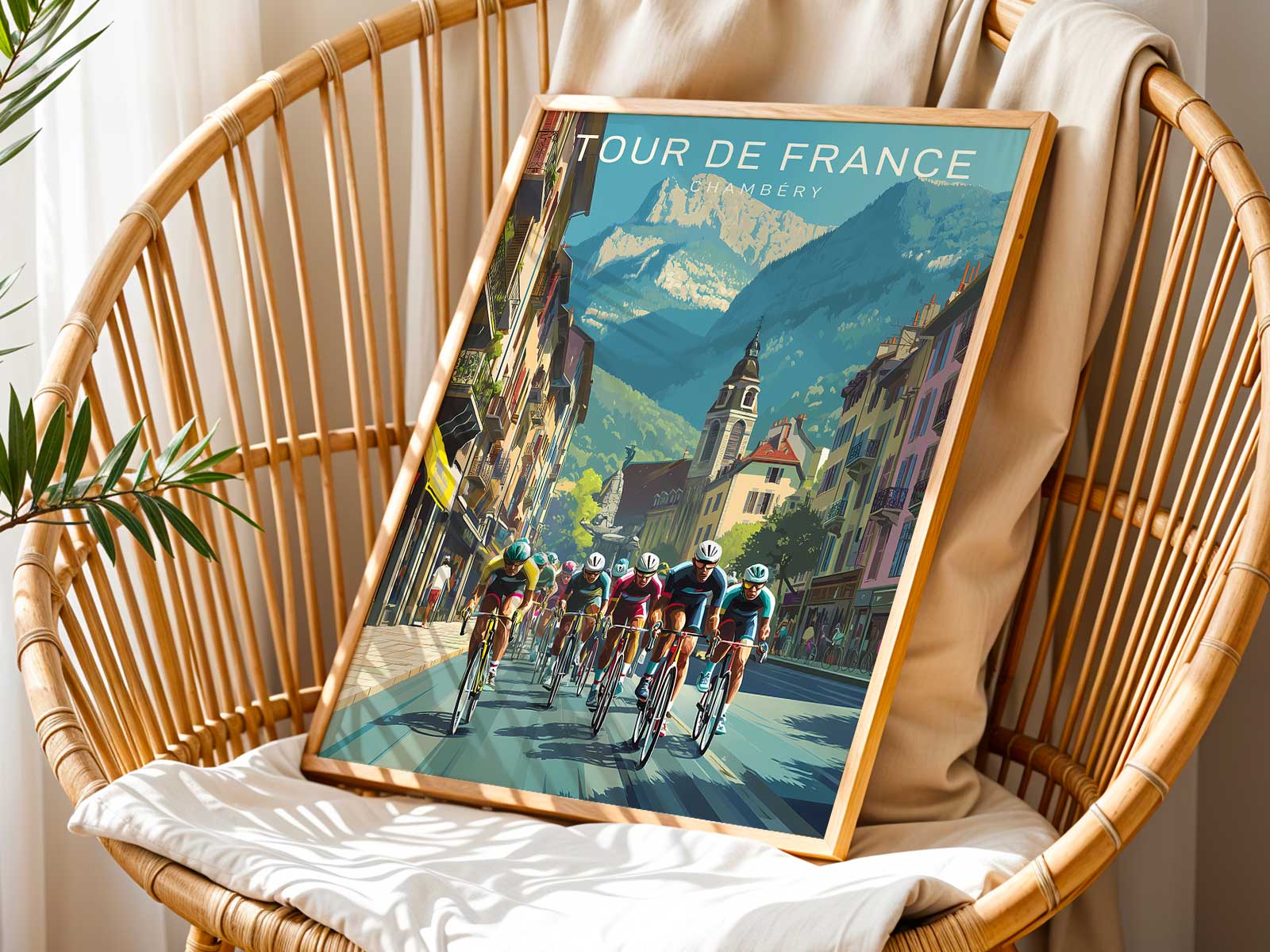
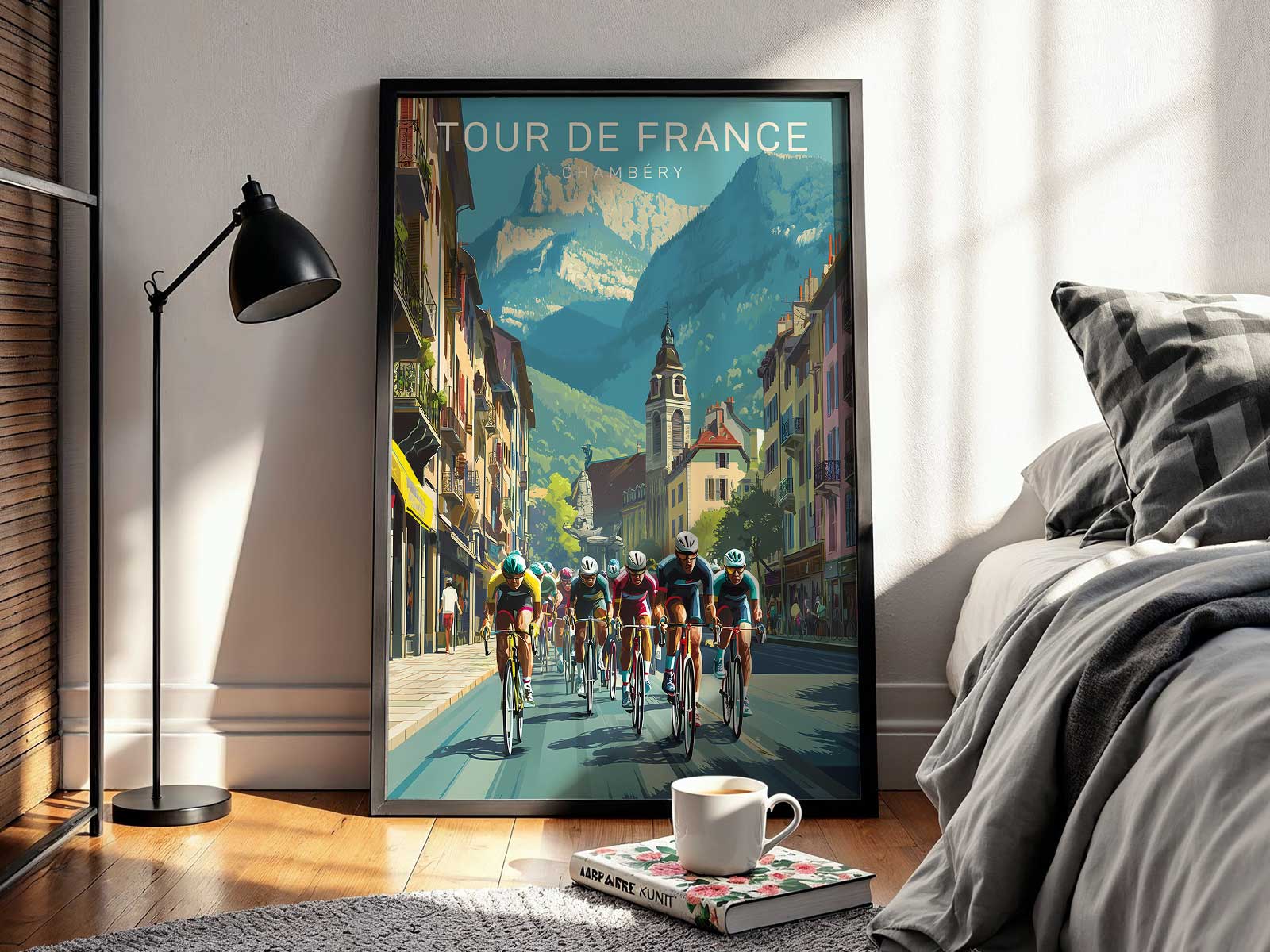
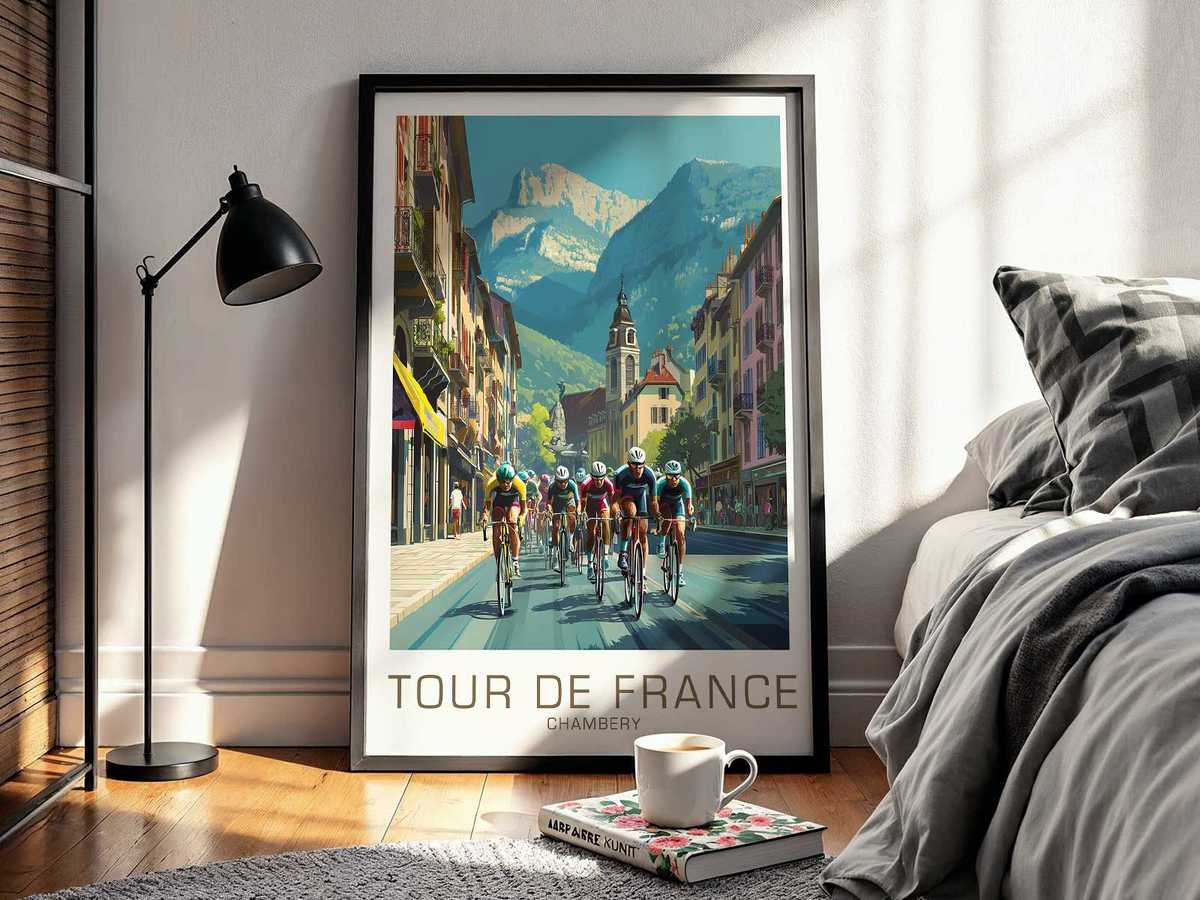
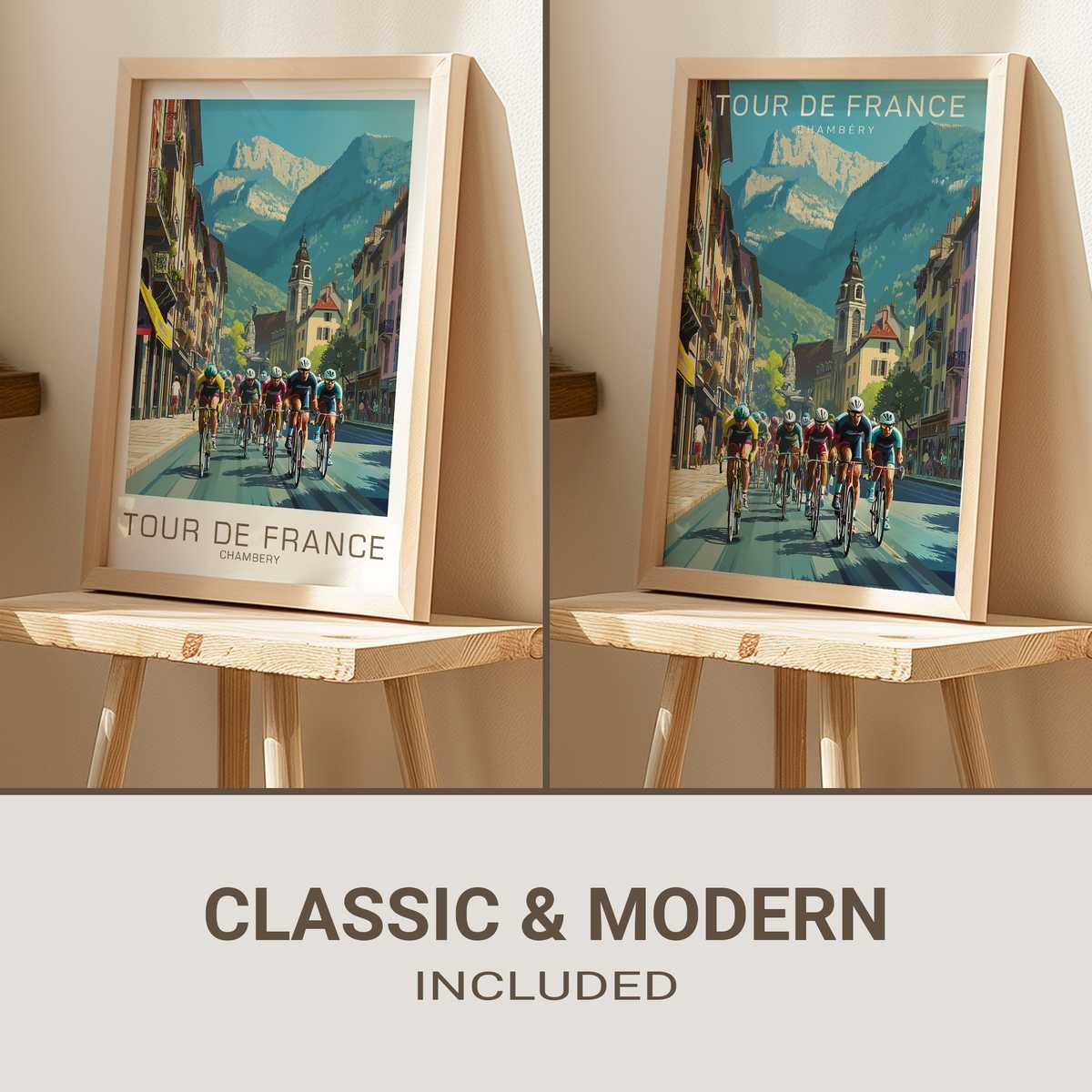
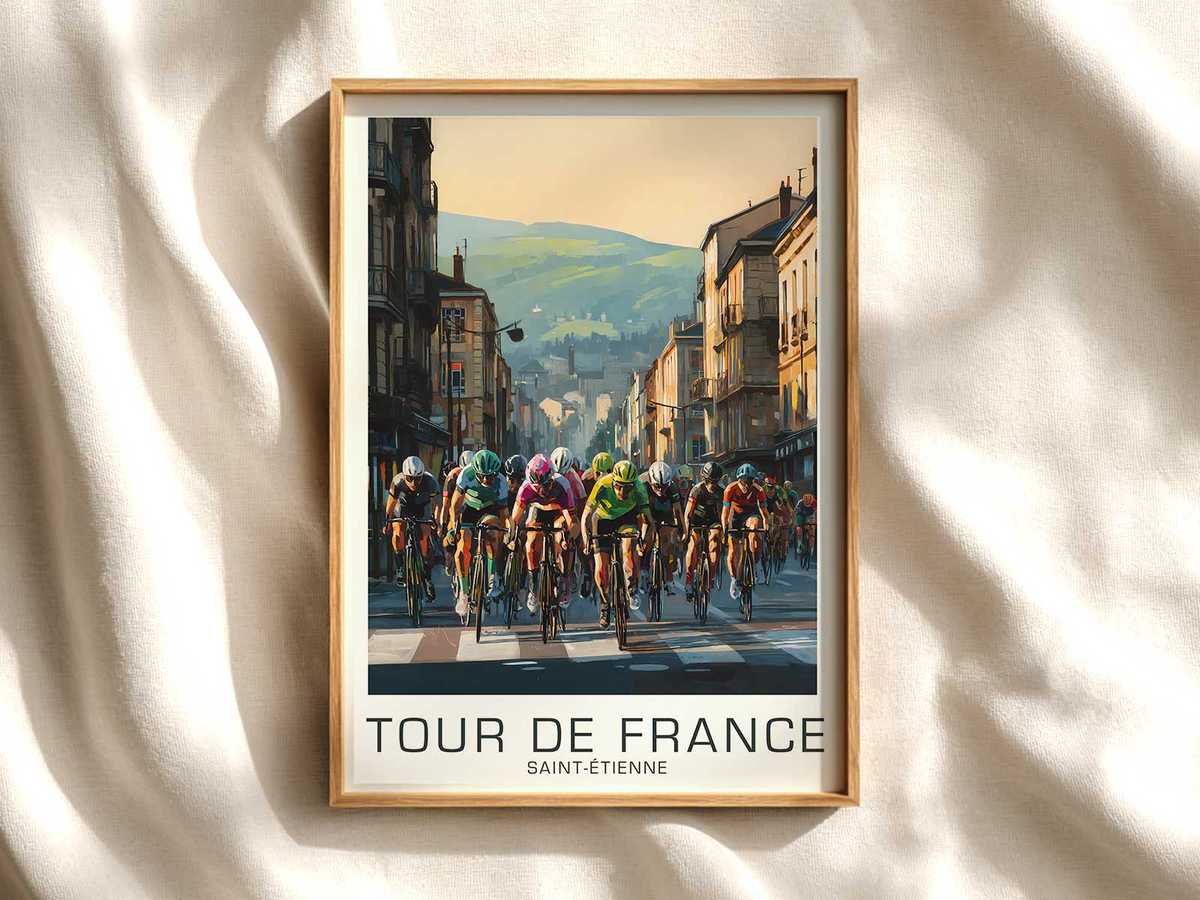
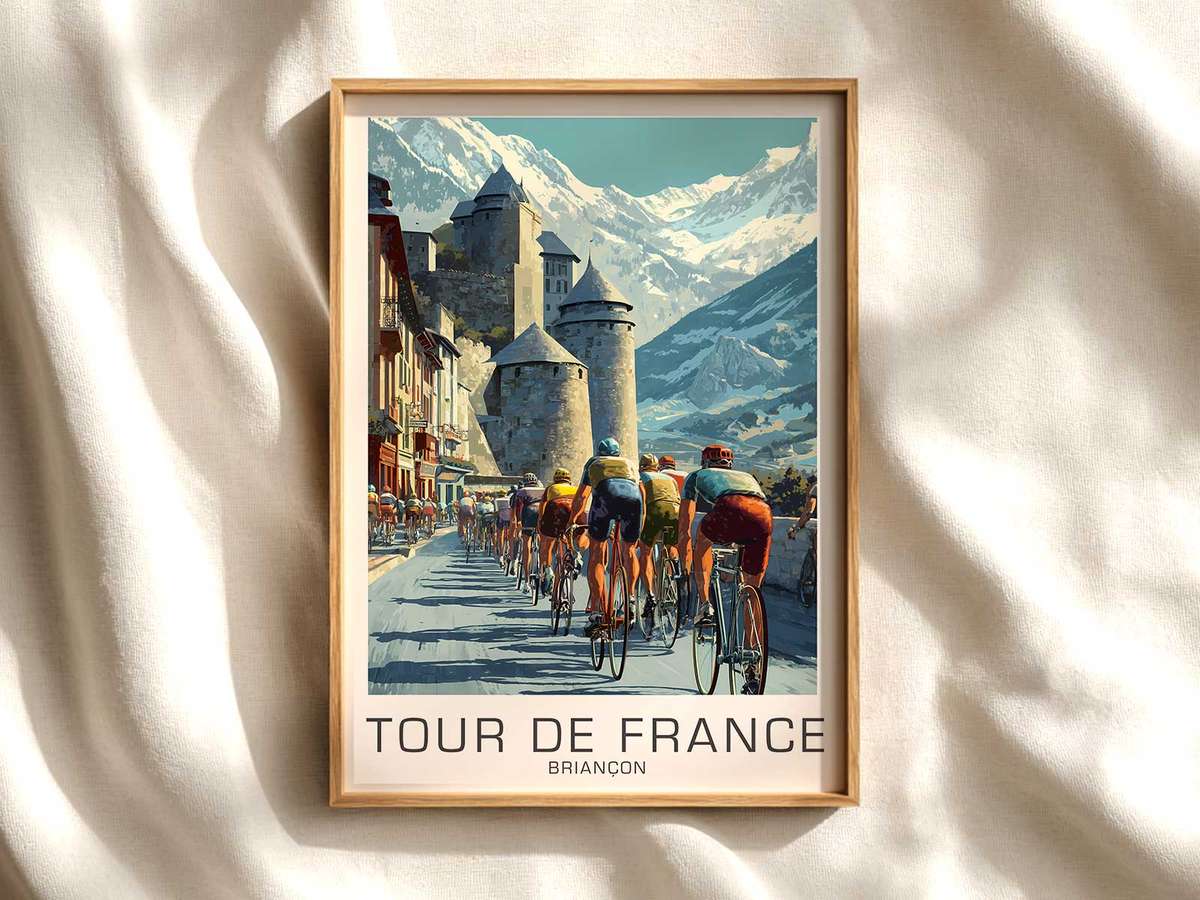
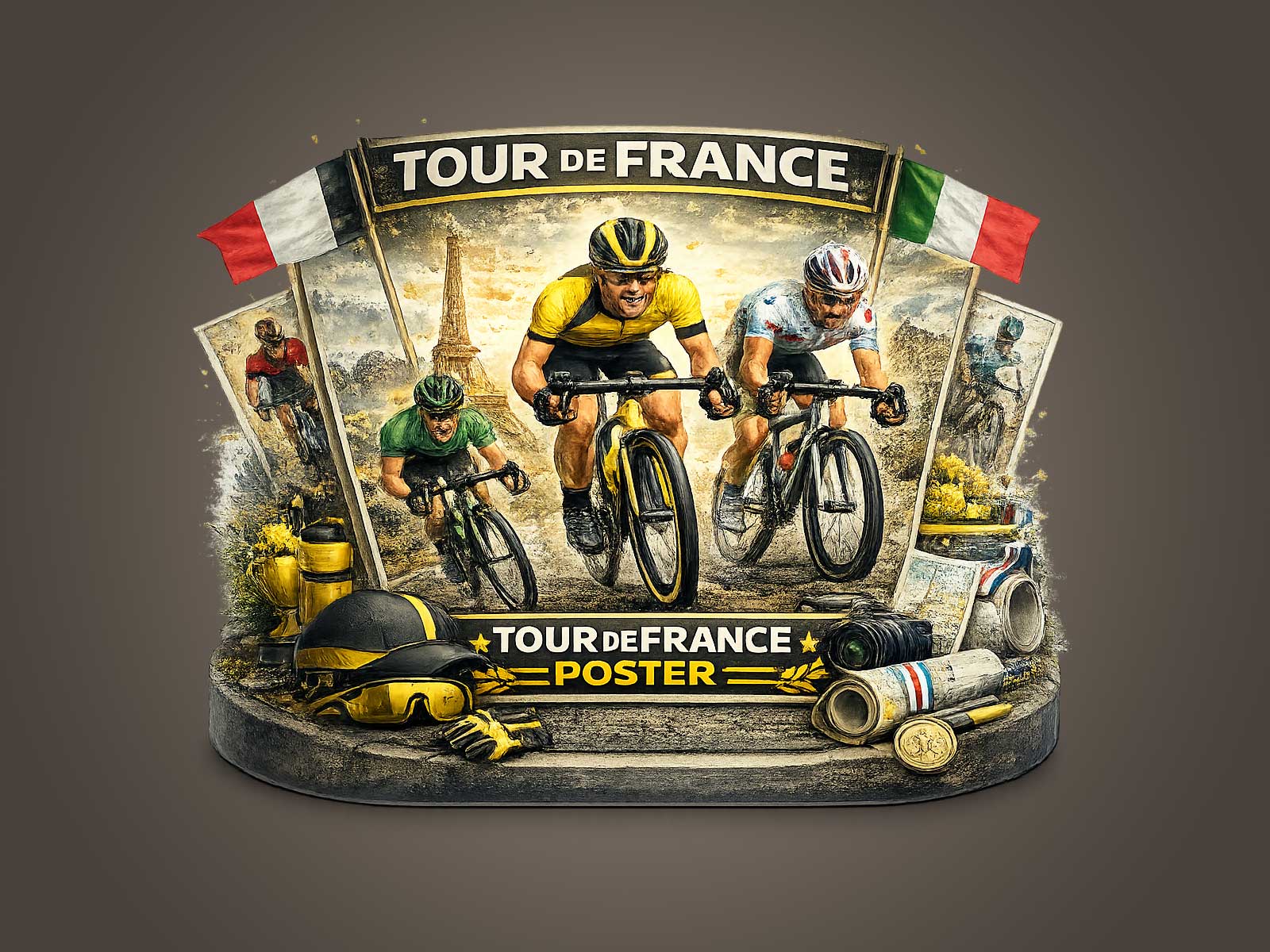
Chambéry is not merely a waypoint; it reads like a stage in itself. In a poster that celebrates bike frame art, the town’s compact urban grain, the foothill slopes and the channelled light of the Alpine valley combine to create a visual shorthand instantly legible to anyone who follows road racing. The composition is less about a rider’s name and more about how the place frames effort: a narrow street that funnels the peloton, a riverside curve that introduces tension, a distant ridge that promises a climb. That decisive sense of place is what makes this artwork sing on a wall.
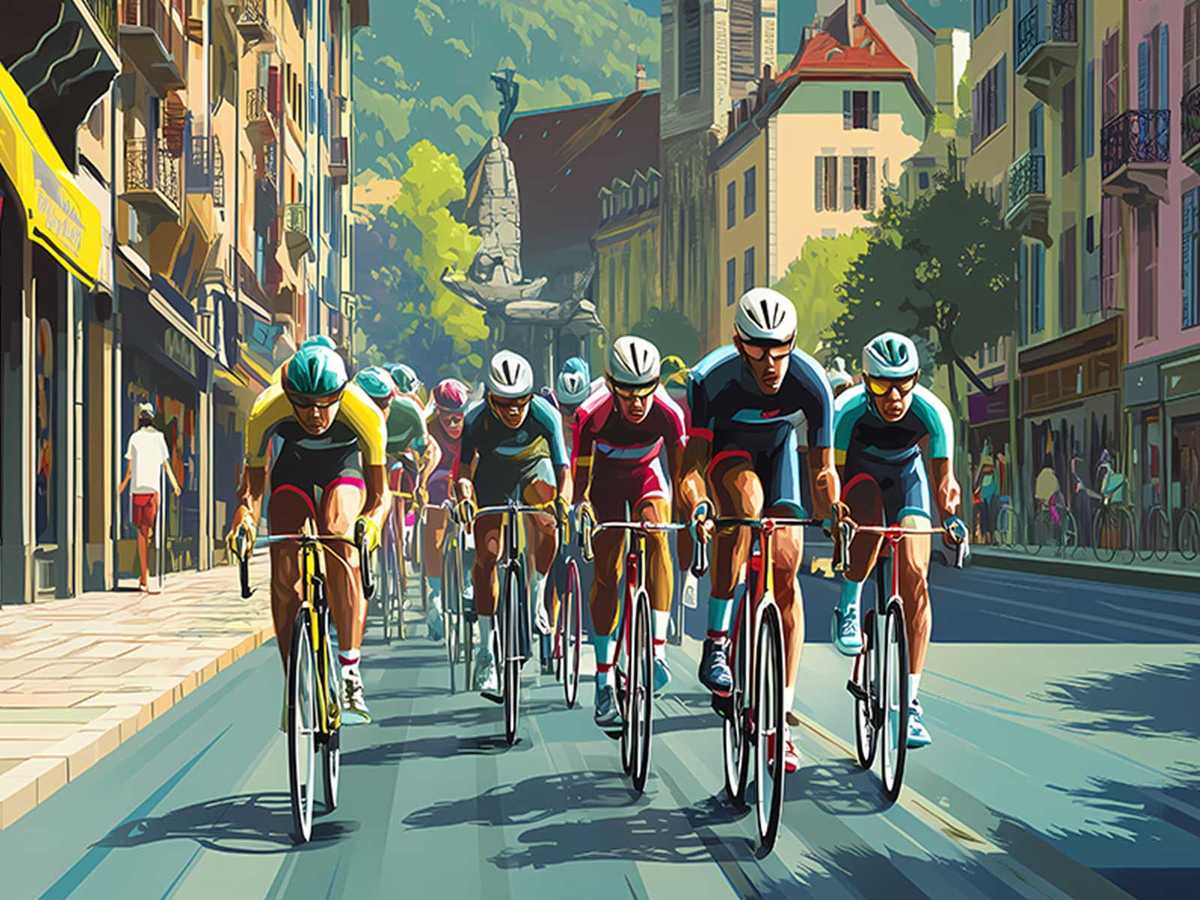
The road becomes a graphic element — a dark ribbon cutting through honeyed stone and slate roofs, a ribbon that reads at a glance: gradient, rhythm, direction. In bike frame art the cyclist is often reduced to posture and silhouette; here, the rider’s hunched shoulders and spinning legs are meaningful only because they interact with the slope and the light. A shallow gradient shown through vanishing guardrails, a hairpin hinted at by a line of clustered houses, and the long, cool shadow of a plane tree all tell the viewer how the stage feels under race conditions. Those visual cues create a shorthand that speaks directly to the cycling aficionado without a single caption.
Light in Chambéry is a compositional device. Valley mornings bring a crisp, high-contrast clarity that sharpens details — cobbles, signage, the sheen on a carbon frame — while late-afternoon haze softens distant peaks into layered blues. The poster leverages these shifts: foreground elements bathed in warm light, background reliefs cooler and more abstract. That atmospheric layering gives depth to a small-format print and invites the eye to travel from bike geometry to horizon, making the image both intimate and expansive. It’s why a framed print can feel like a window onto a day of racing rather than a static photograph.
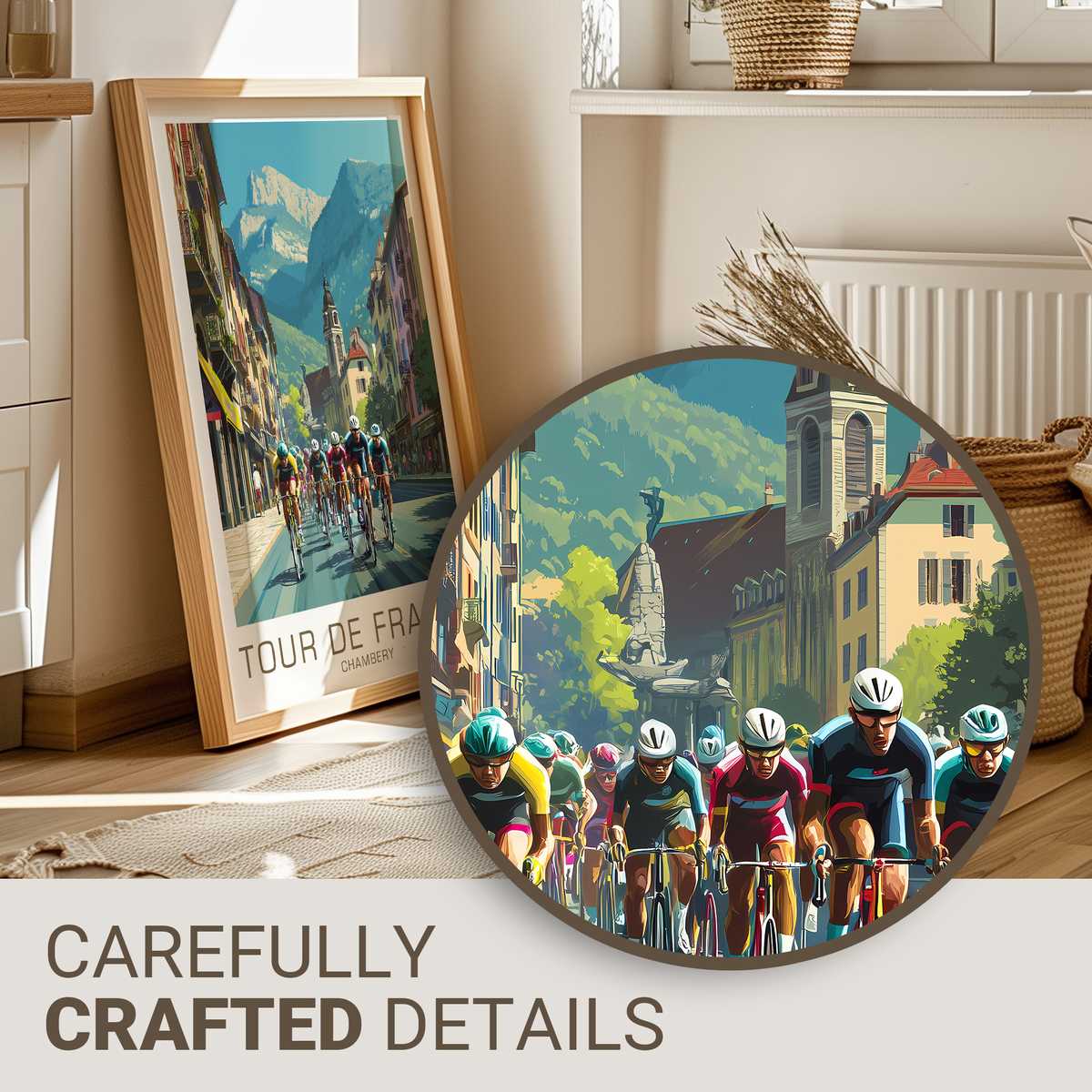
Village texture matters. In Chambéry the stone façades, narrow balconies and wrought-iron railings are not mere decoration: they act as scale markers, telling the viewer how close the crowd can get, how noise concentrates, how the peloton’s speed compresses. A single panel of shuttered windows or a cluster of cheering figures becomes a punctuation mark in the composition. When reproduced as bike frame art, these details reward close viewing — the tilt of a head, the bent elbow of a marshal — but they also read cleanly from a distance, giving the print the kind of visual clarity that suits both a study wall and a living room.
[IMAGE_INSERT_ARTICLE_01]
The relief around Chambéry is subtle but decisive: foothills that rise into alpine shoulders create a sense of impending verticality. In a poster the road’s ascent is implied through converging lines and the compression of architectural elements; the viewer senses both the physical effort demanded of a rider and the strategic cadence a climb imposes. That tension—between the calm geometry of the town and the abrupt claim of altitude—gives the artwork narrative drive without showing a full mountain stage. It’s a narrative built on texture, gradient and the disciplined geometry of racing bicycles.
Race atmosphere is also about temporary occupation. Bunting, spectator lines, and parked team buses are minor visual props that signal transformation: ordinary streets made extraordinary by movement and anticipation. In the print these elements remain restrained — a stripe of color, a repeated shape — so the image preserves elegance while still communicating the charged moment when a place becomes a course. That blend of civic detail and sporting ritual is what elevates stage-led imagery above generic landscape art.
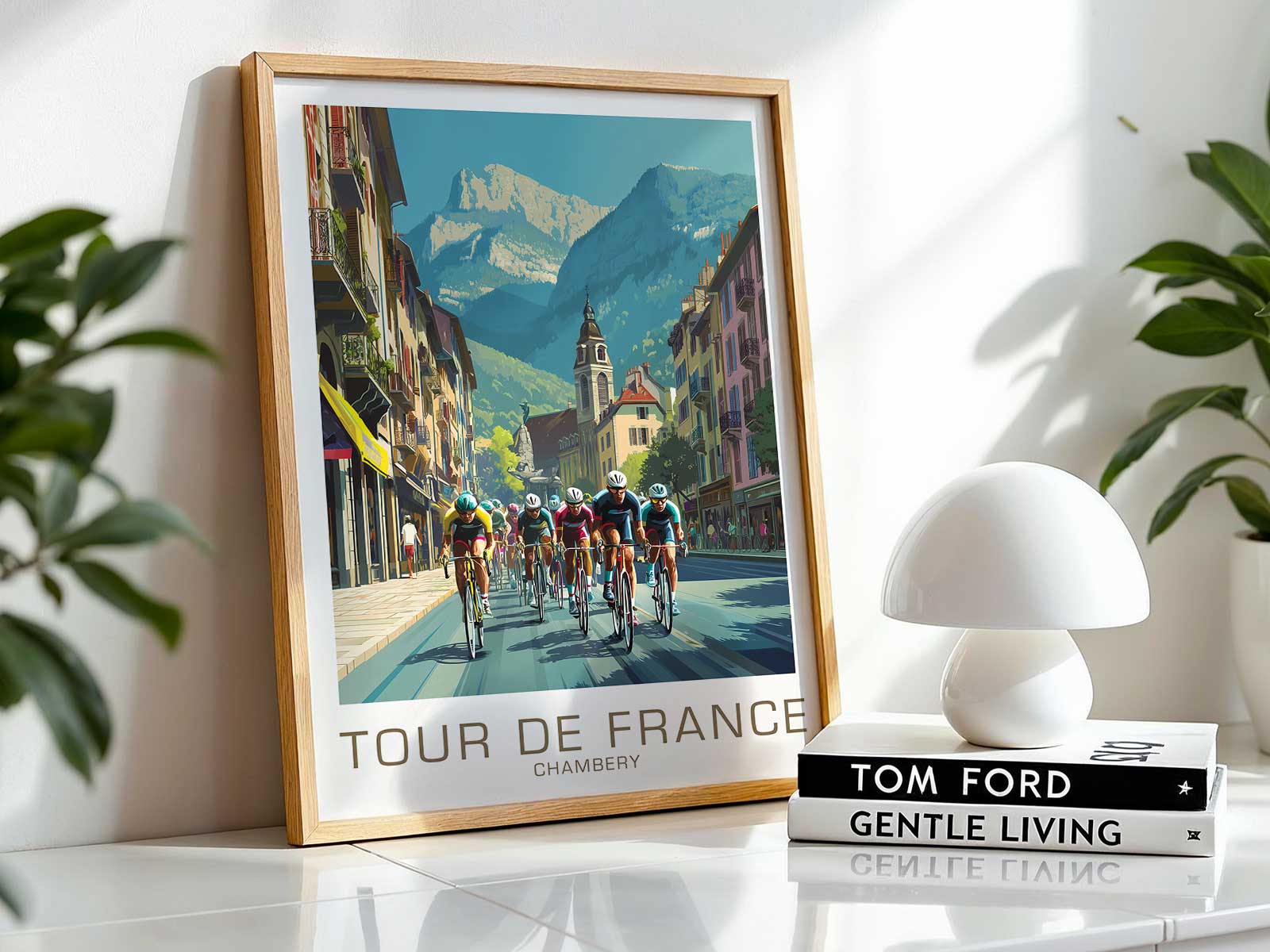
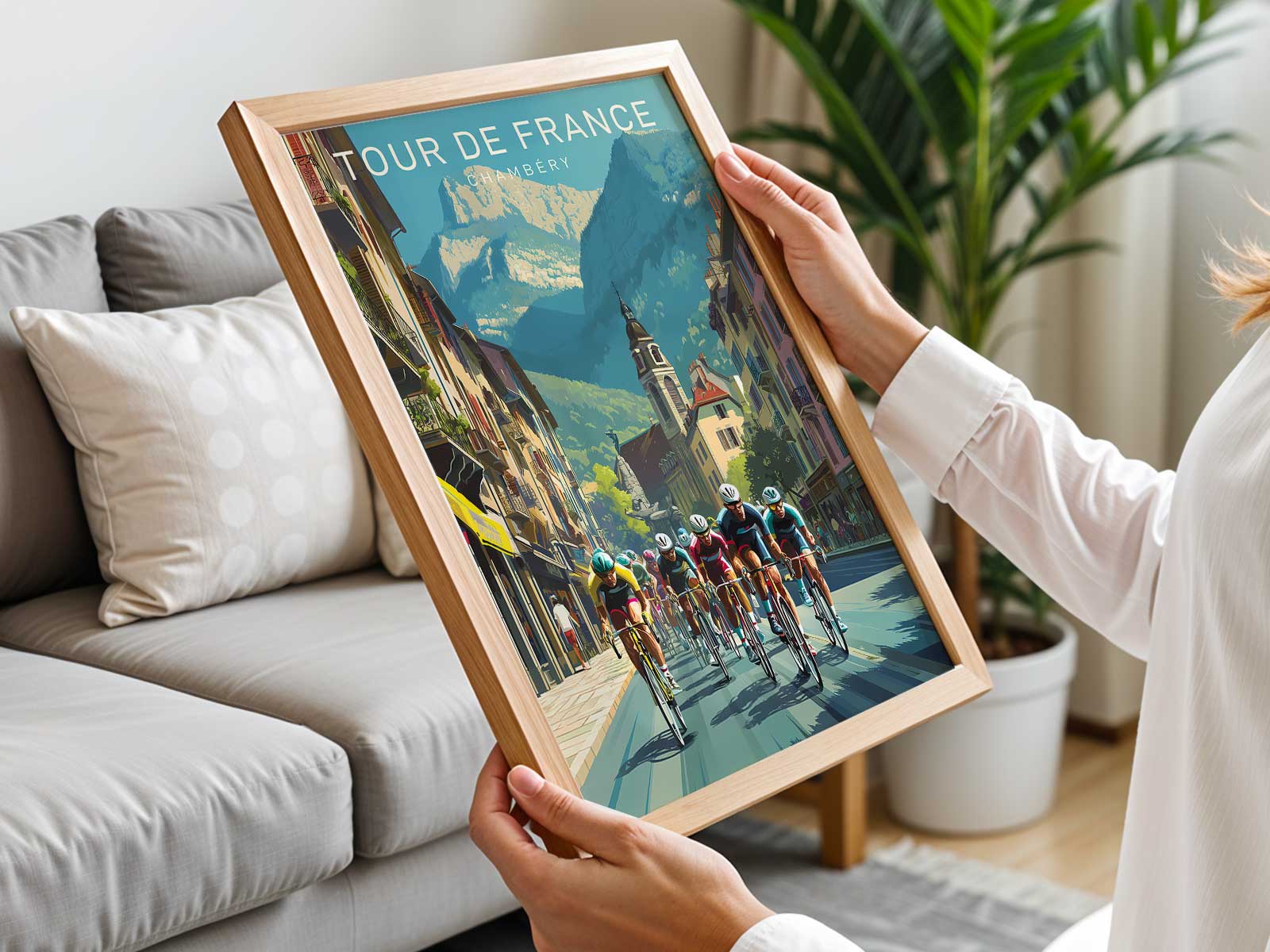
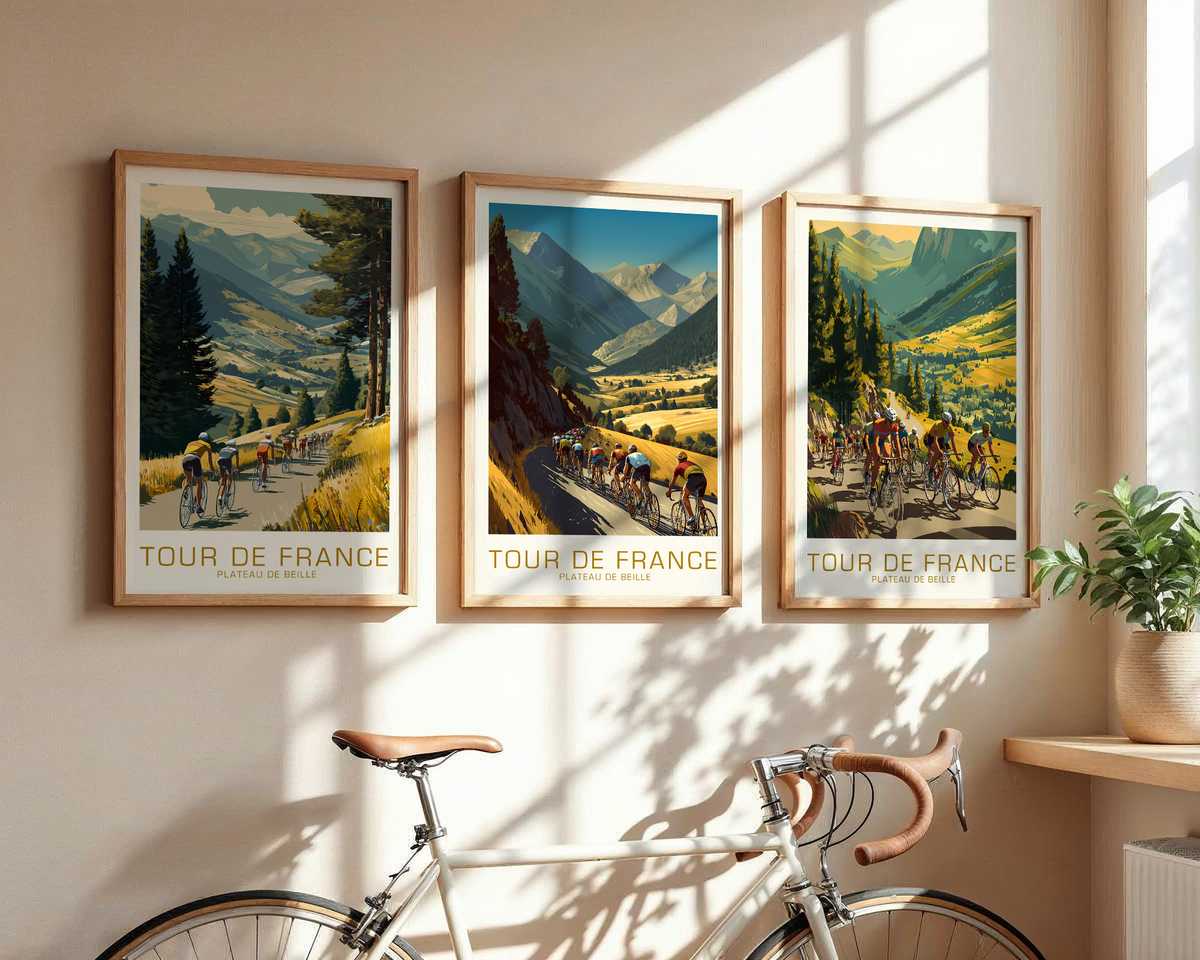
Finally, consider how such a print functions in an interior. Placed above a sideboard or beside a reading chair, the image acts as a compositional fulcrum: its horizontal sweep complements furniture lines while its vertical suggestion of ascent draws the eye upward. The restrained palette and clear road geometry make it adaptable to quiet, refined rooms as well as livelier, sports-focused spaces. It encourages recollection — of races watched, climbs raced, or imagined efforts — without needing to state a result. The artwork’s desirability comes from that precise visual specificity: cadence frozen in profile, a road that promises a climb, and a town that reads like a perfectly designed stage.
Author: