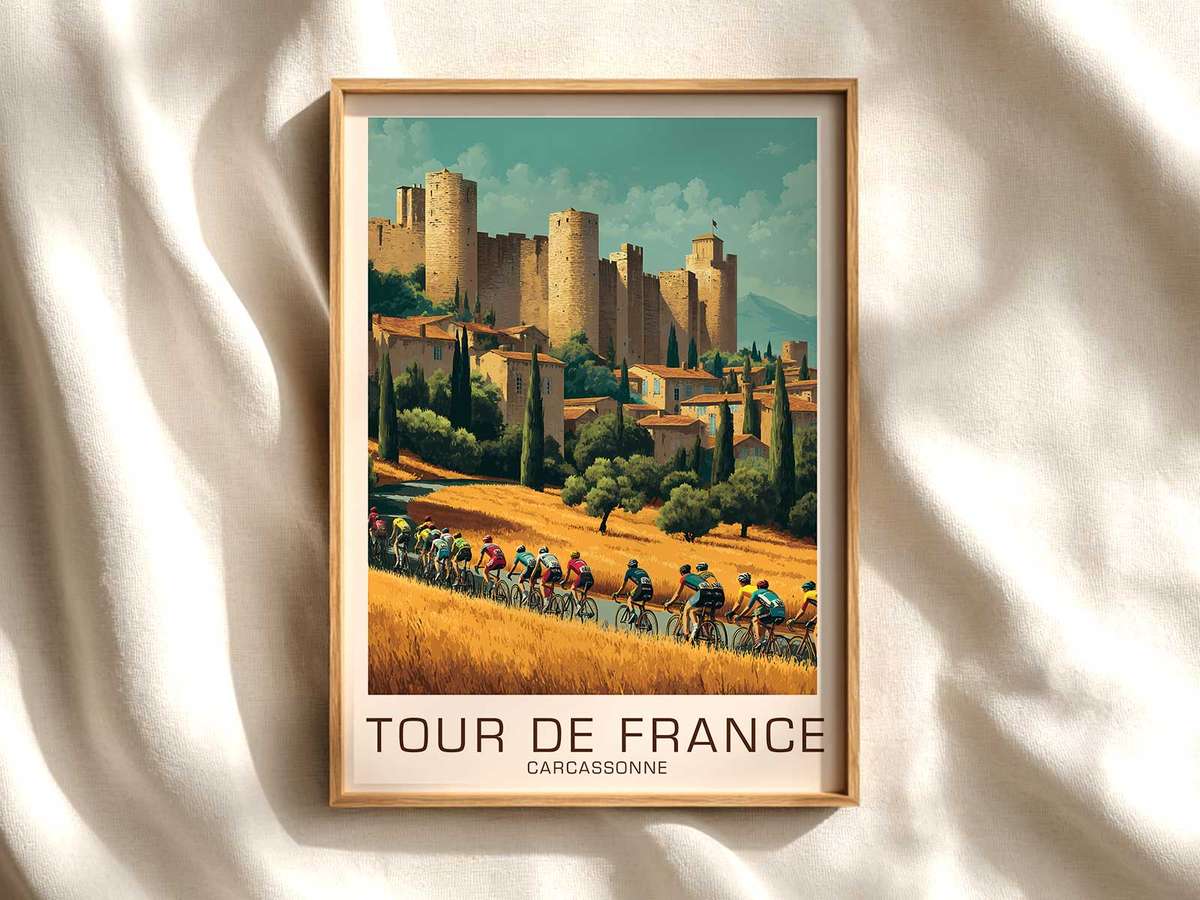
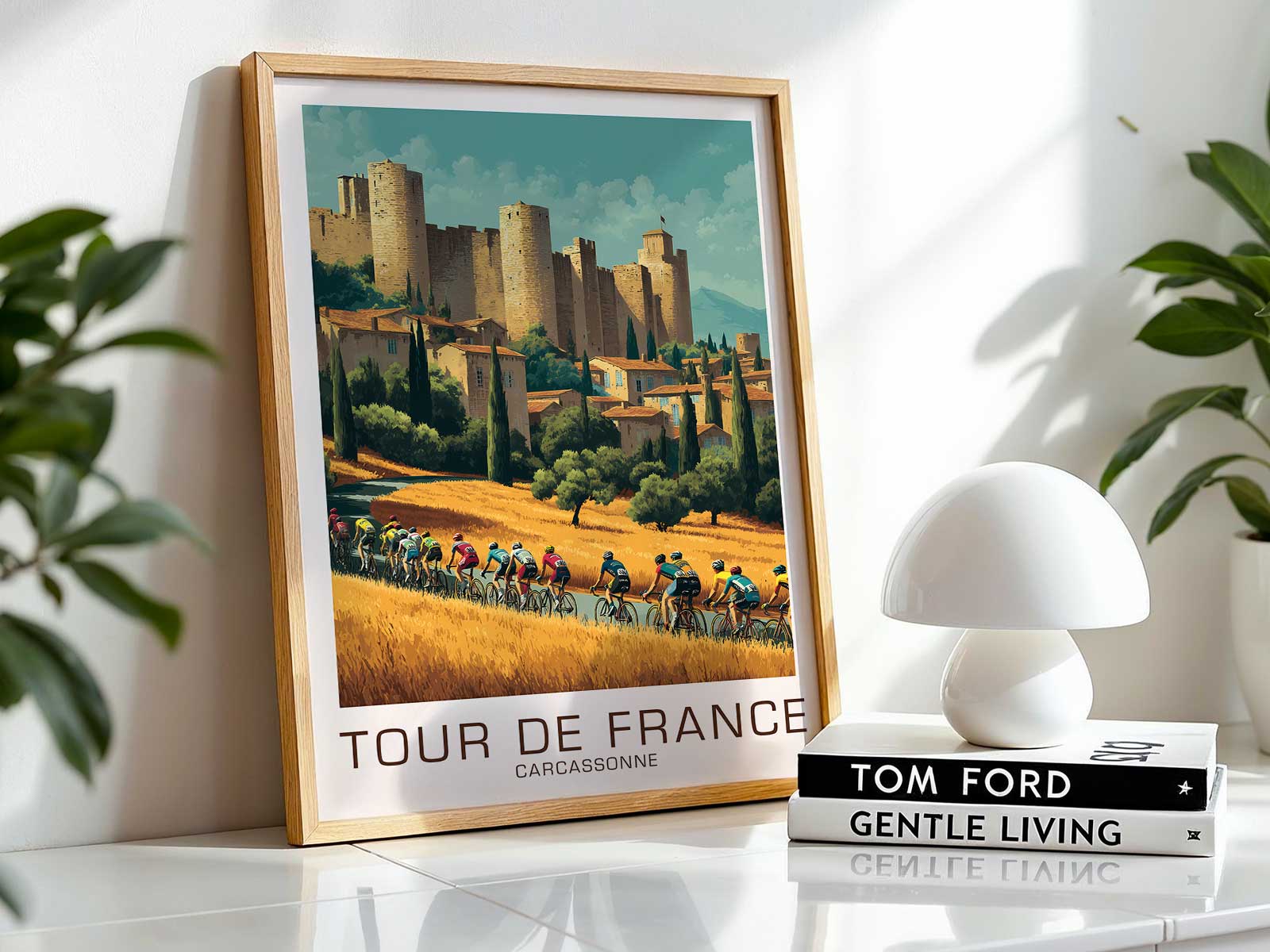
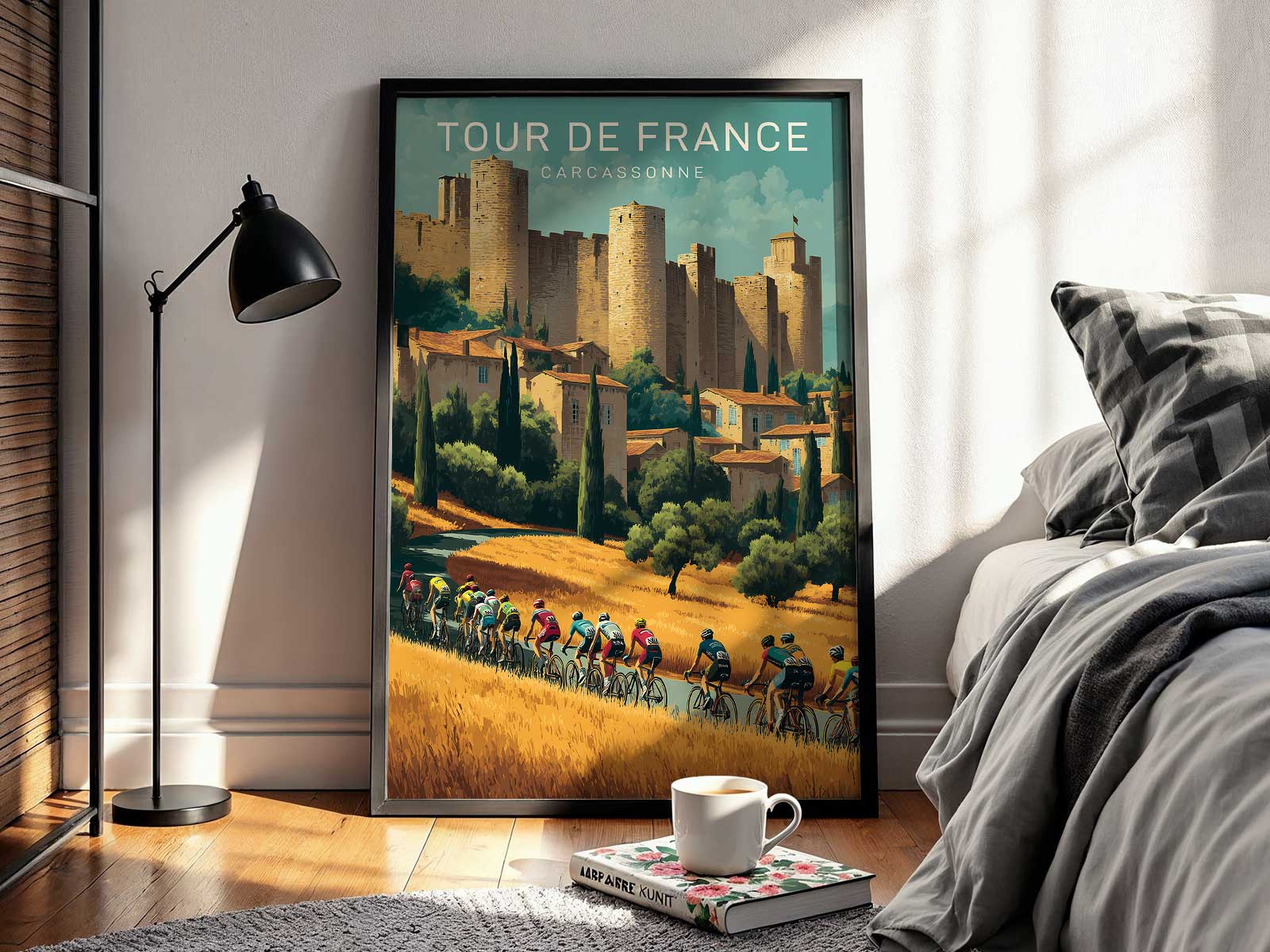
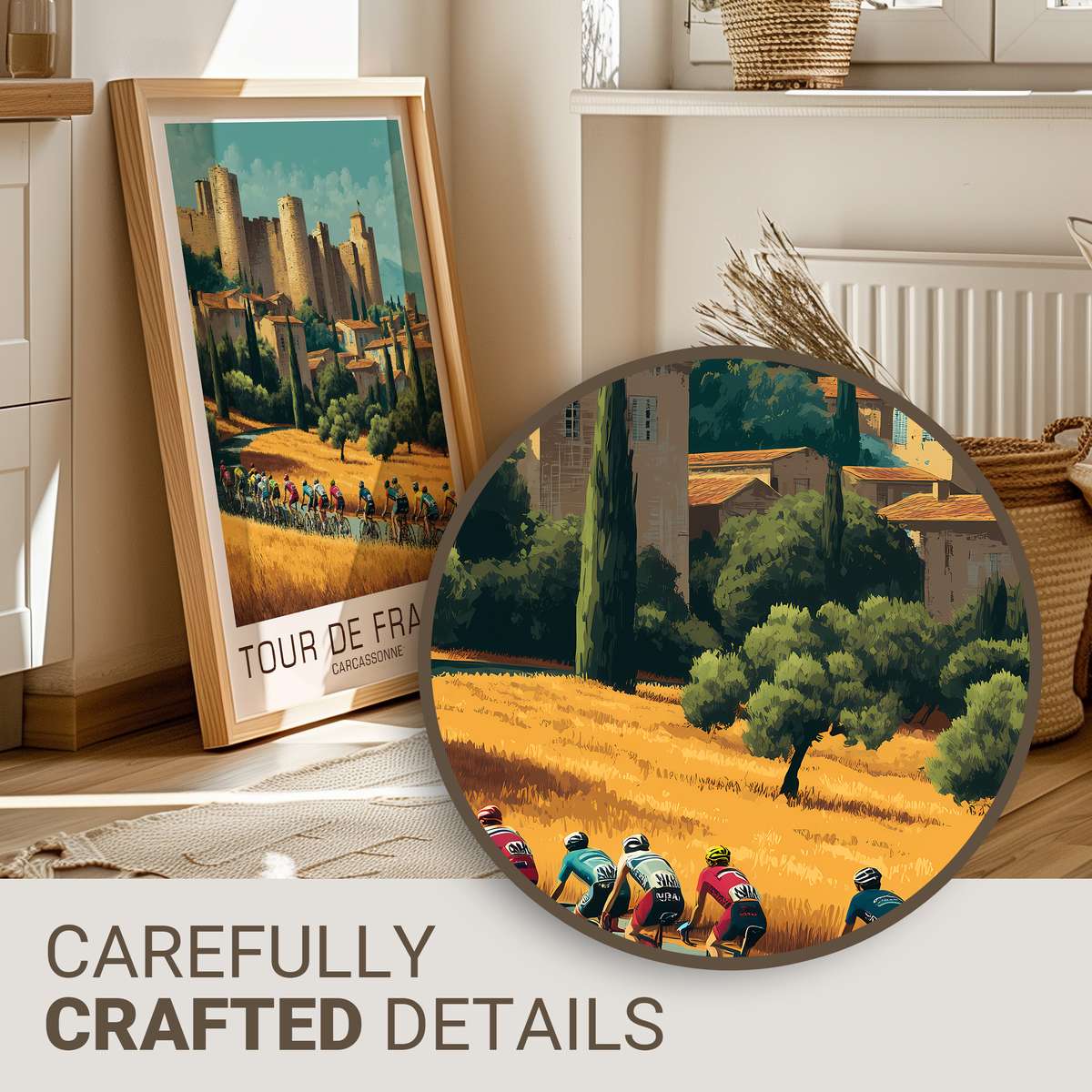
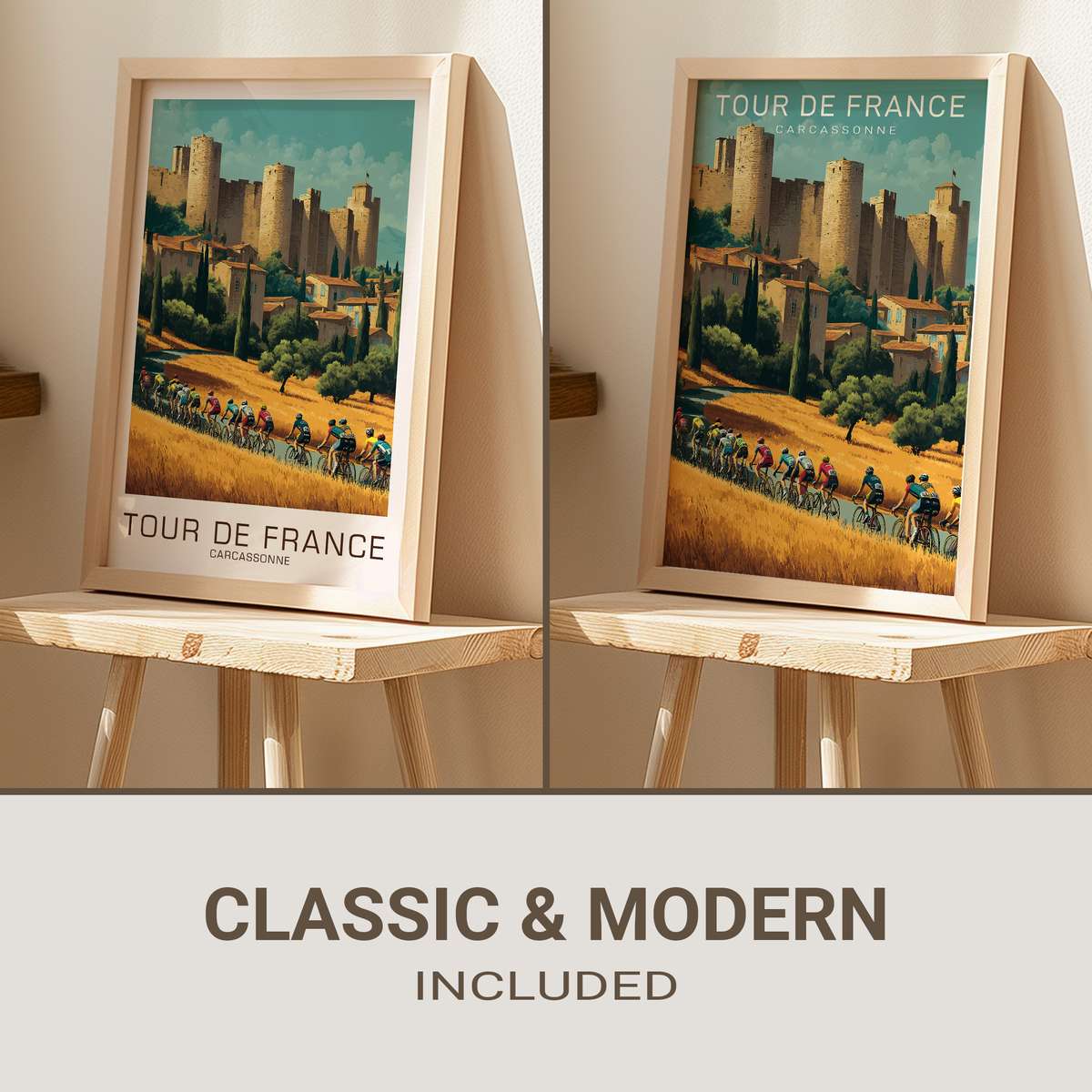
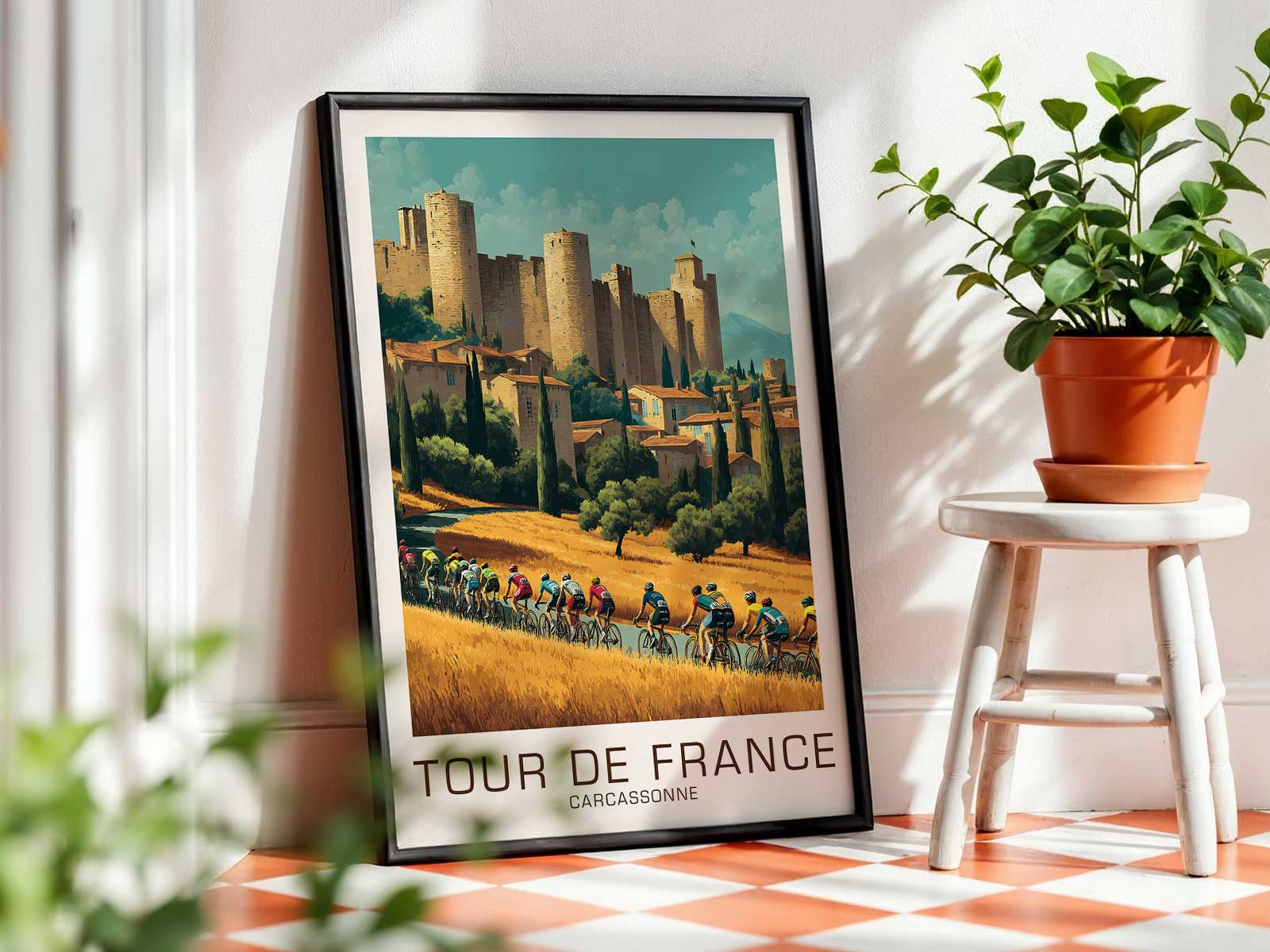
Carcassonne is more than a waypoint on a map; it is a stage-setting with a clear visual grammar that reads instantly to anyone who loves road racing. A poster that places a bicycle or a racing line against the fortified silhouette and the gently rolling terrain turns the city into a narrative: the ancient ramparts provide vertical punctuation, the low southern light sculpts the stone, and the roads threading through vineyards and suburbs mark the rhythm of motion. The result is not merely a portrait of a place, but a distilled race moment in which environment and effort tell the story at a glance.
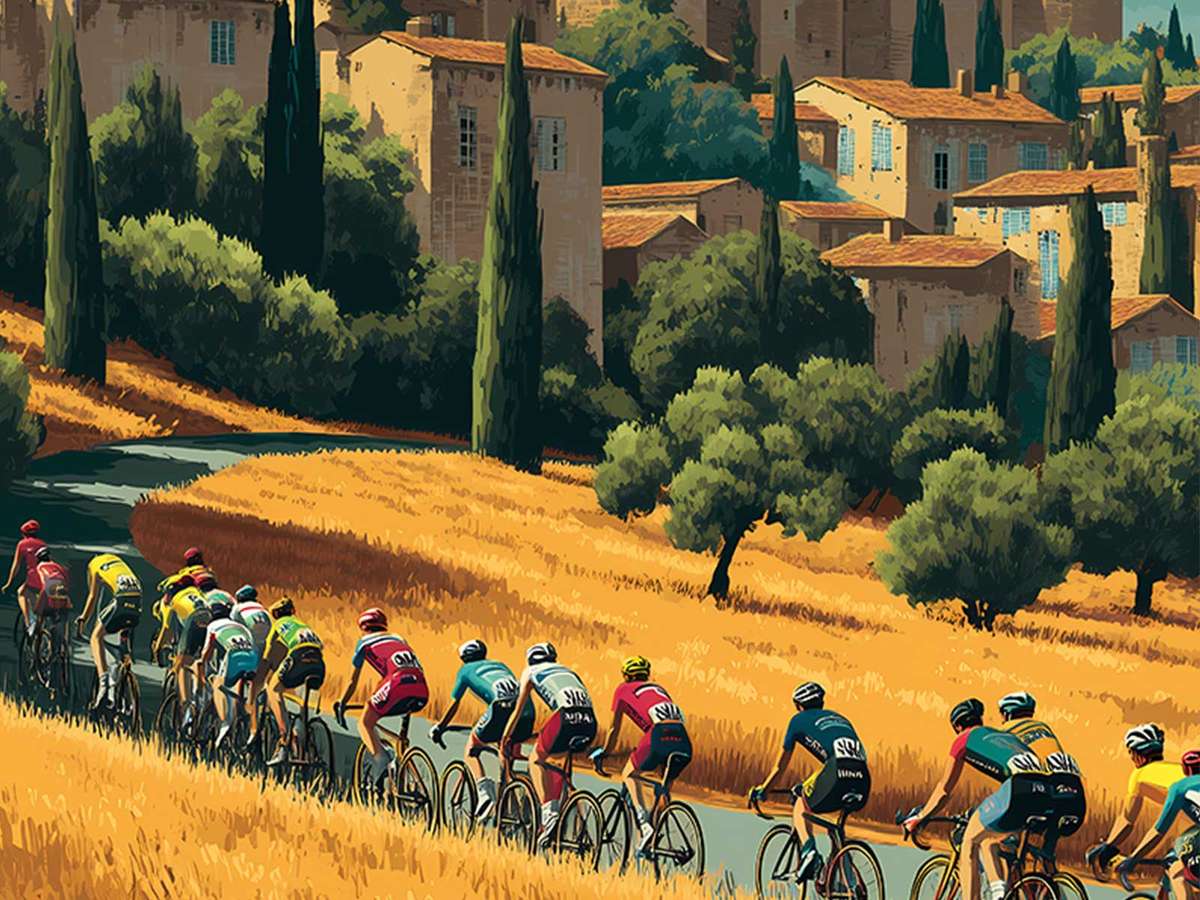
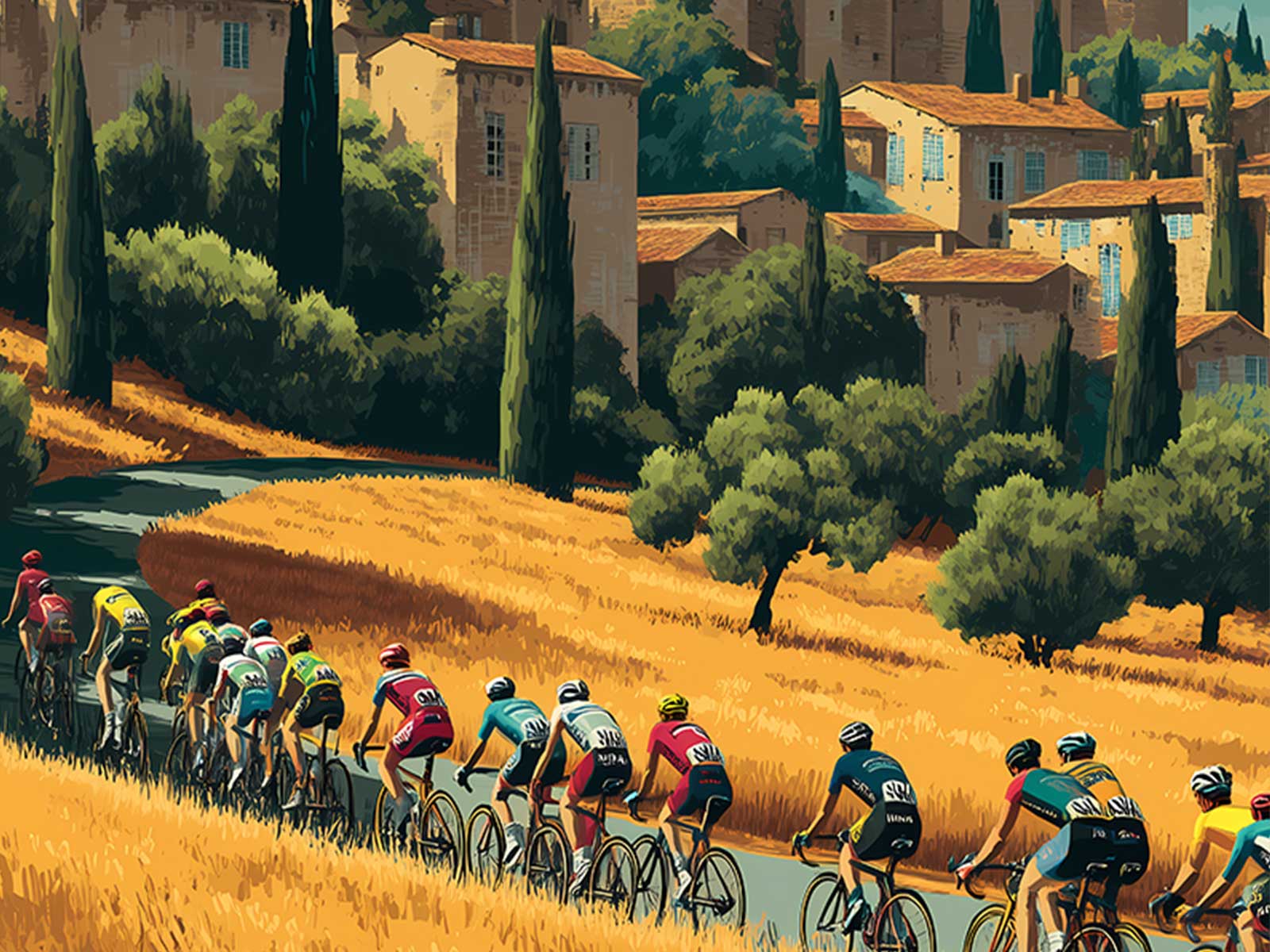
The urban fabric of Carcassonne gives a poster immediate identity. The compact medieval citadel, seen from the valley, becomes a geometric backdrop that balances human scale with historic mass. When a rider is positioned on the lower plain or on a slight rise, the contrast between the low-slung figure of the cyclist and the crenellated skyline creates a telescoped depth: foreground action, middle-distance road, fortified skyline. Light often slips along those ancient walls in warm, ochre tones that harmonise with the earthy palette of asphalt and dry grasses—ideal for an image that wants to feel sun-washed rather than clinical.
Road shape and tilt are central to how this place reads as a race stage. Long, forgiving gradients approaching the outskirts or a short steep ramp through a village both translate directly into visual drama. A gently curving country lane framed by rows of stone houses or cypresses tells of tempo and endurance; a narrow street threaded between walls suggests acceleration, line choice, and crowd proximity. In a poster composition these motifs work like stage directions: the road leads the eye, the gradient sets posture, and the surrounding architecture or landscape supplies character without competing for attention.
The feeling of altitude around Carcassonne is subtle but effective. It is not about high alpine heroics but about a controlled rise and fall that allows a poster to imply effort through angle and shadow. Low ridgelines and scattered groves punctuate the horizon; warm afternoon skylight casts long shadows across a rider’s frame, accentuating muscle tension and wheel rotation. This interplay of light and relief makes the bicycle itself an instrument of narrative—the thin tube and taut wheel become evidence of speed and quiet resistance against the land.
[IMAGE_INSERT_ARTICLE_01]
Crowd presence and village texture are compositional tools. A handful of spectators leaning over stone parapets or clustering at a bend lends scale and a human heartbeat to an otherwise architectural canvas. These details are seldom intrusive: an armrail, a fluttering flag, a small cluster of cheering faces transform the scene from a study in form into a lived event. For a collector, those human elements give the poster an emotional hook—the memory of a roadside cheer or the hush before the peloton arrives—without needing to reference a specific result or rider.
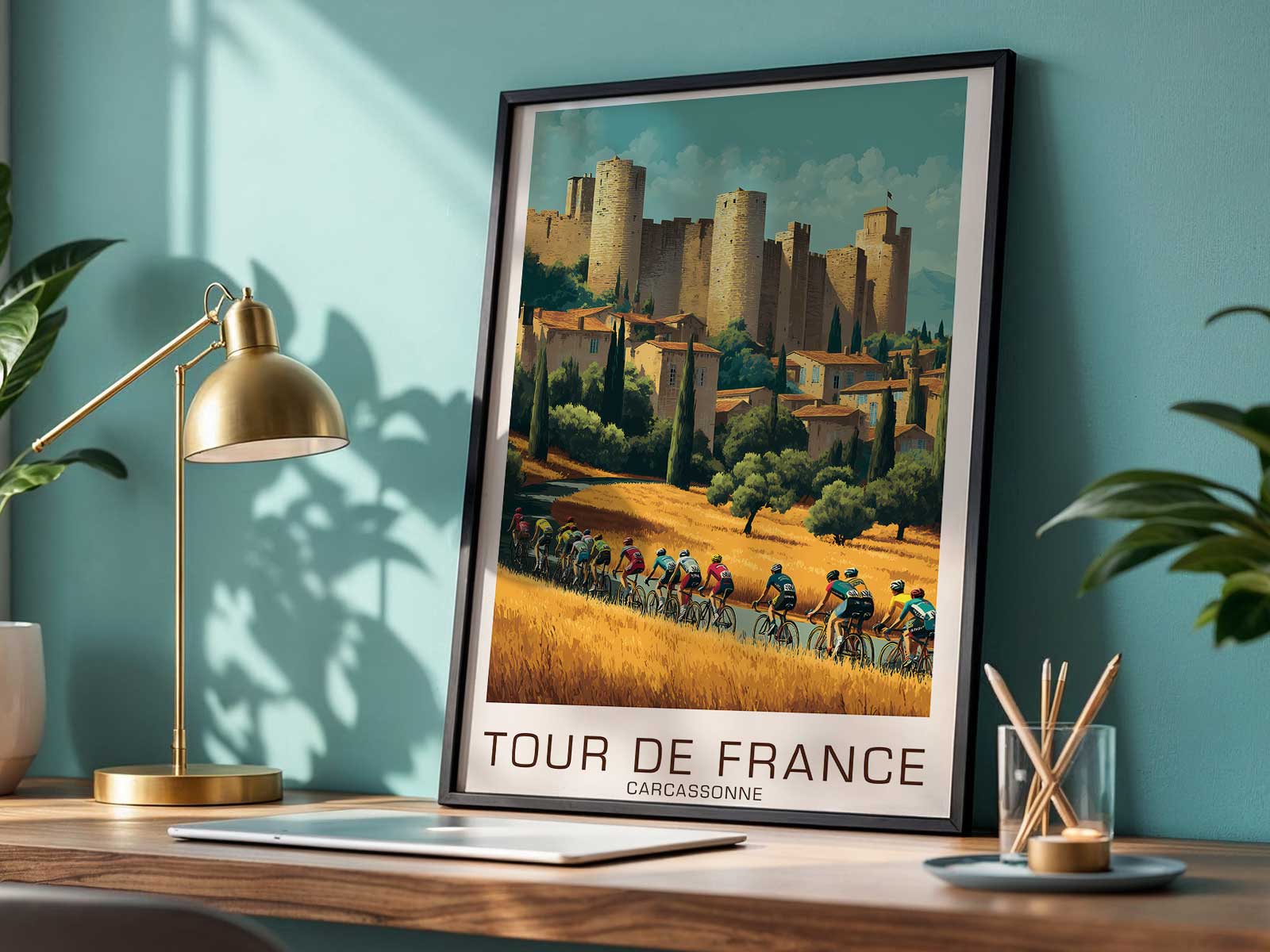
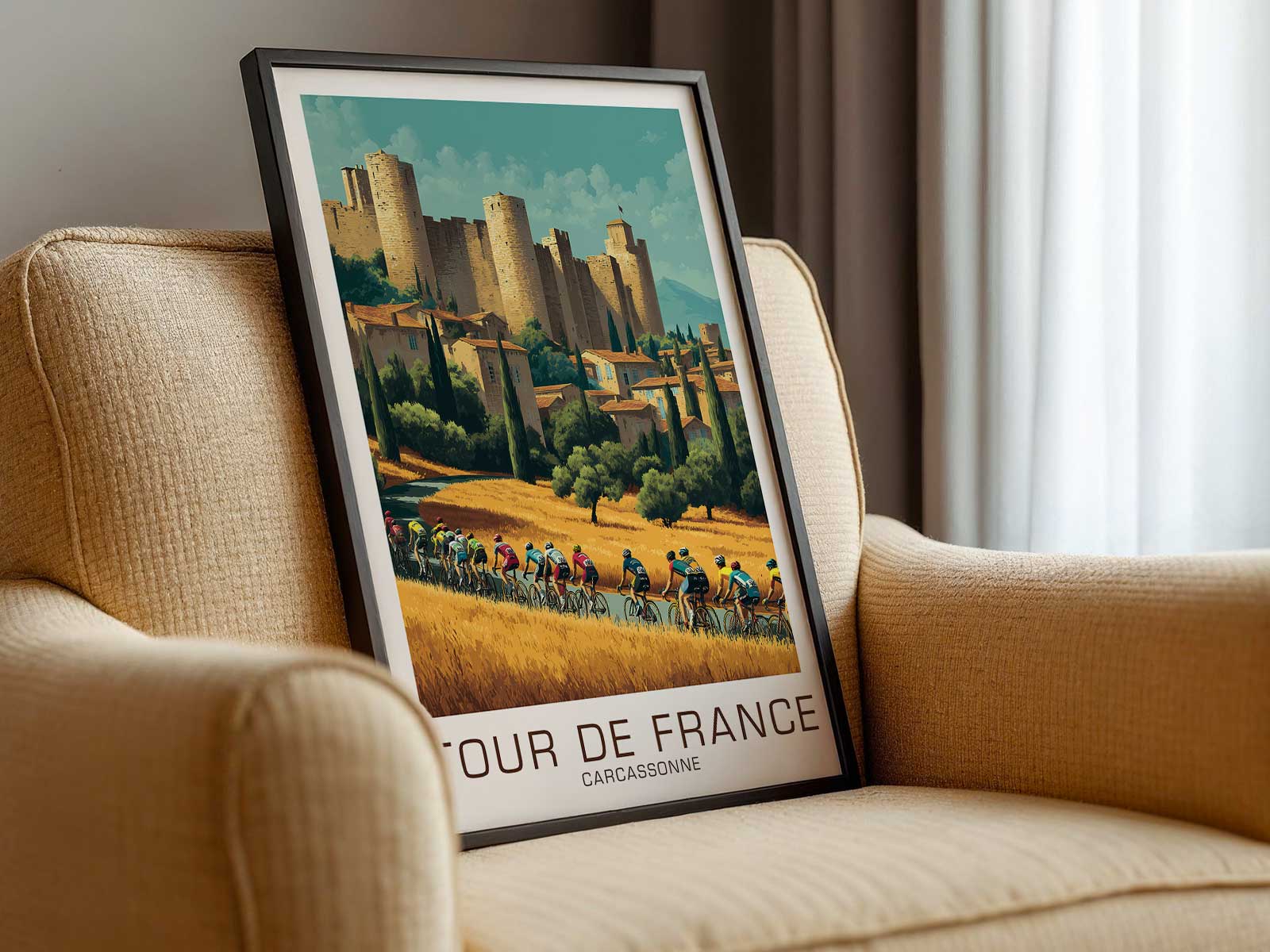
Why does a stage-led image from Carcassonne work so well on a wall? Because it offers an instant sense of place combined with a readable racing narrative. The city furnishes anchors—walls, gates, vineyards, country roads—while the race introduces motion, body language and focus. Together they create a balanced composition that is both scenic and cinematic, suitable for a living room, study or studio where a single image must convey both atmosphere and story.
Viewed as wall art, the poster becomes a quiet exercise in atmosphere: the elegance of the racing bicycle is underscored by architectural dignity, the landscape provides mood rather than distraction, and the viewer can project memory or aspiration onto the scene. This is the appeal of stage-focused cycling art: it celebrates place and performance at once, turning a familiar city into a permanent, framed moment of the race.