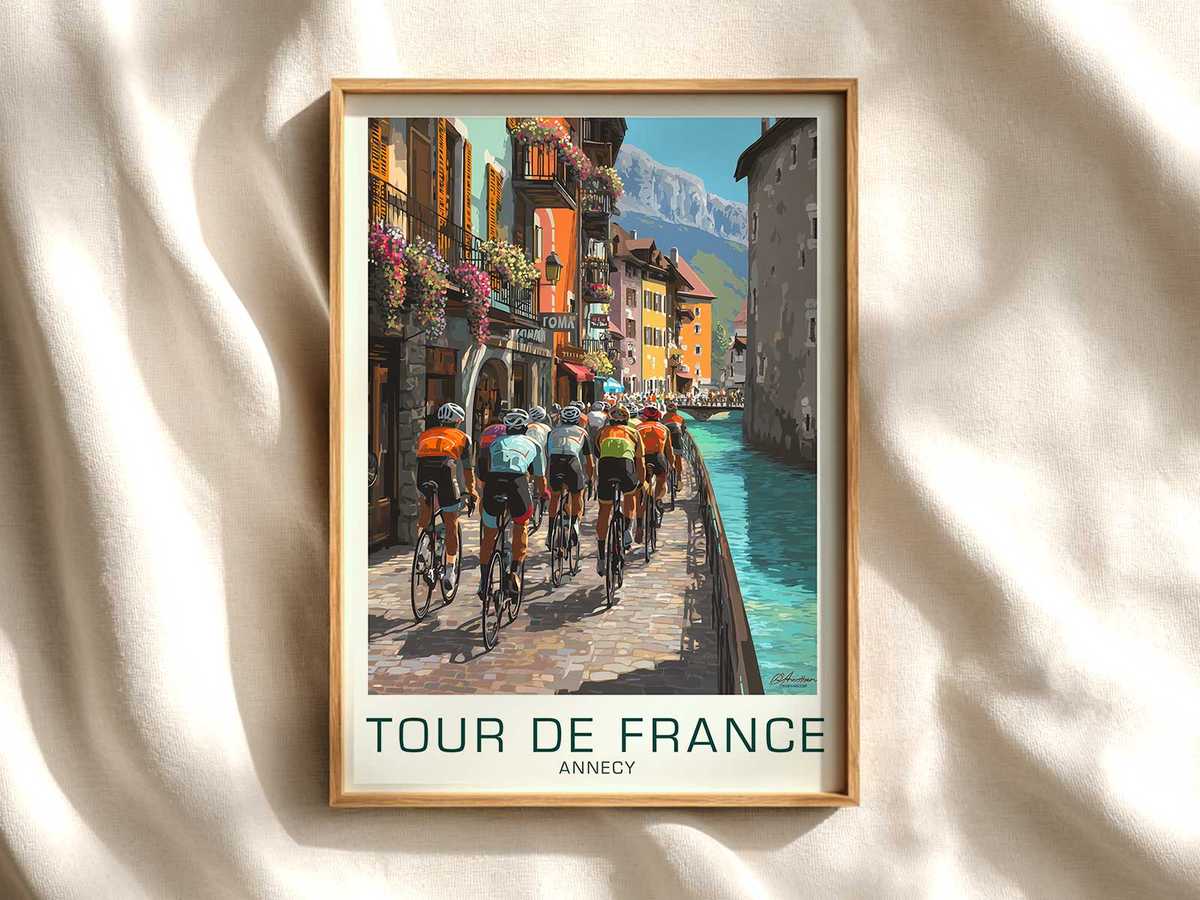
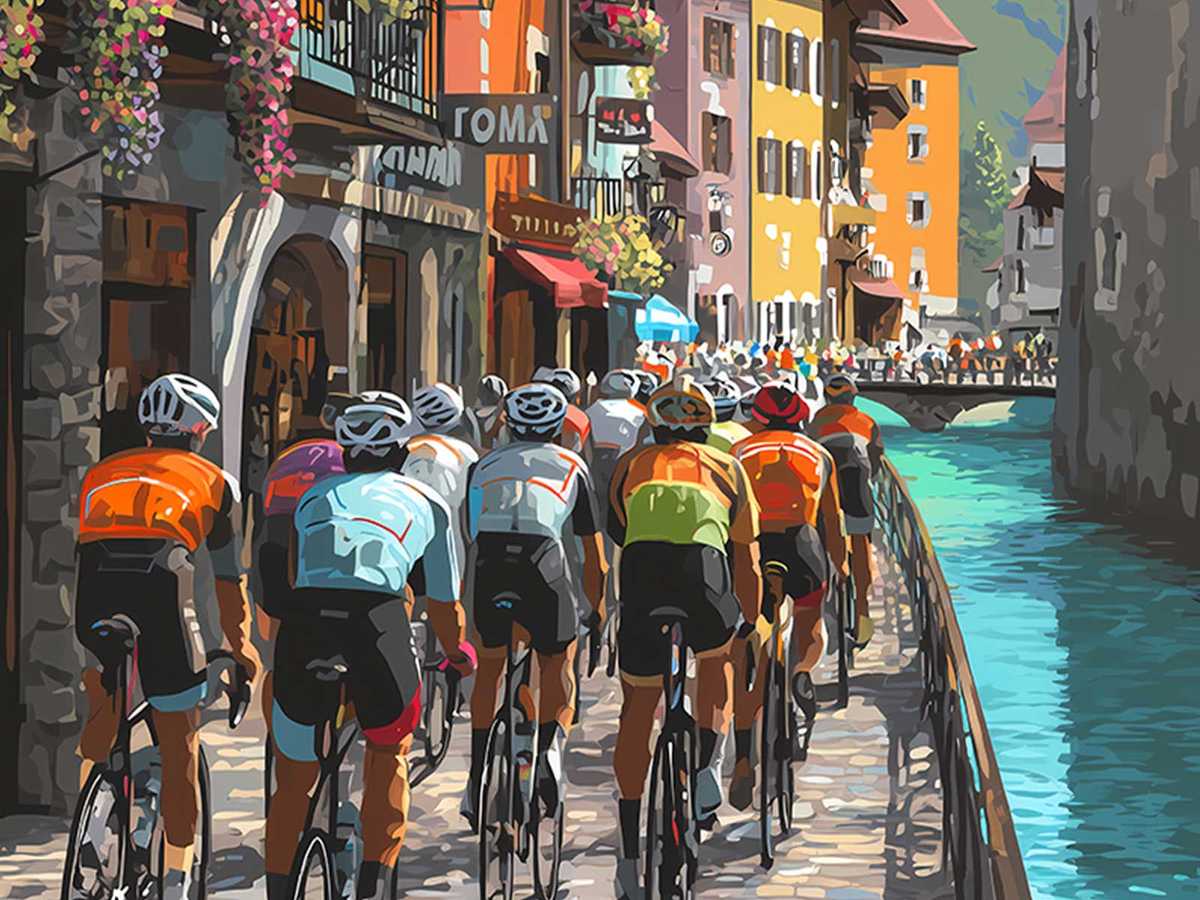
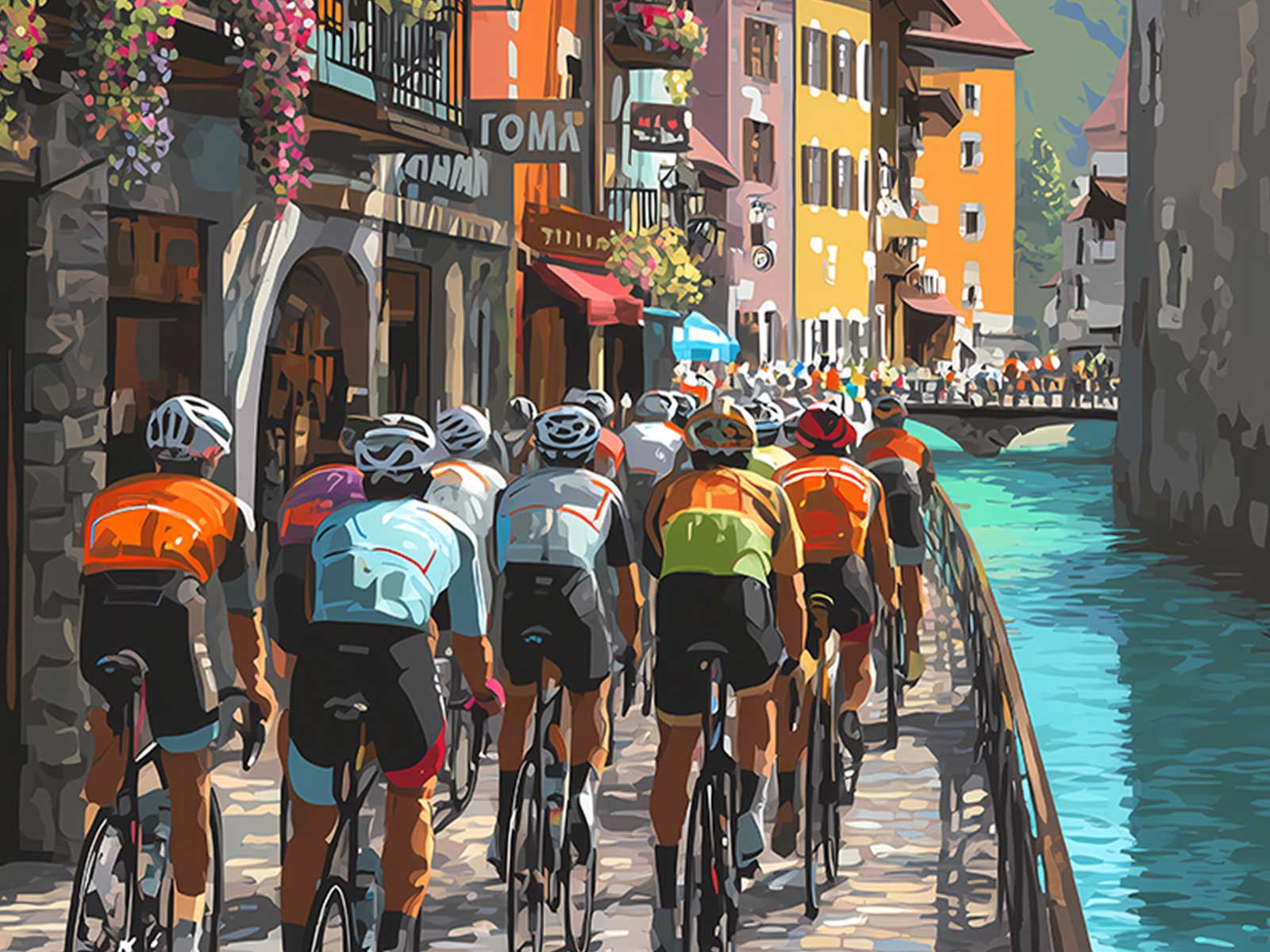
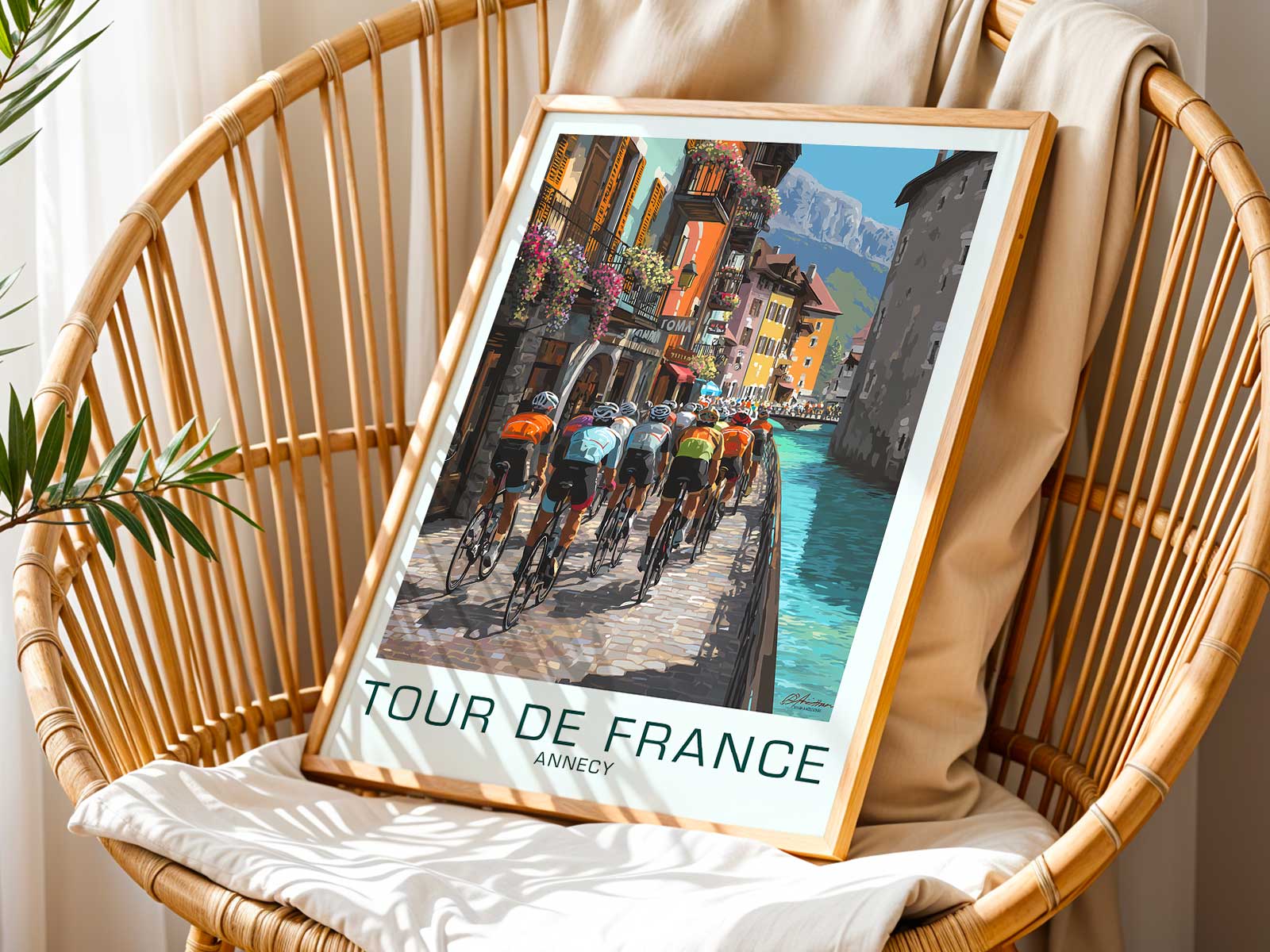
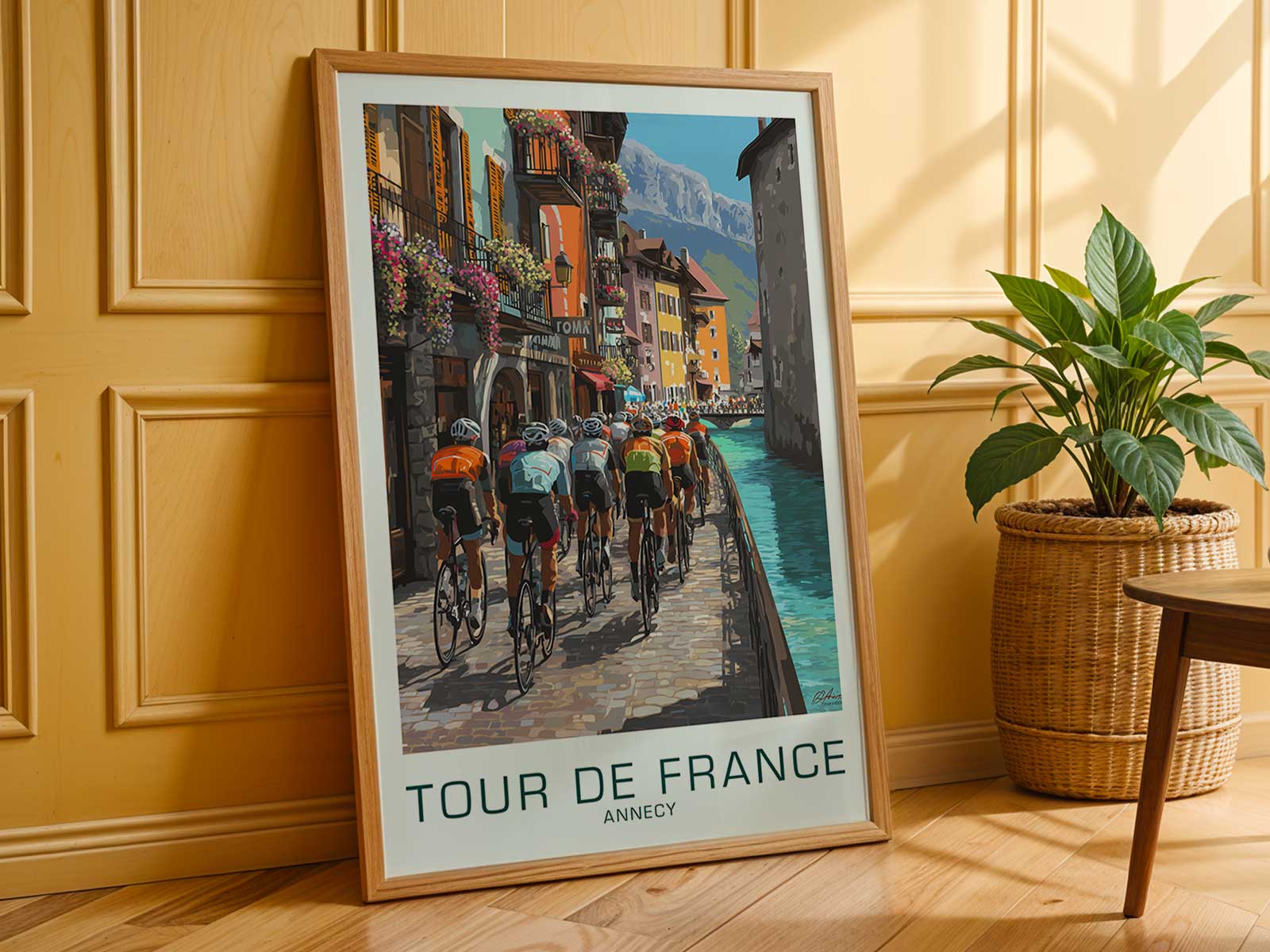
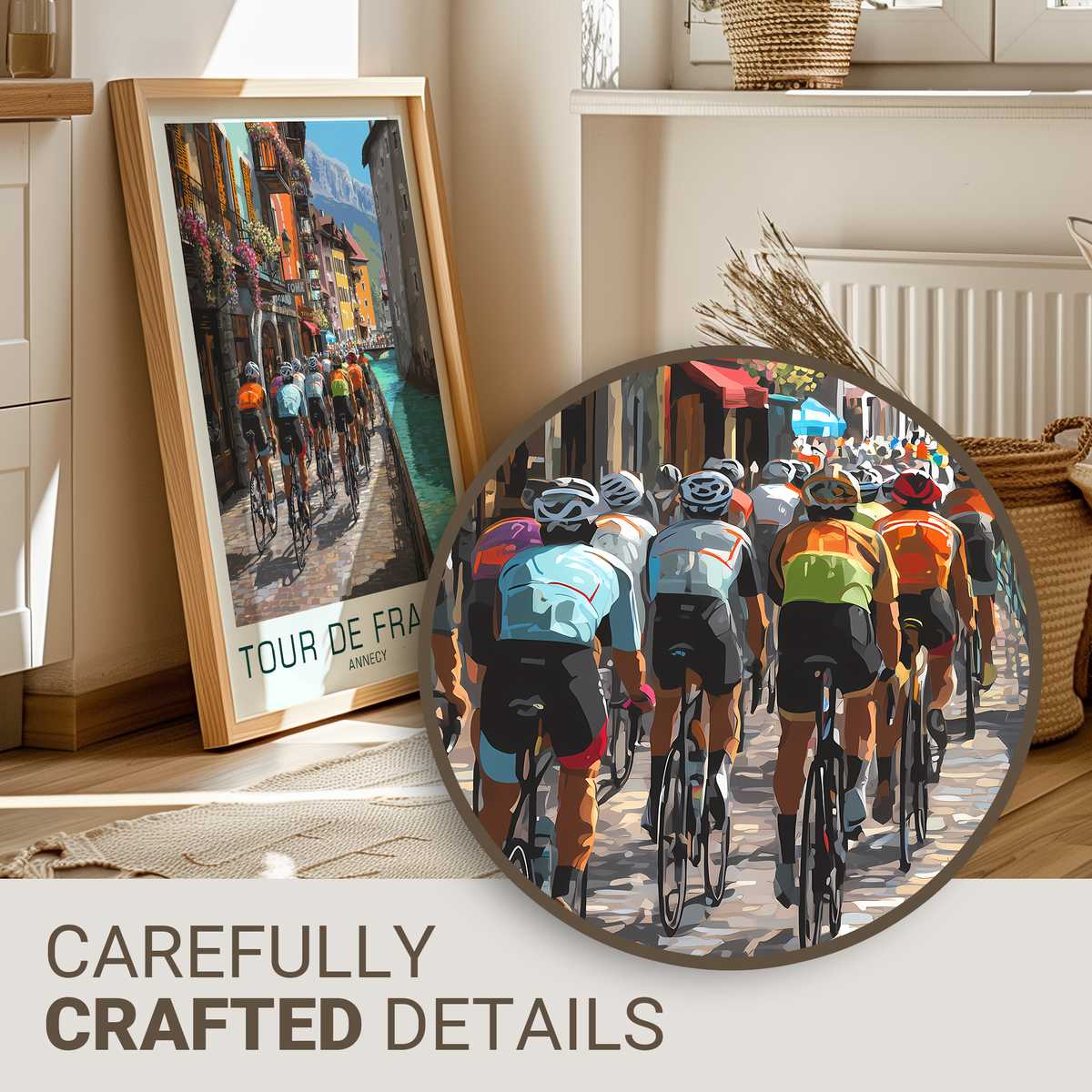
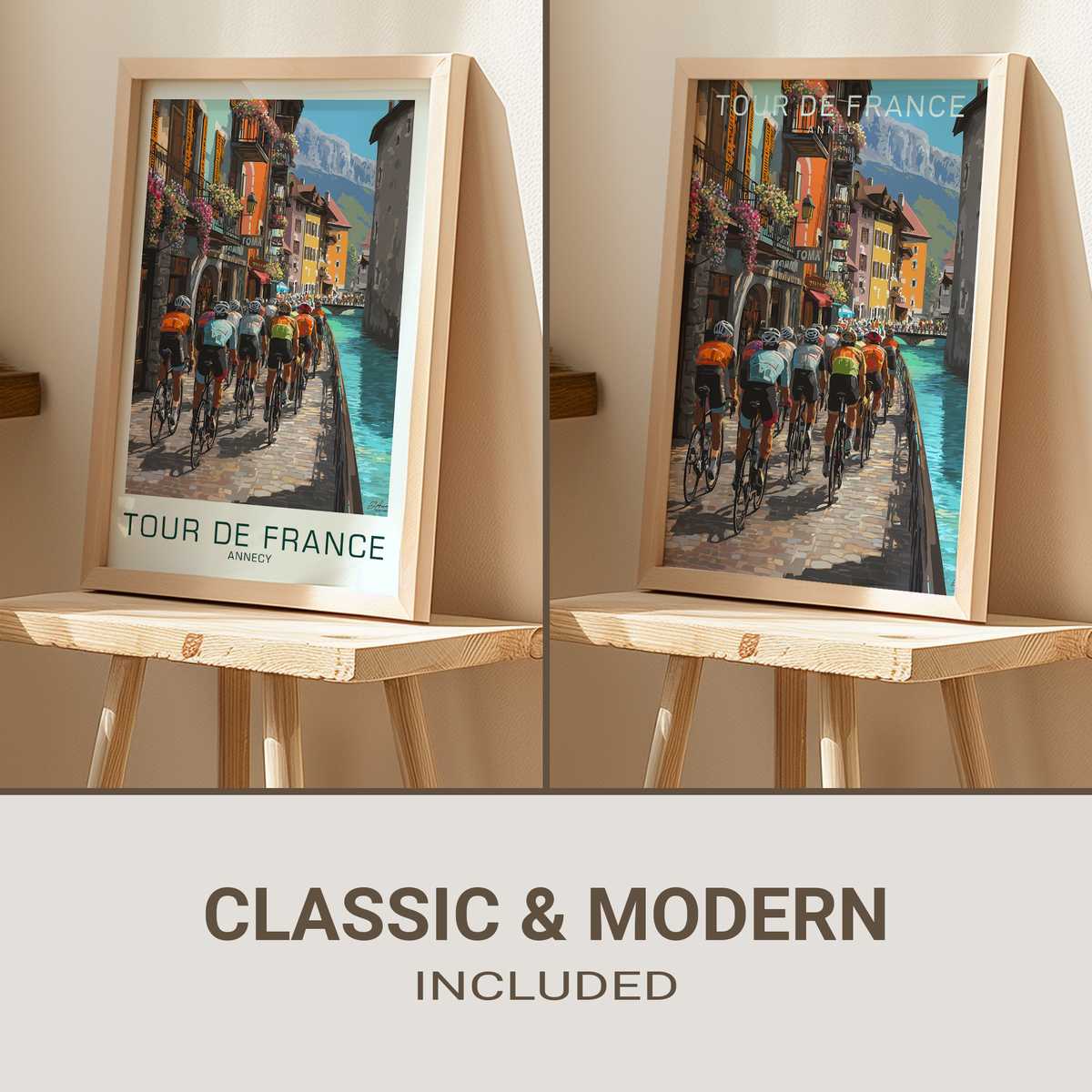
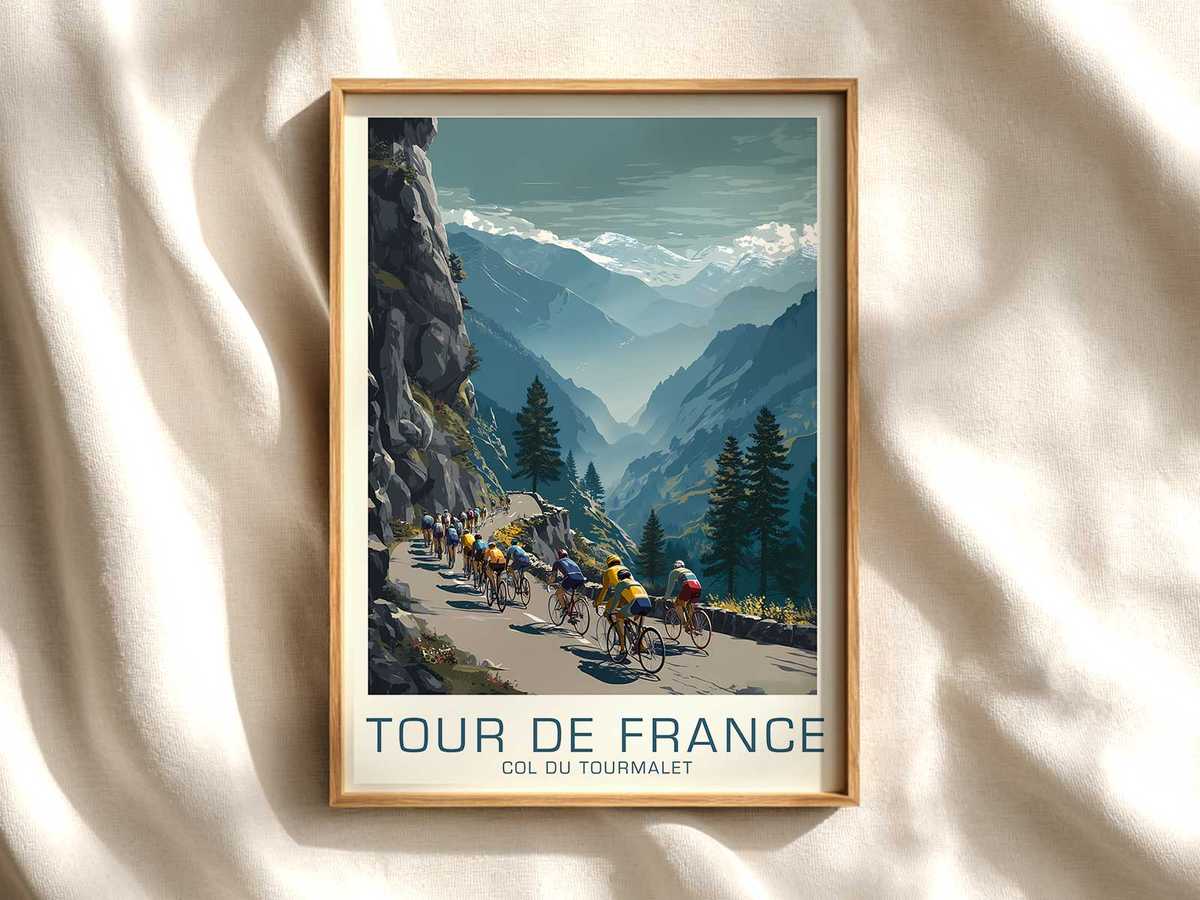
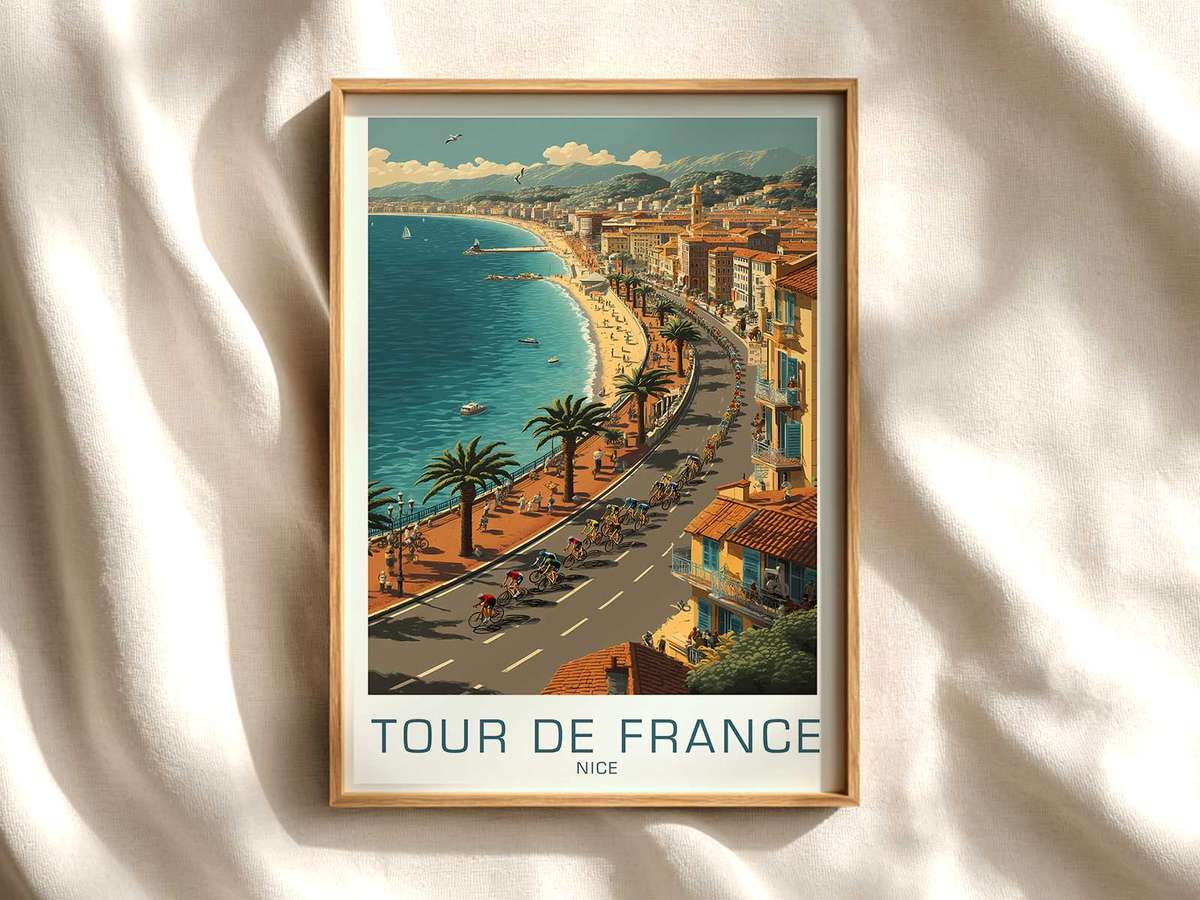
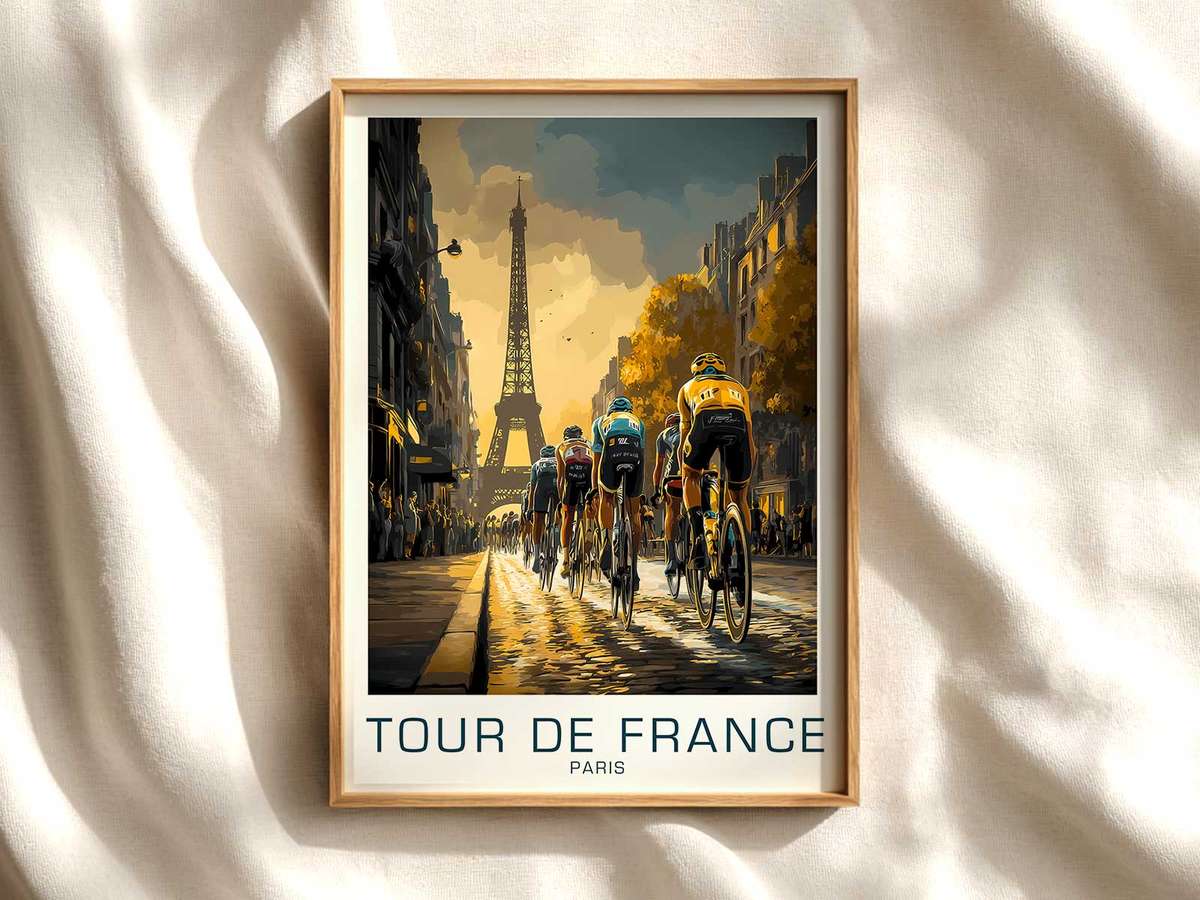
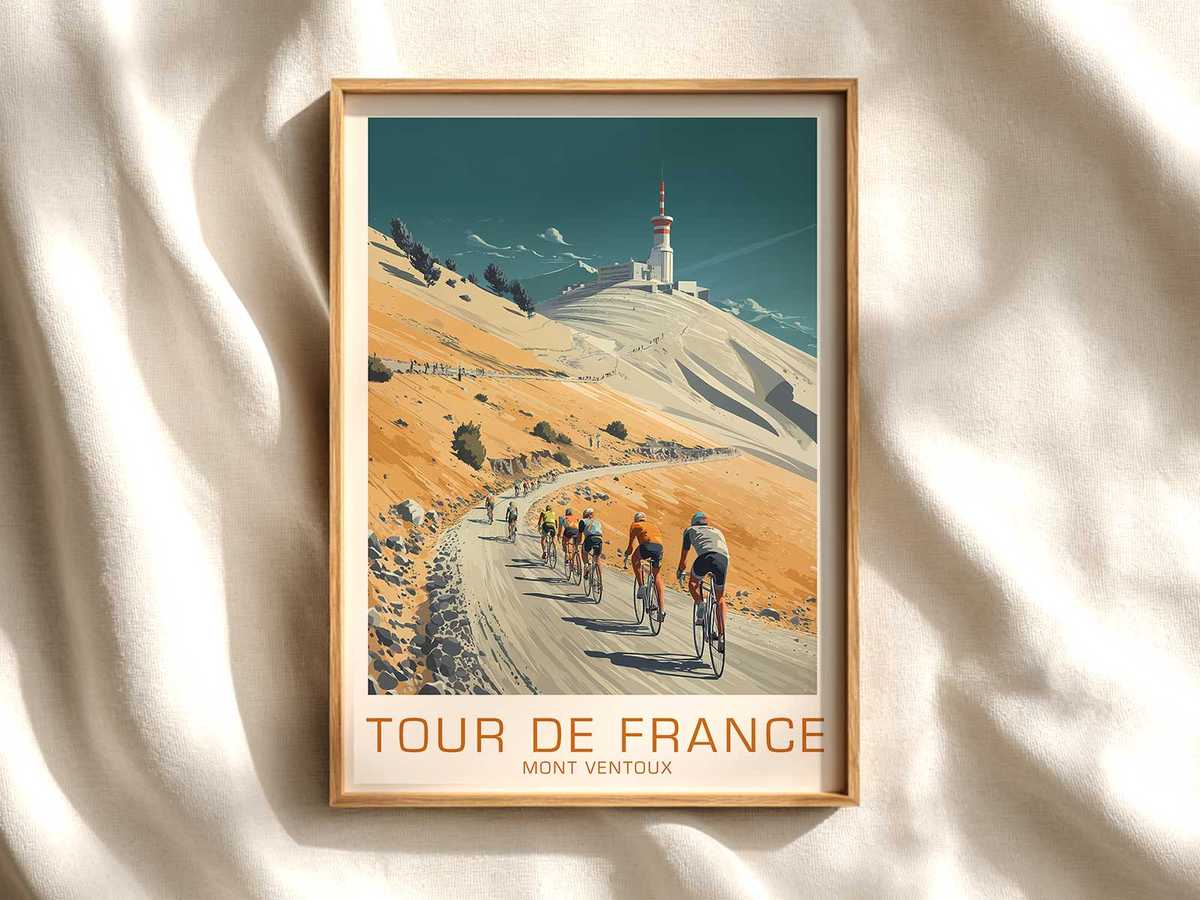
In a poster inspired by Annecy, the racing bicycle is not an accessory: it is the compositional backbone. The verticals and diagonals of the frame trace an architectural line across the picture plane, the wheel circles become measured counterpoints to the mountain horizon, and the cockpit—the bars, stem and thin saddle—defines the forward intent of the scene. This is a poster that uses the machine’s geometry to order space, to create visual tension, and to invite the viewer into a particular touring-forged world.
Viewed at arm’s length on a matte canvas, the frame silhouette reads like a map of purpose. Tubes meet at engineered angles that suggest torque and cadence; the top tube and seat post draw a subtle rider posture even when the figure is implied rather than detailed. Wheels act as compositional anchors: deep rims or narrow profiles slice the light while the spokes rhythmically punctuate negative space. In this Annecy-inspired image, those circles echo the lakes and alpine curves beyond, folding landscape and machine into a single graphic statement.
The poster exploits race posture to instill motion without motion blur. A compact, forward-leaning stance—headlow, shoulders engaged, hands poised over drops—compresses narrative into a single silhouette. That tautness establishes urgency and craft: the bicycle reads not as leisure hardware but as a finely tuned instrument of uphill pursuit. The visual vocabulary of chainstay, fork rake and seat angle becomes shorthand for effort and engineering, so even viewers unfamiliar with component specs can sense mechanical intelligence at work.
[IMAGE_INSERT_ARTICLE_01]
Material culture of the Tour de France is implied rather than catalogued. Leather saddle tones, the gloss of painted steel or the matt of modern carbon, the kink of brake cables and the glint of exposed bolts are suggested through textural contrast and selective highlight. Those cues are quiet but persuasive, reminding the viewer of eras and evolutions without insisting on a precise provenance. The poster therefore sits comfortably between nostalgia and contemporary design—heritage-led yet pared-back, legible on a stairwell or above a minimalist desk.
Color and restraint play a decisive role. A limited palette—muted alpine blues, stone greys and a single warm accent—lets the bicycle’s technical silhouette dominate. Where many sport images rely on crowds or confetti, this approach compresses drama into plane and line: the gradient of a mountain road, the slant of sunlight on a down tube, the micro-geometry of the cockpit. Those details reward close viewing and give the canvas a quiet readability across different room scales.
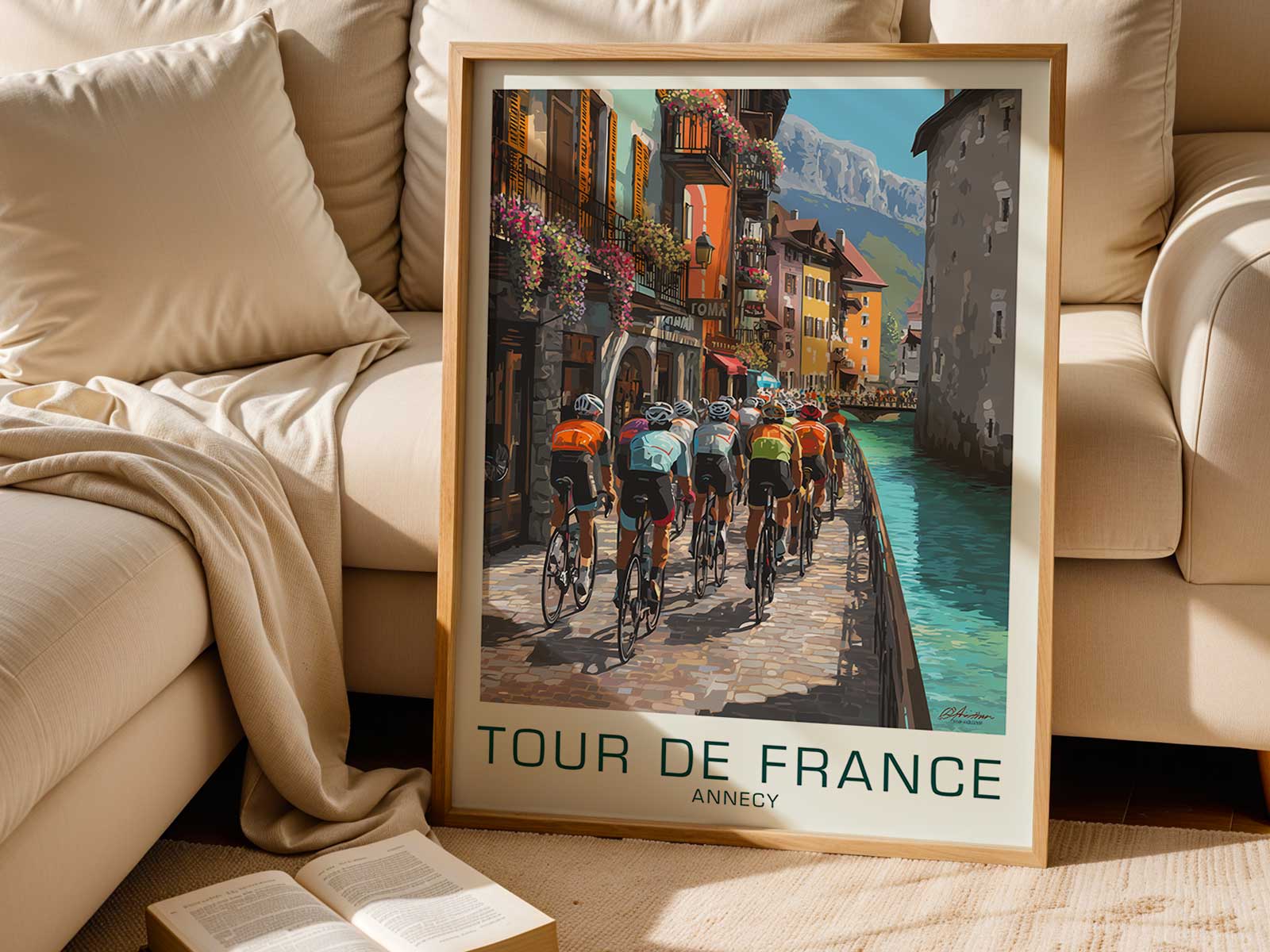
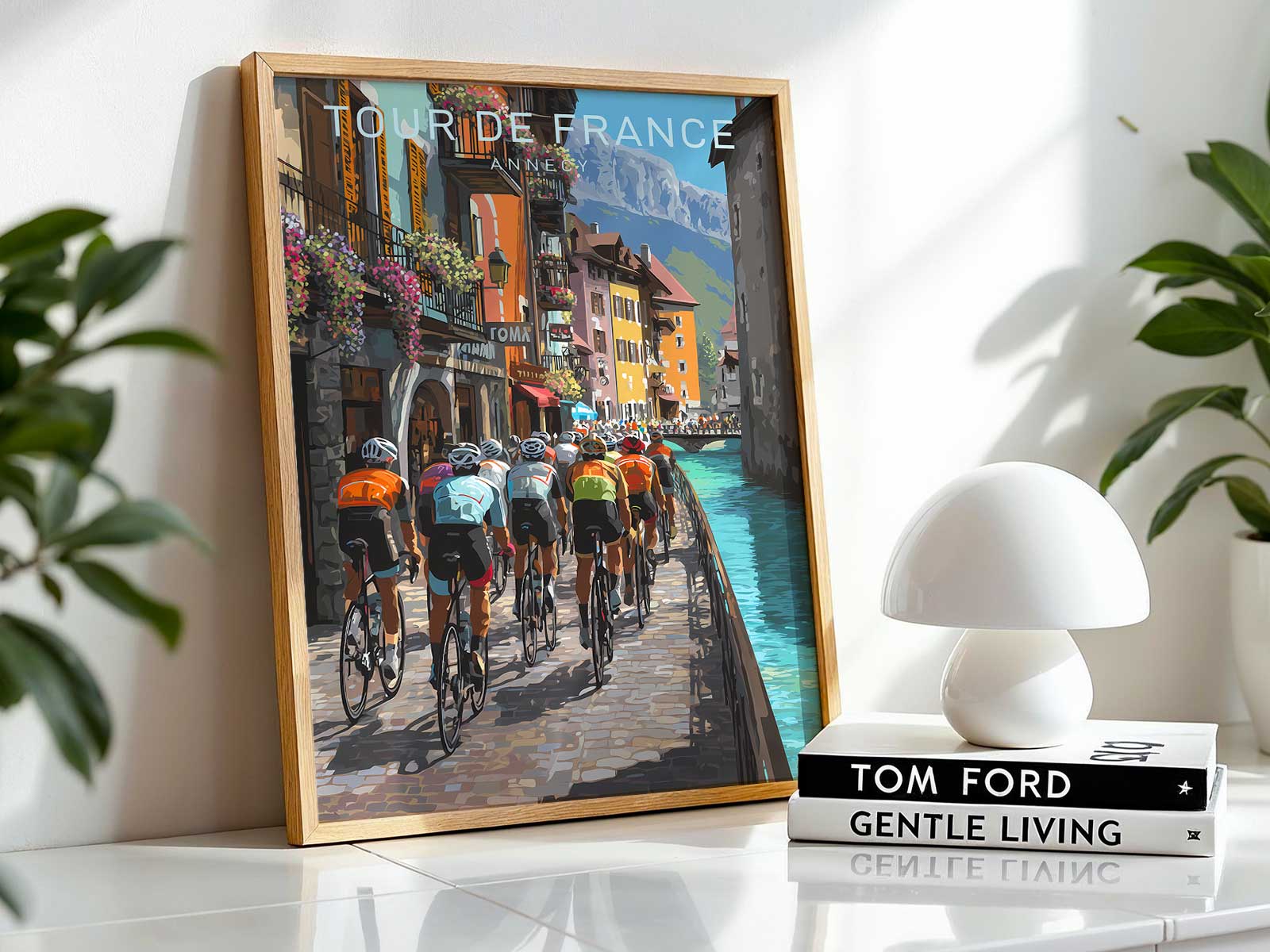
For interiors with a predilection for sporting design, the appeal is conceptual as much as aesthetic. Placed in a study, the piece reads like an argument for discipline and precision; in a garage or studio it affirms a maker’s sensibility. The bike-led image is especially effective where other elements are minimal: a single framed print can articulate an entire mood, suggesting velocity, craftsmanship and the solitary intensity of a climb without dominating the space.
Ultimately, the desirability of this type of poster comes from specificity. By foregrounding frame geometry, wheel form and race stance, the artwork communicates an economy of meaning—the bicycle becomes a symbol of performance and memory rather than a decorative afterthought. That clarity is what makes an Annecy-inspired bicycle canvas wall art feel display-worthy: it invites the viewer to appreciate the machine as architecture, to recall the culture of the Tour de France, and to inhabit a room with the poised energy of a well-tuned race bike.