What skills do professional cyclists need? The essentials explained
Professional cycling is often seen as a test of raw horsepower. That is part of it, but the real dividing line is broader: endurance plus repeatable performance, sharp bike skills, racecraft, pacing knowledge, recovery systems and emotional control. Those combined abilities are what teams and coaches train for and evaluate.
Quick answer
Being a professional requires more than long rides. You need sustained aerobic capacity, the ability to repeat hard efforts, excellent positioning and bike handling at speed, disciplined pacing and recovery routines, tactical awareness inside the peloton, and controlled decision‑making under pressure.
What this article reveals
- Which physical and technical skills separate strong amateurs from professionals.
- How pacing, fatigue and recovery shape real race performance.
- Why bike handling, positioning and mental control are non‑negotiable.
Defining the real standard
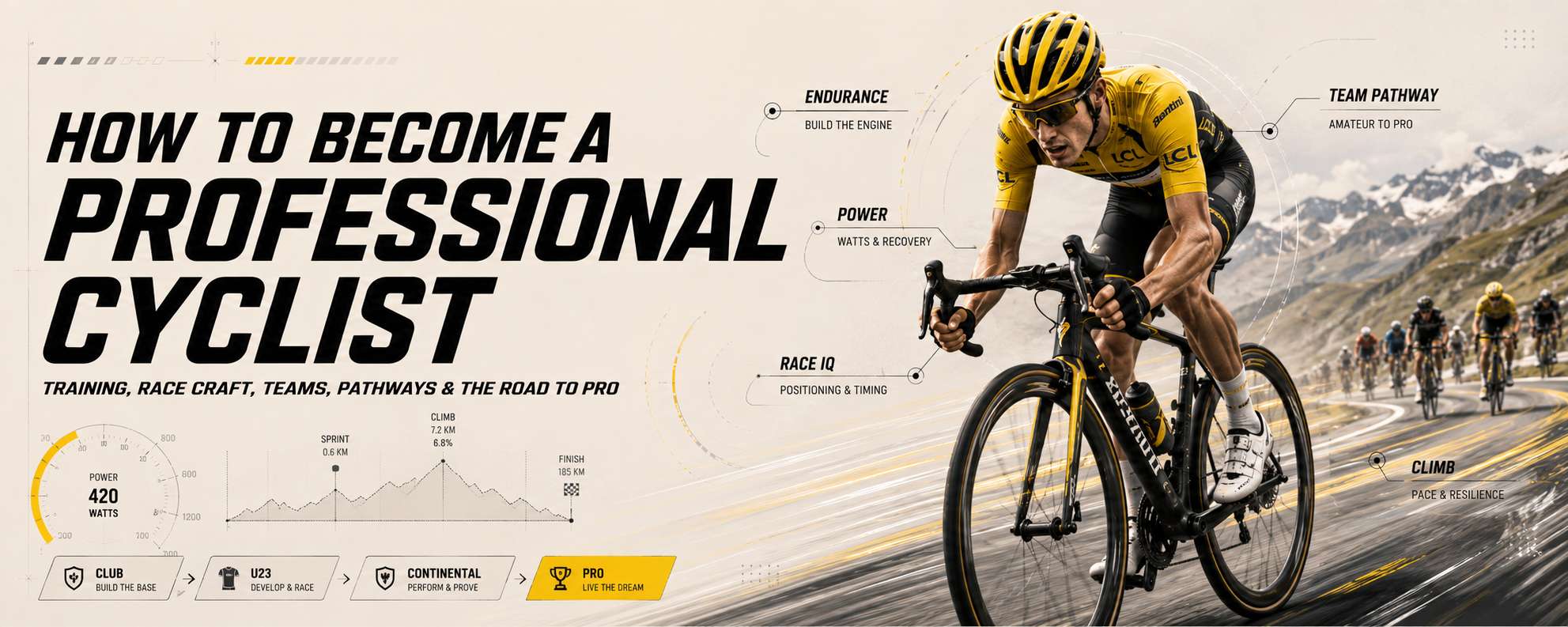
National federations and elite coaching programmes describe professional-level ability as a package: high aerobic endurance built through large training volumes, combined with tactical and technical competence. That means being able to perform at race intensity for long days and then recover, while also matching the micro‑skills that keep you safe and competitive in a bunch.
Physical engine and fatigue resistance
Endurance is the foundation. Professionals accumulate large weekly training hours to develop sustained aerobic power needed for long races and stage events. Crucially, what matters in races is not a single peak value but repeatability — the capacity to deliver repeated hard efforts and resist the gradual rise of fatigue across hours and days.
Coaches and research emphasise that pacing and individualized models of fatigue and recovery determine how that engine is used. Effective riders understand how to distribute effort across a time trial or a stage so their power, speed and decision-making remain useful when it matters most.
Technique and bike handling
At professional speed, small handling skills become decisive. Balance, cornering, descending, braking and riding millimetres from other riders are taught and practised in development programmes. Good handling reduces wasted energy, lowers crash risk and allows a rider to maintain position through technical sections where others hesitate.
Practice drills — cone slaloms, group simulations and controlled descending work — are standard in coaching resources because these skills are learnable and repeatedly seen to separate riders in real races.
Positioning and peloton behaviour
Positioning inside a bunch is tactical and safety training in one. National programmes prioritise learning how to hold a wheel, read where gaps will open, and predict moves so you are never chasing from behind. Done well, positioning saves energy through drafting and places a rider to respond to accelerations or to launch their own move.
Conversely, poor position forces extra work, increases crash exposure and often ends a rider’s chance before key climbs or sprints. The ability to hold position under pressure is therefore a practical skill coaches teach as urgently as intervals and threshold work.
Pacing, tactics and race intelligence
Pacing is both a physical and a tactical skill. Research on individualized fatigue and pacing models shows that optimal effort distribution — in a time trial or across a stage — depends on anticipating how the body will recover and fatigue. Riders who understand these dynamics avoid wasted attacks and pick moments when recovery and team support matter most.
Tactical awareness extends beyond pacing: timing attacks, reading moves, knowing team roles, and judging risk vs reward are all competencies that coaching frameworks list alongside fitness. Racecraft is frequently what separates two riders with similar engines.

Recovery, nutrition and routine
Planned recovery protocols—sleep, nutrition, warm‑ups and cool‑downs—are integral to how professionals train and race. Coaching guidance stresses that adaptation happens off the bike; therefore fuelling the work correctly and following deliberate recovery behaviours sustain performance across multi‑day events and heavy training blocks.
These are not optional niceties but routine practices that let a rider translate training load into consistent race form.
Mental skills and emotional control
Mental resilience, focus, and calm decision‑making under stress are formally recommended elements of rider development. Emotional control prevents poor choices in frantic finales, helps manage pain and keeps teamwork functional when stakes are high. Coaches include mental skills training alongside physical and technical drills because psychological steadiness materially affects race outcomes and recovery.
What amateurs often misjudge
Many talented club riders overestimate how far pure fitness will carry them. Without refined positioning and handling, they lose advantage in the bunch. Without pacing literacy and recovery routines, their strong single efforts do not translate into race consistency. And without racecraft and emotional control, they miss opportunities that experienced riders seize instinctively.
Development programmes therefore emphasise deliberate practice: technical drills, simulated bunch work and structured process goals that teach how to apply fitness effectively.
Development pathway and what teams notice
Teams and national coaches look for a composite profile: physical endurance and repeatability, demonstrable bike skills, consistent race results in stronger fields, and observable tactical sense. They value riders who can do roles reliably — protect leaders, chase, or animate races — not only those with headline wins. Practical drills and season‑long consistency are the clearest ways to show this mix.
How to assess your potential realistically
Useful signs of real potential are repeatable performances across races, calm and correct behaviour in the bunch, reliable recovery between hard days, and measurable improvement from deliberate technical practice. These are better predictors than a single fast time trial or a lucky win.
Testing yourself in tougher races, practising peloton skills under coach supervision, and tracking recovery and adaptation will show whether you can bridge the gap from strong amateur to an elite development environment.
Closing interpretation
So, what skills do professional cyclists need? The honest answer is that no single attribute suffices. Endurance and a durable engine open the door, but positioning, bike handling, pacing knowledge, recovery practices and controlled decision‑making are what let a rider turn fitness into consistent race performance. Teams and coaches judge the package — the visible engine plus the invisible habits that preserve and apply it under pressure.
Author: Cynthia D.