Could You Pass a Professional Cyclist Fitness Test?
Ask a simple question—could you pass a professional cyclist fitness test? The quick, honest answer is conditional: professionals combine very high aerobic capacity, sustained power and repeatability, precise recovery and low body fat with role-specific skills. One lab value or single ride won’t tell the story.
Quick answer
Professional road cyclists typically sit at the top of physiological ranges: very high VO2max, stage-specific sustained power outputs, and pronounced fatigue resistance tied to glycogen management and recovery. A single fitness test can show potential, but passing a 'pro test' depends on the role, repeatability, and how you recover across days.
What pro-level physiology actually looks like
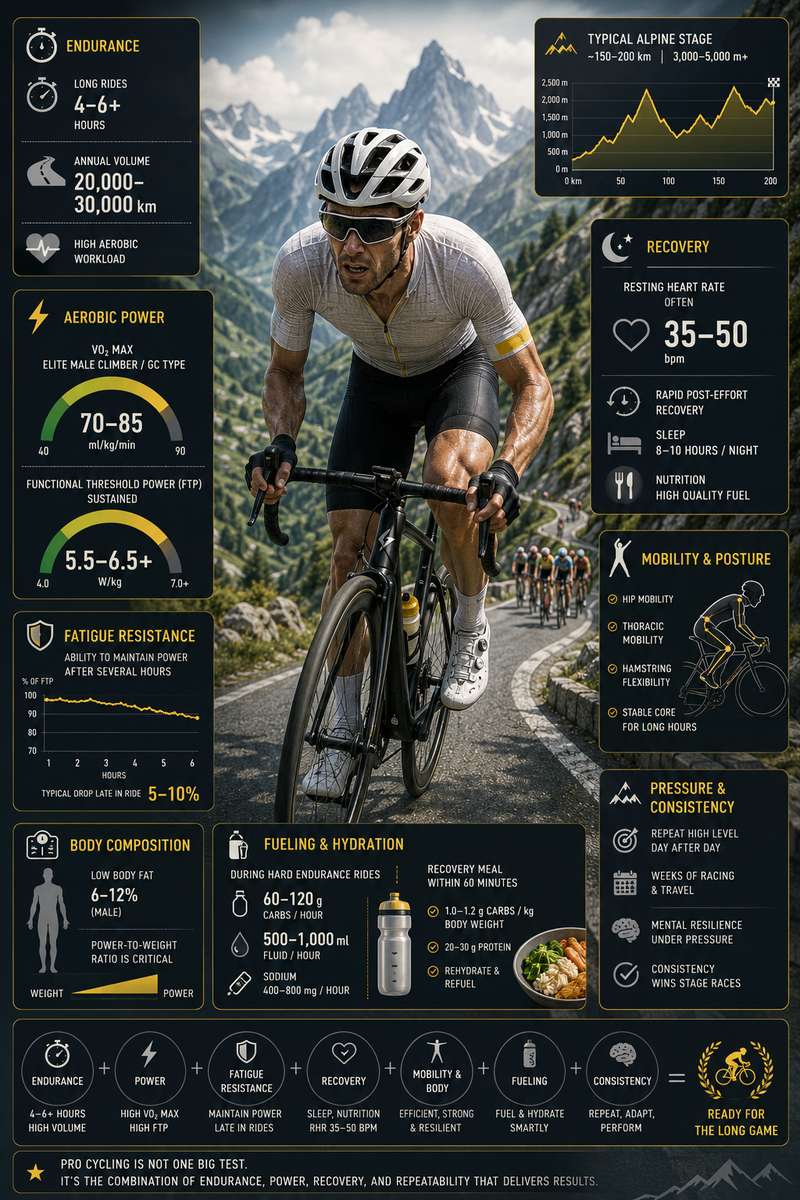
Scientific studies of male professional road cyclists report very high aerobic capacities: VO2max values commonly fall in a high range, with elite climbing specialists toward the upper end. Classic literature and reviews place professional VO2max broadly above typical recreational levels and describe large absolute oxygen uptakes in elite males.
Power profiles at the professional level vary by terrain. Stage averages and specific efforts differ: flat stages have lower average outputs while mountain efforts demand much higher sustained power. Literature shows examples where uphill efforts for extended durations produce substantially higher power and watts-per-kilogram values than stage averages. Professionals also produce very large short anaerobic peaks for sprints or attacks.
Beyond a number: power, repeatability and fatigue resistance
Power and VO2max measure important capacities, but race performance depends on the ability to use those capacities repeatedly. Stage racing requires riders to exercise at a high fraction of their VO2max for long periods, intersperse repeated high-intensity efforts, and recover sufficiently between them.
Muscle glycogen dynamics are central. Depletion during hard efforts reduces sustained output; replenishment across and between stages determines how effectively a rider can repeat efforts. That is why physiological testing alone—while useful—does not fully capture a rider’s fatigue resistance across multiple race days.
Recovery and the science of bouncing back
Professional cyclists use targeted recovery strategies supported by the literature. Timely carbohydrate and protein intake after efforts helps restore glycogen and support muscle repair. Periodised rest and quality sleep are fundamental. Short-term modalities such as cold-water immersion or compression garments have evidence for aiding acute recovery markers and are often part of multidisciplinary programs.
Recovery isn’t a cosmetic extra; it is a performance system that determines whether high aerobic power converts into repeatable race output over a multi-day event.
Body composition and long-term considerations
Elite road cyclists typically have low body-fat percentages compared with the general population and maintain high lean mass appropriate to their role. Studies report male competitive cyclists ranging from low double-digit body fat down into single digits depending on the season and rider type.
However, the literature also flags important health considerations. Cyclists show a risk of lower bone mineral density compared with athletes in weight-bearing sports. Contributors include limited weight-bearing loading and, in some cases, low energy availability. Measurable body-composition changes also occur over multi-week stage races—fat mass often decreases and fat-free mass can vary—so teams monitor these signals closely.
Mobility, flexibility and function on the bike
Mobility training is recommended within multidisciplinary support to maintain functional range of motion, reduce overuse injury risk, and enable efficient positioning on the bike. While extreme flexibility is not a performance determinant, adequate hip, thoracic and shoulder mobility helps a rider hold aerodynamic positions and transfer power efficiently.
In short: mobility supports performance by preventing losses in power delivery and by reducing cumulative injury risk that would otherwise impair training and racing consistency.
How testing reveals ‘possible’ but not ‘guaranteed’ pro potential
Tests—VO2max, lab power-duration profiles, and field power testing—give actionable data. They can show whether a rider’s aerobic engine and short-duration power sit within ranges documented for professionals. But the verified literature also shows there is no single universal pass/fail threshold across roles. A climber’s profile differs from a rouleur’s or a sprinter’s, and stage-race success depends on recovery and repeated efforts as much as peak numbers.
Therefore, a test can identify promise and specific weaknesses (e.g., poor repeatability or slow recovery), but it cannot alone predict race results or team selection.
Which limits show up first in real racing
In multi-hour races the first cracks often appear as degraded repeatability and delayed recovery: a rider can hit a strong single effort in a lab but struggle to reproduce that after hours in the saddle or on consecutive days. Glycogen depletion, inefficient substrate use and incomplete recovery mechanisms are common culprits identified by the literature.
Other failings—poor positioning, weak descending, or tactical inexperience—won’t show on a physiological test but will decide races on the road. The physiological ceiling and the ability to apply it under fatigue together determine selection for higher levels.
What you can realistically test yourself
Use structured lab or field protocols to assess aerobic capacity and power-duration profiles, and track recovery markers such as perceived fatigue, sleep quality, and body-composition trends. Monitor how quickly you restore power across repeated efforts and after hard days; that practical repeatability is a clearer signal of stage-race potential than a single peak number.
Also pay attention to mobility and baseline bone-health indicators if resources allow—these are longer-term markers clinicians and team staff watch in cyclists.
Final interpretation and next steps
Could you pass a professional cyclist fitness test? Possibly—if your VO2 capacity, sustained power and repeatability fall into the ranges observed in professional riders and your recovery and body composition are managed safely. But passing a test is not the same as thriving in professional racing. Teams and race demands value repeatability, role fit, recovery systems and day-after-day durability alongside numbers.
If you’re curious about your level: get tested, track repeatability across days, prioritise recovery and mobility, and view a lab or field test as one piece of evidence rather than a final verdict.
What this article reveals
- Pro cyclists combine very high VO2 and role-specific power with fatigue resistance and recovery systems.
- Glycogen management and repeatability across days often expose limits before a single peak test does.
- Low body fat and lean mass are common but bring bone-density and energy-availability considerations.
Author: Alex R.