
Is it too late to become a professional cyclist?
Ask yourself what you mean by "professional." A weekend rider can become a fast, race-capable amateur at many ages with focused training; reaching the professional ranks that supply WorldTeams and the major stage races usually follows a different clock. Age matters for physiology, accumulated race experience, and the networked pathways teams use to recruit—but it does not produce a single universal cutoff.
This article explains, in practical terms, what age changes, what can still be improved later in life, and which ambitions remain realistic at different stages.
Quick answer
It isn’t a simple yes-or-no. Physiological peaks for road racing tend to fall in the late 20s to early 30s and many pros arrive after U23 development; starting late narrows the usual recruitment window and makes elite breakthrough harder, but meaningful gains and competitive racing remain possible with focused training and the right opportunities.
What this article reveals
- How age affects VO2max, threshold and endurance, and why decline is gradual.
- Which racing skills and experiences teams look for beyond raw power.
- Realistic late-entry pathways versus the standard junior/U23 pipeline.
- What older beginners can test to assess genuine professional potential.
The question you must define: which professional level?
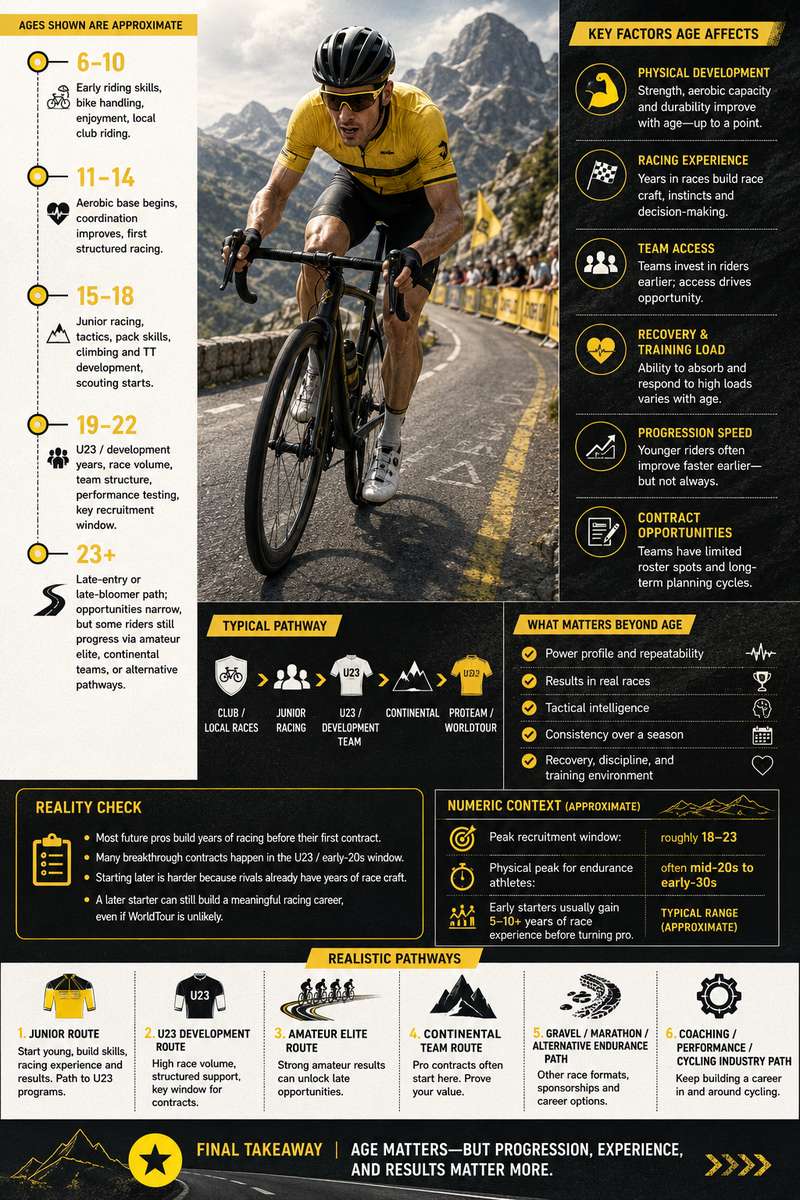
Professional cycling is not one level. There are paid riders on Continental teams, ProTeams and WorldTeams; some ride national-level pro races and others the Grand Tours. The evidence shows most riders who populate these professional rosters reach that stage in their early-to-mid 20s and that peak competitive performance for many road events sits in the late 20s to early 30s. That distribution matters: teams commonly recruit from junior and U23 development pathways because those riders combine youth, physiological upside and accumulated race experience.
How age changes the physical engine
Core endurance determinants—VO2max, lactate threshold and economy—change with age. Studies summarised by sport physiology reviews show VO2max declines on the order of several percent per decade after about 30, although highly trained masters athletes preserve far better function than sedentary peers. In short: physiological decline is real but gradual, and a well-trained older rider will outperform an untrained younger one.
That matters because professional selection rewards both high peak capacities and the ability to sustain intense efforts across long days and multi-week blocks. Starting later reduces the years available to build those durable adaptations under race stress, but it does not eliminate the potential for significant improvements in cardiorespiratory fitness with focused training.
Why race experience and skills are as decisive as power
Teams do not sign riders for a single test number. Racecraft—handling at speed, cornering, descending, reading the peloton and timing efforts—changes how physiological capacity is expressed in real races. Accumulated race hours teach positioning and tactical choices that a lab result never shows. That is why the junior and U23 calendar matters: it grants repeated exposure to stronger fields, where mistakes are punished and visible consistency is rewarded.
The usual development pathway and why timing matters
Most professional teams recruit through structured development pathways: junior teams, U23 squads and continental-level racing that exposes riders to tougher competition and gives teams observational data across seasons. UCI registration and neo-pro rules create a framework in which teams expect certain prior categories and racing experience when offering first professional contracts. Starting outside that flow—arriving late from a different sporting background or from pure recreational riding—makes the route to a contract atypical and therefore harder, not because late improvement is impossible, but because teams have less visibility and less time to project upside.
What teams notice beyond wins
Scouts and directors evaluate riders for roles, not only victories. They look for consistent performance in the right contexts, ability to perform race duties (domestique pulls, lead-outs, steady tempo on climbs), and a pattern of improvement across seasons. Teams commonly prefer younger riders because they can develop them over multiple years; this preference is visible in roster-age analyses where mean pro ages fall in the mid-to-late 20s.
For a late starter to be noticed, they typically need either standout results against high-level fields or demonstrable, repeatable abilities that match a team’s immediate needs.
Hidden obstacles and common misconceptions
Two misconceptions are frequent. First: a single impressive ride guarantees recruitment. Reality: teams prize season-long performance and context—quality of competition, role in the result, and repeatability. Second: physiology is fixed. While peak determinants decline gradually with age, targeted training produces substantial gains even later in life; however, building the race-hardened durability and tactical maturity that teams value usually requires several seasons of specific competition.
Realistic late-entry pathways
If you start late and want to aim for paid racing, the pragmatic options are clearer when separated by ambition:
- Competitive amateur / elite amateur: achievable with focused training, smart race selection and consistent performance; many riders reach solid national-level results later in life.
- Continental / domestic professional teams: possible for late developers who post strong results against established fields or who fill an identified team role; these teams often recruit riders with proven race experience rather than raw late improvement alone.
- WorldTour / highest international level: statistically and structurally more difficult to reach without following youth development pathways, because teams usually recruit riders in their early 20s and project development into the late 20s.
What older beginners can test now
Before chasing contracts, test realistic signals of potential: how well you improve aerobic fitness with structured training, how rapidly you adapt to race intensity, and whether you can translate training gains into consistent race performance across a season. Crucially, measure repeatability—can you deliver high efforts late in races and recover between hard days? Teams value reproducible performance over isolated peaks.
Closing interpretation: realistic hope, honest framing
Is it too late to become a professional cyclist? The scientifically supported answer is conditional: late starters can make large fitness gains and enjoy competitive success, but the standard pathways into paid professional cycling favour riders who have built years of targeted training and race experience earlier in their 20s. Physiological decline after 30 is gradual, not catastrophic, yet the recruitment ecosystem and peak-age distributions mean the odds of breaking into the highest tiers fall as you start later.
That does not turn late effort into a waste. Many meaningful careers and roles exist at national, continental and masters levels, and targeted, honest self-assessment can reveal whether to pursue a pro contract or to aim for high-level amateur success. Define the specific level you want, measure progress across seasons, and let race results—contextualised by competition quality—decide next steps.
Author: Cynthia D.