
How to Become a Professional Cyclist: From Local Club to Continental and Beyond
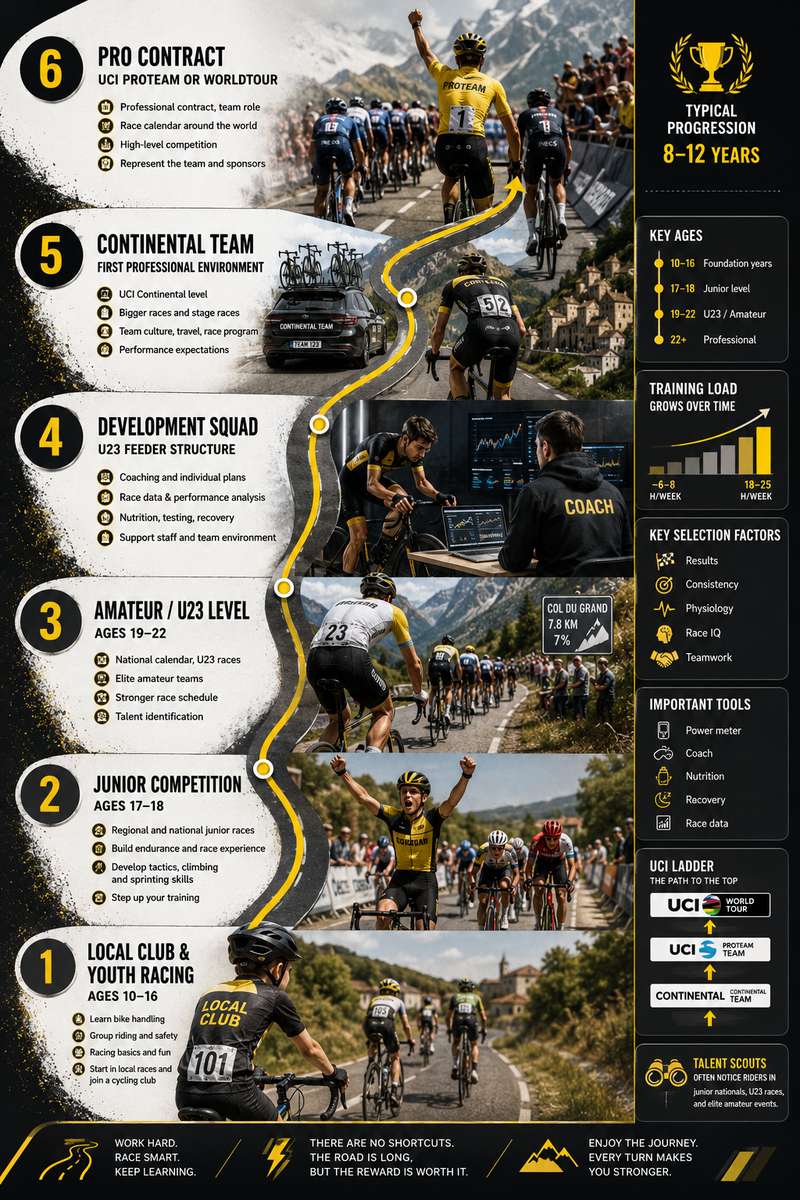
Becoming a professional cyclist follows a recognisable pathway: start at a local club, learn to race in sanctioned events, progress through national categories and development programmes, and use Continental teams as the stepping-stone toward a ProTeam or WorldTeam contract. That sequence is straightforward in outline but full of hard selection points that separate occasional winners from riders who earn professional roles.
Quick answer
Follow the ladder: grassroots club racing → sanctioned local/regional races and category upgrades → national-level and junior programmes → development/U23 squads and UCI Continental teams → first professional contract with a ProTeam or WorldTeam.
What this article reveals
- How sanctioned local racing and category systems create measurable progression.
- Where national federations and LTAD/development programmes fit into selection.
- Why UCI Continental teams are the usual development step before pro contracts.
Start at the club: the foundation is local and sanctioned
The journey that leads to a professional contract almost always begins in grassroots cycling. National federations advise joining a local club and entering sanctioned races. These entry-level events give structured competition, rules, and safety—simple things that matter when teams begin to compare results across riders and seasons.
Clubs provide coaching, race introductions and the first real exposure to race tactics, group riding and finishing under pressure. Because the races are sanctioned, performances feed into the formal category system and into the record that selectors and teams will eventually read.
Understand the category system and measurable progression
Many federations use a numerical category ladder to move riders from novice to elite. For example, a typical progression begins at Novice/Category 5 and advances through higher categories to Category 1. Riders earn upgrade points and advance by racing and achieving results in sanctioned events.
The category system does more than record wins. It structures the field so riders graduate into stronger races incrementally. That incremental increase in competition quality is how genuine ability is exposed and evaluated by coaches and teams.
National development programmes and LTAD: purposeful preparation
National federations use Long-Term Athlete Development frameworks and accredited coaching resources to identify and prepare riders with potential. Junior and national team programmes offer focused coaching, selection to stronger races, and a framework for stepping up to international competition.
These programmes matter because they create consistent standards: selection, training guidance and exposure to higher-level events. For many riders they are the bridge between regional success and the attention of development squads or Continental teams.
Development squads, U23 programmes and UCI Continental teams
After success at national-level racing and participation in development programmes, riders typically move into development squads or U23 teams. UCI Continental teams represent a formal, registered level on the UCI continental circuits and are widely recognised as the entry-level professional/semi-professional step.
Continental teams race in tougher fields and on an international calendar that exposes riders to a wider range of race situations. That exposure is the practical test: teams use Continental races to assess a rider’s consistency, role capability, and response to sustained, higher-intensity competition.
Why this ladder matters: results, role and repeatability
Teams do not hire isolated victories; they evaluate how a rider performs in progressively stronger environments. Sanctioned results and category progression provide traceable evidence that a rider can handle tougher races. Development programmes and Continental races show whether a rider can repeat effort after multiple days, adapt to team roles, and contribute beyond individual wins.
That is why moving through the ladder matters: each step adds context to results and permits selectors to judge a rider’s likely value to a pro team.
What teams and selectors notice beyond the scoreboard
At every level selectors look past single results. They compare performances within stronger races, check consistency across a season, and assess whether a rider can play a team role. National programmes and Continental teams are where riders prove they understand race demands and can be relied upon tactically and professionally.
Being visible in sanctioned events and national programmes is crucial—those records are the currency teams use when making offers.
Practical next steps for an ambitious rider
If you want to follow this pathway: join a sanctioned club, race in entry-level events, track category upgrades, and pursue coaching or national development opportunities. Aim to progress into stronger regional and national races, seek selection for junior or U23 programmes if eligible, and target placement with a development squad or a UCI Continental team when results and experience align.
Each step should be treated as a test: is your racing clean, repeatable and useful to a team? Use sanctioned results and federation-led programmes to build a visible, verifiable record.
Final interpretation: a structured ladder, not a single shortcut
How to become a professional cyclist is not a single magic move but a sequence of increasingly demanding environments. The pathway—local club racing, category progression, national development, Continental teams, then ProTeam/WorldTeam contracts—is the accepted structure used by federations and the UCI. Each level tests a different mix of skill, consistency, team sense and readiness for international racing.
Use the ladder deliberately: compete in sanctioned races so your progress is measurable, pursue federation development where available, and treat Continental-level racing as the critical proving ground before professional contracts are offered.
Author: Cynthia D.