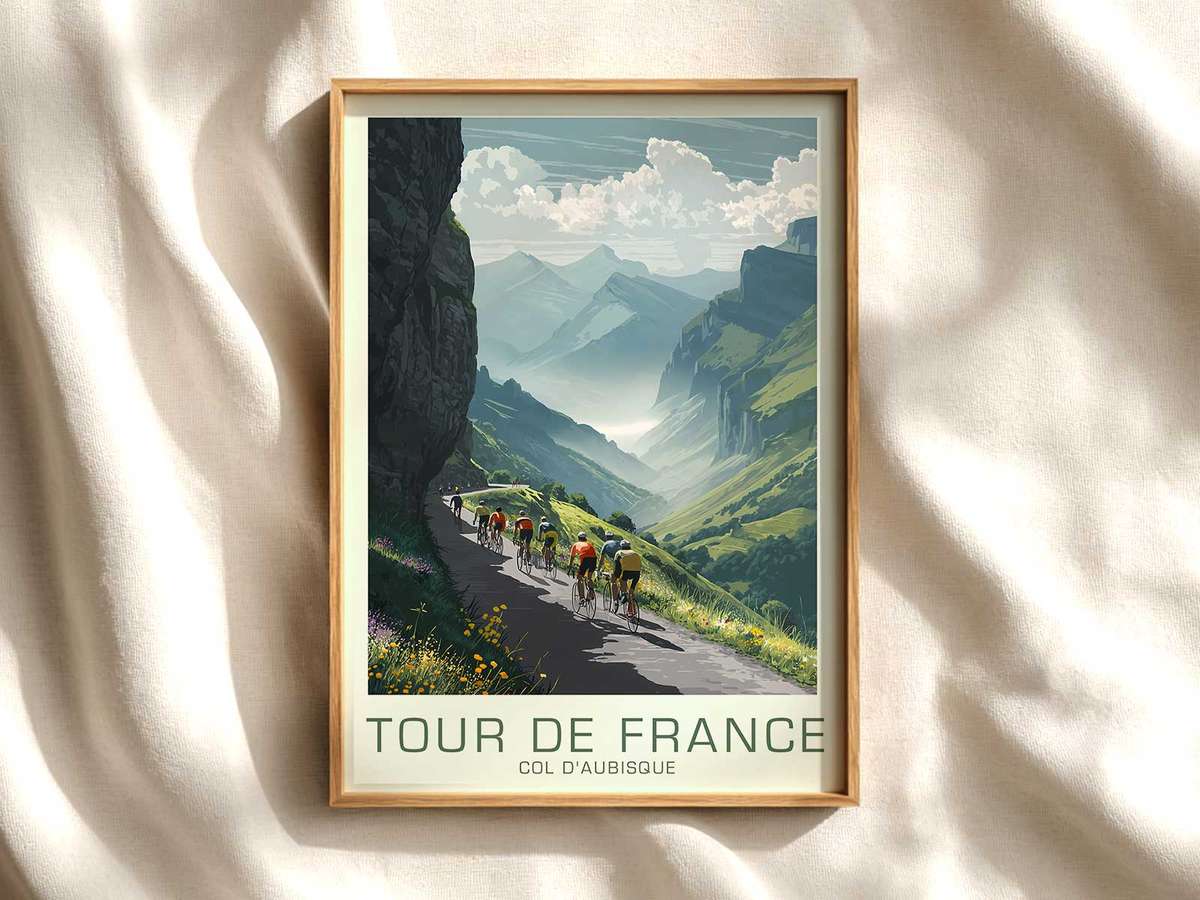
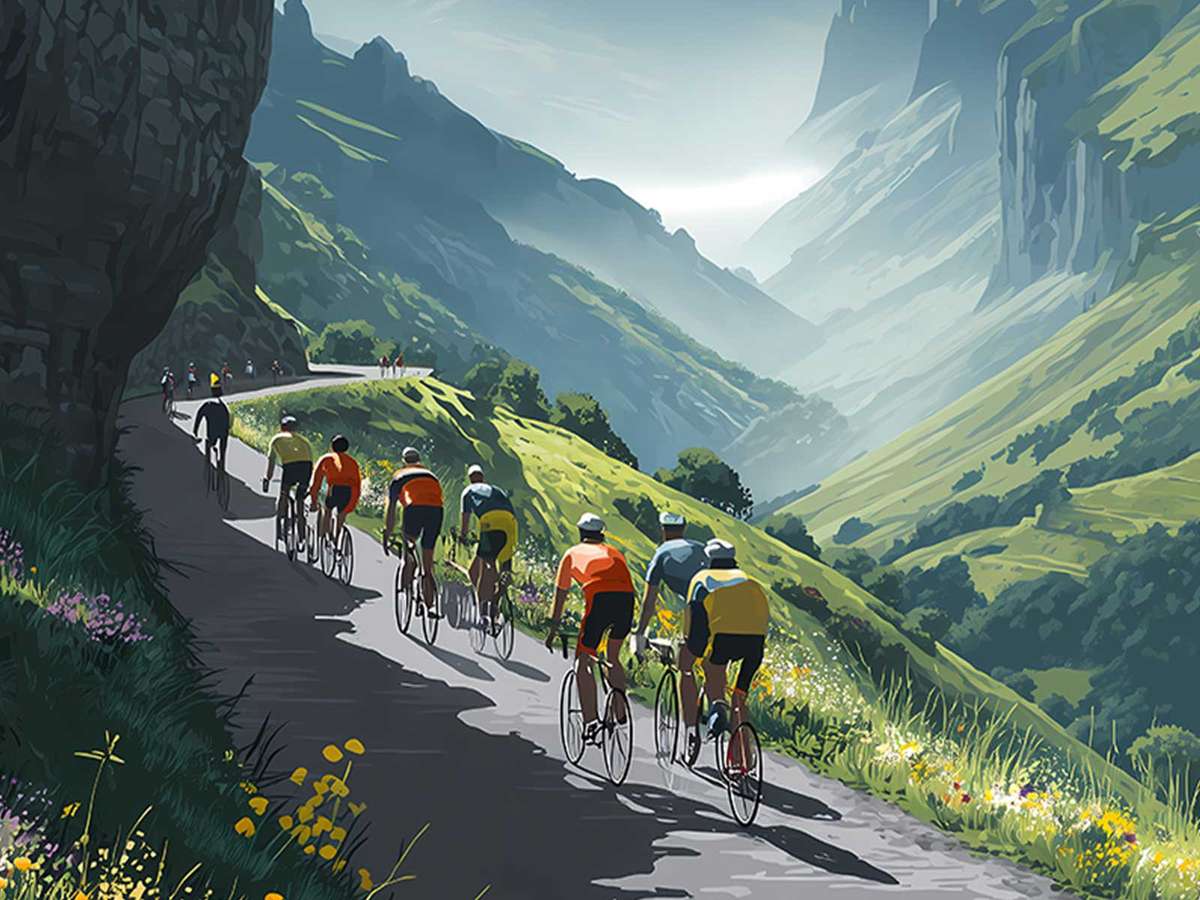
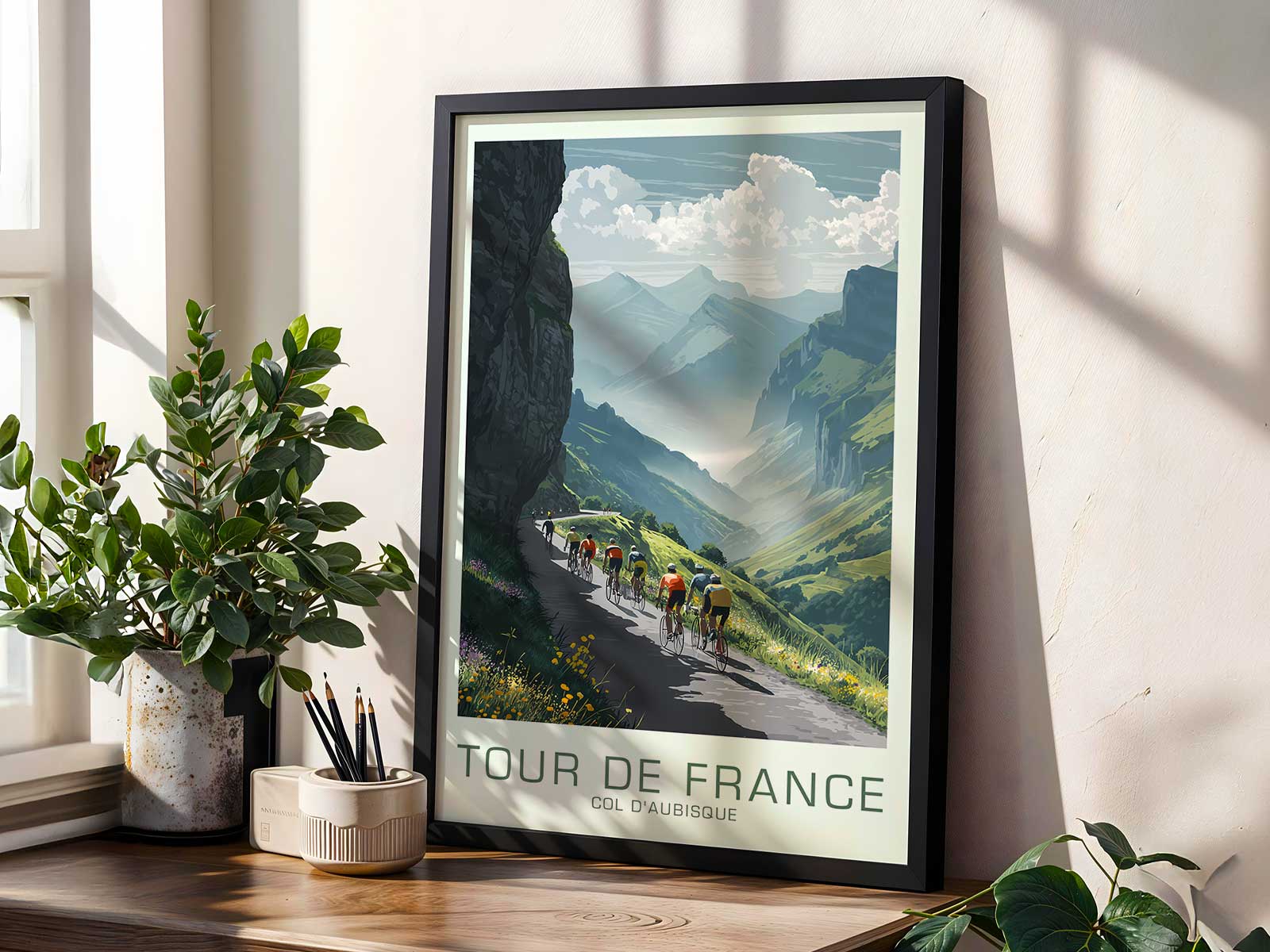
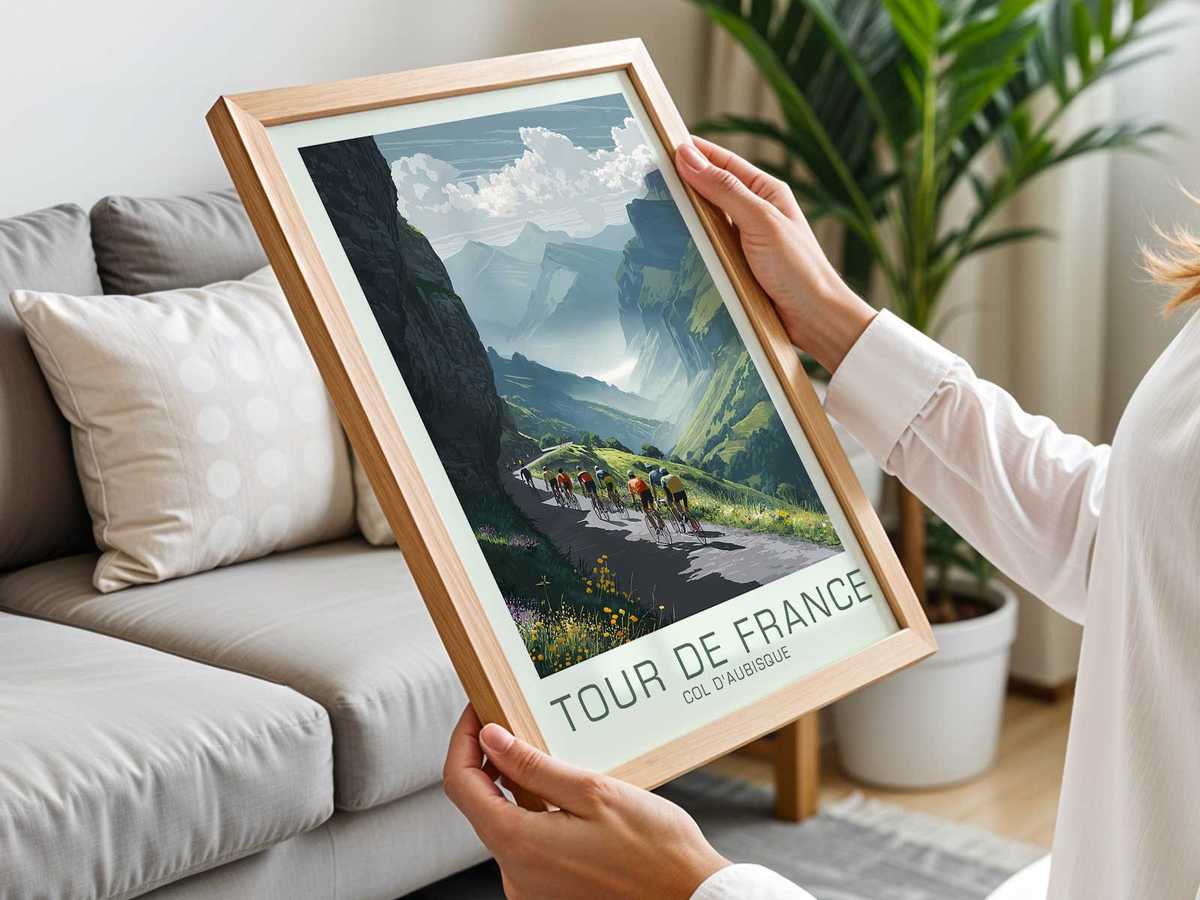
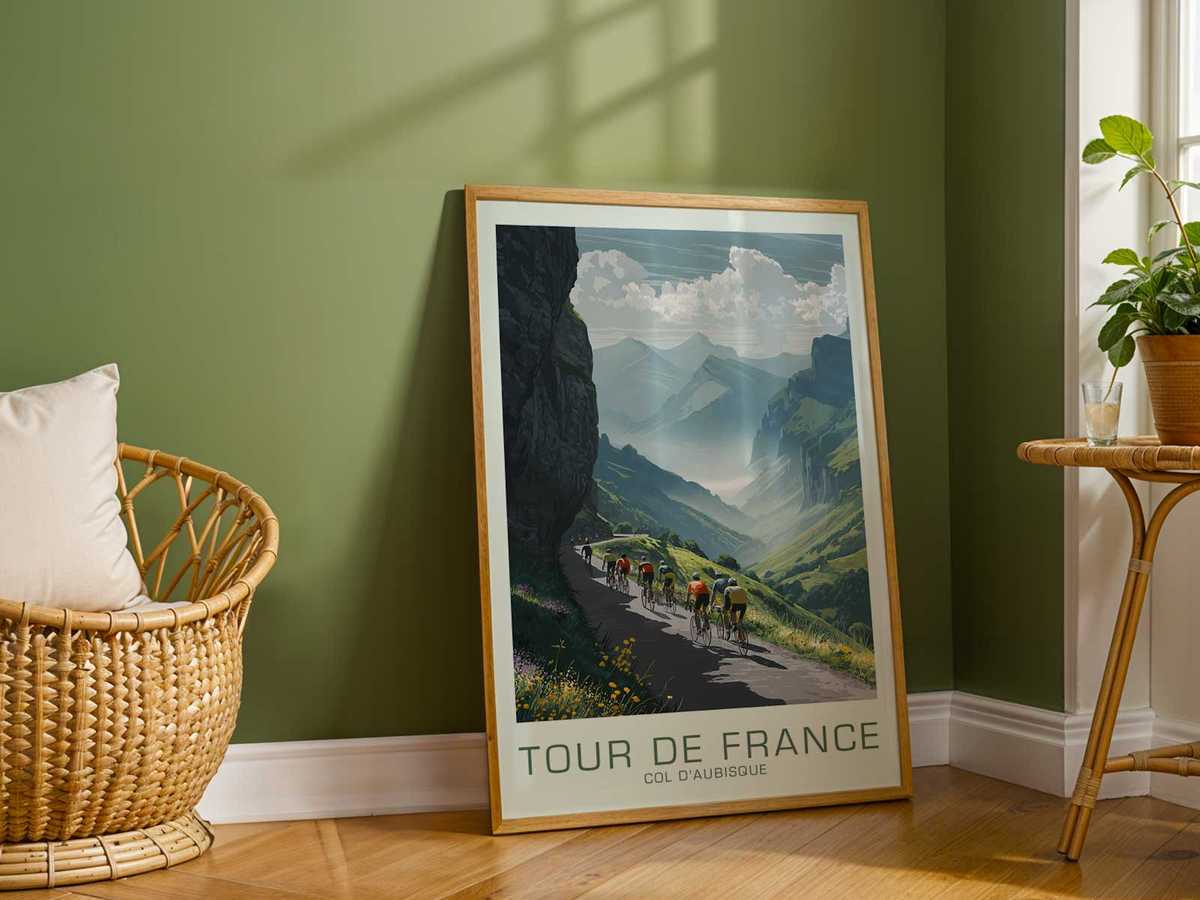
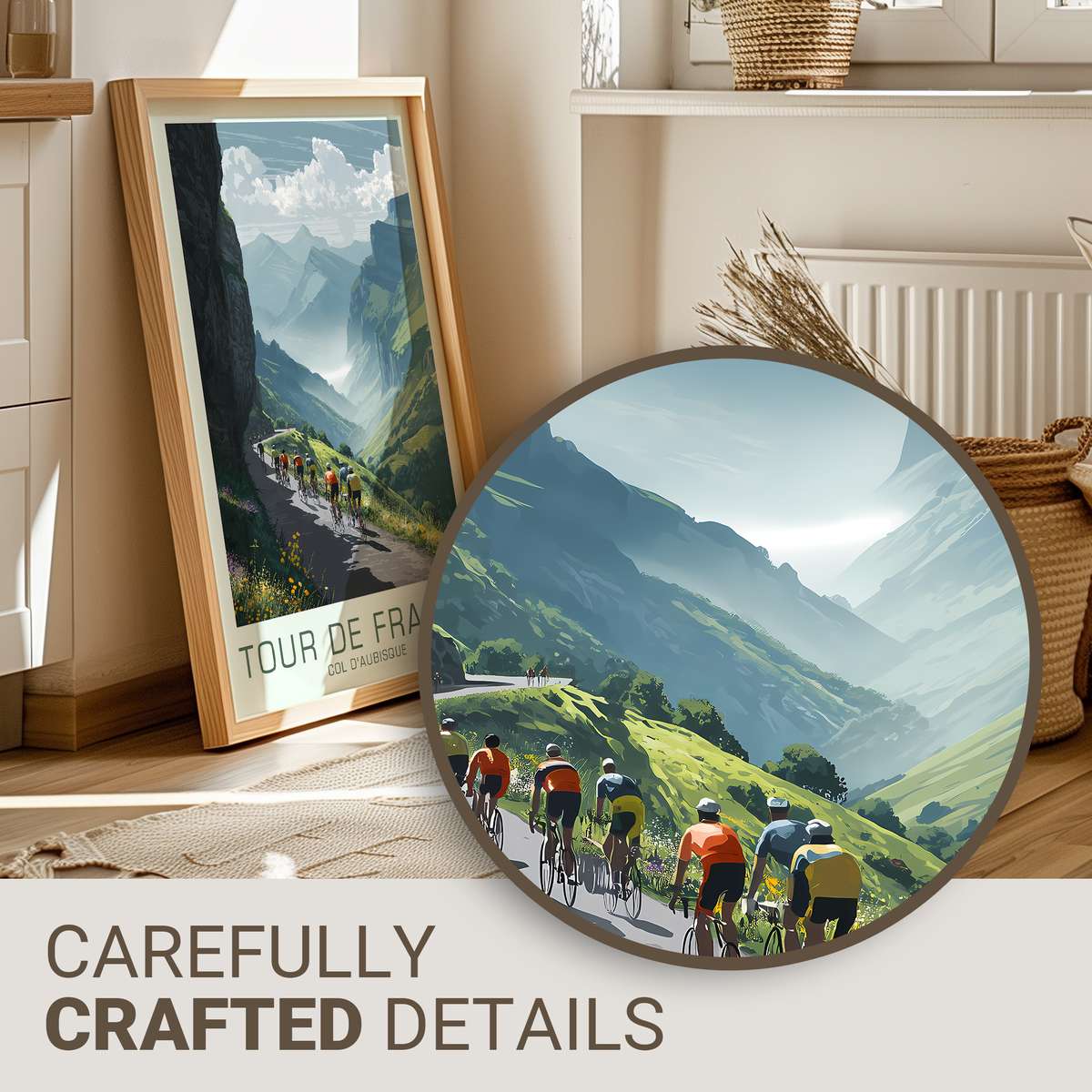
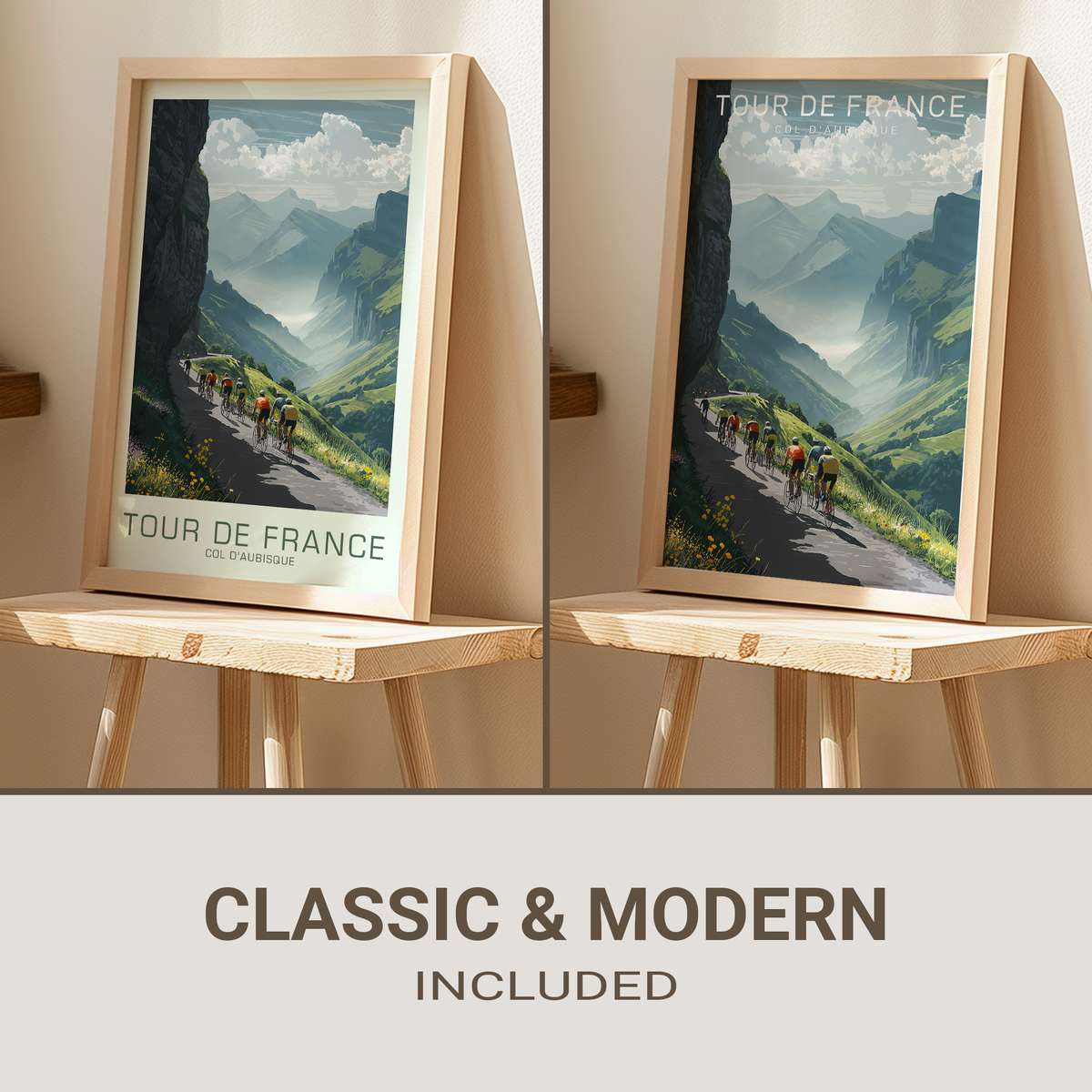
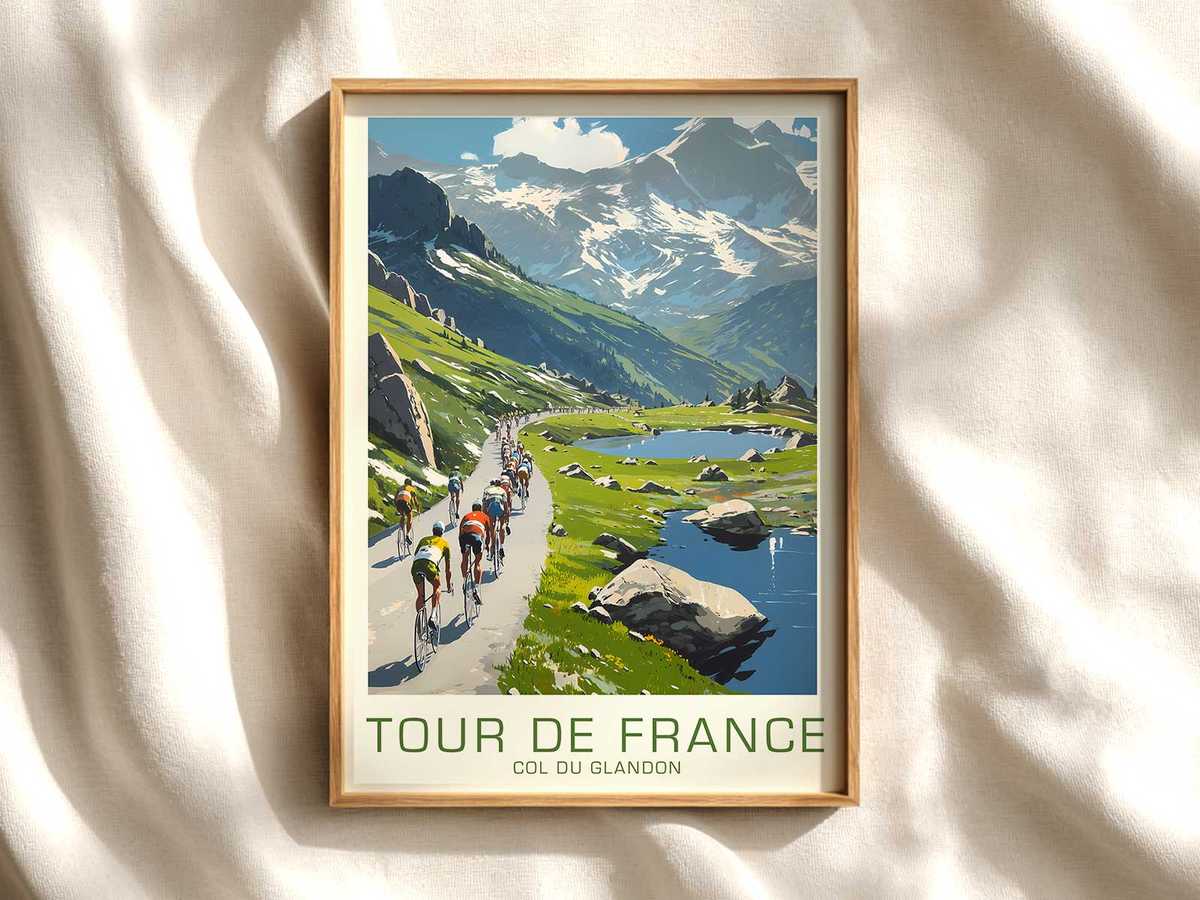
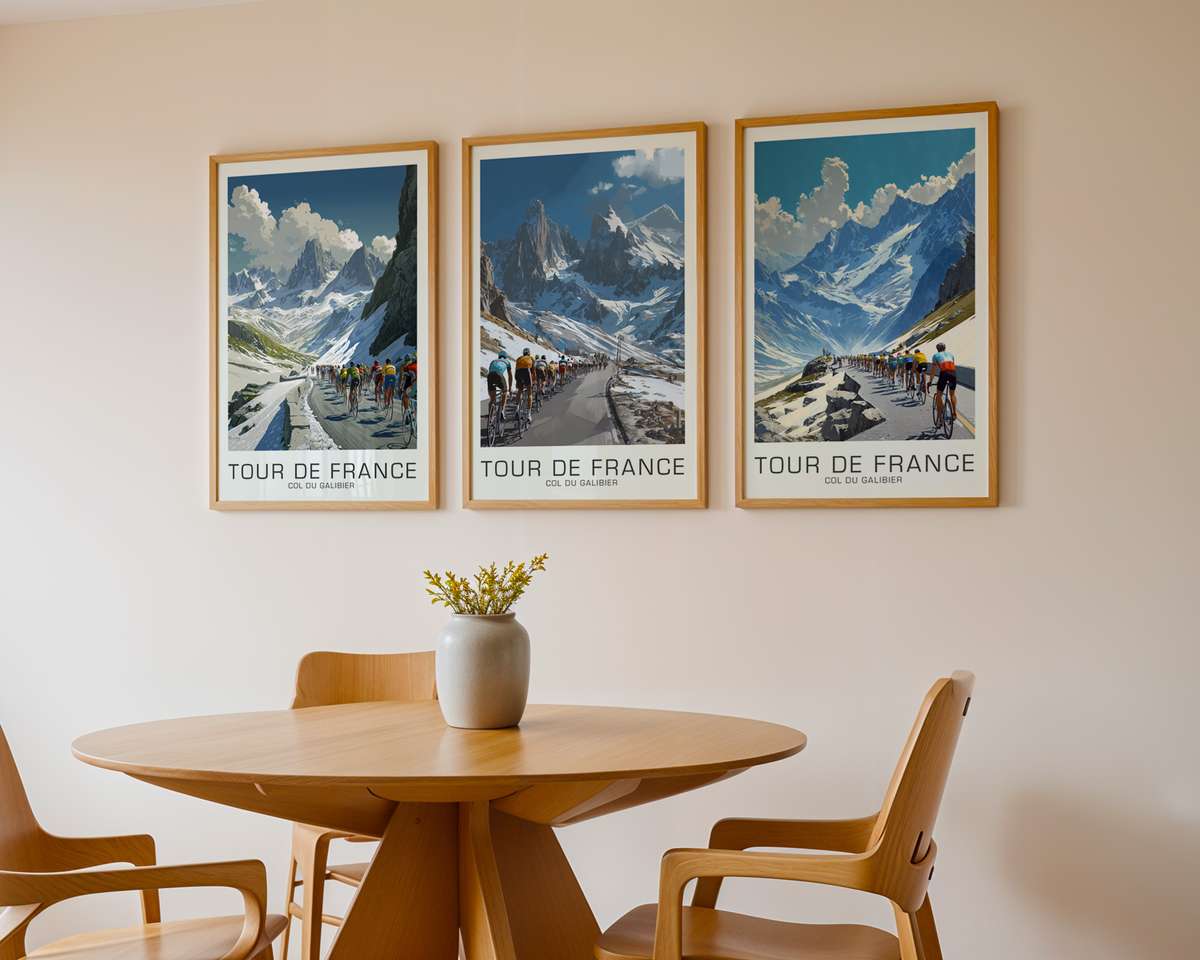
The Col d’Aubisque is more than a name on a route sheet; as a visual subject it is an elemental stage of suffering and spectacle. A well-composed bike race poster of the pass translates that lived drama into graphic terms: the ribbon of road climbing a bare shoulder of mountain, the measured tilt of the slope, and the hard light that sculpts rock and riders into a single, cinematic gesture. These are the tools that let a still image conjure a full ascent.
Look first at the road. In mountain-stage imagery the road is the narrative spine: a narrowing band that organizes distance, direction and difficulty. On a Col d’Aubisque poster the curve of the tarmac and the succession of switchbacks give the composition momentum. Even without a rider, the incline is legible—guardrails, terraces and the foreshortened repetition of turns tell us how the climb compresses time. When a cyclist is present, their posture—torso low, cadence fixed—becomes an index of prolonged effort. The road’s texture and gradient do the heavy lifting: they promise pain, reveal endurance and make the scene readable from across a room.
Landscape and altitude supply the emotional scale. The Aubisque’s skeletal ridges, scattered boulders and distant valley floors create layers that push the eye outward and upward. A poster that emphasizes the mountain’s verticality—an angle that lets steep faces meet a wide sky—makes the ascent feel monumental rather than merely athletic. Villages or pass buildings, small and almost toy-like in the frame, serve as human counterpoints to the massif; they anchor the image in lived geography and remind the viewer that the Tour temporarily turns remote places into stages of public attention.
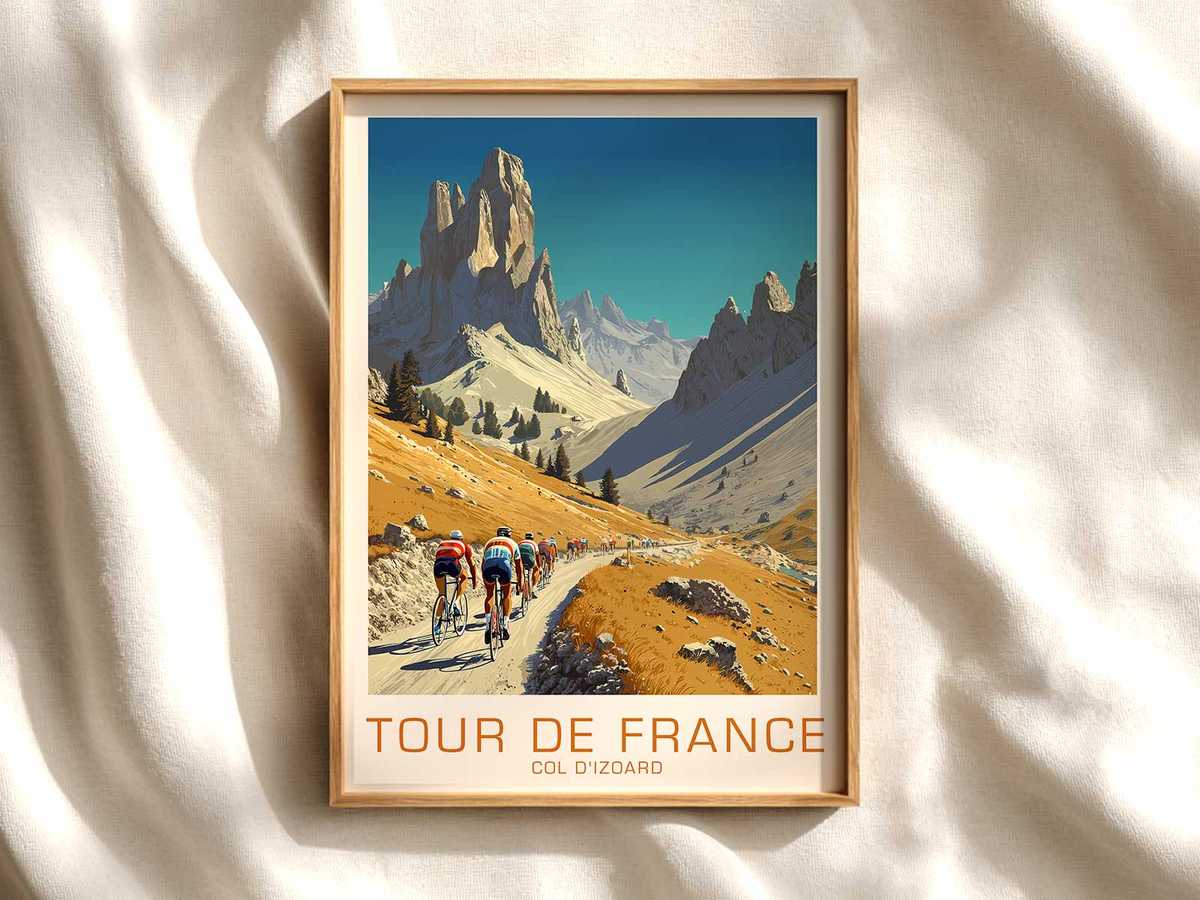
Light is the mood-maker. At mid-morning the sun tilts across the slope and highlights the knuckles of rock and the sheen of asphalt; late-afternoon light brings long shadows that dramatize every contour. A restrained palette—cool greys of stone, the warm ochres of scrub, the pale blue of high air—lets color work as atmosphere rather than spectacle. When dust or mist laces the upper reaches, the climb acquires a heroic, almost mythic hush: the summit is imagined before it is seen. That sense of altitude is what separates a travel postcard from a poster that feels like an epic scene frozen at its emotional peak.
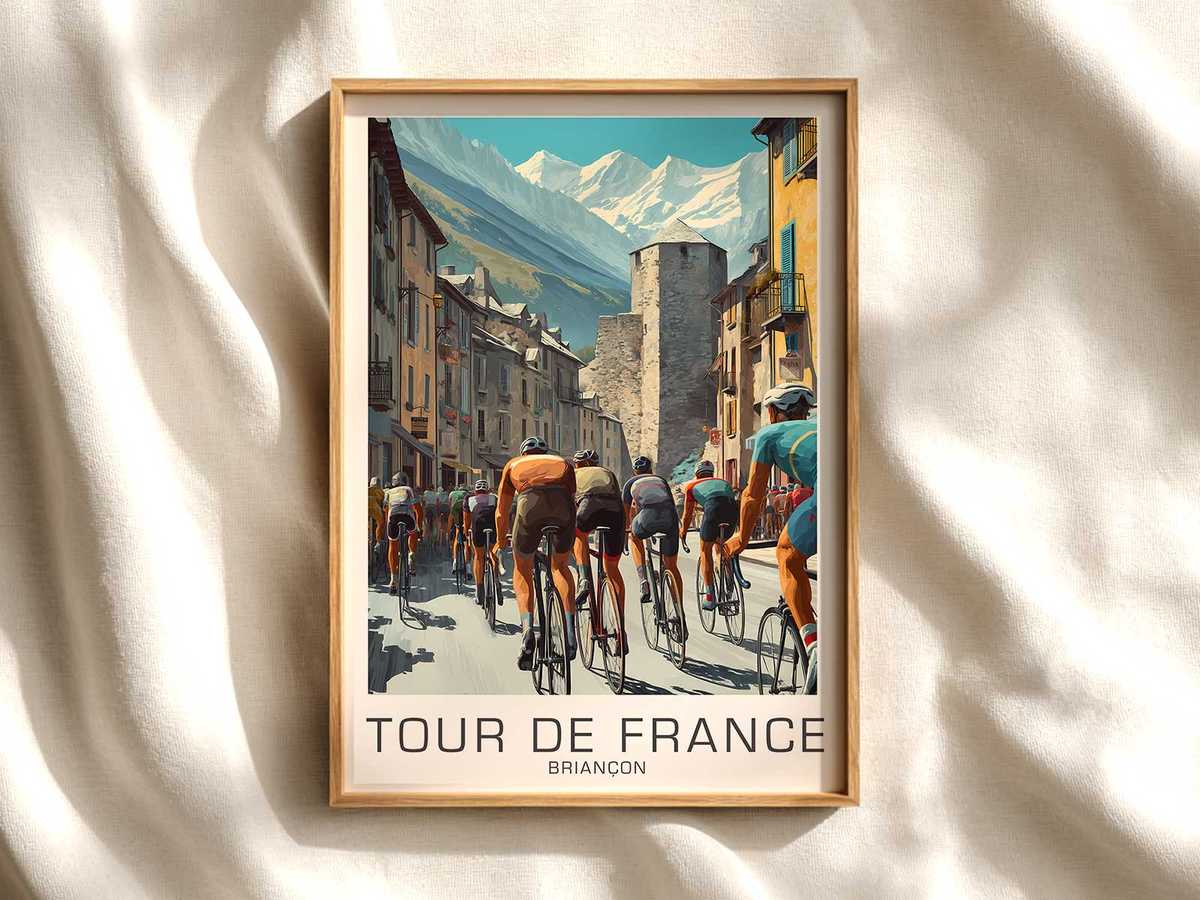
Roadside crowds and village textures give stage imagery its human scale and theatricality. A scattering of spectators leaning over stone walls, a cluster beneath a sparse plane tree, bunting that flutters and frames a corner—these details remind us the passage is communal. They supply the social temperature of the race without overwhelming the central act: a lone rider or a small group negotiating gradient after gradient. In framed form, those spectator accents read as choreography: small gestures that heighten the primary performance of ascent.
[IMAGE_INSERT_ARTICLE_01]
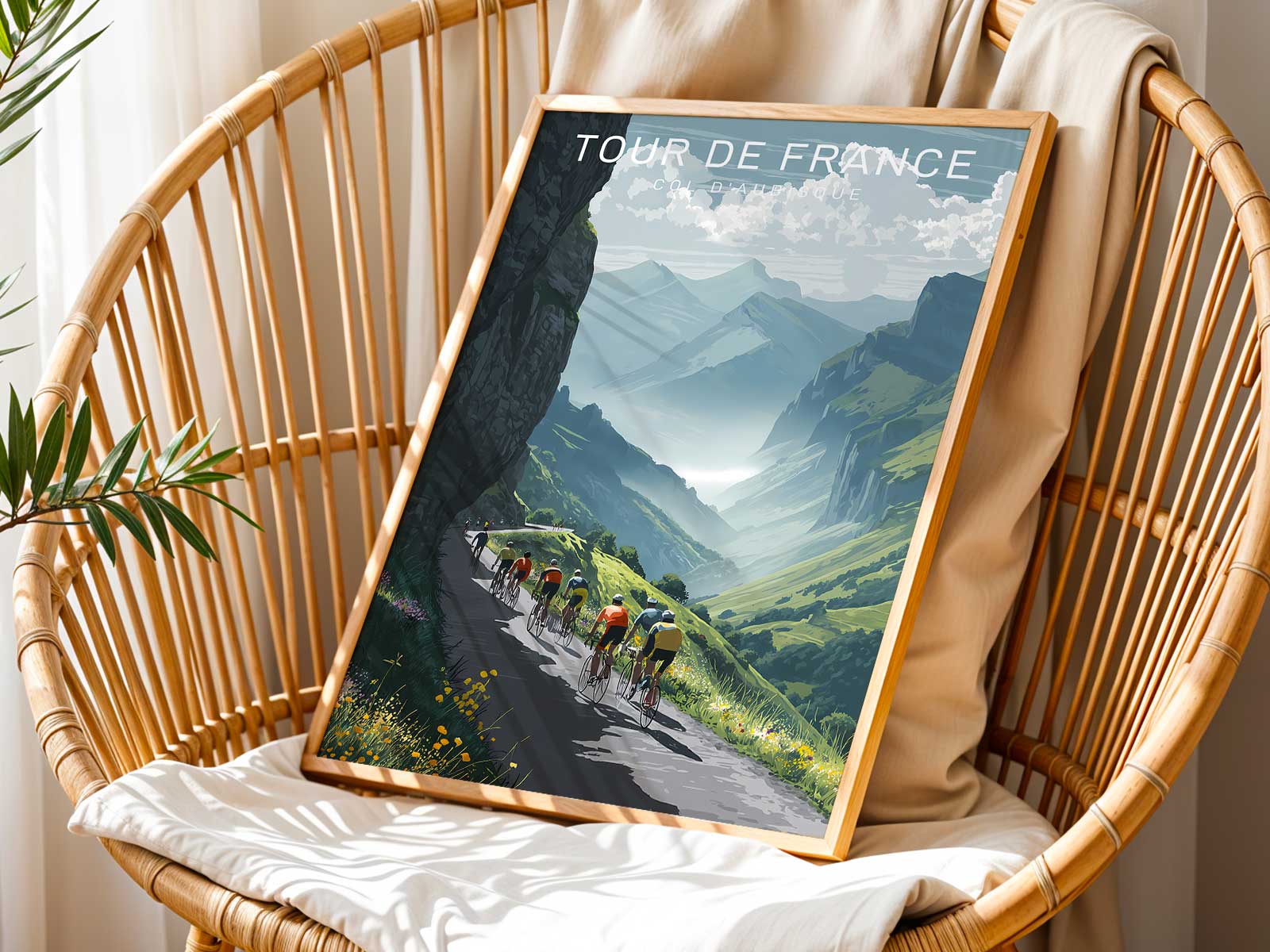
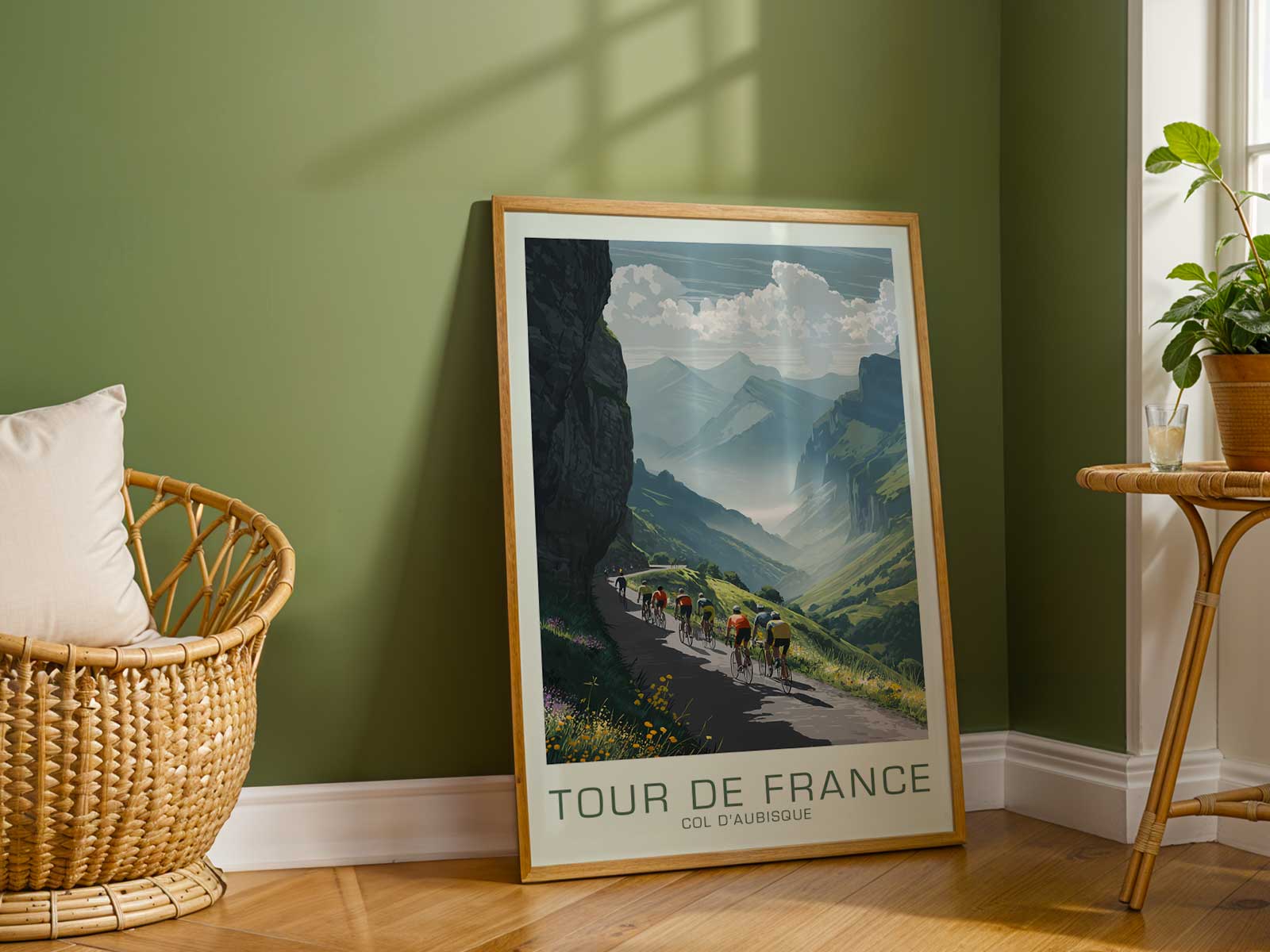
Why does such an image work as wall art? Because it supplies a narrative that is both compact and expansive. Visually, the slope and light provide a clear focal journey—your eye travels the climb as a story—while the landscape offers room to breathe. Emotionally, the poster holds two promises: the spectacle of effort and the calm of place. Hang it in a study or living space and the piece does not shout; it invites the viewer into a moment of concentration and elevation, a quiet reminder of persistence rendered in ridge, road and sky.
The best Col d’Aubisque posters avoid cliché by leaning into specifics: a particular corner angle, a restrained color harmony, the honest grit of mountain tarmac. These elements give the artwork authenticity without claiming archival provenance. They allow collectors and admirers to respond to place—its geology, its light, its tiny human flourishes—rather than to a name or a result. That is why stage-led imagery holds a unique appeal: it celebrates where the effort happens, not only the outcome of the day.
Place, slope and light are the essential instruments of cycling poster storytelling. When they are combined with the human sign of struggle—a bent back, spinning legs, a distant crowd—the image acquires what every great stage has: an atmosphere of epic endeavor and quiet beauty.