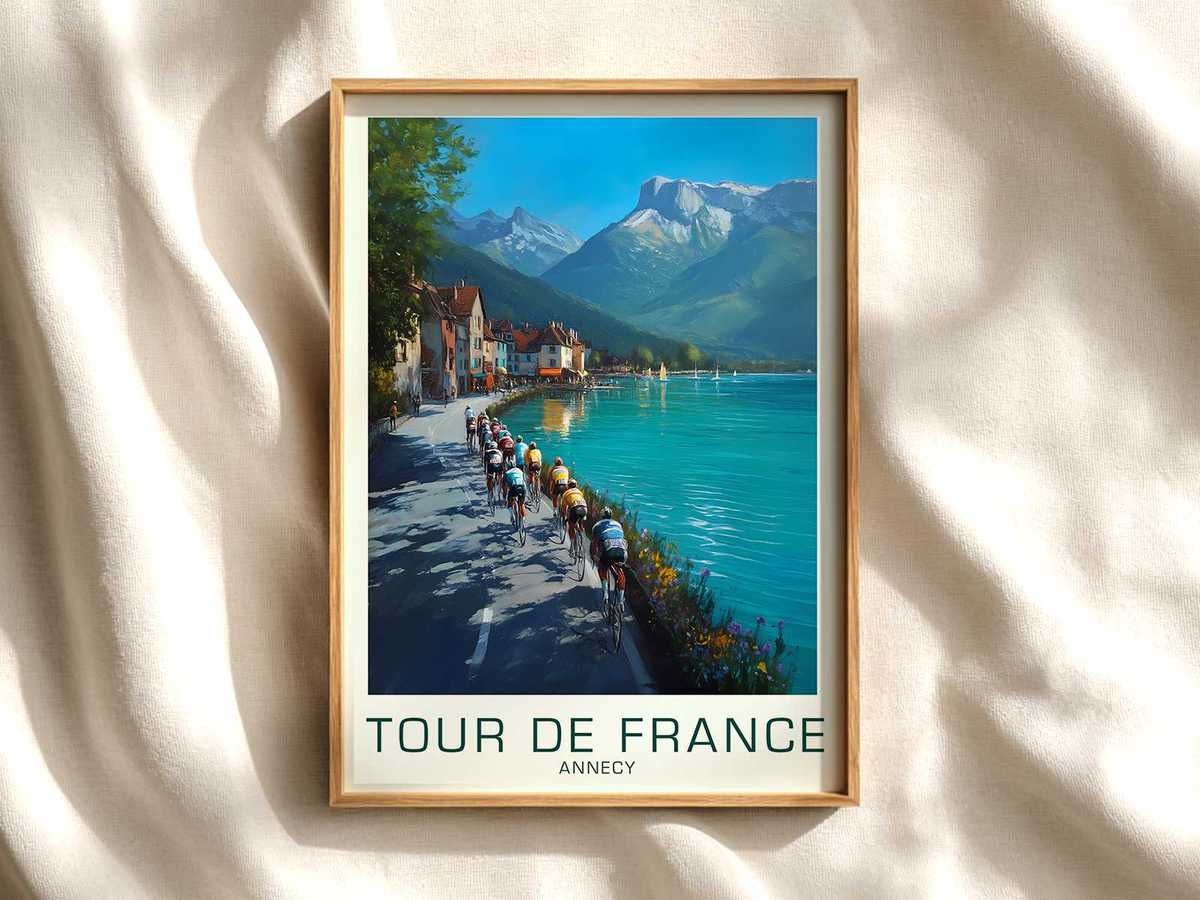
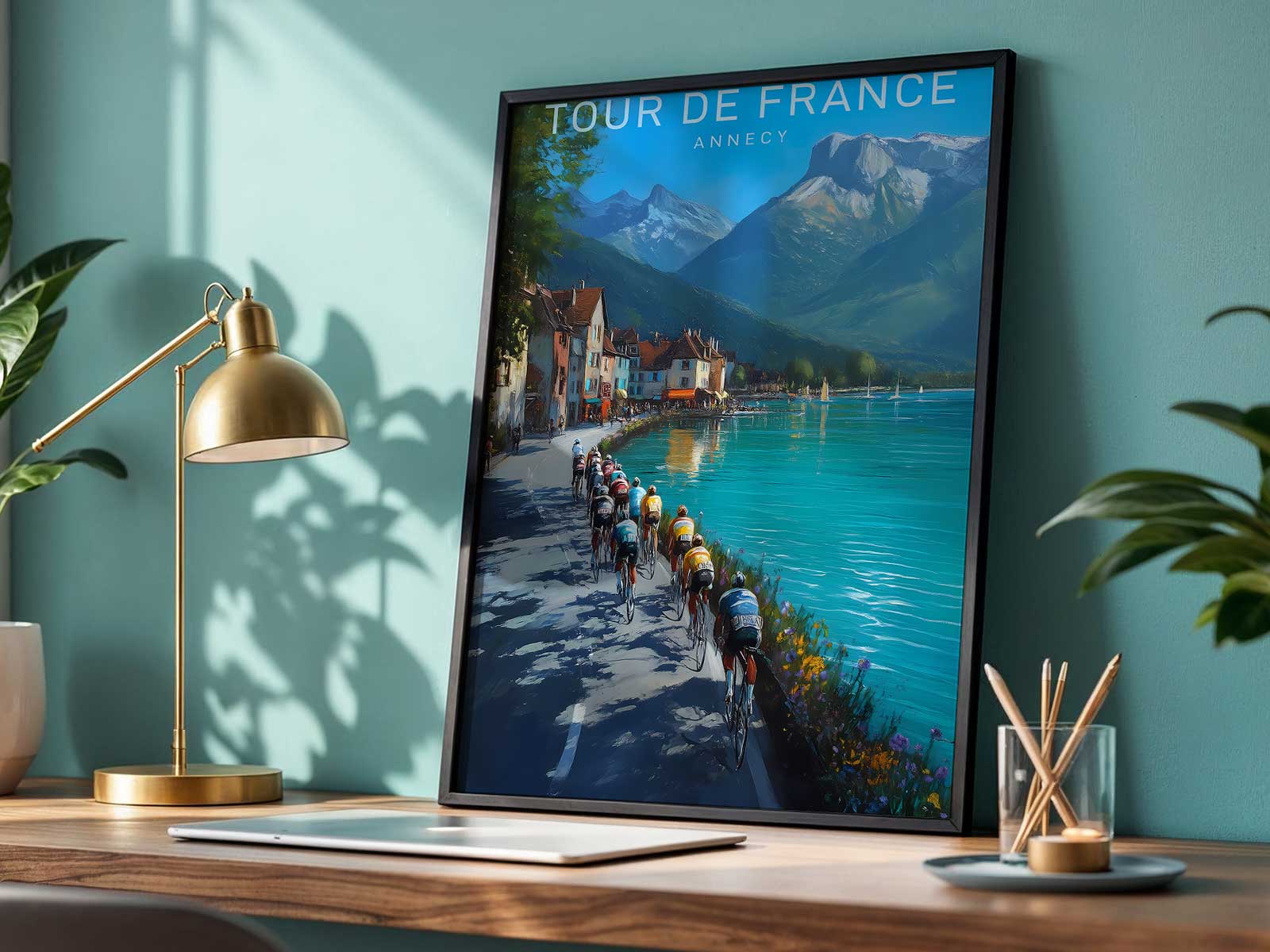
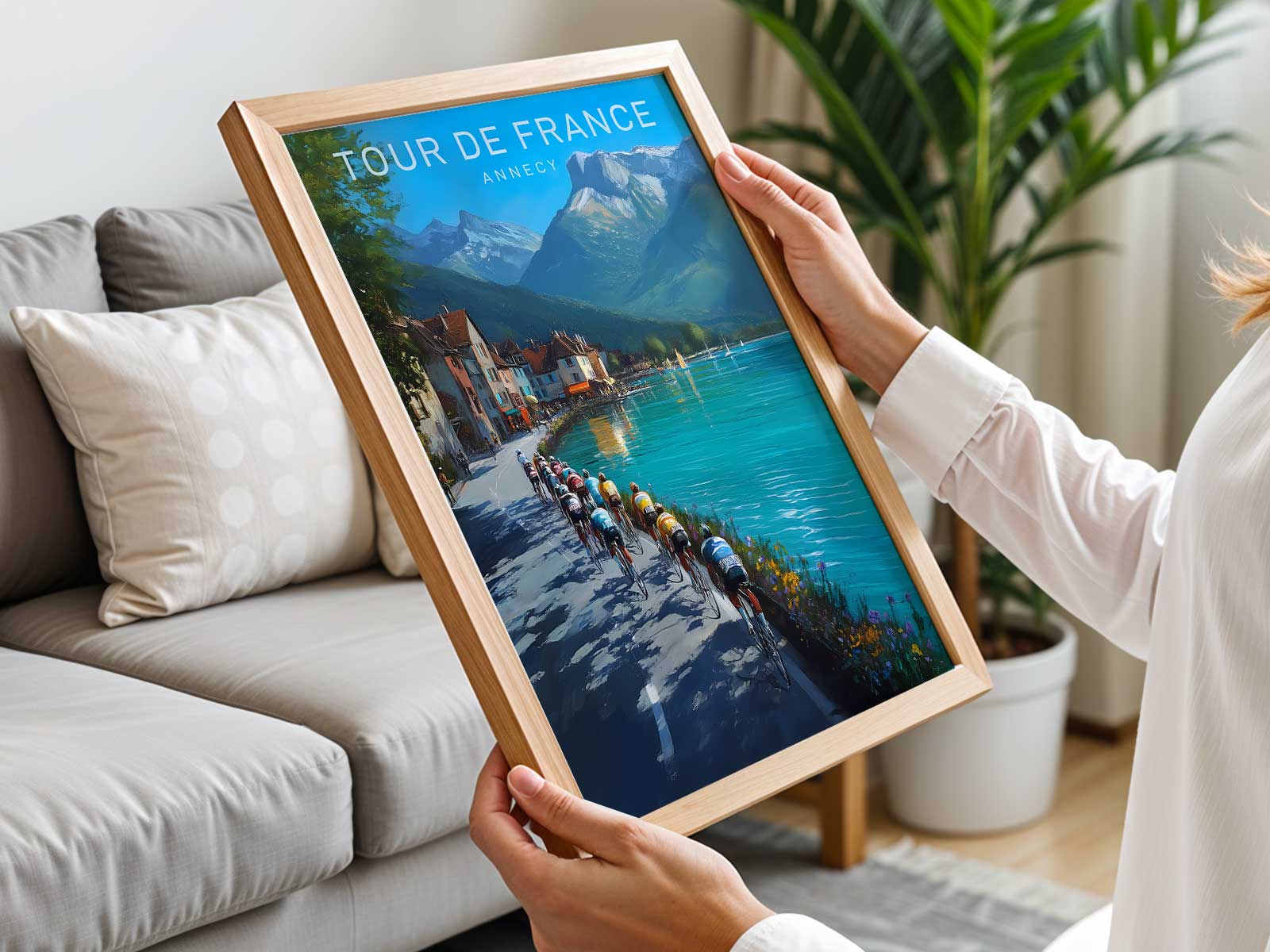
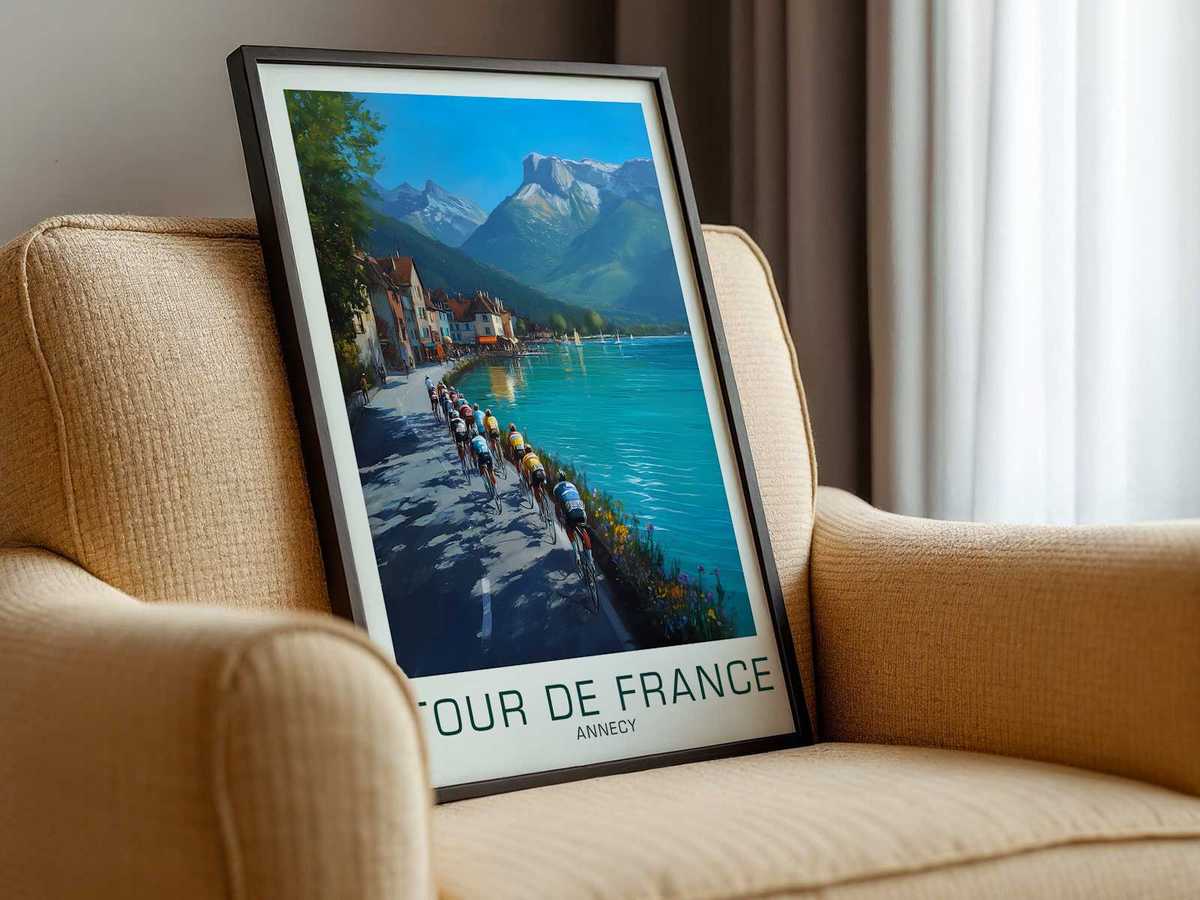
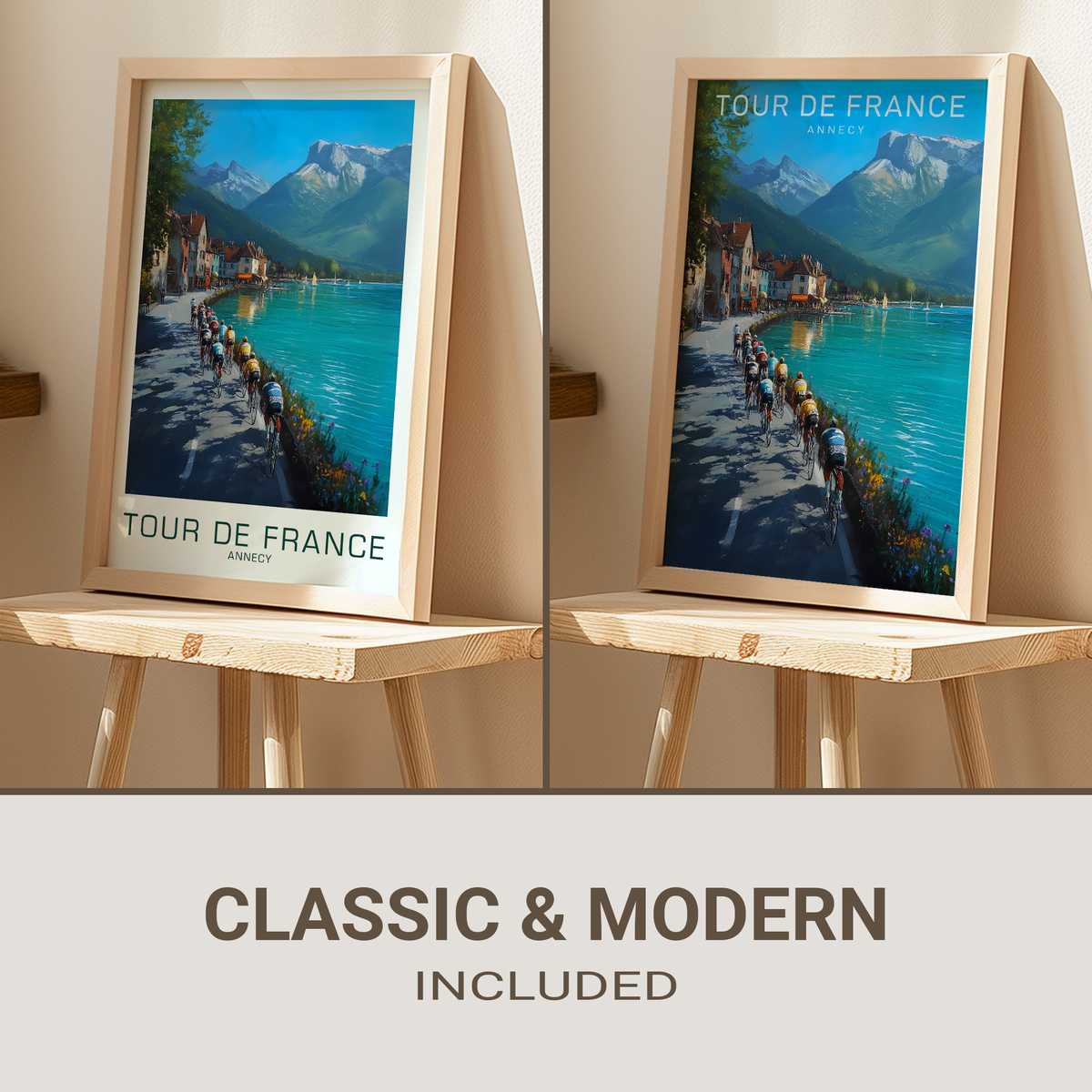
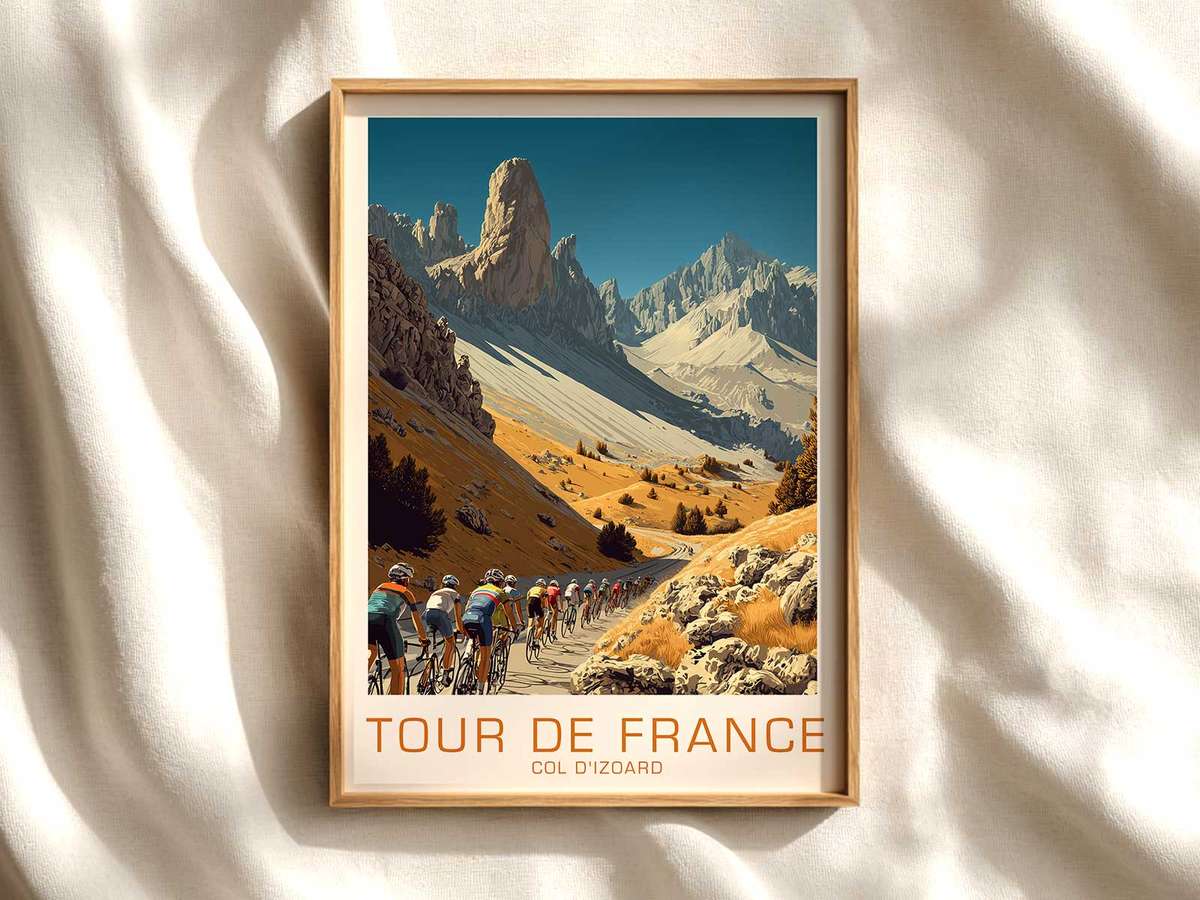
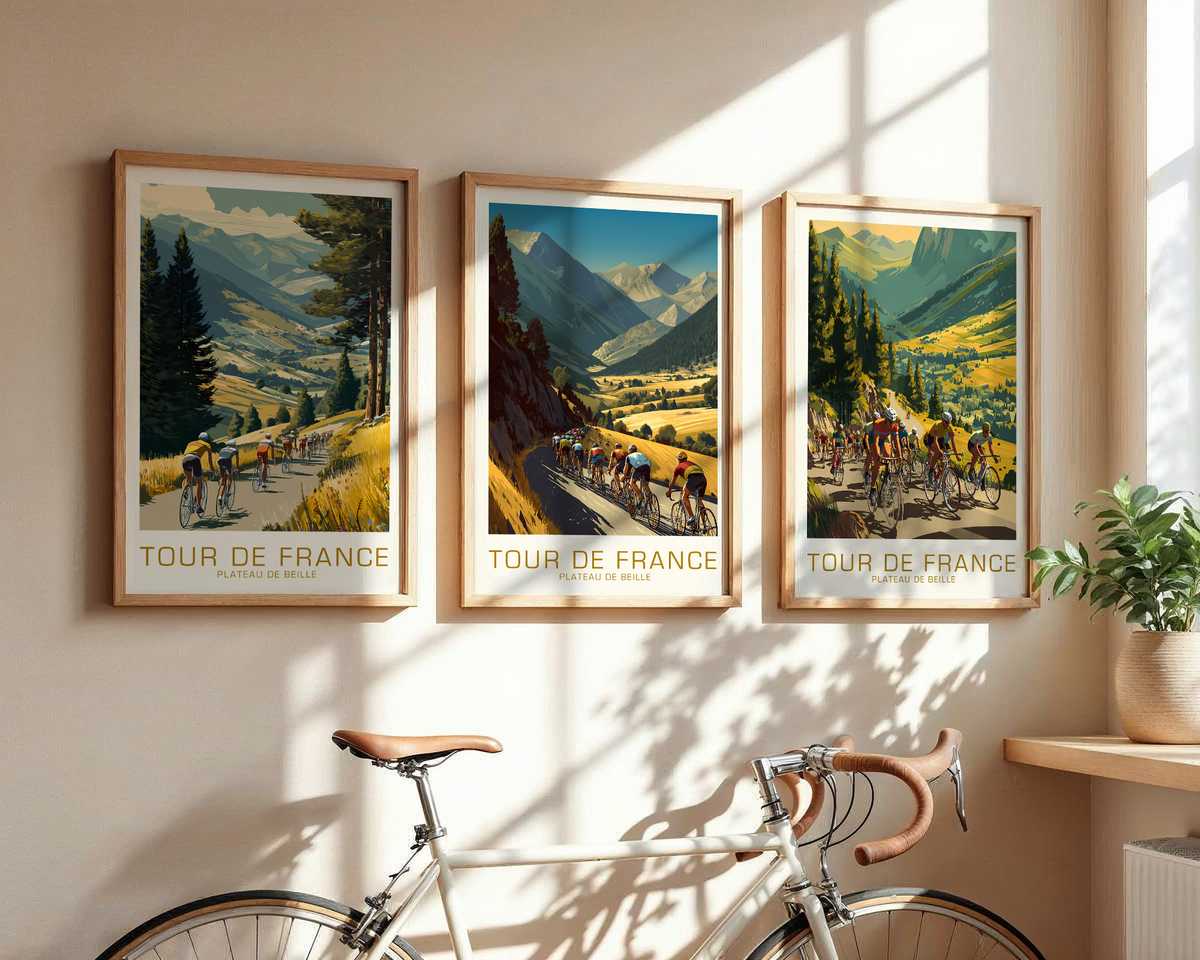
There is a special clarity when a place reads like a stage: the road becomes a storyline, the light defines intent, and the village or mountain slope supplies the emotional punctuation. A poster that treats Annecy as more than a backdrop—one that composes the town’s shoreline, its approach roads and the subtle climbs into a single frame—offers a visual narrative a cycling fan recognises immediately. This is not about results or riders; it is about how landscape and urban grain combine to feel like a race before a wheel turns.
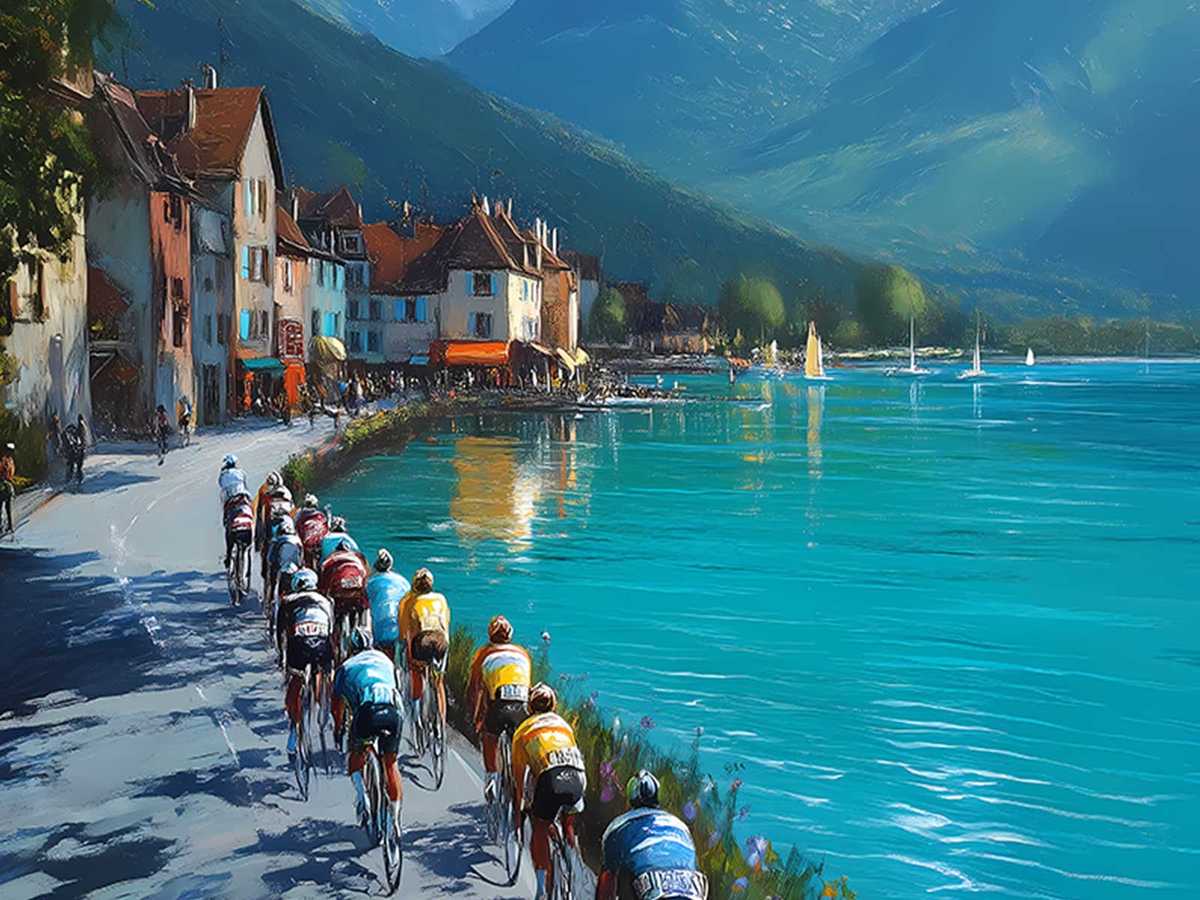
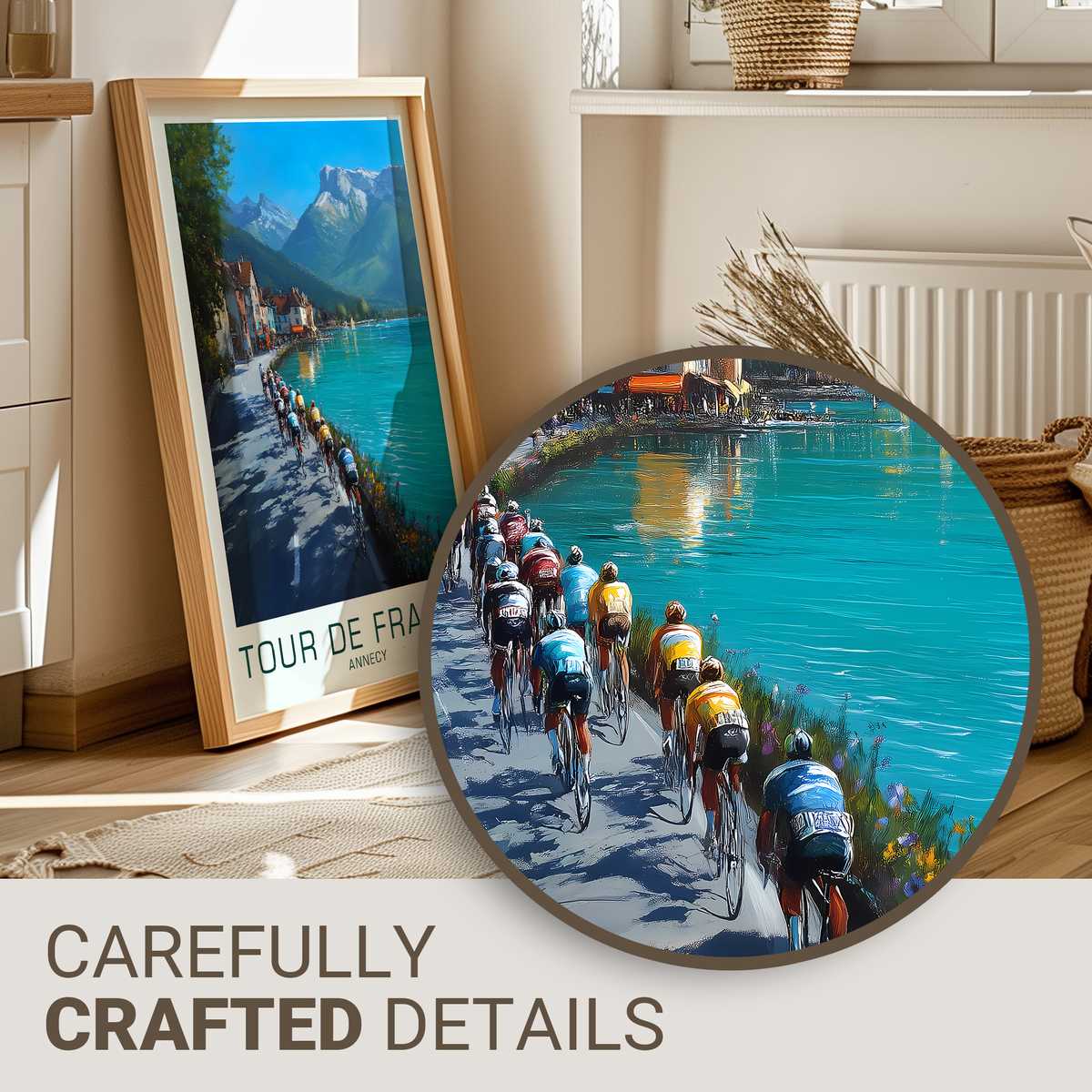
The first impression such an image gives is geomorphic and intimate at once. Narrow riverside boulevards, the gentle sweep of a lakeshore road, and the compact roofs of an alpine town create strong horizontal anchors in the composition. Against them, a steep shoulder of foothills or a nearby pass lifts the eye. That vertical counterpoint—road carved into slope, a string of switchbacks hinted at in the distance—instantly communicates gradient and effort. For a poster, that contrast between placid water and implied ascent becomes a visual shorthand for stage drama.
Light matters as much as line. Morning or late-afternoon sun along the lake throws long shadows from bell towers and chestnut trees, softening the hard geometry of asphalt. In print, this measured light translates into tonal layers: warm reflections on water, cool slate of shaded facades, and the bright, reflective ribbon of the road where a peloton would glide. Such tonal restraint is why an Annecy-focused piece reads well on a living-room wall—its palette feels considered, the drama simmering rather than shouting.
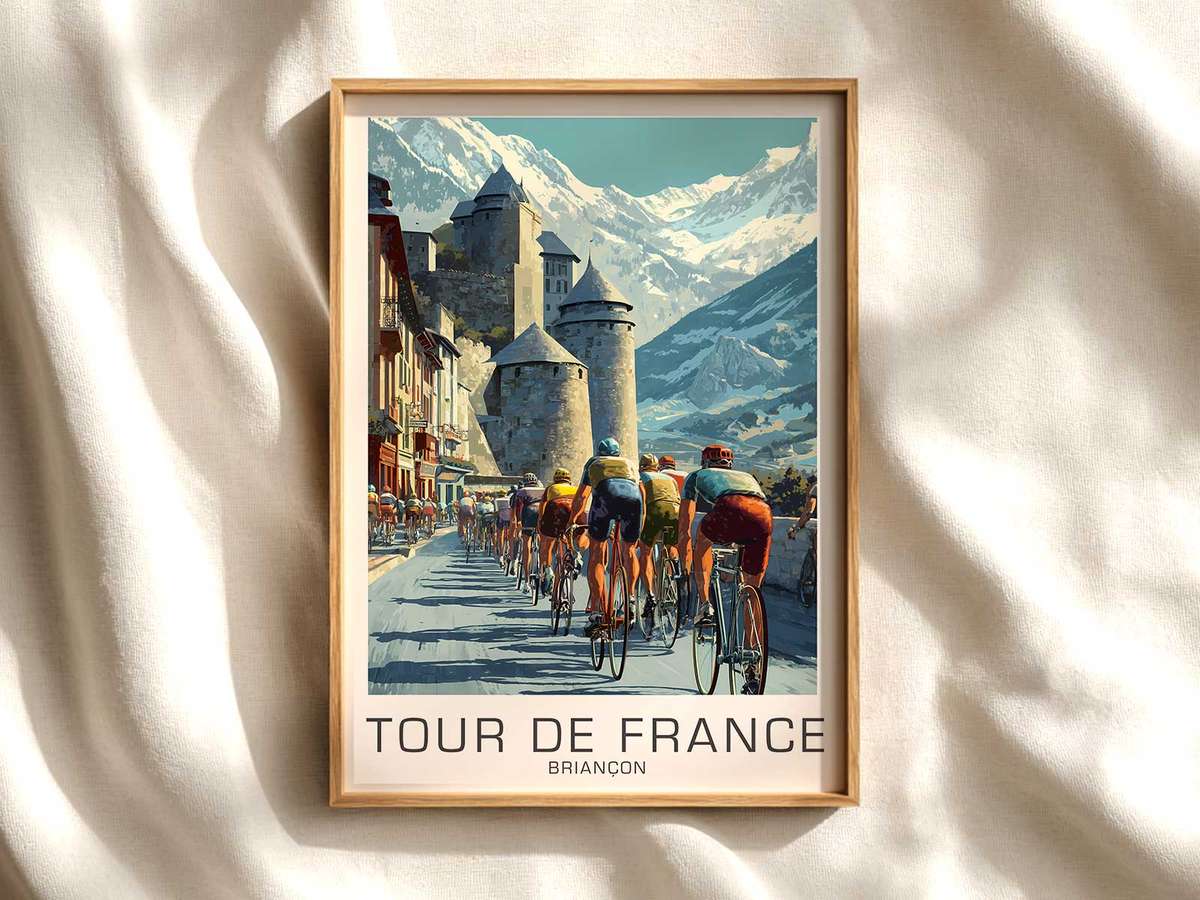
The urban texture of small towns near Annecy gives the artwork immediate legibility for the cycling eye. Cobbled corners, narrow alleys opening to market squares, and stone houses with laundry lines suggest human scale and spectator presence. Even when the image contains no crowds, those details imply a raceable place: the logical corner to attack from, the place where the road narrows and the rhythm changes. That implied choreography of riders and roads is what turns a scenic print into a stage portrait.
[IMAGE_INSERT_ARTICLE_01]
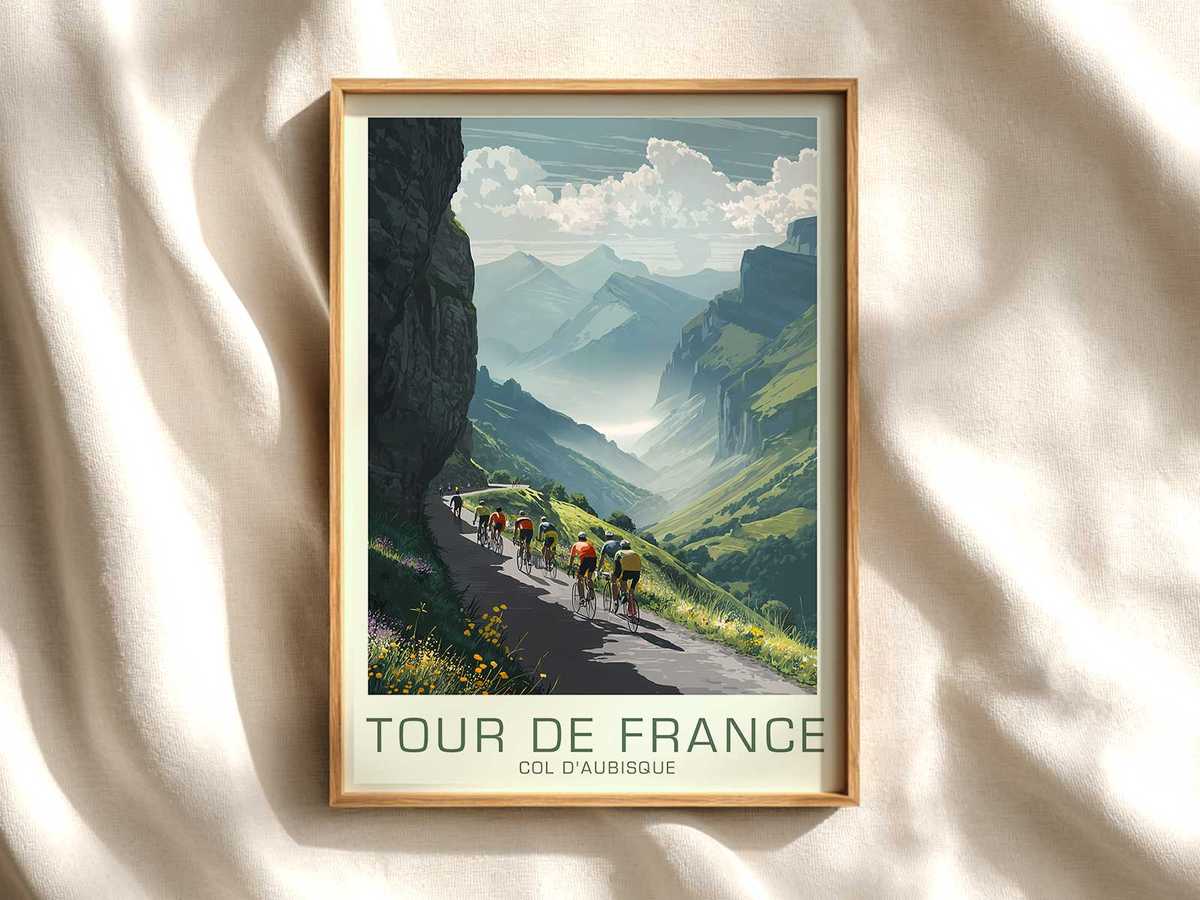
Road geometry—the subtle camber, roadside stone walls, and sequence of bends—functions as the poster’s vocabulary. A single ascending line becomes a gesture of endurance; a crouched bike silhouette parked against a retaining wall becomes an emblem of solitary effort. Because the viewer recognises these cues, the image carries the memory of many races without referencing a specific edition. The scene reads as familiar: you understand the grade, the likely speed, the wind direction, the spectator vantage point, and the kind of fight the road demands.
Atmosphere is partly temporal. A quiet pre-race morning, with cafés closed and terraces empty, produces a contemplative mood—ideal for places meant to calm a study or living room. Conversely, a late-afternoon shot with flags and clustered figures vibrates with expectancy; the same street becomes theatre. A good Annecy poster lets you choose the mood: contemplative heritage or taut anticipation—both are credible because the place itself accommodates them.
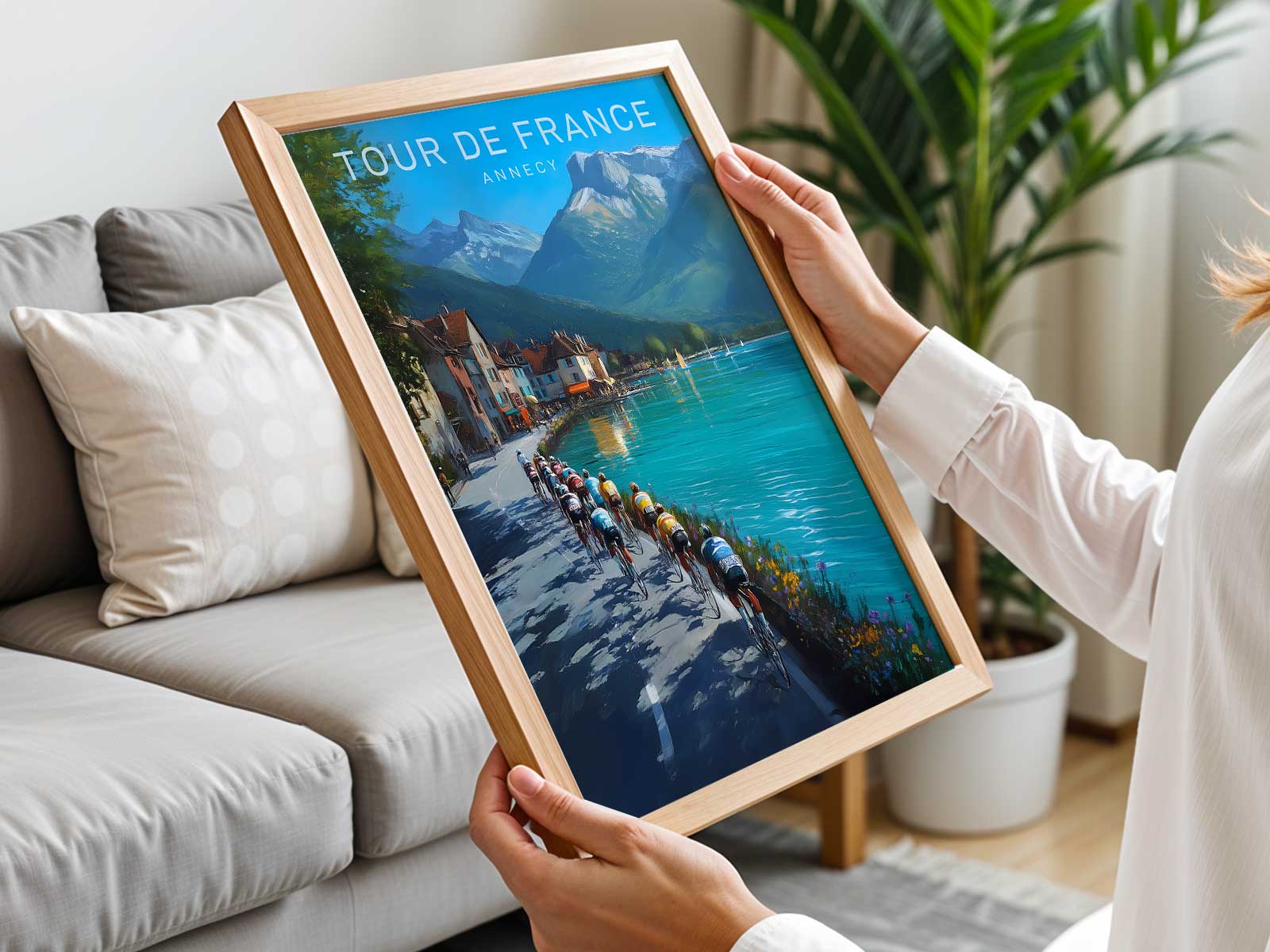
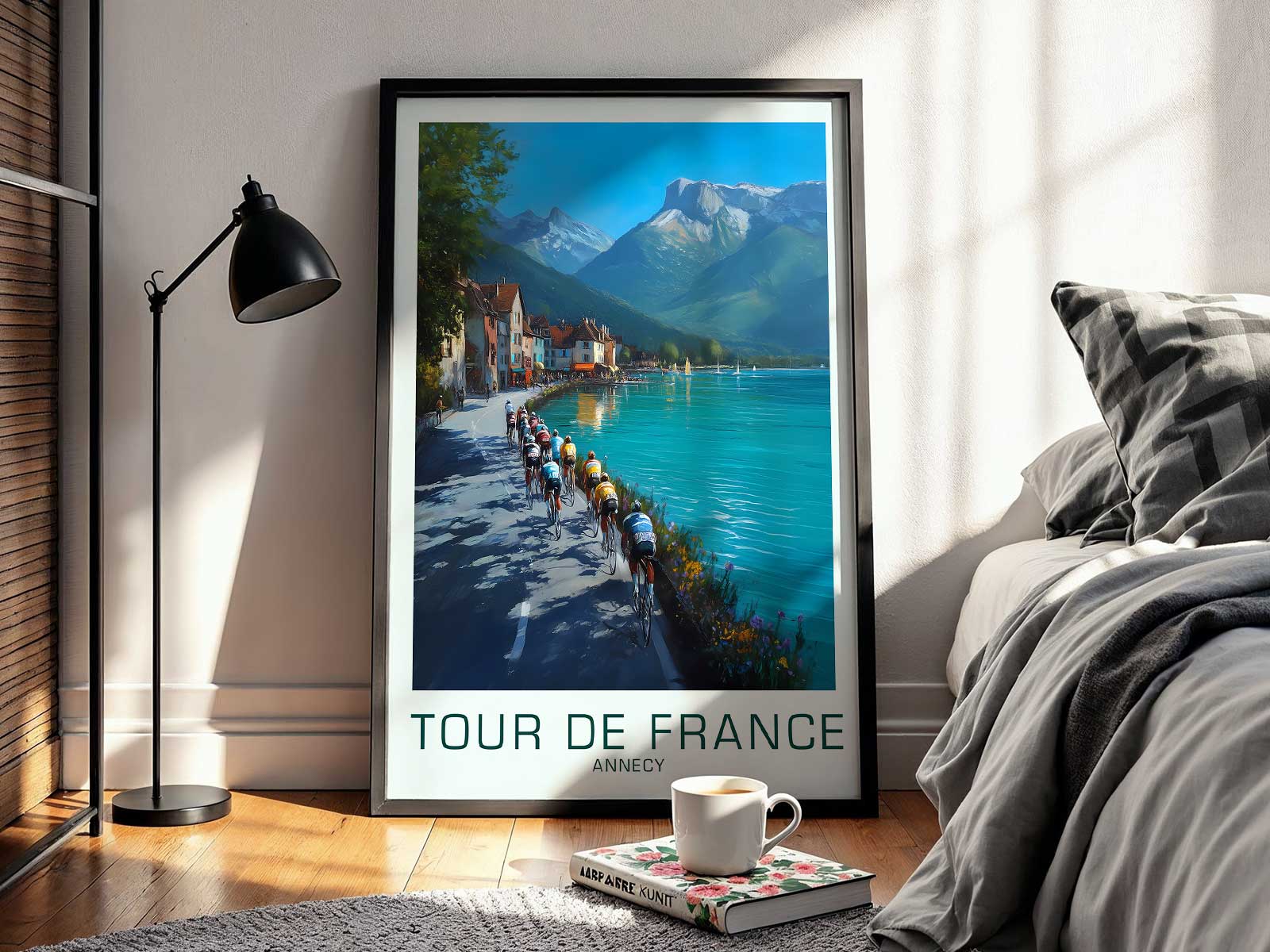
Finally, the reason stage-led images work so well as decor is their ability to anchor memory and projection. They are decentered sports images: the place does the storytelling and the viewer supplies the action. On a wall, that invites conversation, recollection, and daydreaming—whether you recall a ride along a lakeside road, imagine a climb that begins in a market square, or simply appreciate the compositional purity of road, water, and mountain. The artwork becomes a place to return to, turning a room into a small landscape of endurance and light rather than a mere sports poster.
Purchase decisions for cycling wall art are best guided by this scenographic reading: choose the print that captures the road you want to remember or the mood you want to live with. In Annecy’s case, the reward is a piece that feels lived-in and raced-in at once—an image where urban texture, route geometry, and lake-lit atmosphere fuse into a single readable stage.