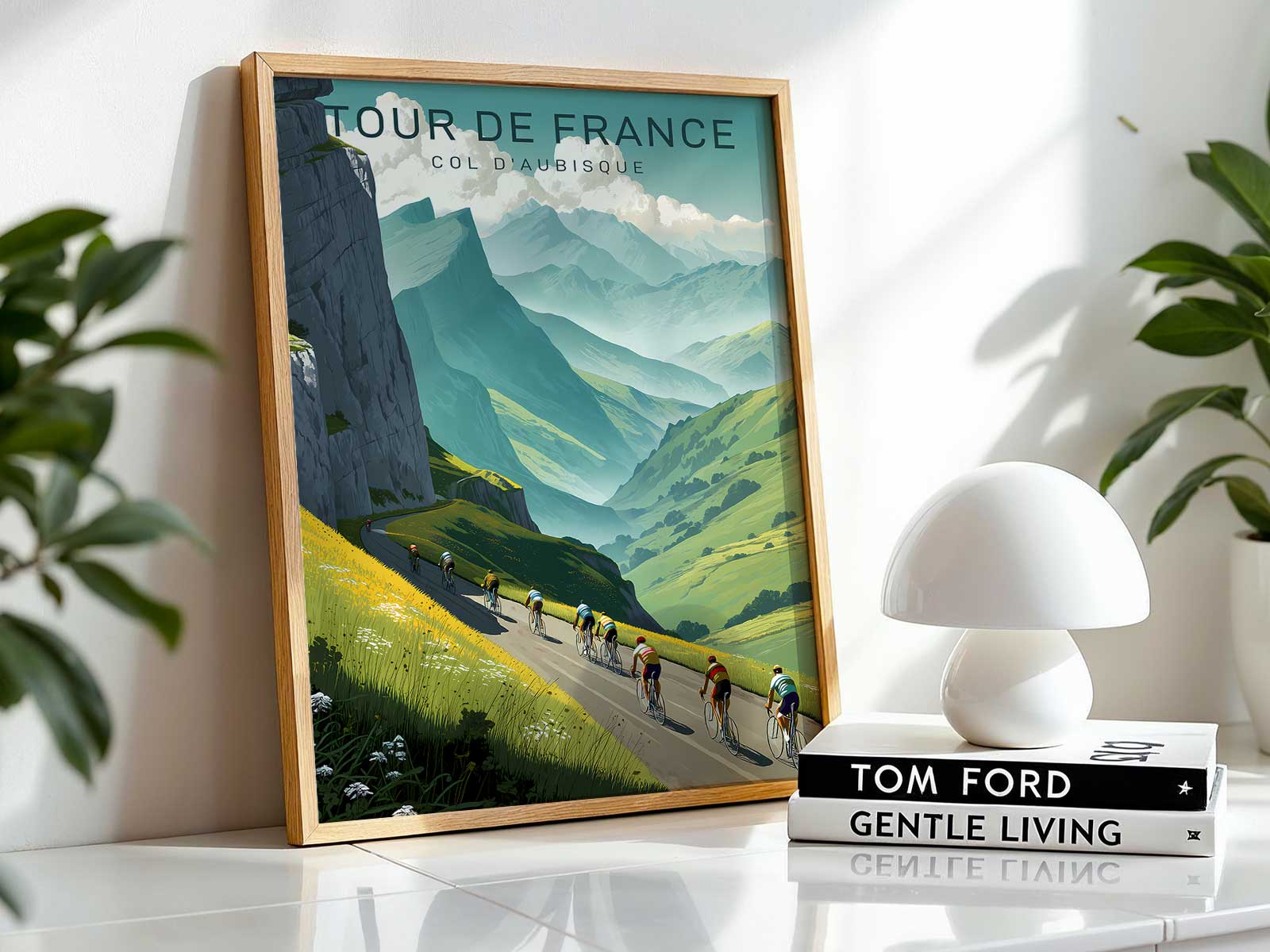
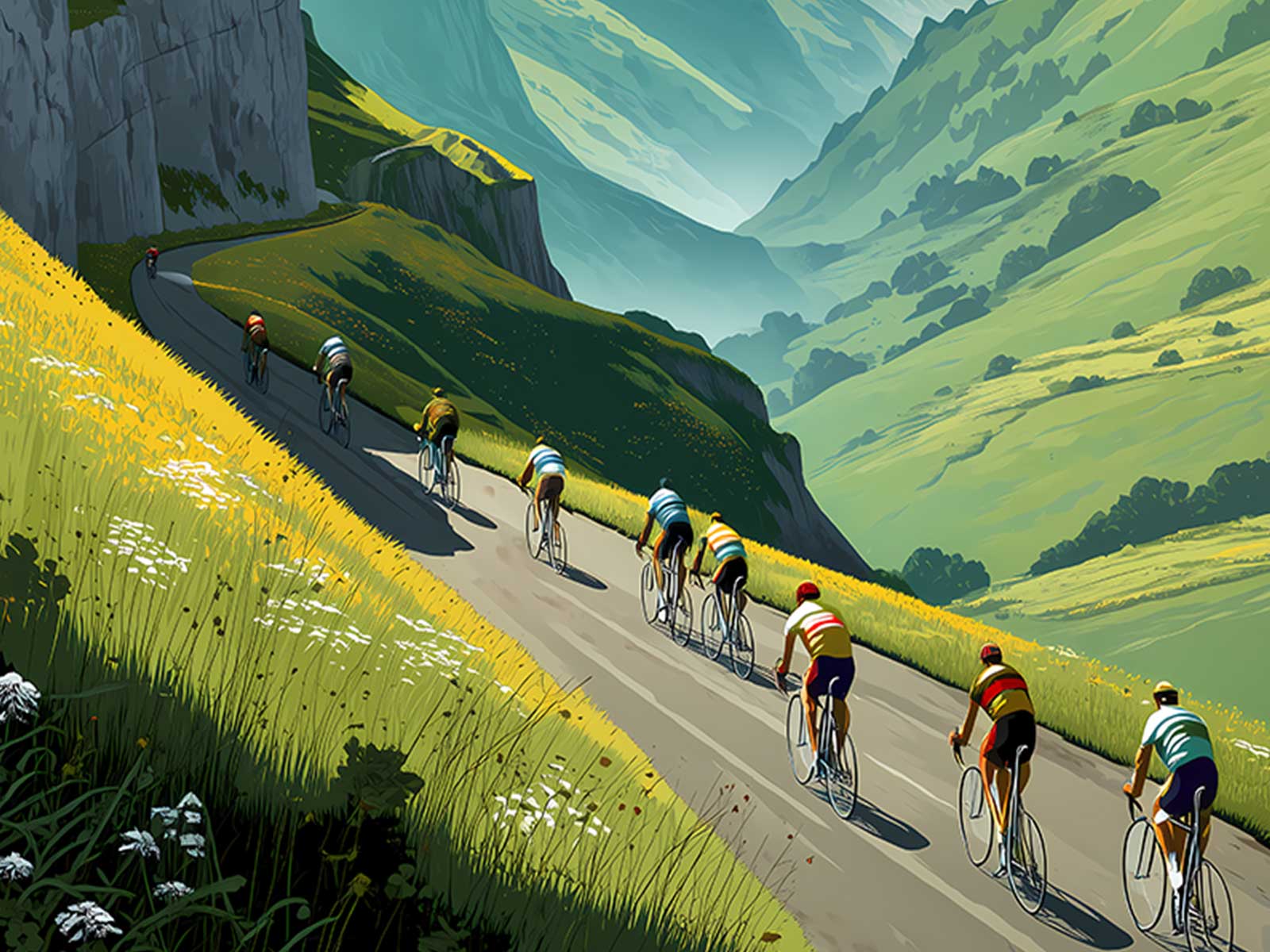
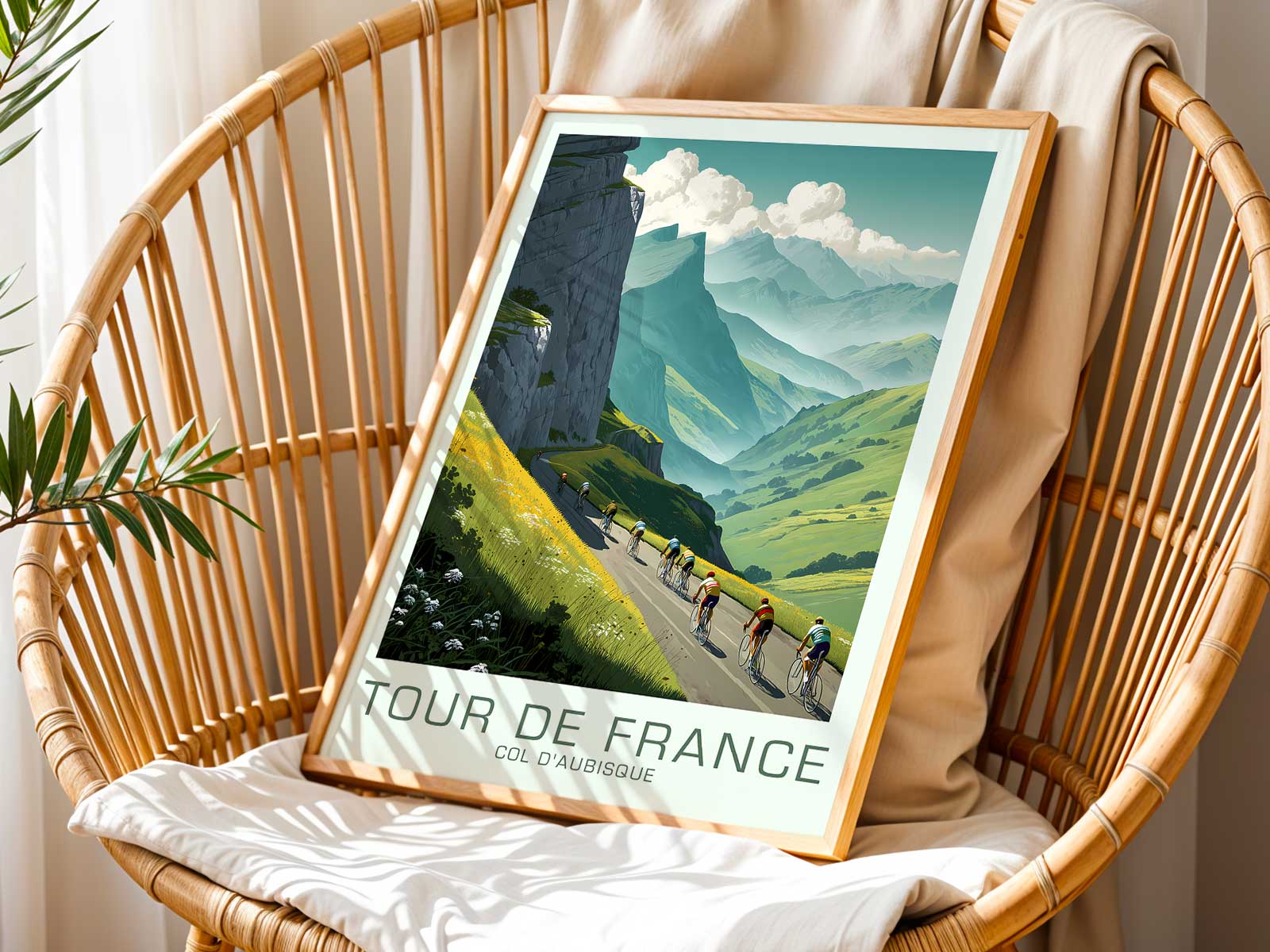
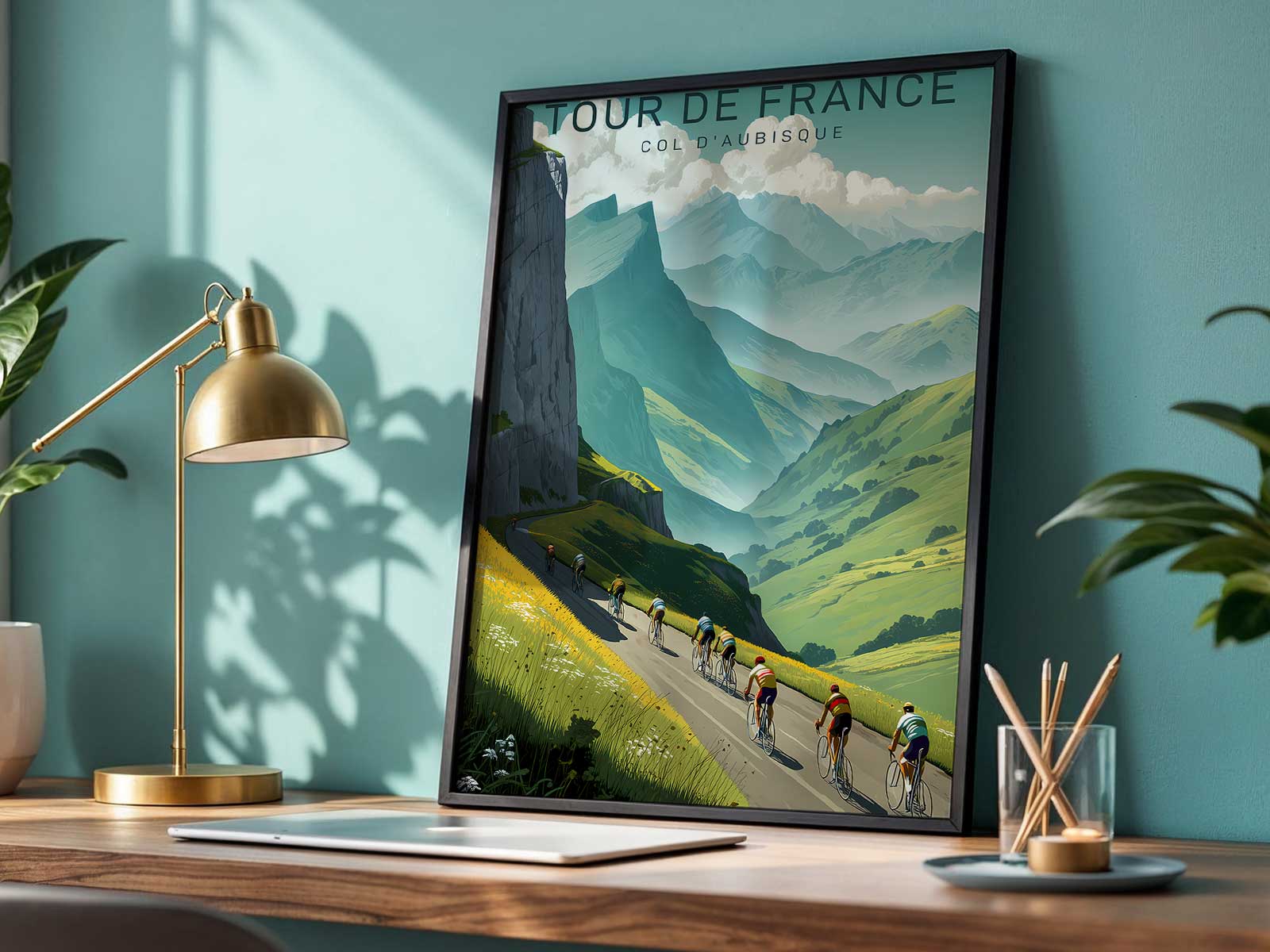
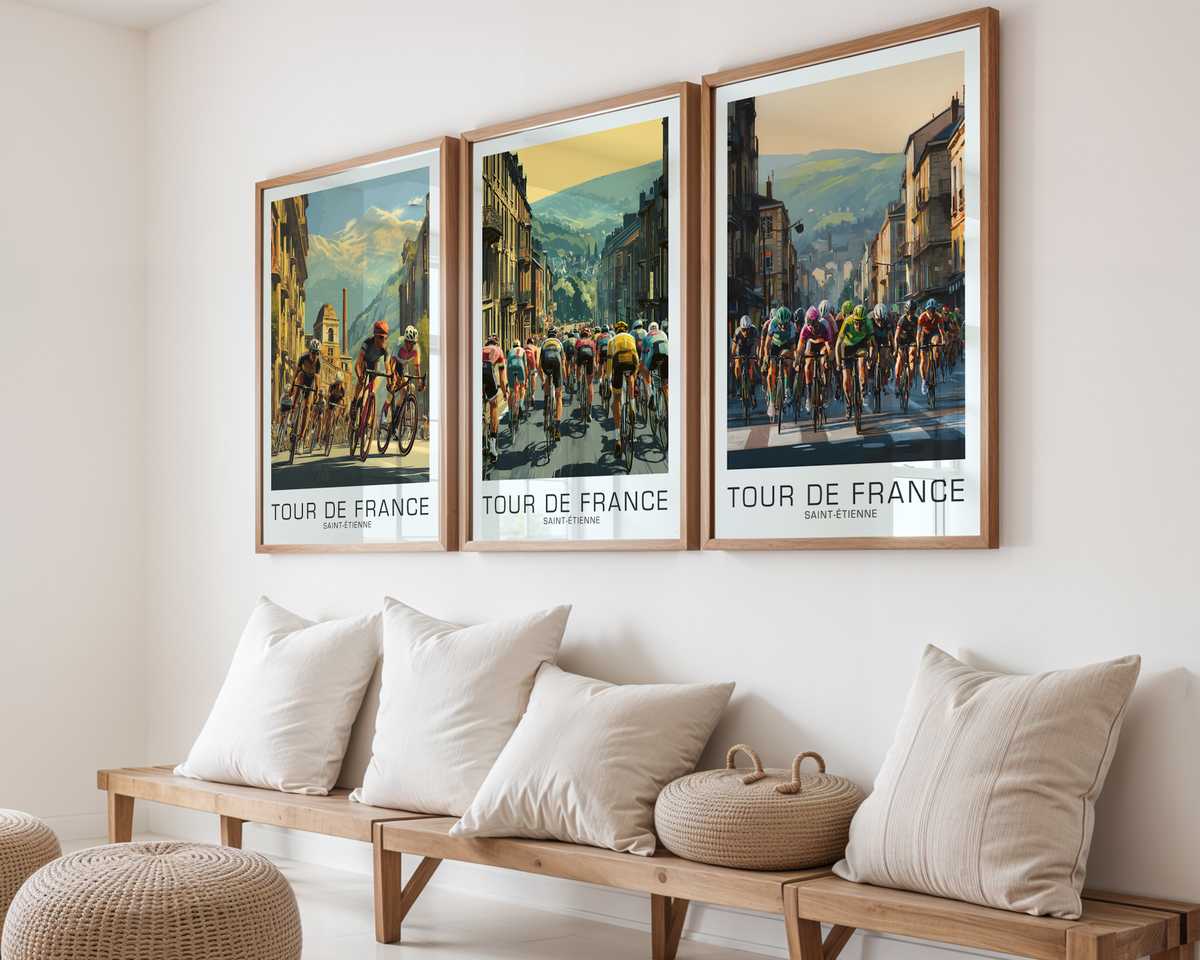
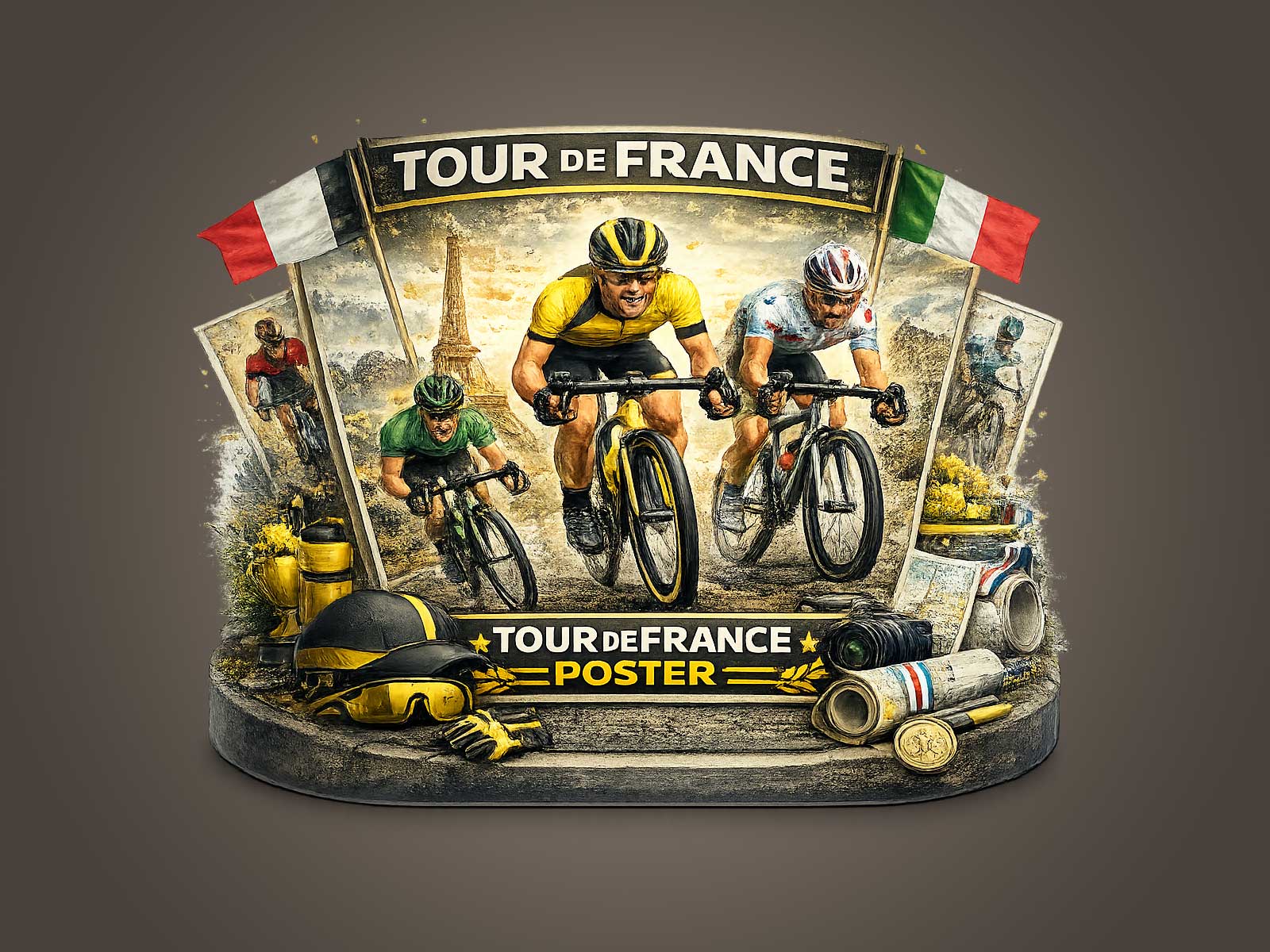
There is a particular kind of portrait that the mountains produce: not of landscape alone, but of an instant in conflict. This poster renders the Col d’Aubisque as a narrow theatre where gradient, fatigue and tactical proximity collide. The image arrests one second of a climb—an attack or a response—so precisely that the viewer can still sense pedal strokes, breathing and the tiny micro-adjustments of hands on hoods. Framed as wall art, that single frozen second reads like a short film, a compressed narrative that implies the minutes and kilometres that came before and the unknowns that follow.
What makes this scene work as bicycle art prints is timing. The rider’s body is mid-commitment: shoulders low, cadence measured, jaw set. Nearby rivals crowd the rim of the frame, their silhouettes and wheel clearances communicating tactical threat. The road’s pitch is readable in the way the foreground falls away and the chainline tightens; texture in the tarmac and a clipped roadside marker give the eye a reliable slope to read. Those visual cues—posture, spacing, gradient—are what let a still image tell a story of effort and decision. You do not need the sound of the crowd to know that something is about to happen.
Pressure is visible here as negative space as much as shape. A gap of a few pedal revolutions between two riders becomes the stage for risk: a marginal attack, a committed chase, or the fragile moment of cooperation. The proximity of rivals creates tension—wheels aligned like matched breaths—while the surrounding emptiness of the mountain amplifies each gesture. In graphic terms, the composition compresses speed: blurred wheel spokes, a faint dust trail, and a lean angle that together suggest momentum without the need for cinematic motion blur. This compression is why such prints feel cinematic yet intimate.
[IMAGE_INSERT_ARTICLE_01]
Emotion in this poster comes from readable endurance. Sweat-dark jerseys, a clenched hand, and an open mouth half-hidden by a helmet visor tell of accumulated kilometres and the stubborn decision to keep attacking. The visual language is specific: a dropped shoulder reveals effort; a tucked knee suggests acceleration; a line of rivets on the bar tape implies a rider’s grip and the micro-movements of control. These are the details that make the piece more than a picture of a road—they make it a study in courage and calculation.
For interiors, the appeal of such a print is quietly architectural. In a study, the poster’s disciplined palette and strong diagonal lines can direct sightlines and suggest forward motion without noise. In a living room or a studio, it lends a narrative anchor: an object that invites repeated examination and new discoveries—a missing breath here, a recalculated gap there. The art doesn’t demand to be explained; it rewards a slow look. It works best when partnered with uncluttered spaces and natural materials that echo the mountain’s austerity—raw wood, matte frames, soft light—so the image reads as a memory rather than an ornament.
Finally, the strongest implied instant in this scene is a summit attack caught half-born: either the first lunge that will define a stage or the decisive counter that rearranges a race. That ambiguity is the poster’s power. It asks the viewer to finish the story, to imagine the seconds that followed. As bicycle art prints, images like this transform a room by offering more than aesthetics; they offer a suspended drama, a distilled lesson in risk and perseverance that looks as good above a desk as it does in a hallway. The Col d’Aubisque here is not just a place on a map—it is an emotional geography rendered with clarity and restraint, the kind of image that stays with you long after you turn away.