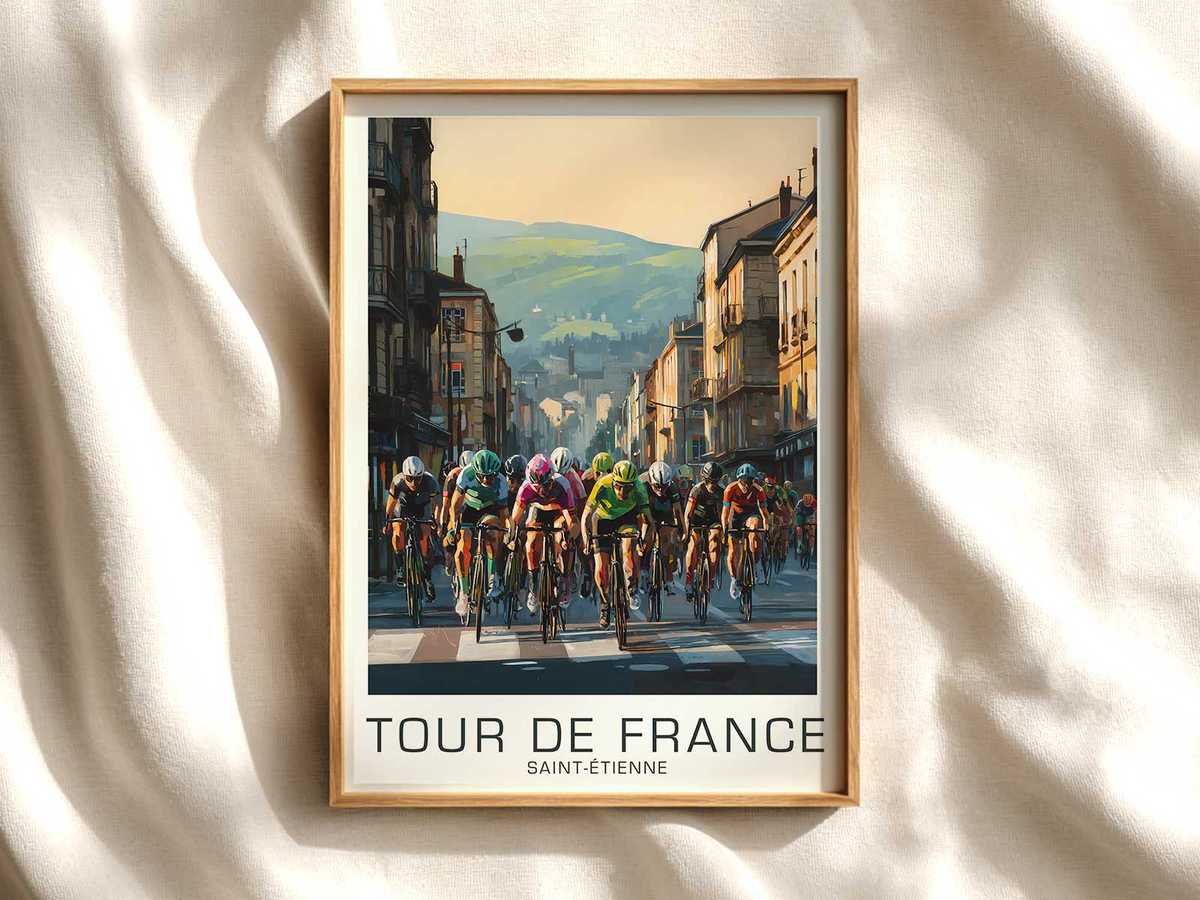
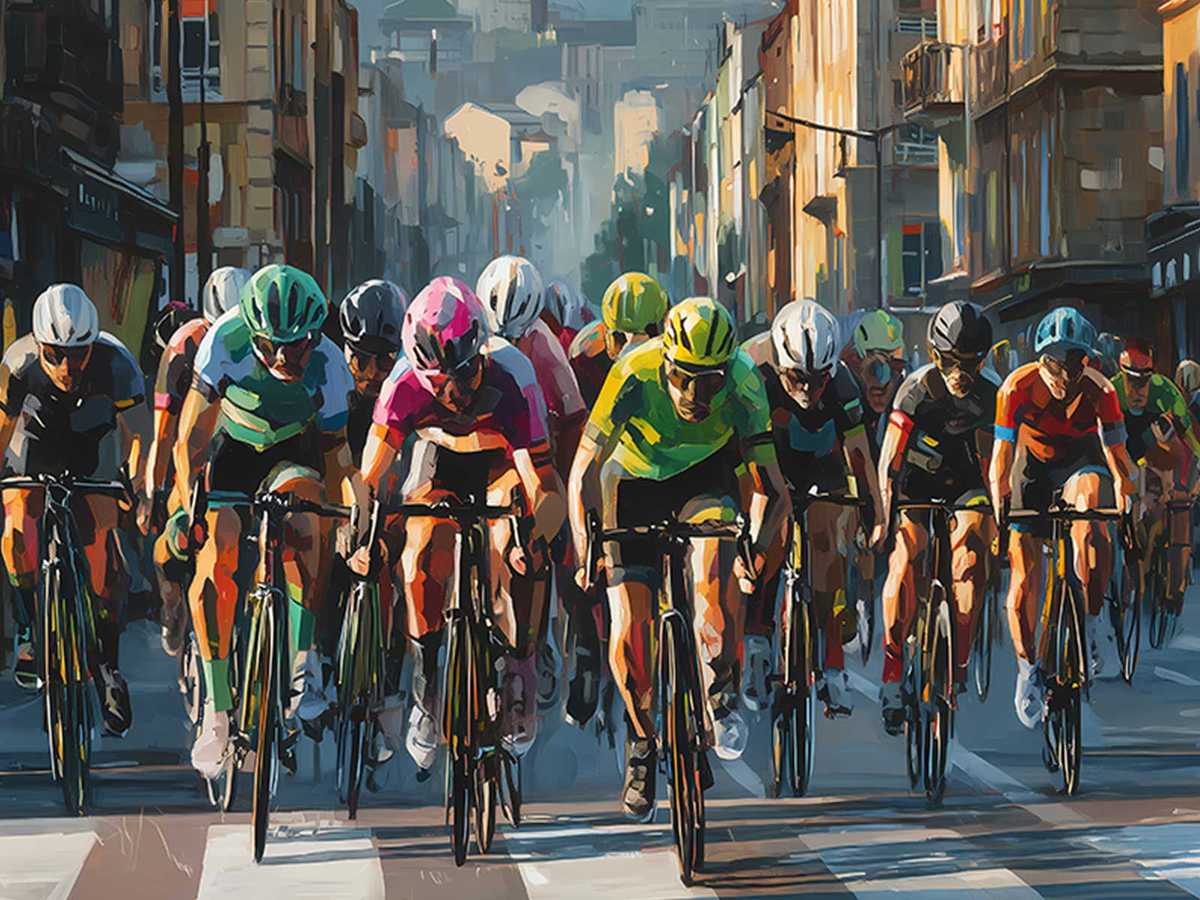
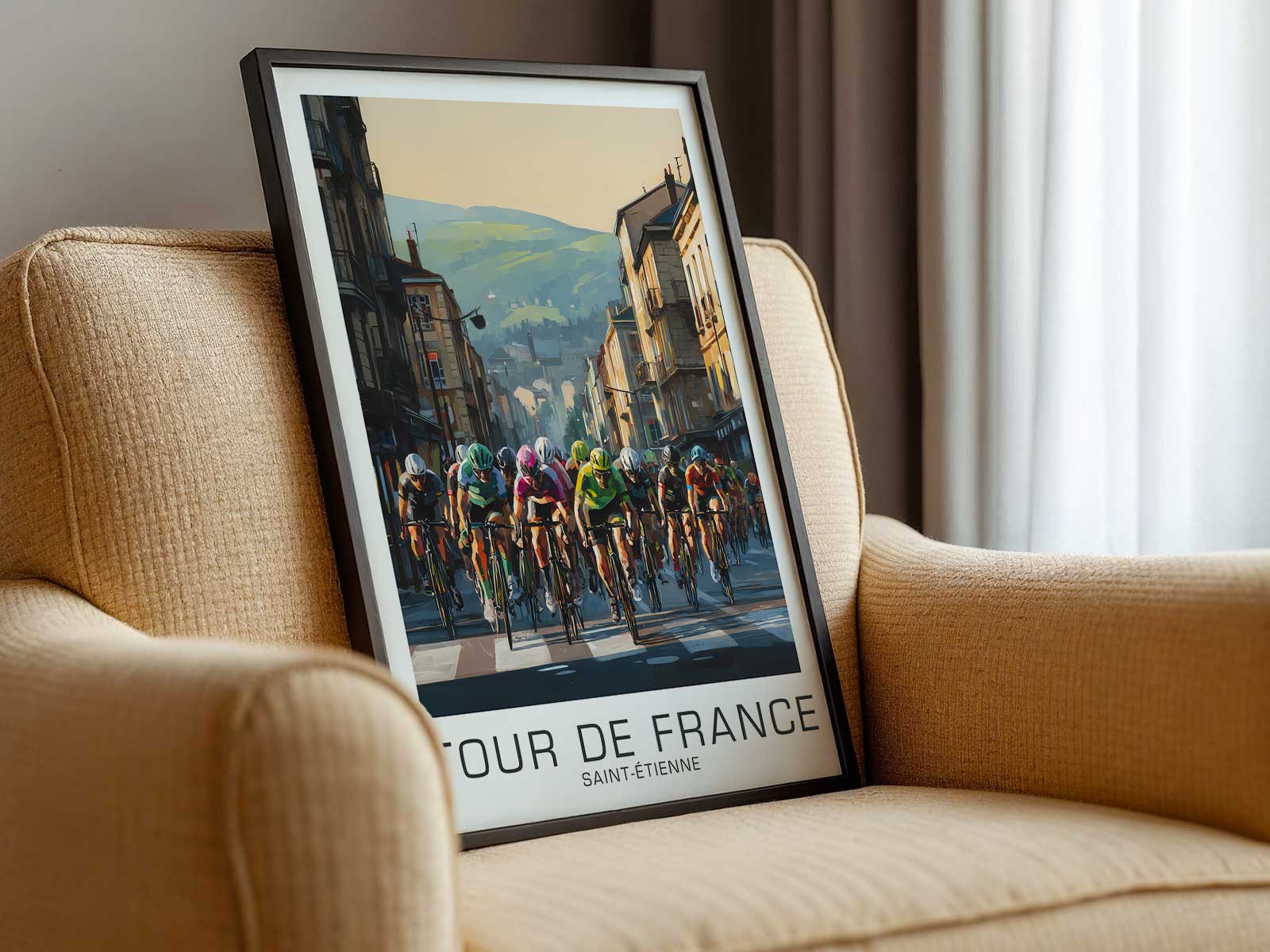
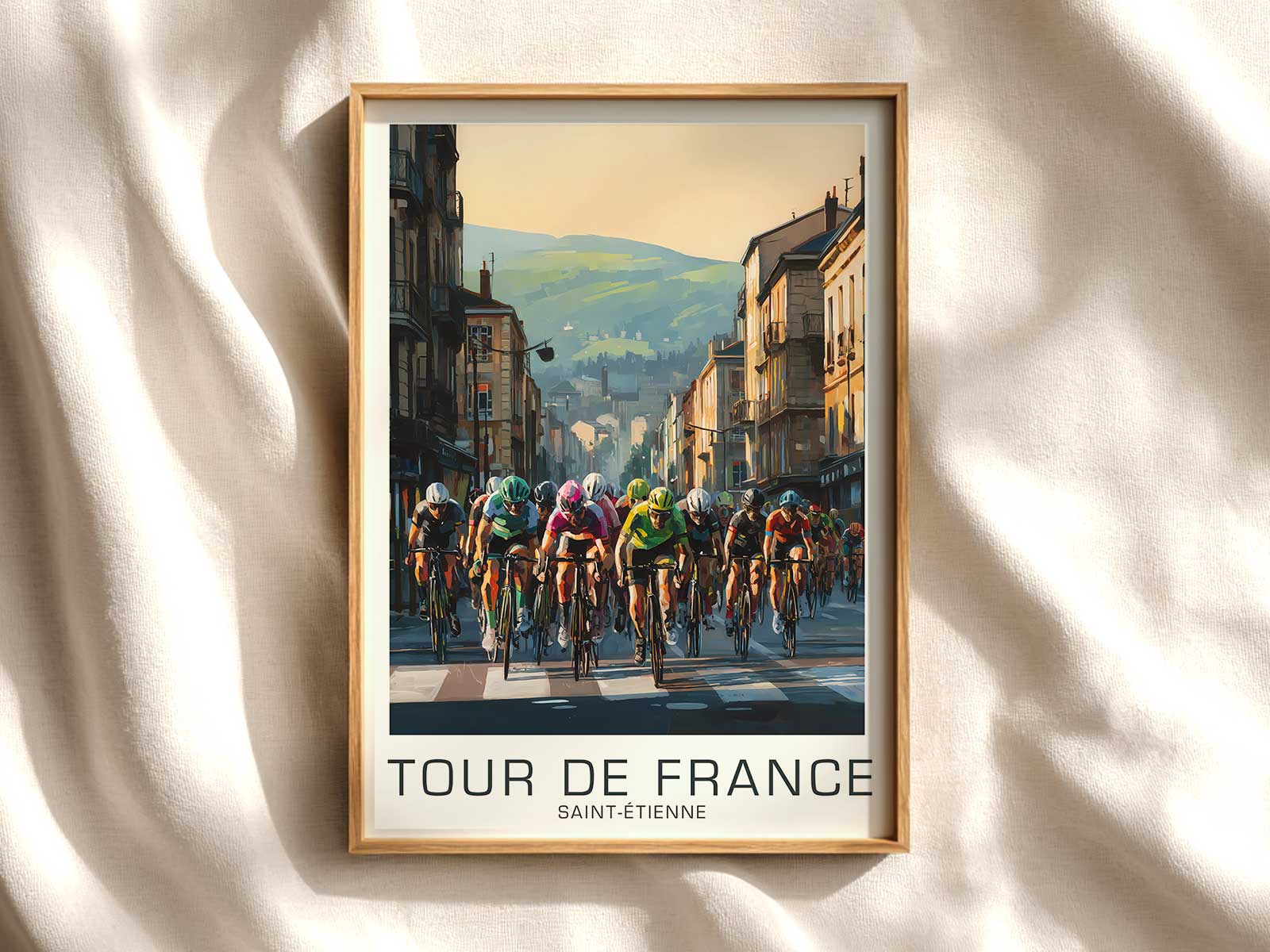
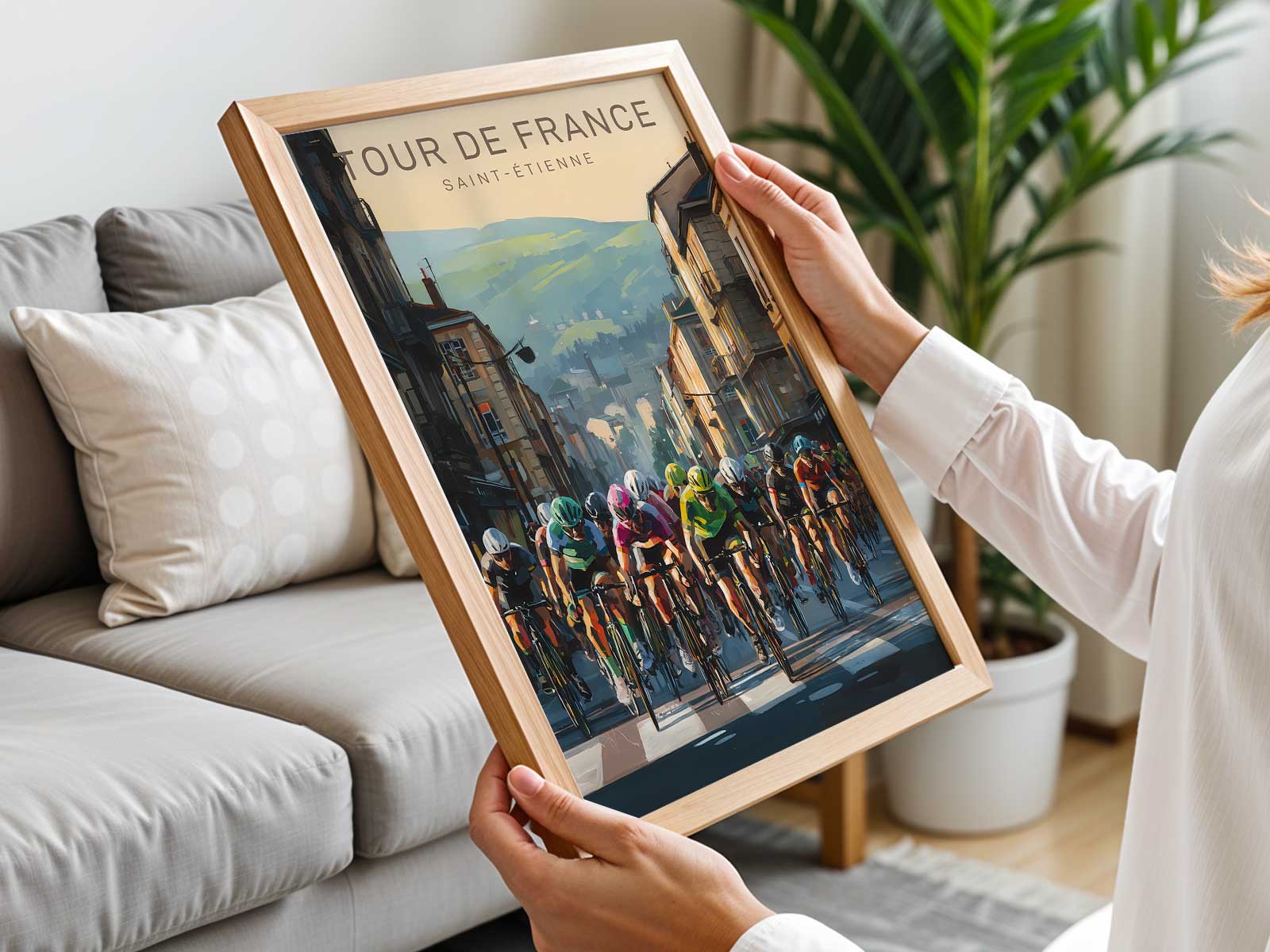
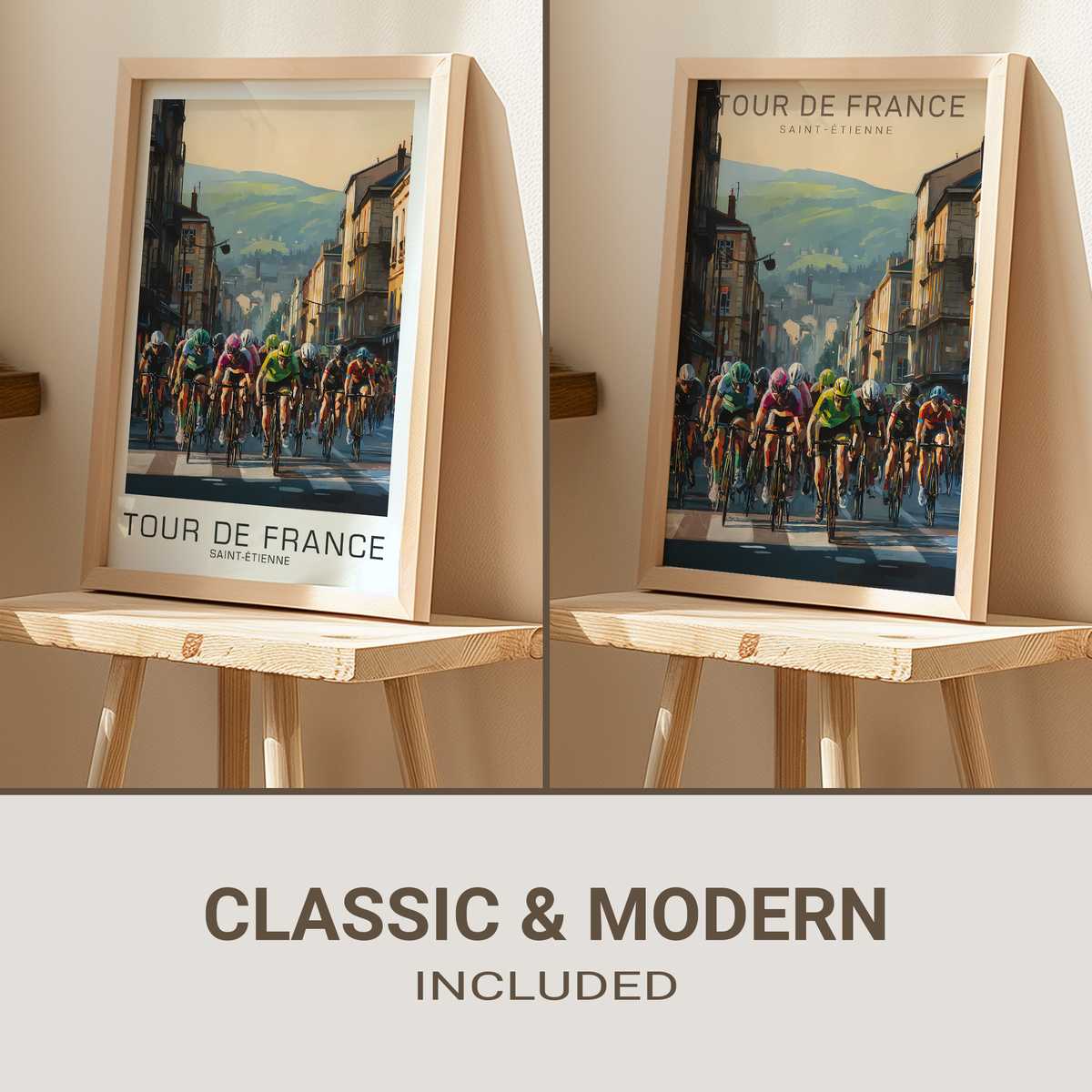
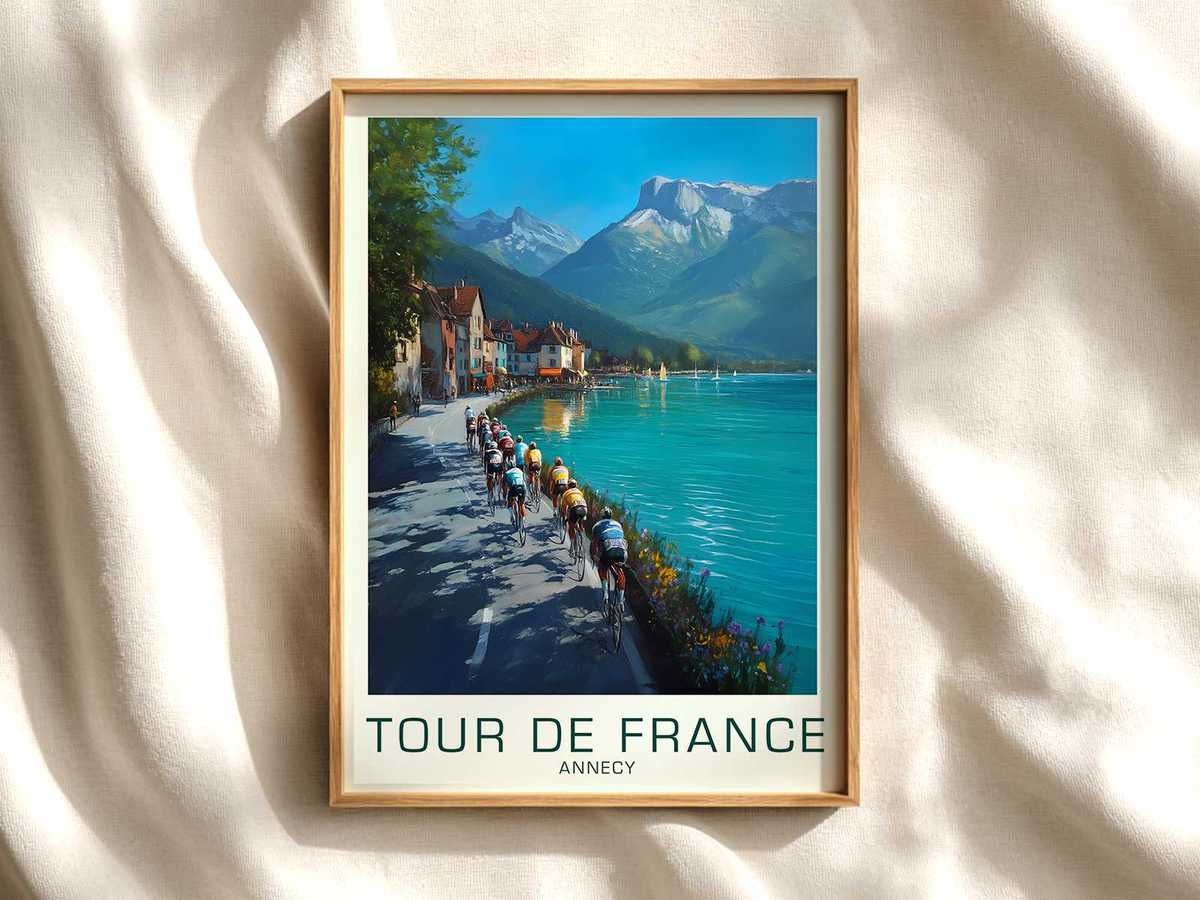
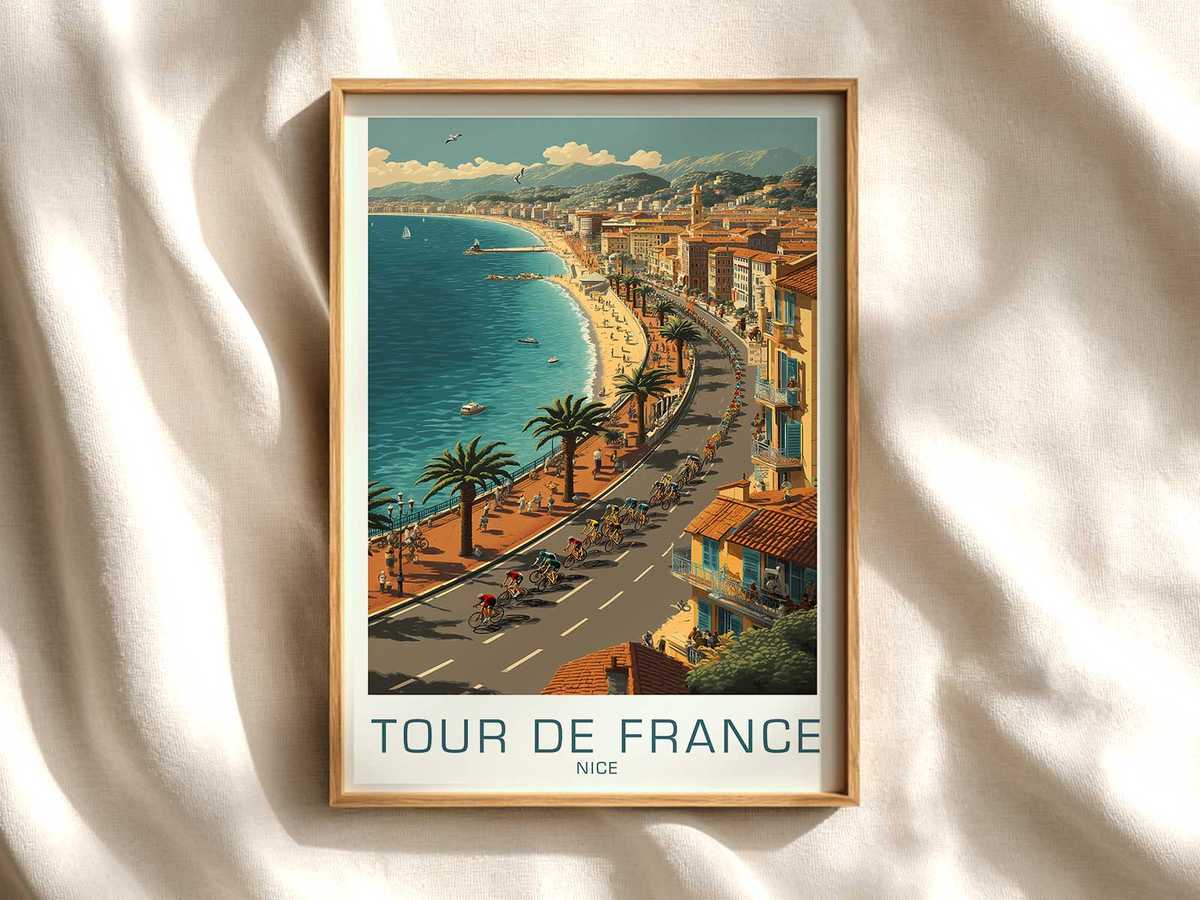
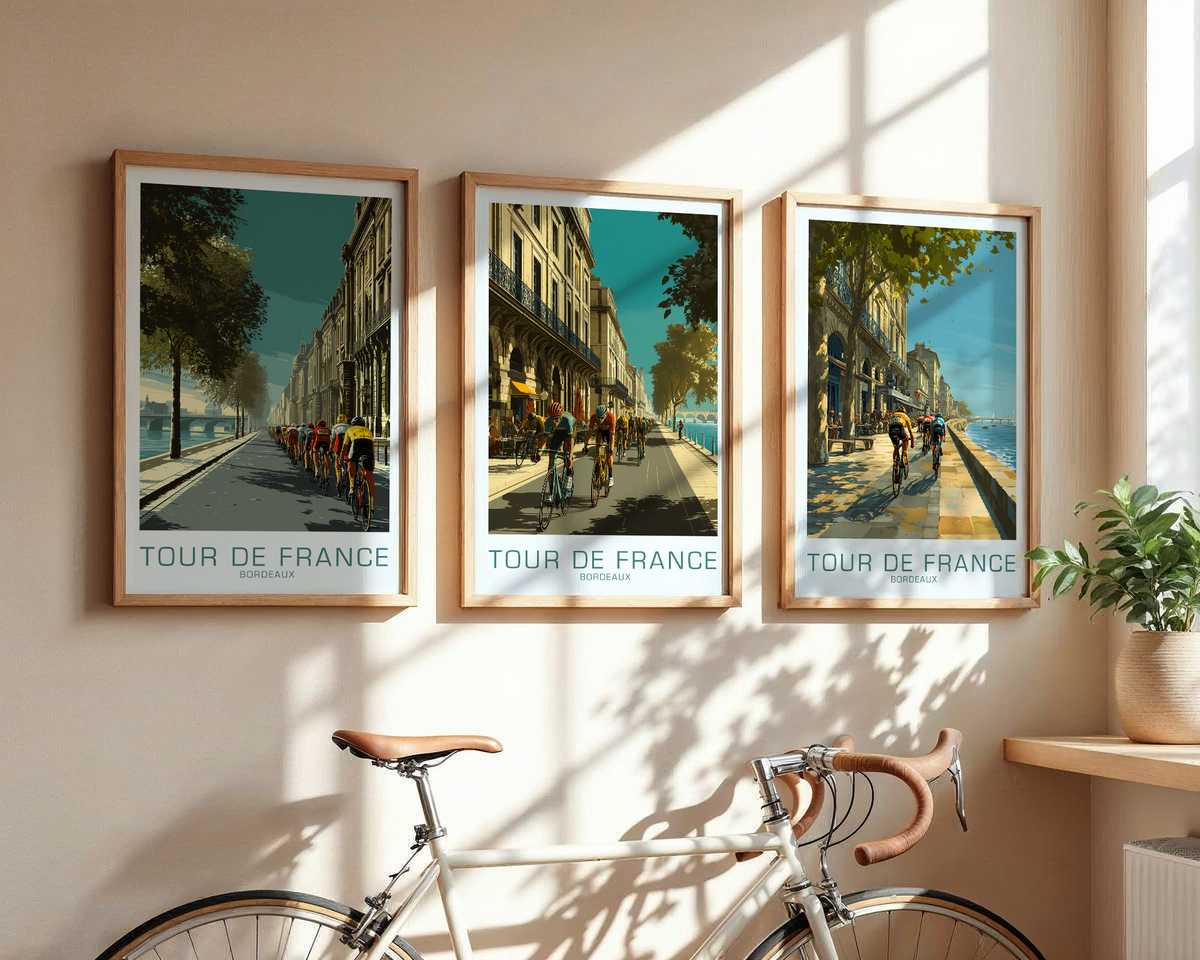
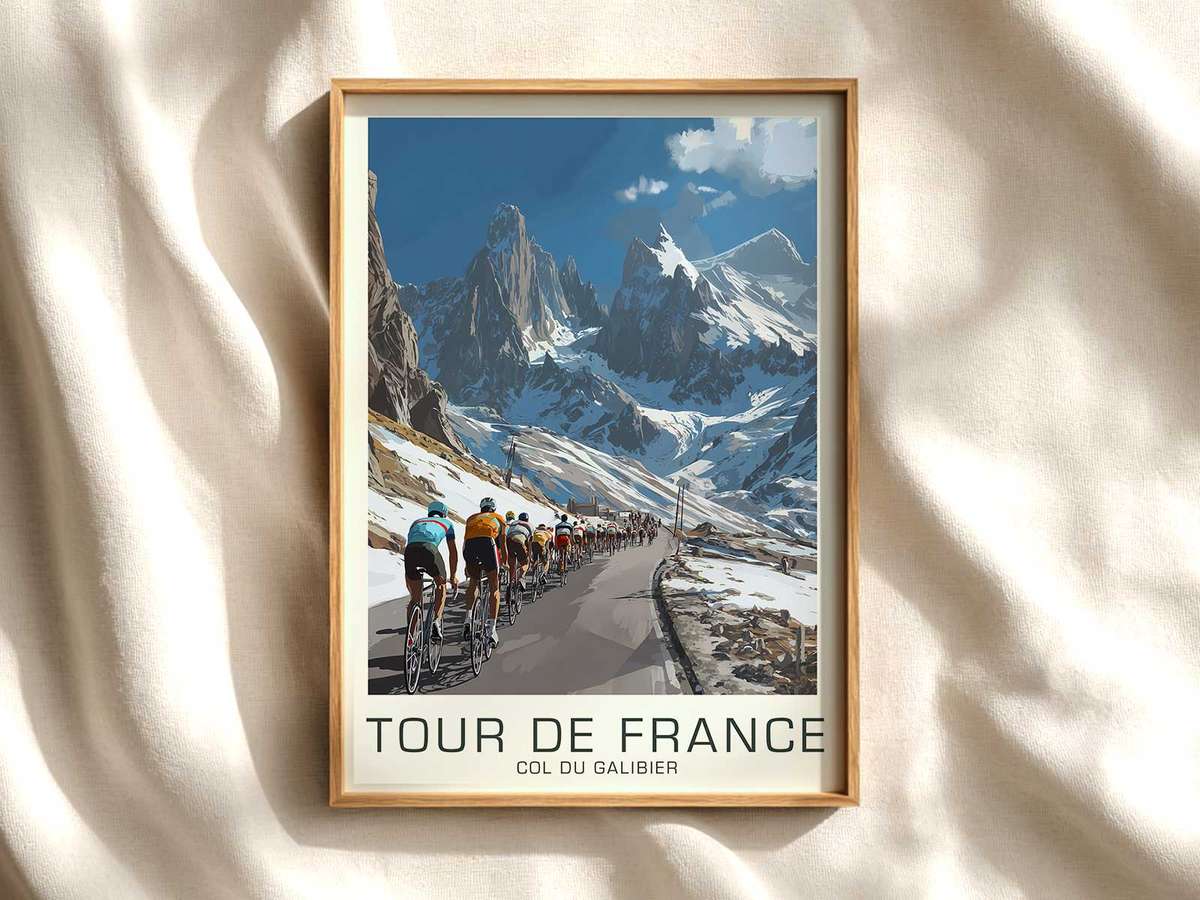
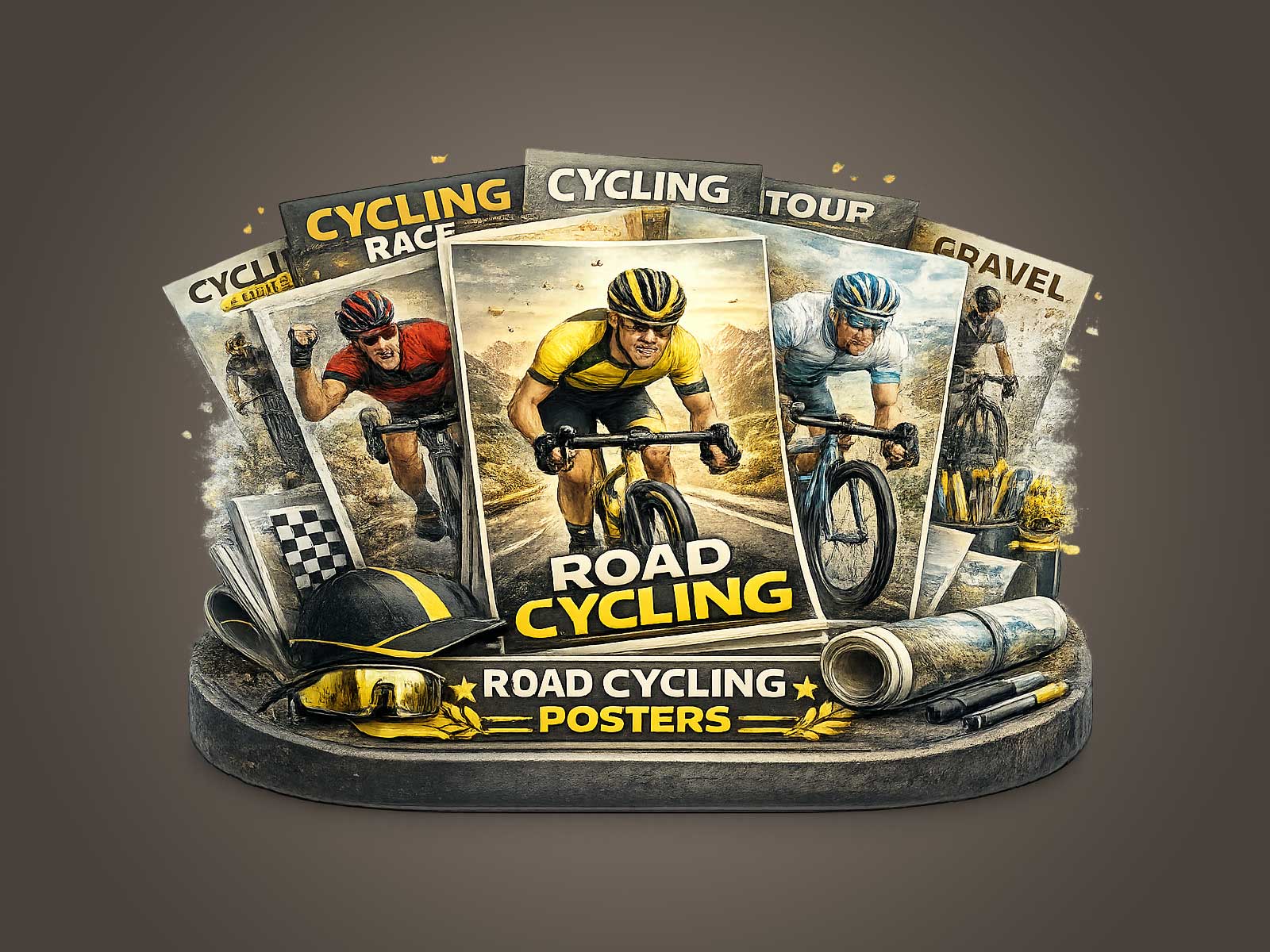
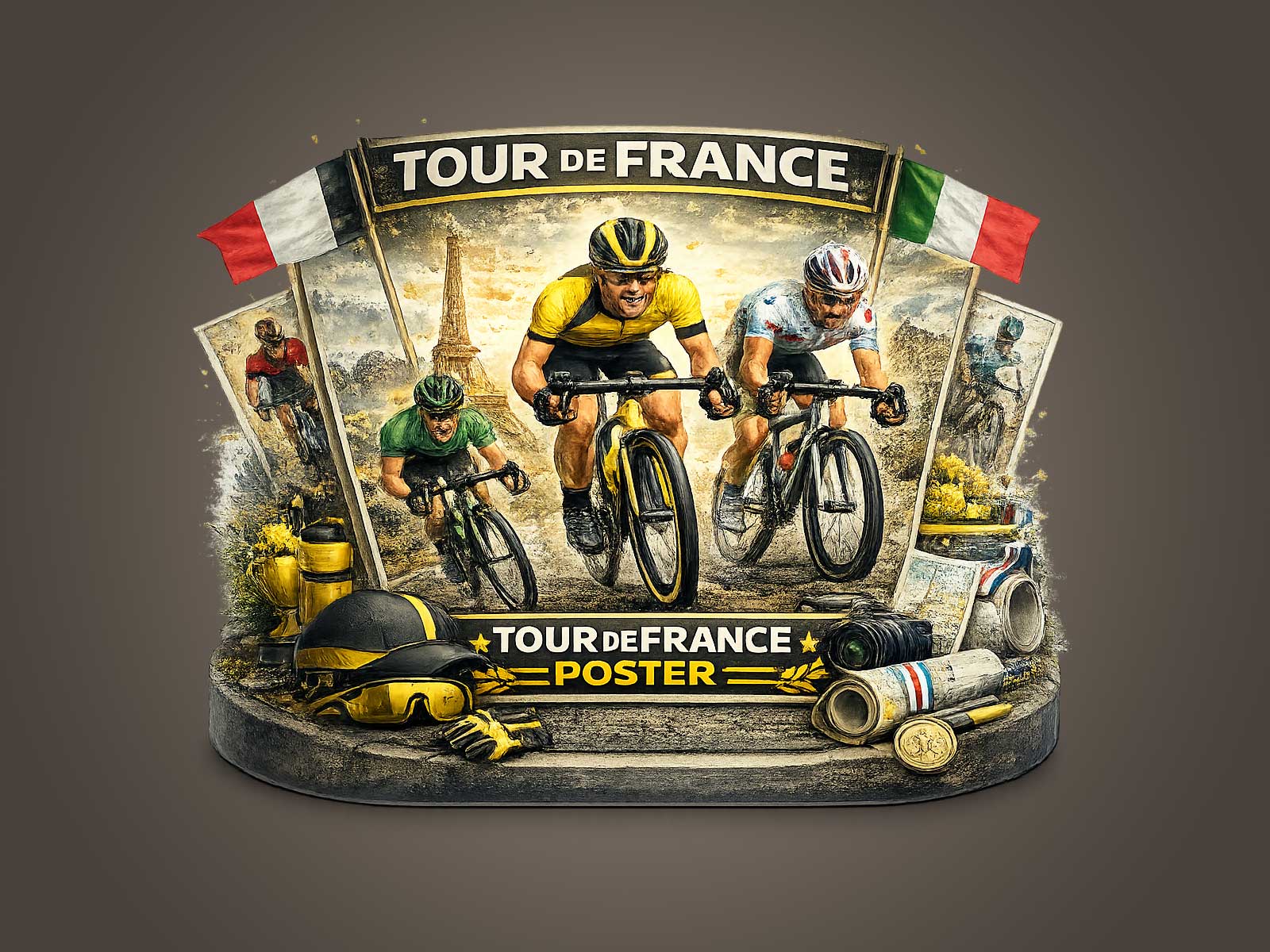
An artwork inspired by Saint-Étienne gains its authority by making the bicycle the organising principle of the composition. Rather than treating the rider as a mere occupant of space, this poster elevates frame geometry, wheel silhouette and cockpit lines into the visual grammar of the piece. The machine becomes a structural axis: top tube and seat tube draw an implied diagonal across the scene, chainstay and fork suggest forward momentum, and the circular cadence of the wheels anchors the composition like a pair of silent metronomes.
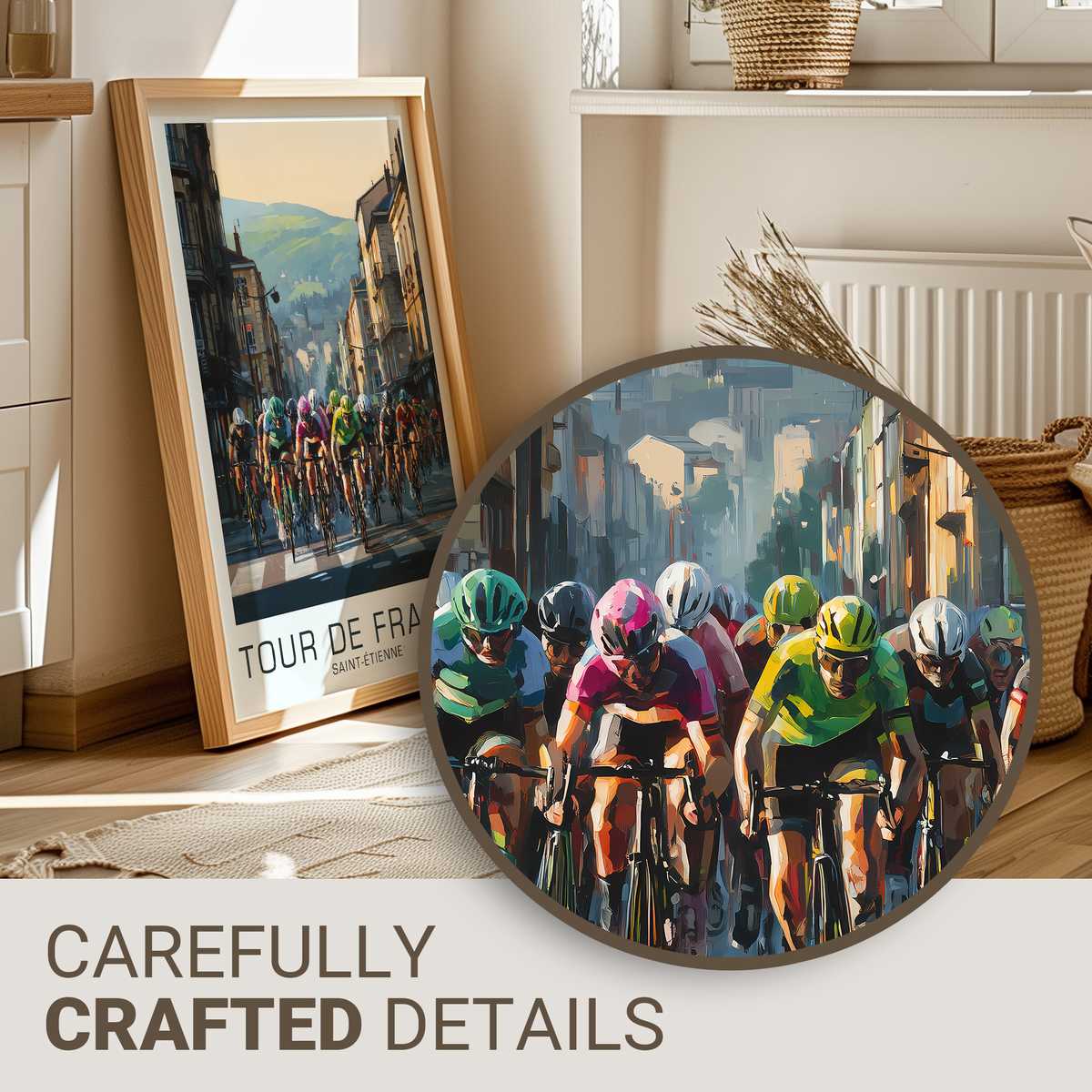
Seen close-up, the bicycle’s technical silhouette reads like a set of precise brushstrokes. The slenderness of the frame contrasts with the confident mass of the wheel rims; shallow-versus-deep rim shapes, tyre width and spoke rhythm all translate into a measured visual tension. The cockpit — bar drops, stem angle and brake hoods — locates the narrative pivot where human intent meets mechanical resolve. Even without naming materials or groupsets, the poster makes the bike legible as a performance object: taut lines, purposeful junctions and a saddle-to-handlebar slope that suggests either a steady climb or an aggressive pursuit.
That tension is essential to the poster’s emotional pull. A climb out of Saint-Étienne, imagined through gradients and muted town colours, is implied by the bike’s posture: a low front end, compact rider silhouette, pedals held in a poised cadence. Alternatively, the same machine framed against a blurred roadside or urban lamppost can read as sprint readiness, the spokes shimmering into optical motion. The visual cues are economical but specific — a wheel seen edge-on becomes speed, a headtube turned slightly toward the viewer becomes intent.
[IMAGE_INSERT_ARTICLE_01]
Material culture is evoked not by labels but by tactile suggestion. Matte paint tones, subtle chips of colour on a downtube, the shadow cast by a tubular tyre on asphalt — these are shorthand for a racing history and mechanical craft. The poster’s restrained colour palette and careful negative space let the bicycle’s mechanical elegance breathe, so the viewer senses tools, maintenance rituals and the quiet intimacy of machine ownership without a single explicit object shot of a pump or spanner.
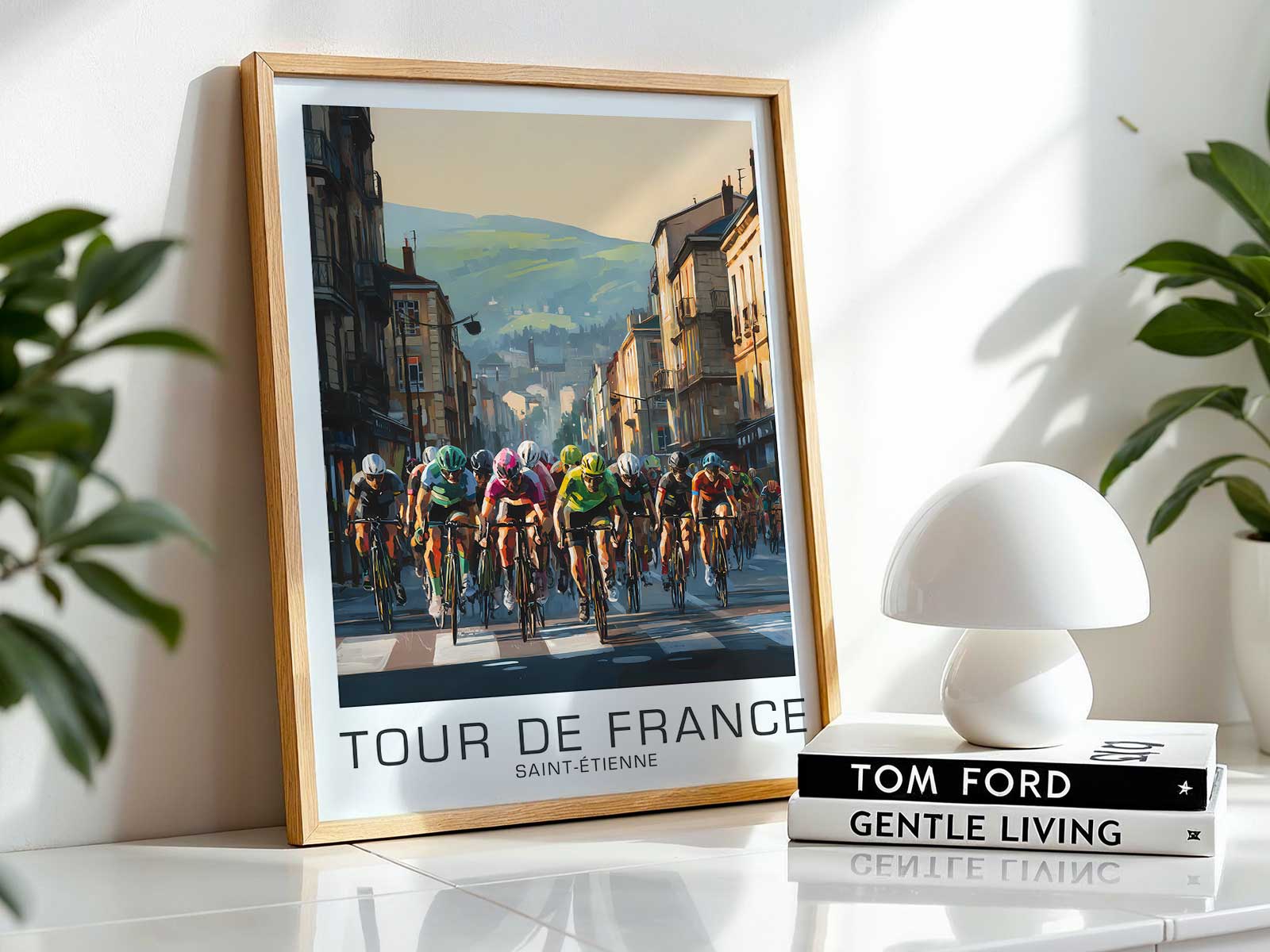
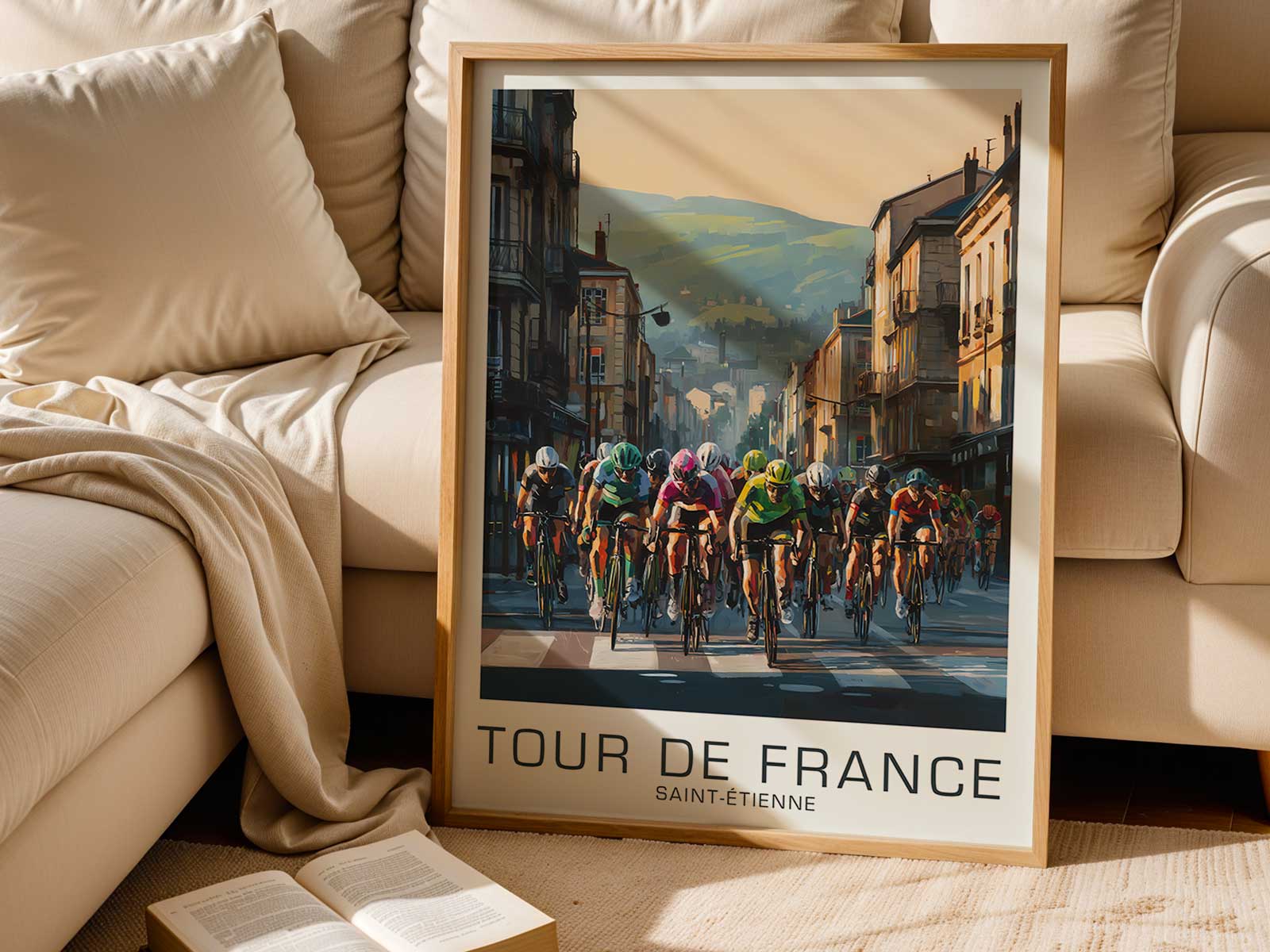
For interiors, this approach feels especially considered. In a study or design-led living room the poster reads like a statement about precision and taste: it speaks to someone who values engineered form and the poetry of function. In a garage or studio it affirms a collector’s eye, the way a single framed image can anchor a wall and mirror a real-world machine. The image does not shout; it disciplines the room, adding focus and composure through its mechanical honesty.
What makes bike-first Tour imagery display-worthy is its capacity to convey both motion and monumentality. The bicycle is small and intimate in reality, yet as a graphic protagonist it scales up emotionally: the frame’s junctions become architectural nodes, the wheel’s circle becomes a compositional sun. That duality — fragile tool, noble subject — explains why such prints draw the eye. They are at once technical studies and evocative memories of racing terrain, heritage and effort.
Ultimately, a Saint-Étienne inspired poster that privileges the bike shows how much a single machine can carry: visual rhythm, implied narrative and cultural memory. It invites the onlooker to read posture and part, to imagine cadence and gradient, and to situate the art within a room that prizes design, movement and a quietly assertive aesthetic.