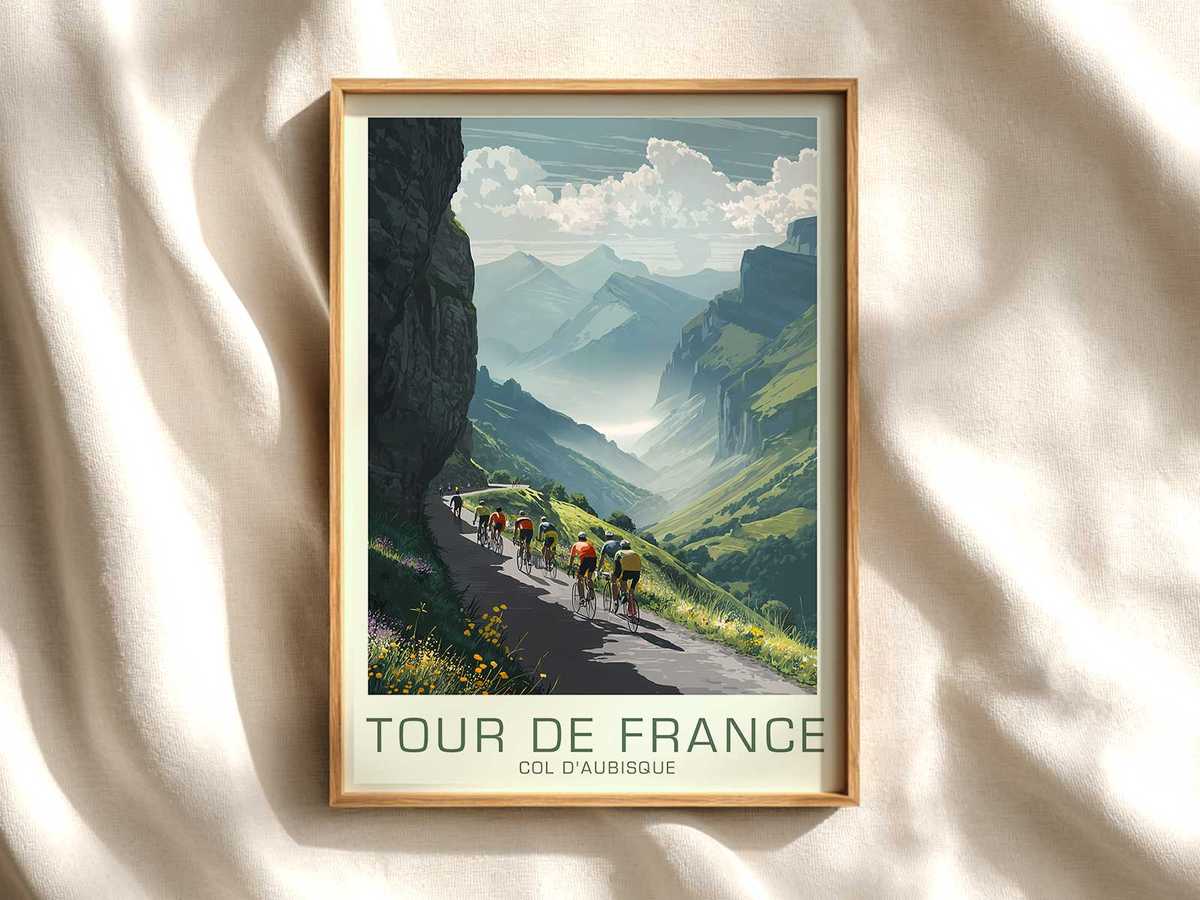
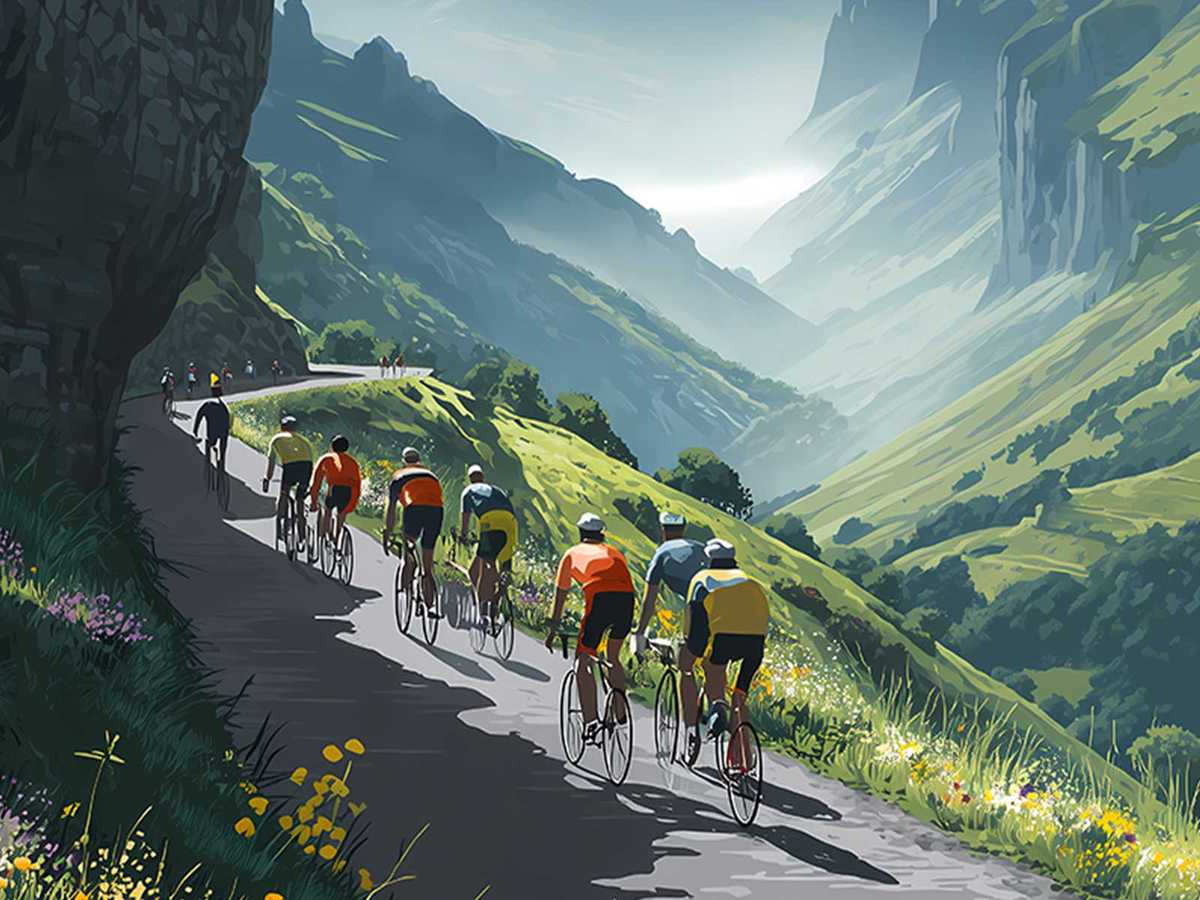
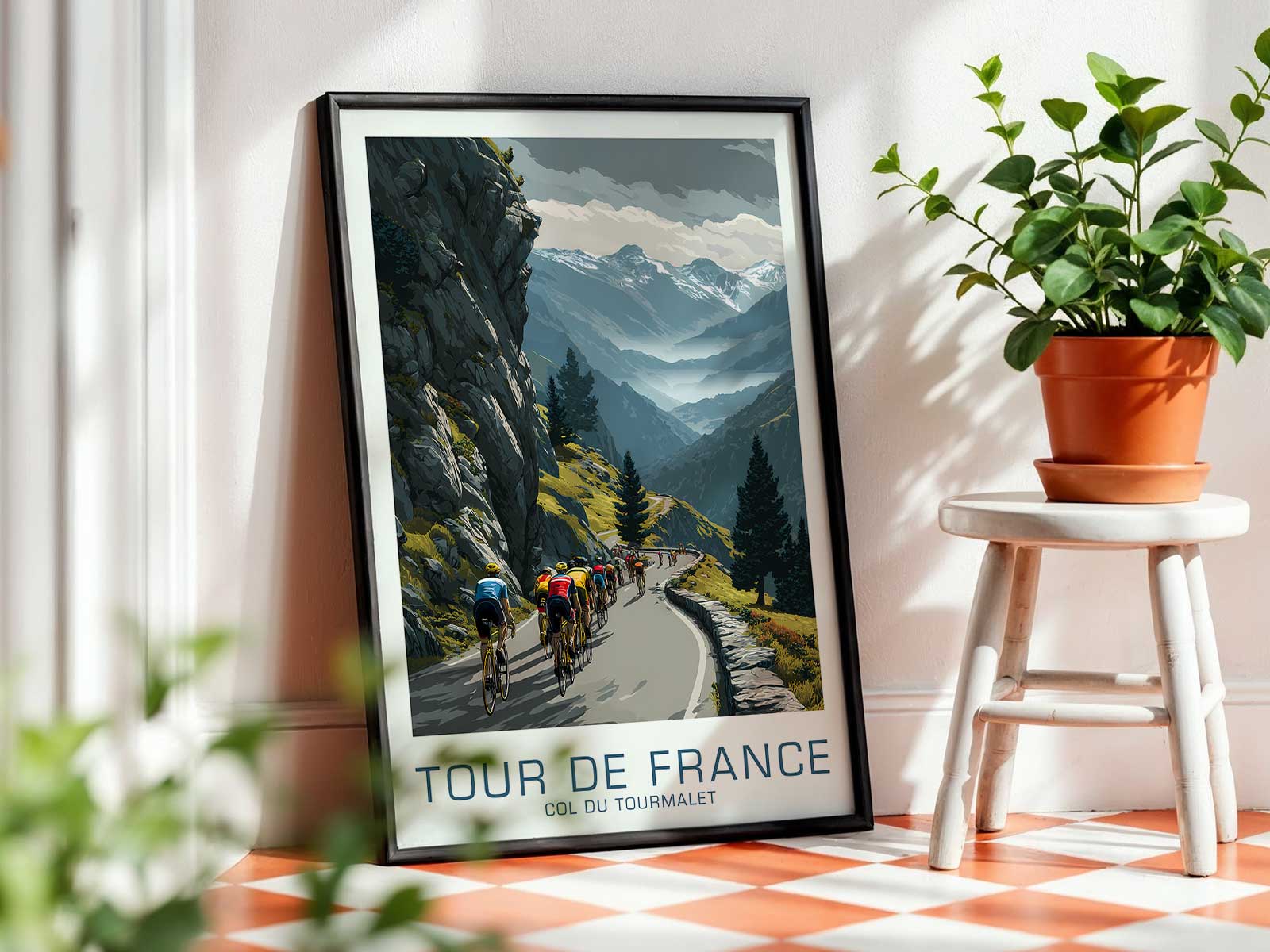
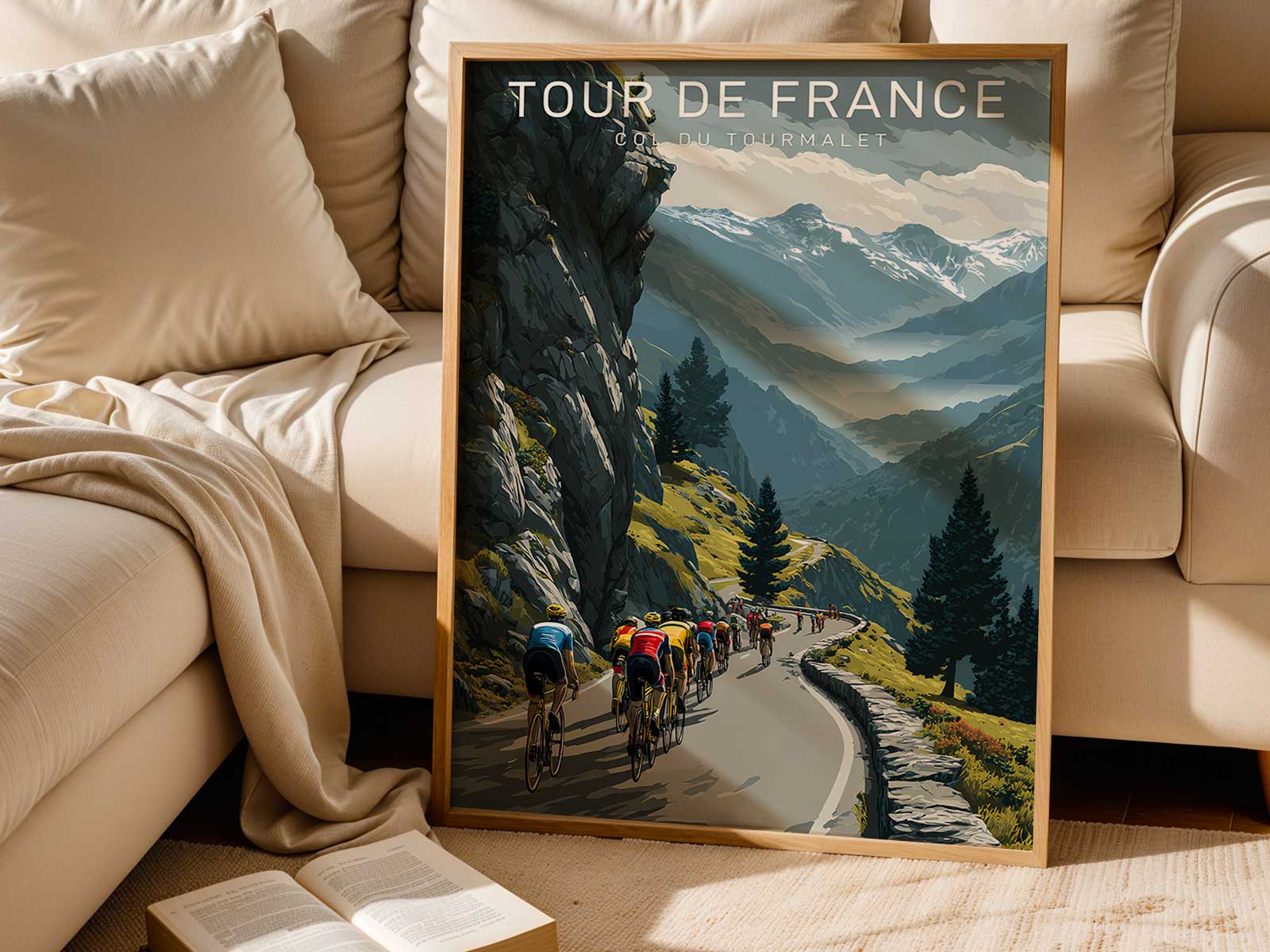
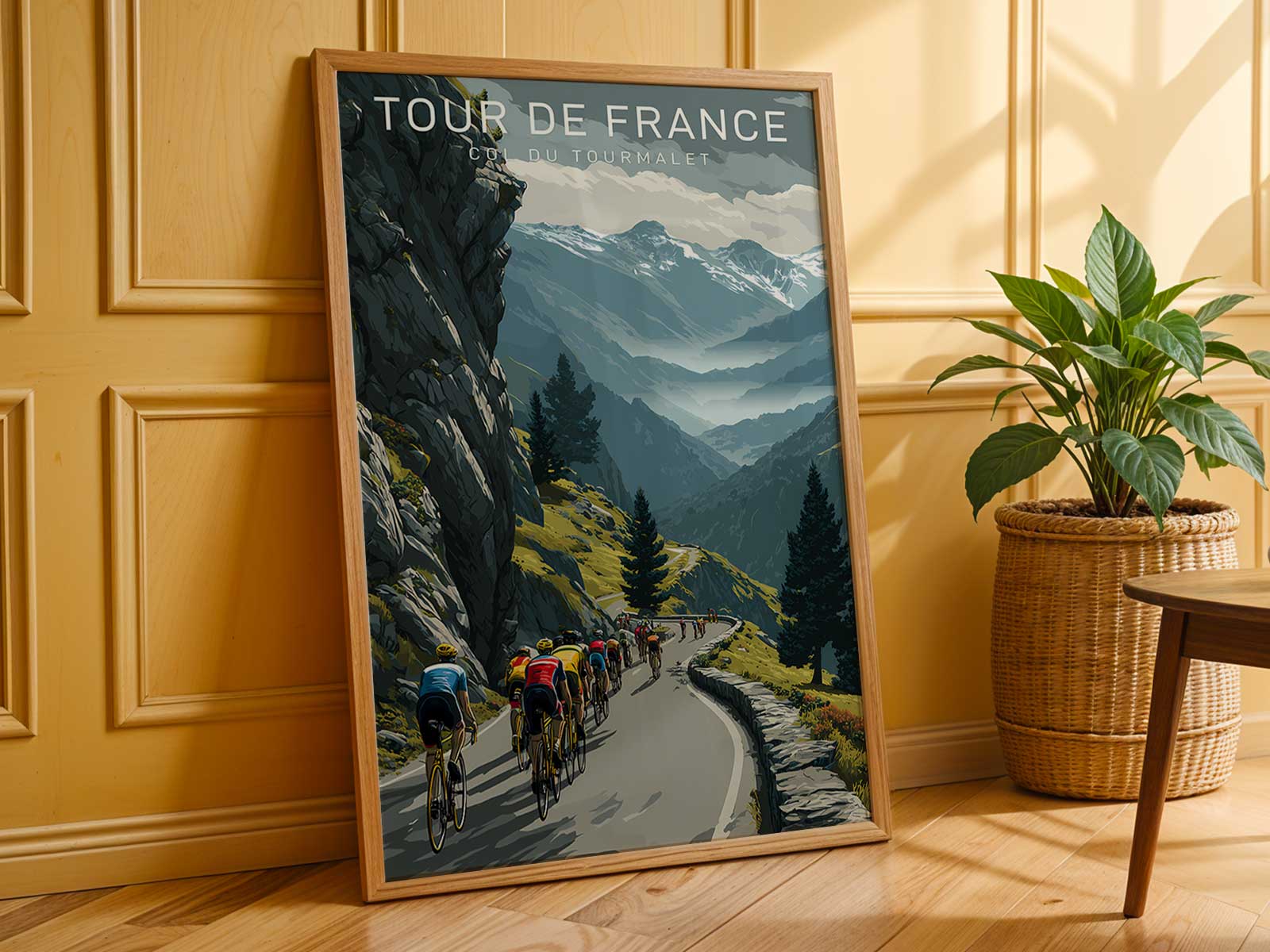
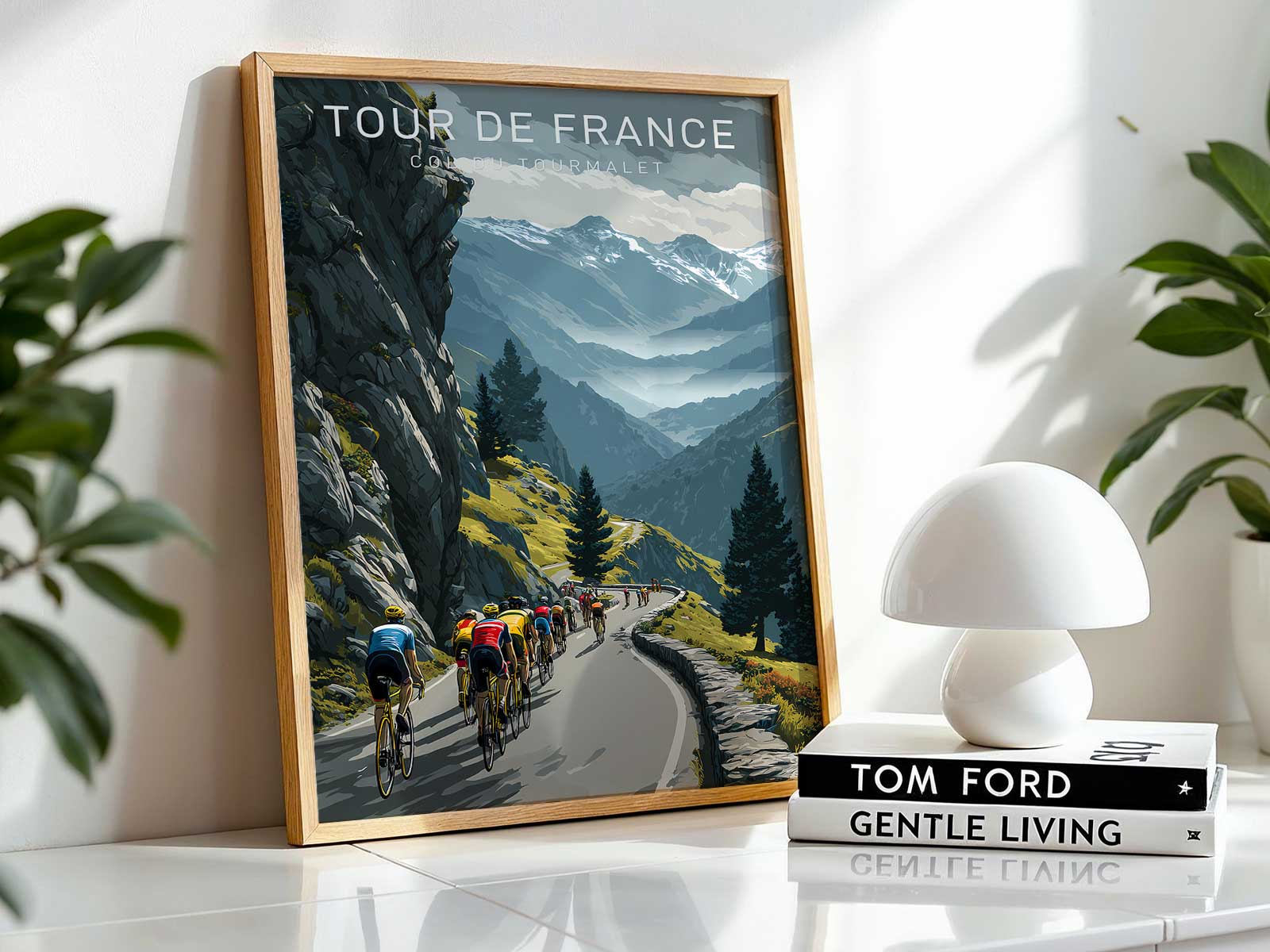
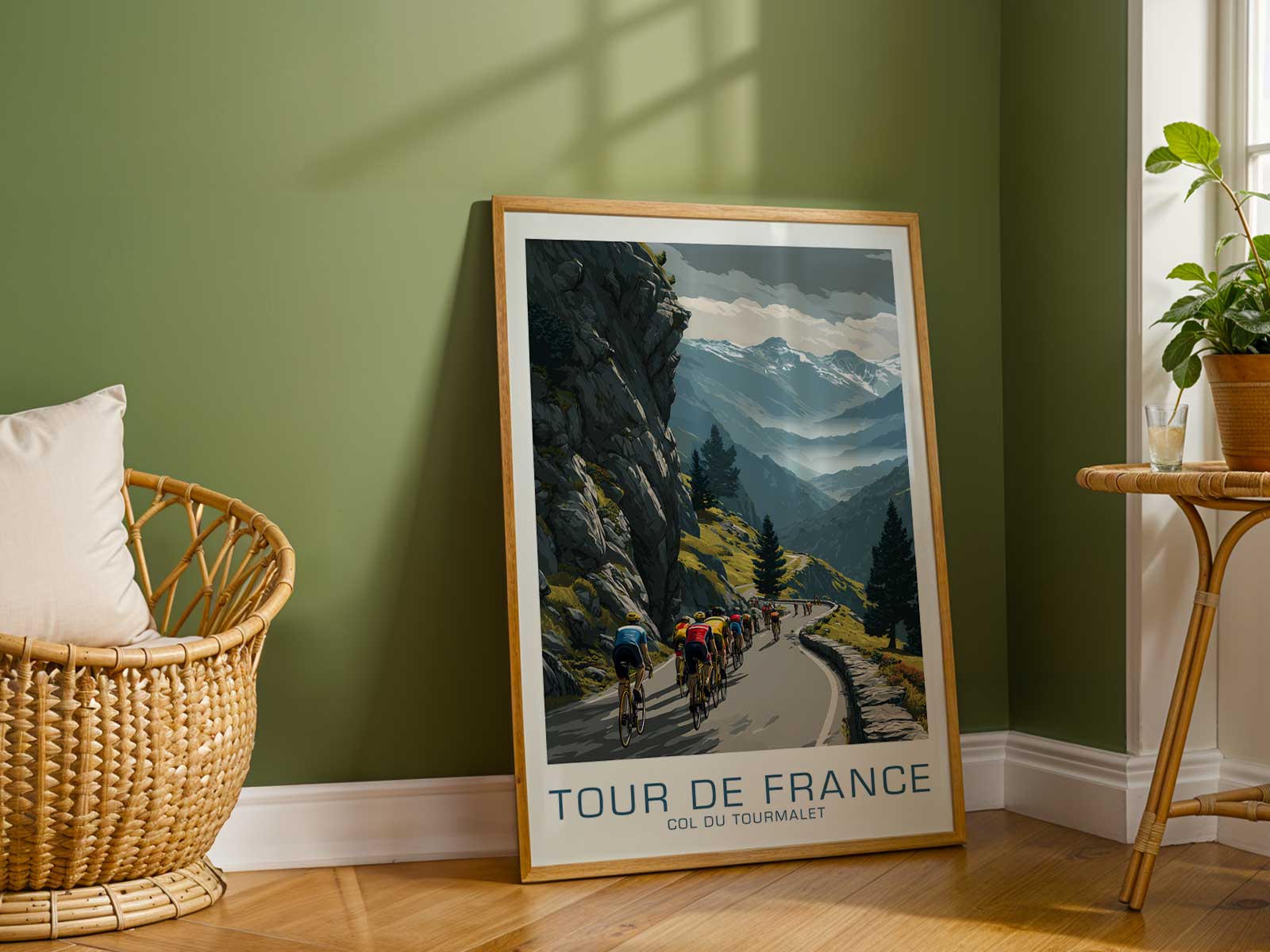
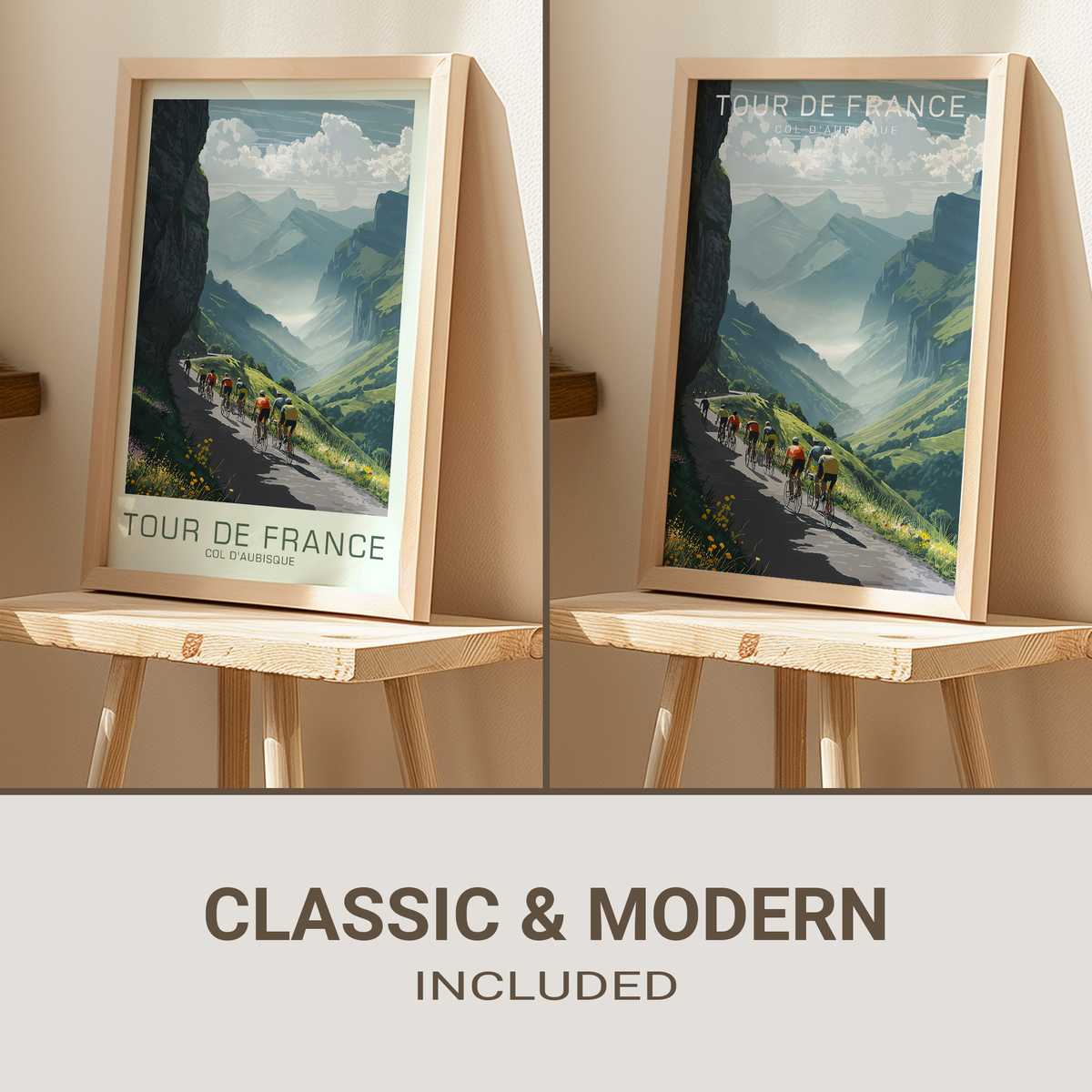
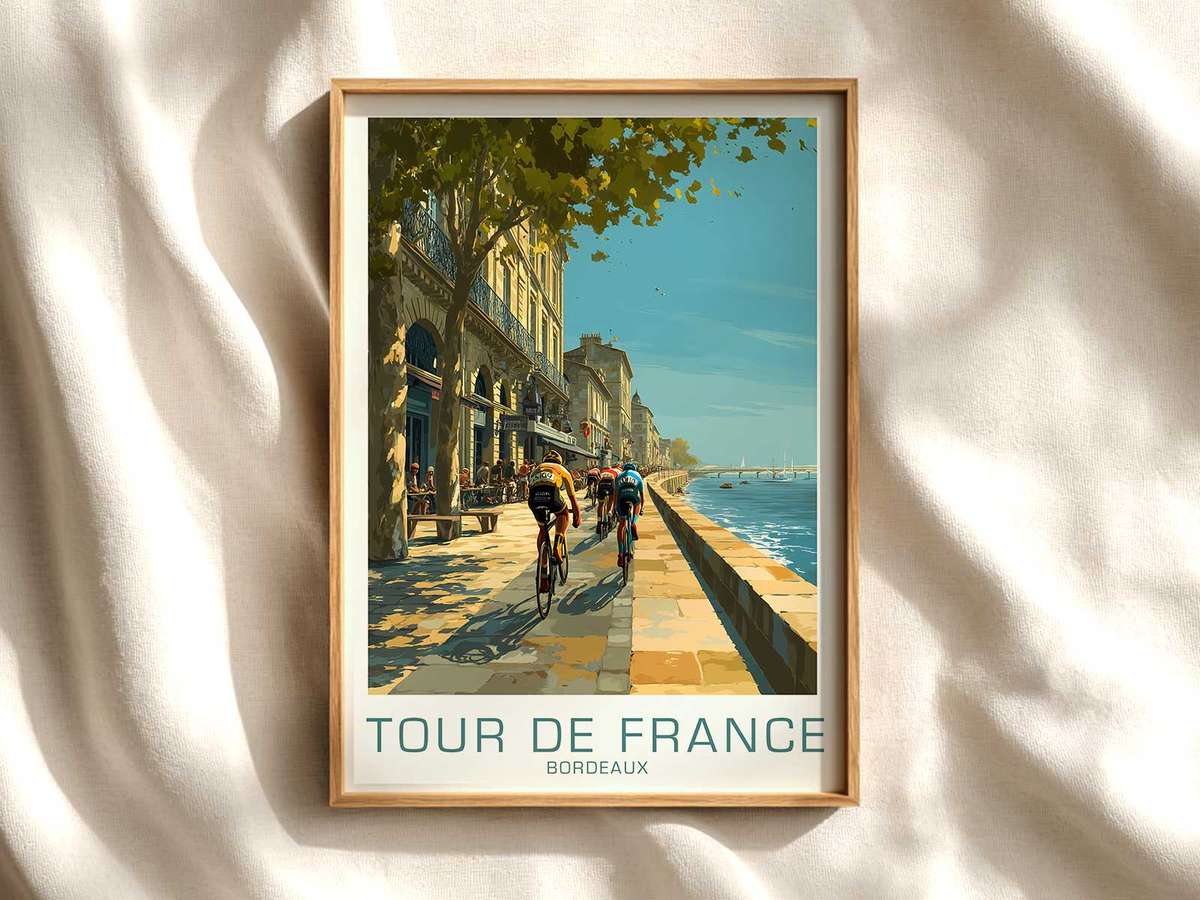
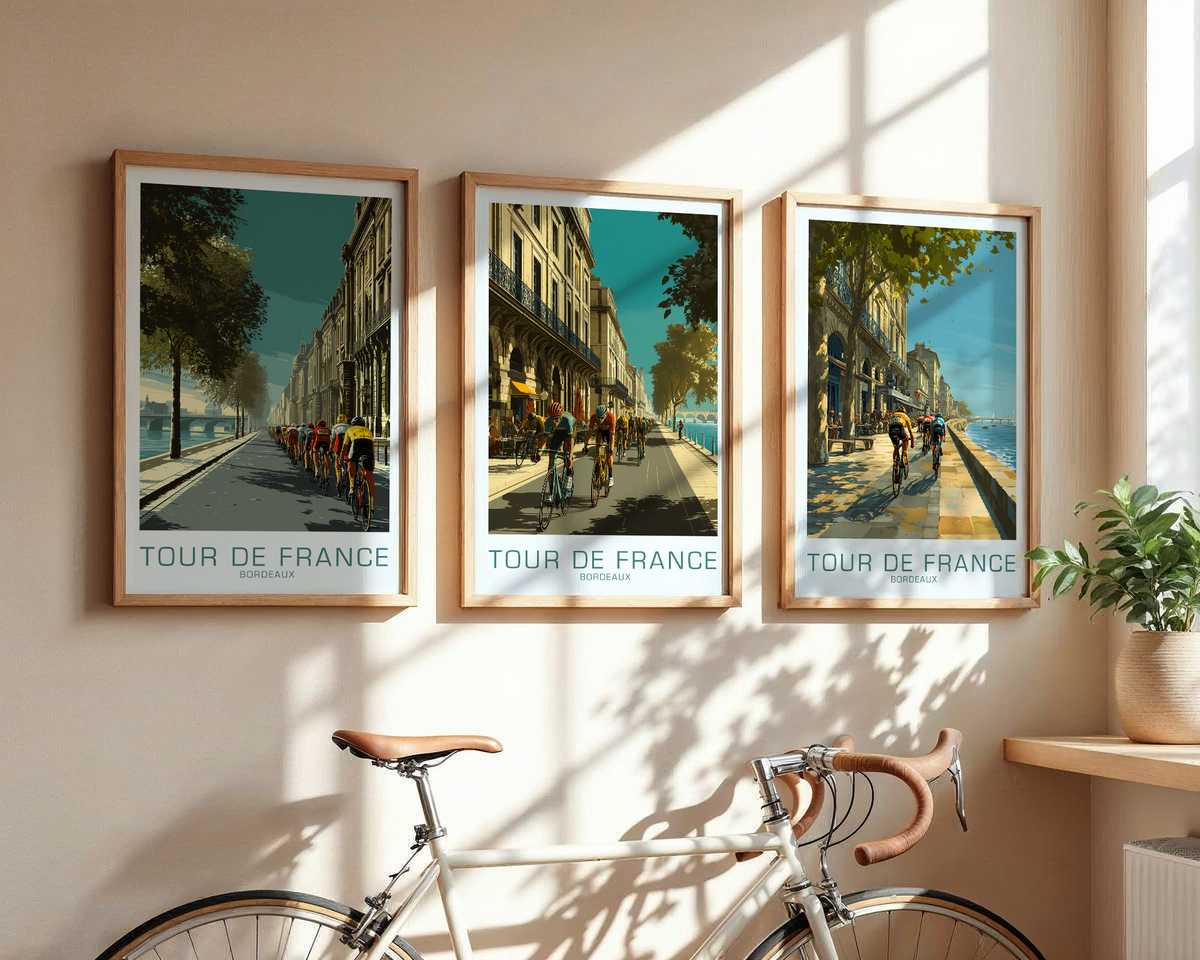
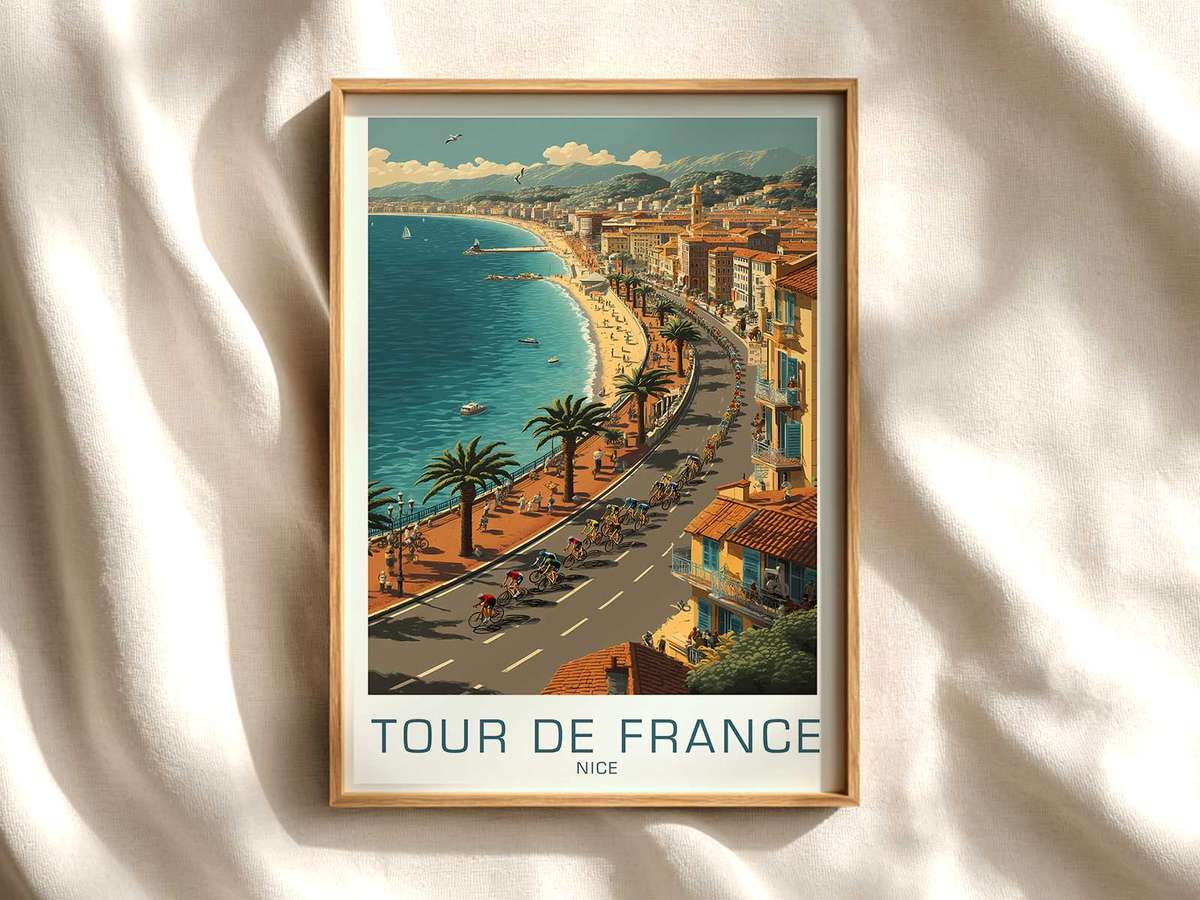
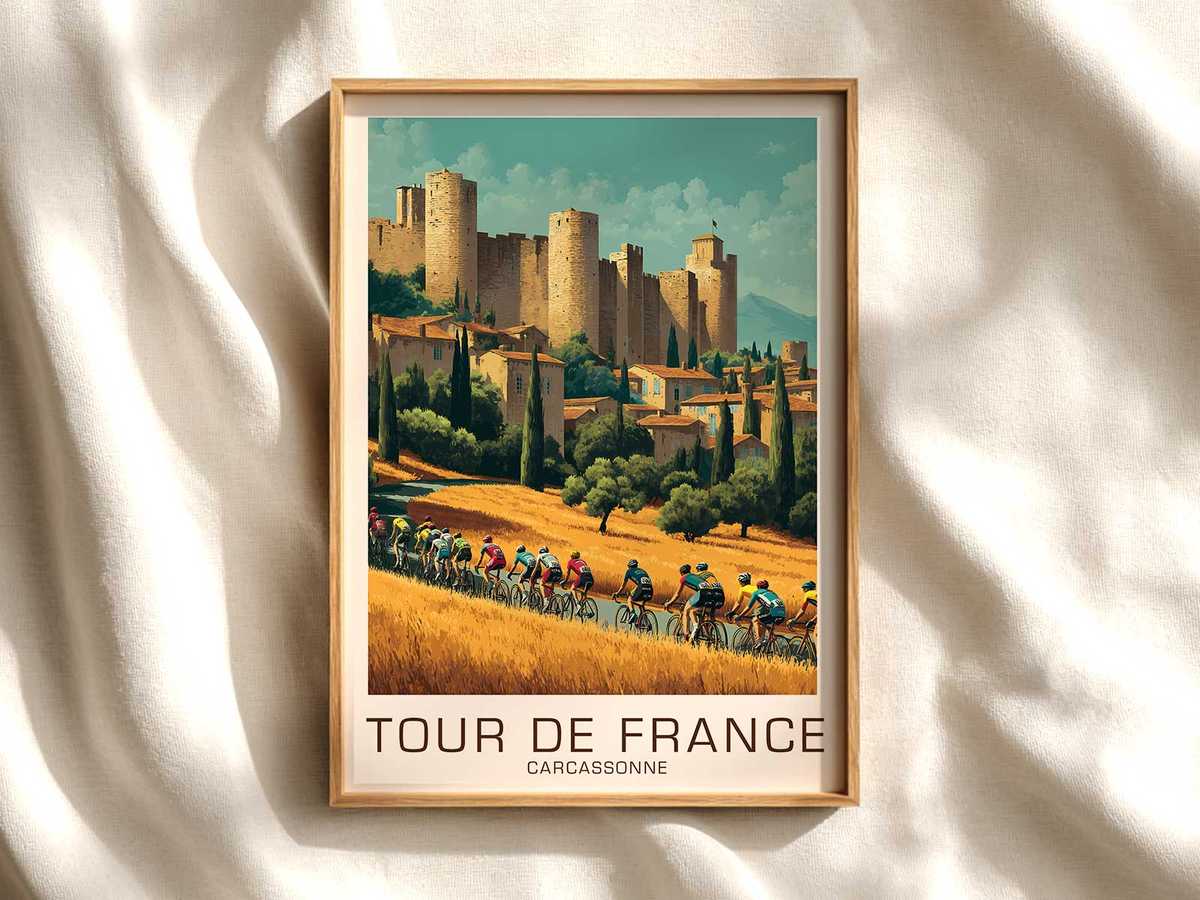
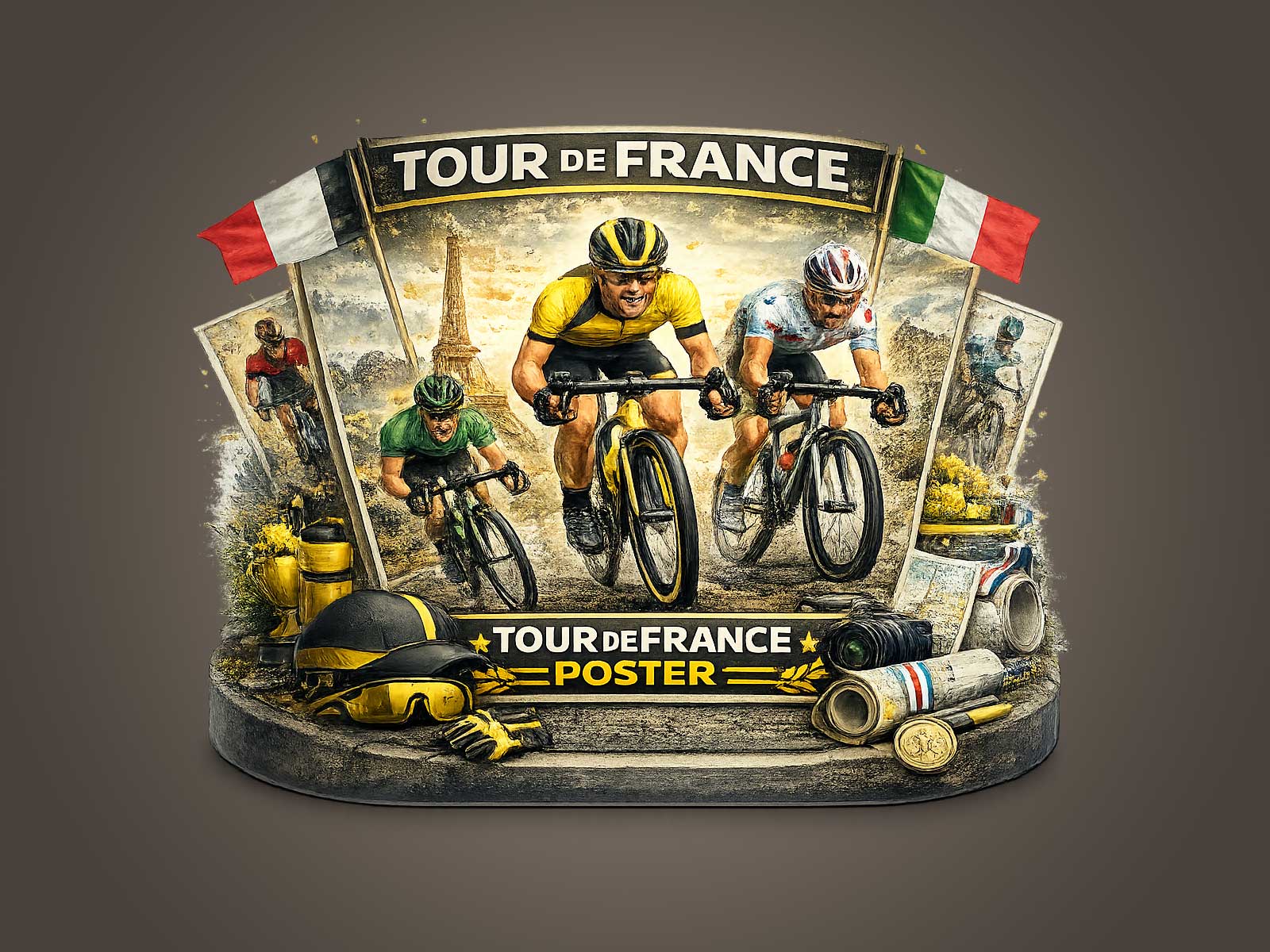
The poster shows one decisive second on the Col du Tourmalet where everything converges: a rider’s shoulders lowered over the bars, a chainline under load, legs carved by fatigue, and the rounded stone of the road bending upward into the next hairpin. This is not a portrait of victory or defeat but a suspended moment of uncertainty—an instant that reads like a tiny film still and yet contains an entire stage’s worth of story.
The visual drama comes from three simple elements working in concert: the slope of the mountain, the compressed proximity of rivals, and the visible labour of the rider’s body. The gradient frames intent—the road climbing away, forcing a change in cadence and posture—while the racers’ spacing signals tactics: a narrow gap, a wheel slightly ahead, and the suggestion of response or counterattack. In that spacing the viewer understands time as a resource under negotiation; the poster makes the negotiation palpable.
Timing is everything. The image freezes the exact beat when a pedal stroke can mean separation or collapse. You sense the effort in the taut muscles and the tucked head; you feel the race clock as an absence—no clock is shown, but the moment implies an approaching minute where everything will be revealed. That implied before-and-after is the heart of why this image works as wall art: it invites the imagination to complete the story. Is this the launch of a summit attack, the last gasp before the group regroups, or the instant a contender concedes ground? The uncertainty is the artwork’s narrative engine.
[IMAGE_INSERT_ARTICLE_01]
Compositionally, the poster uses contrast and negative space to amplify tension. The cyclist’s silhouette against the open sky or the textured verge gives the figure gravity; the road becomes a directional line that pulls the eye, suggesting movement even in stillness. Colour choices—muted alpine greys, a flash of team colour at a sleeve or helmet, the ochre of the roadside—operate like film grading: they preserve documentary grit while heightening focus on the human struggle. This restraint prevents the image from feeling decorative and keeps it grounded in the sport’s physical truth.
What makes a single race instant display-worthy is its capacity to reveal the sport’s deeper qualities: courage under pressure, the arithmetic of margins, and the discipline of pacing. A summit attack condensed into one frame communicates fatigue transformed into decision; a compressed chase shows the tactical intelligence of proximity; a poised sprint catchment compresses speed, risk and timing to their barest essentials. The Tourmalet poster does not need a caption to relay these themes; its visual grammar—angle, spacing, and posture—does the explanatory work.
Bringing this poster into a room changes how the space is read. In a study it becomes a prompt for focus: the rider’s concentration mirrors the intent of someone at a desk. In a living room or game room it introduces an undercurrent of movement, an invitation to imagine the next turn. Framed simply, the image offers a balance between presence and restraint: it is striking at first glance, and the longer you look the more narrative detail reveals itself—the grind of the tyres, the texture of the jacket, the slight lean of the body negotiating the camber.
Ultimately, this Tour de France poster functions like a distilled sporting anecdote. It captures not a fact but an emotion: the precarious, electric moment before the race declares its next protagonist. For lovers of race narrative and considered interiors alike, that concentrated uncertainty is what makes the artwork linger on a wall and in the mind.