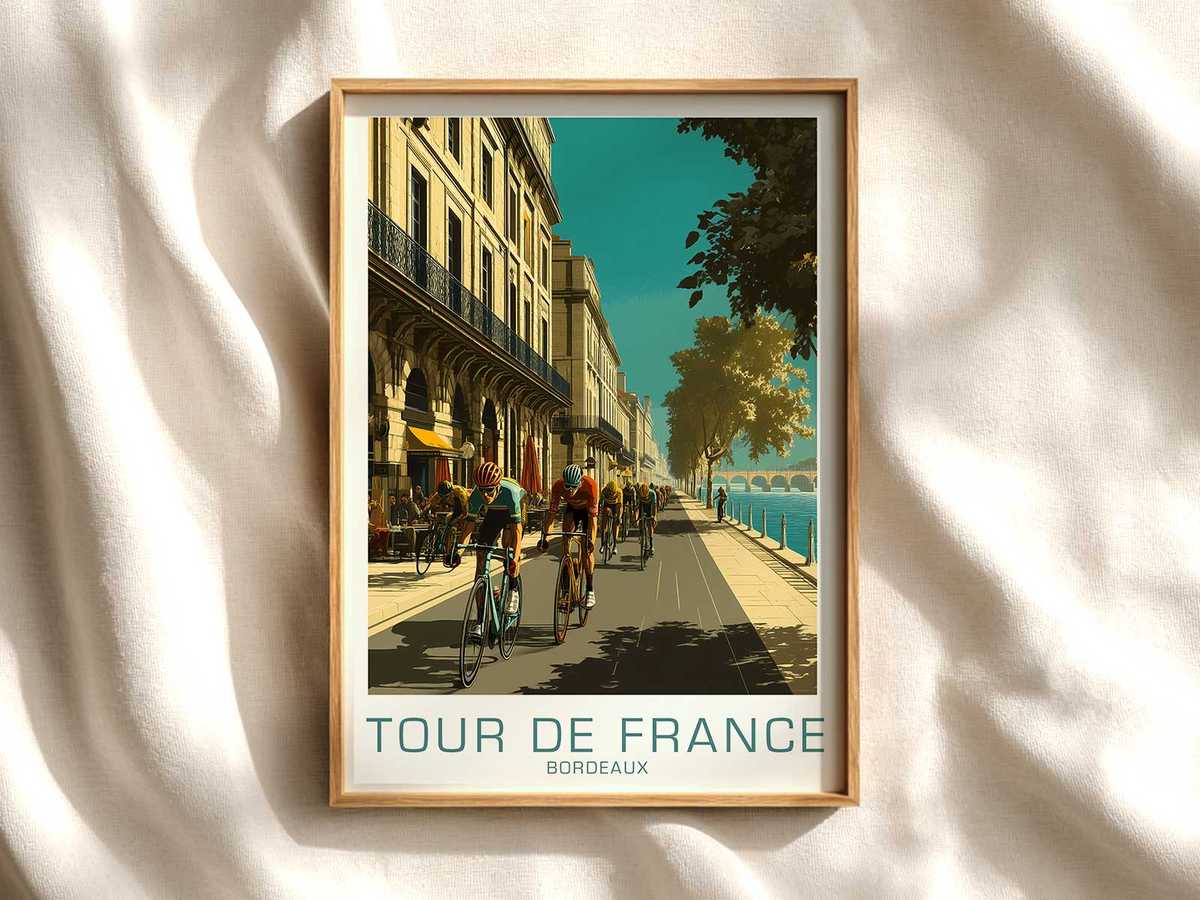
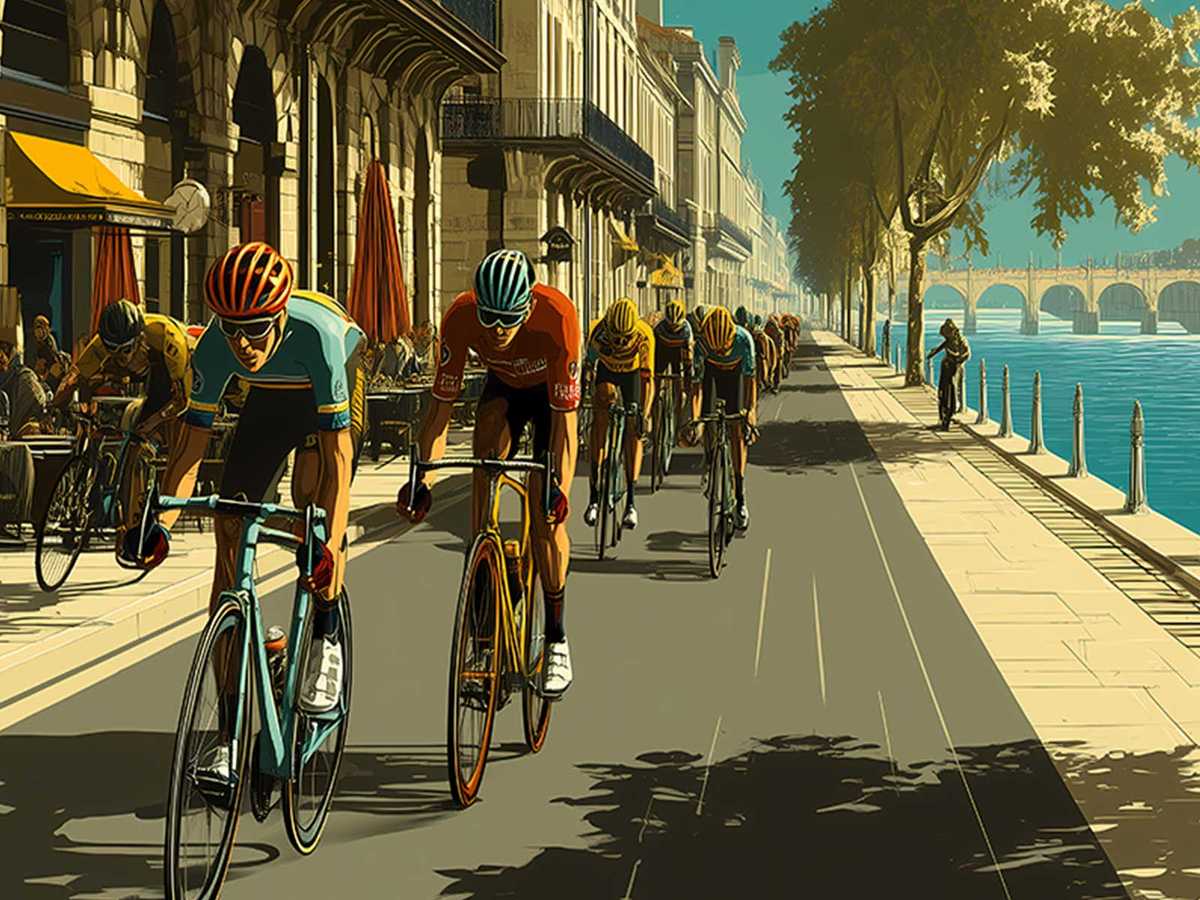
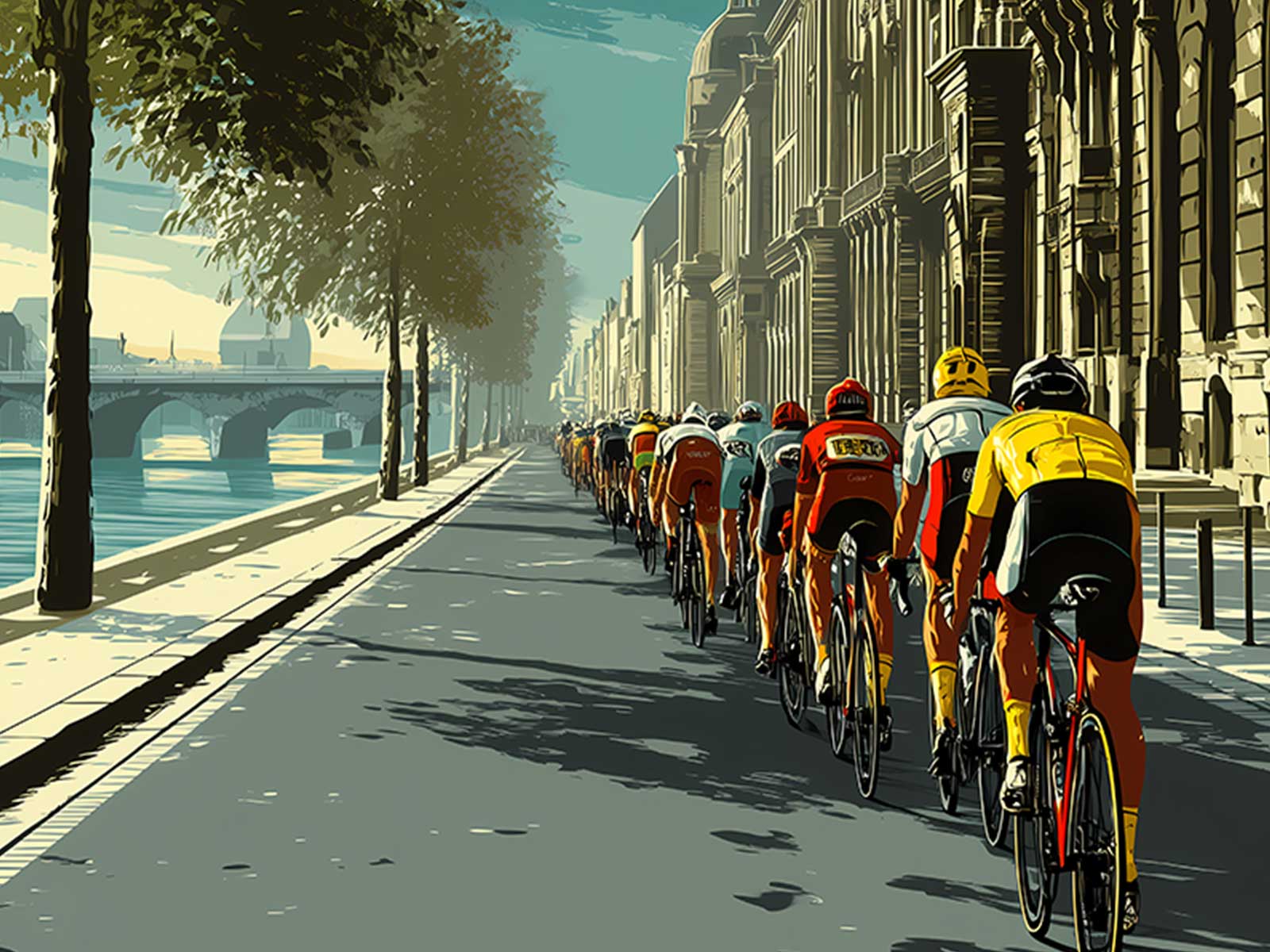
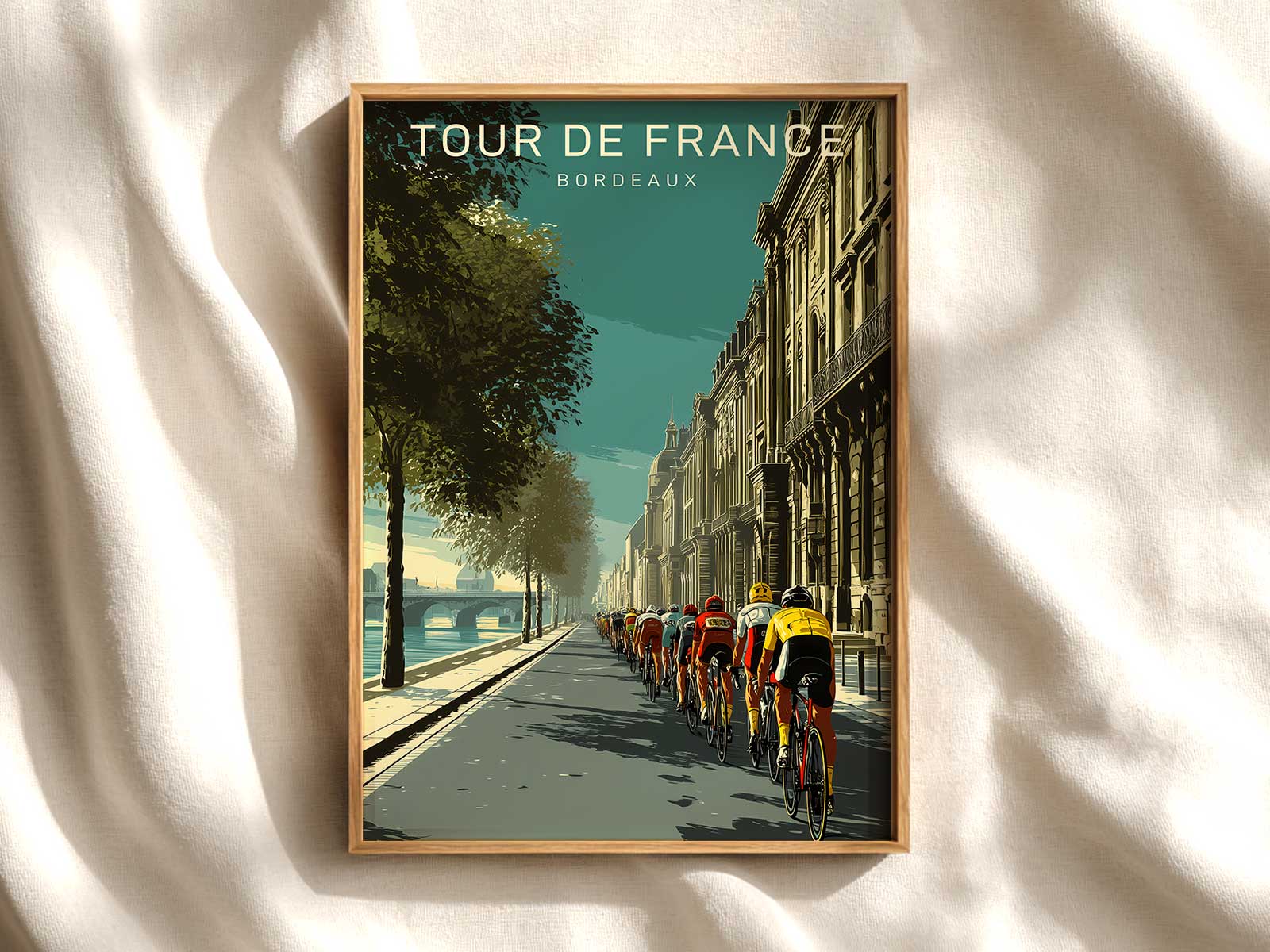
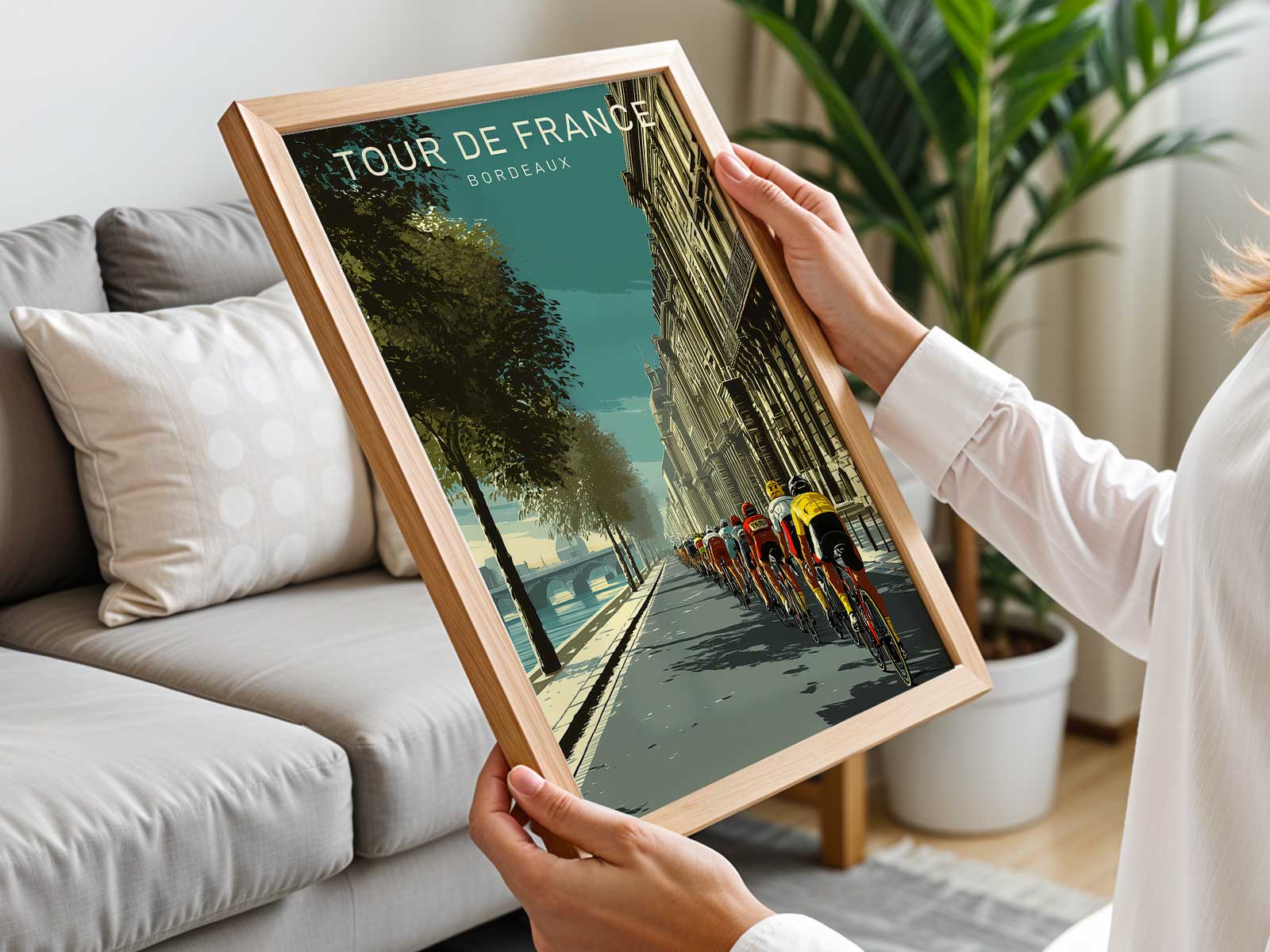
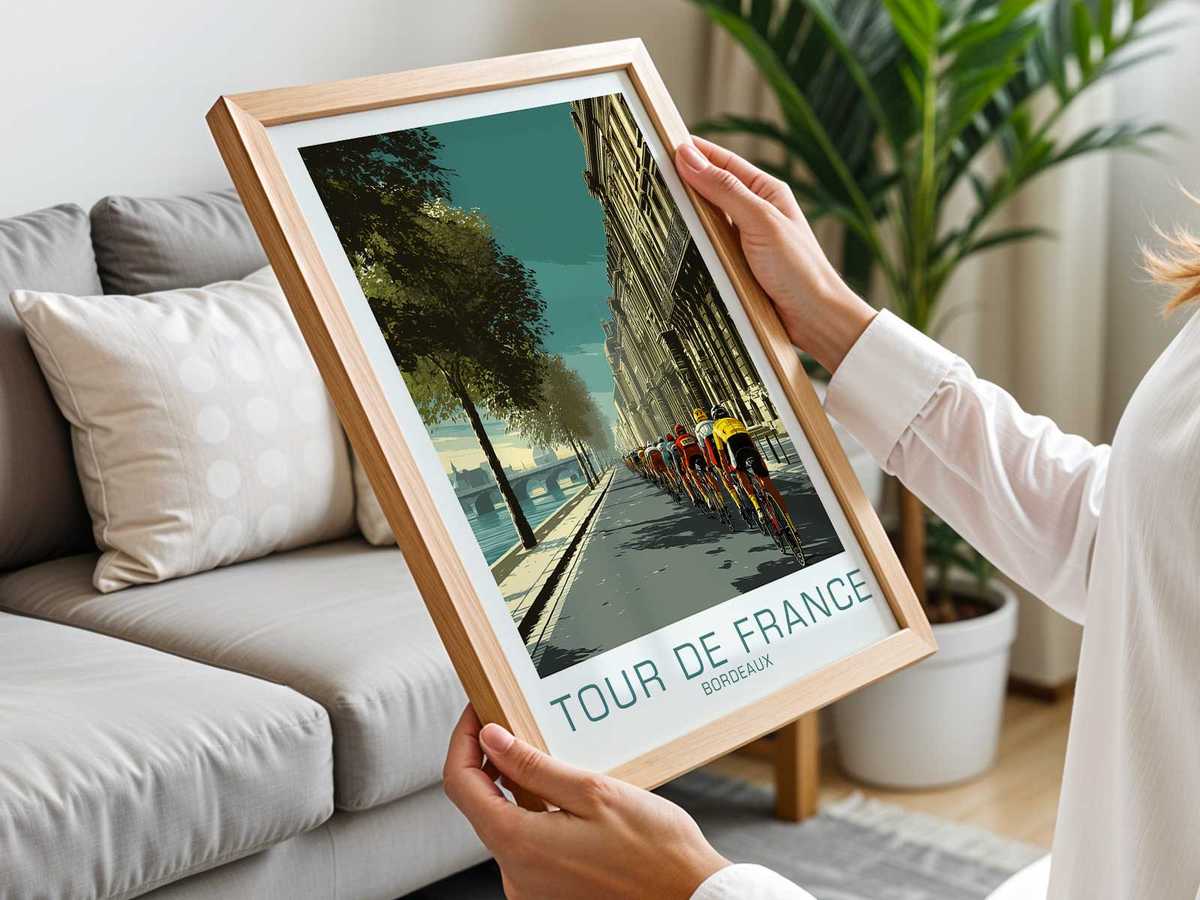
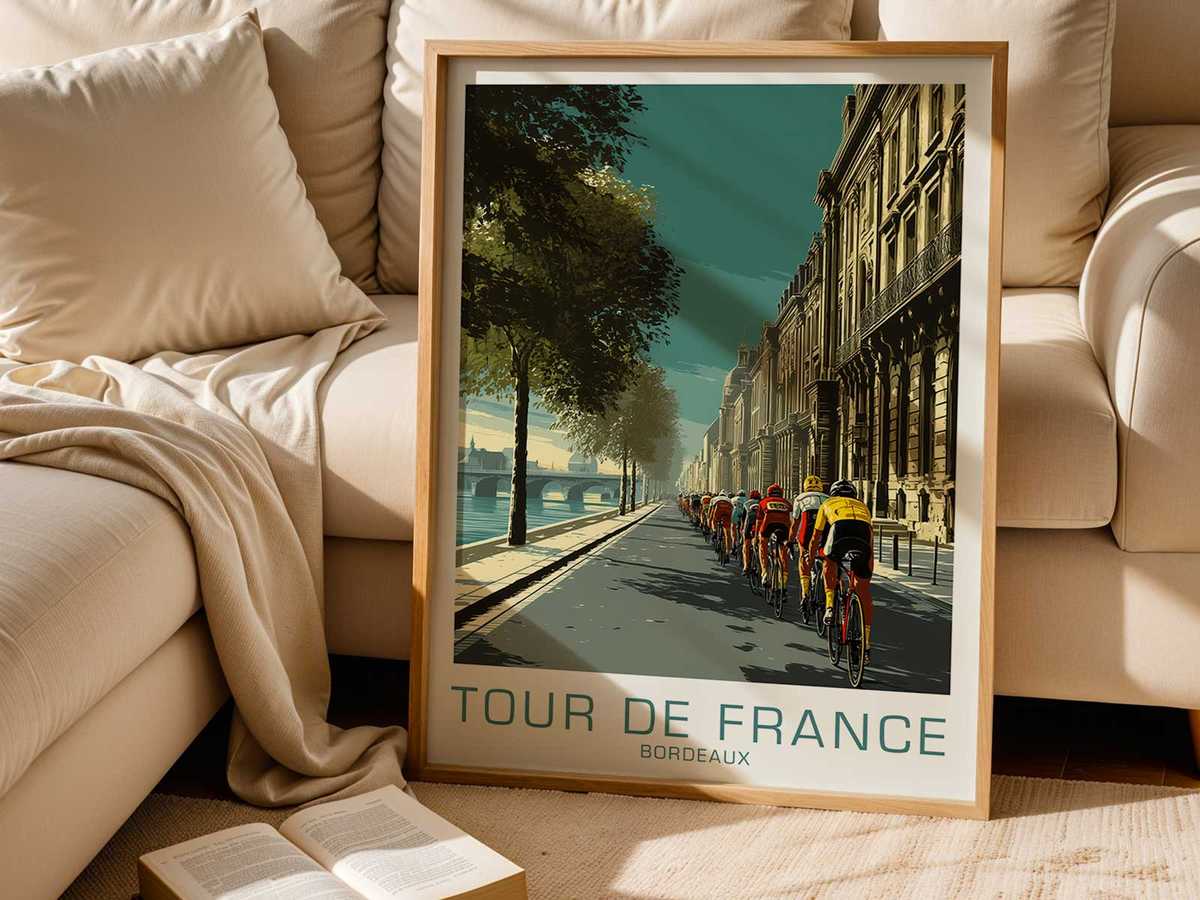
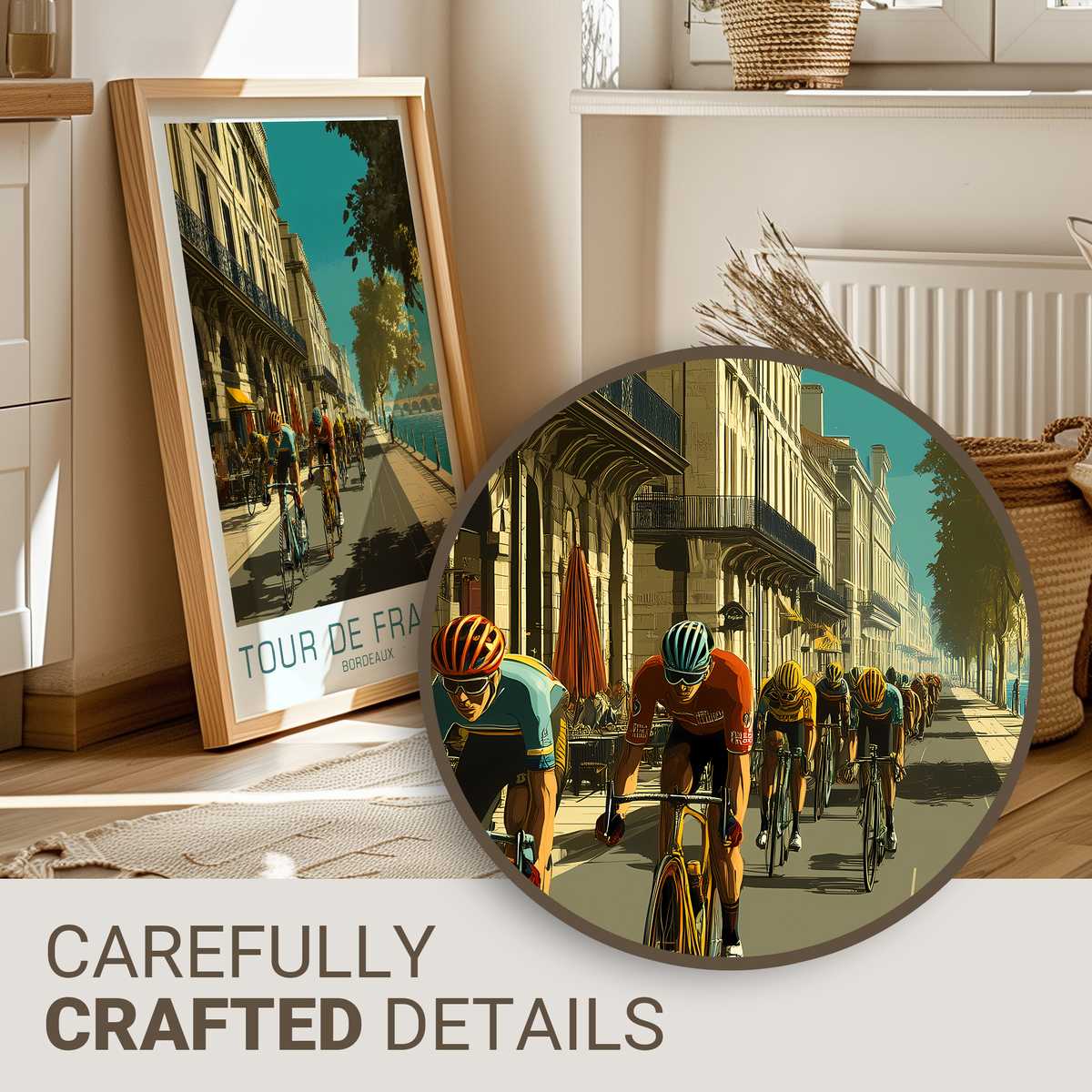
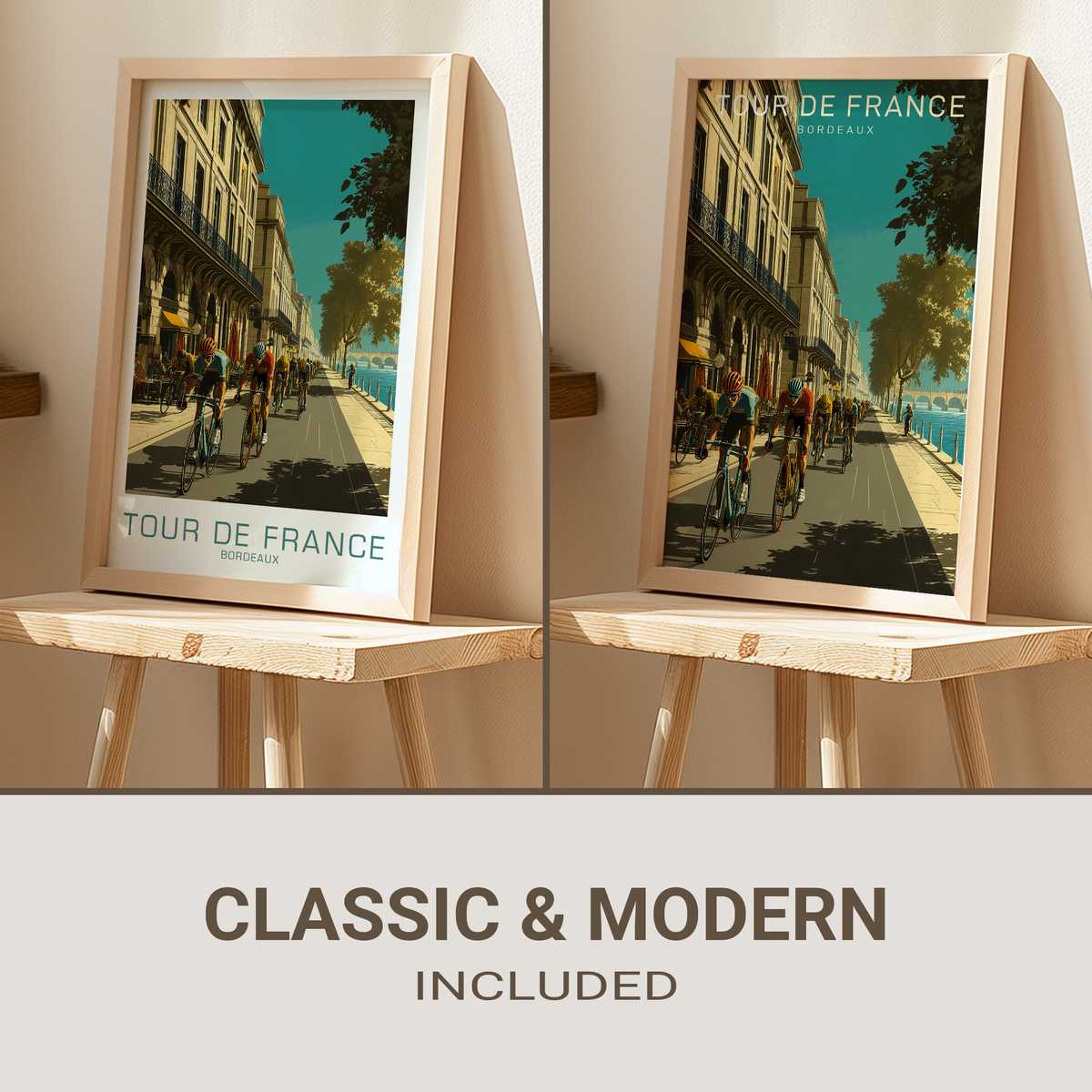
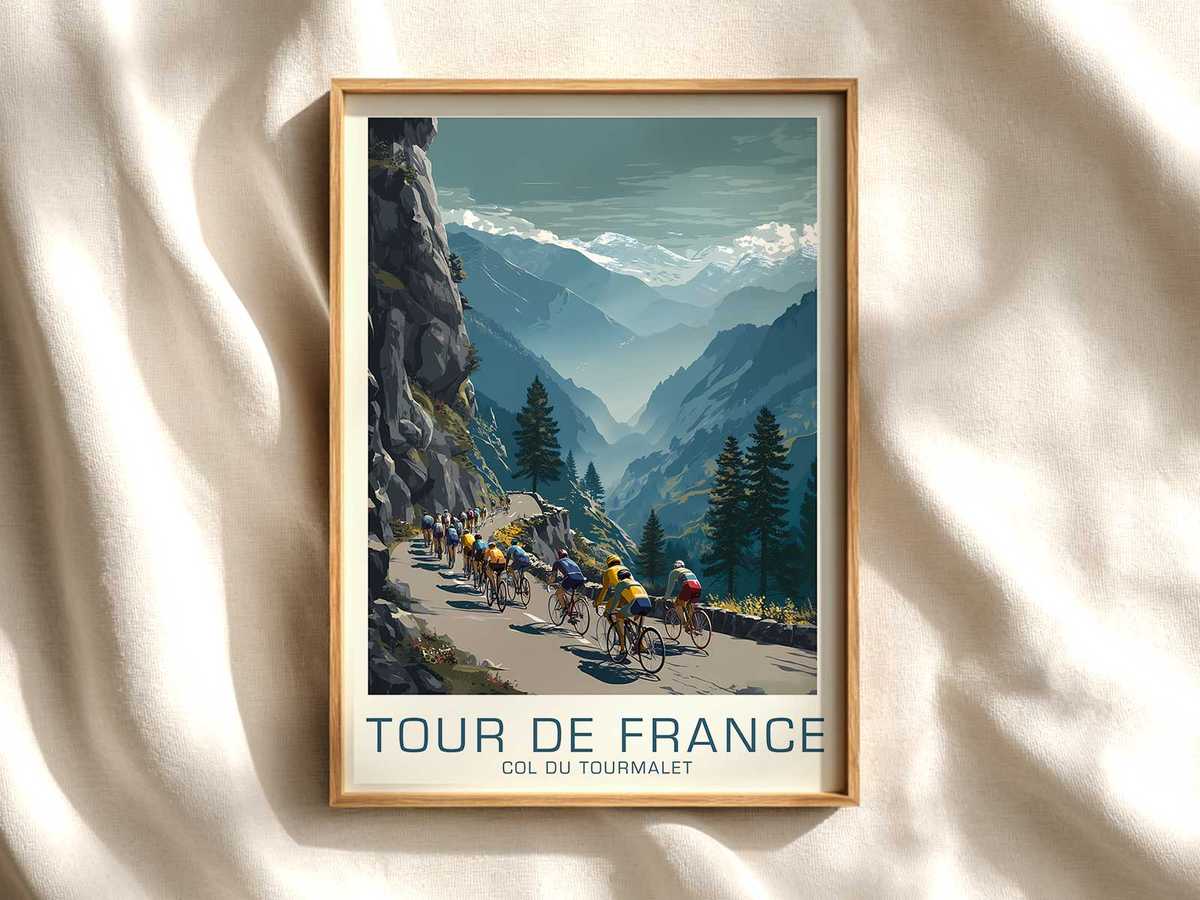
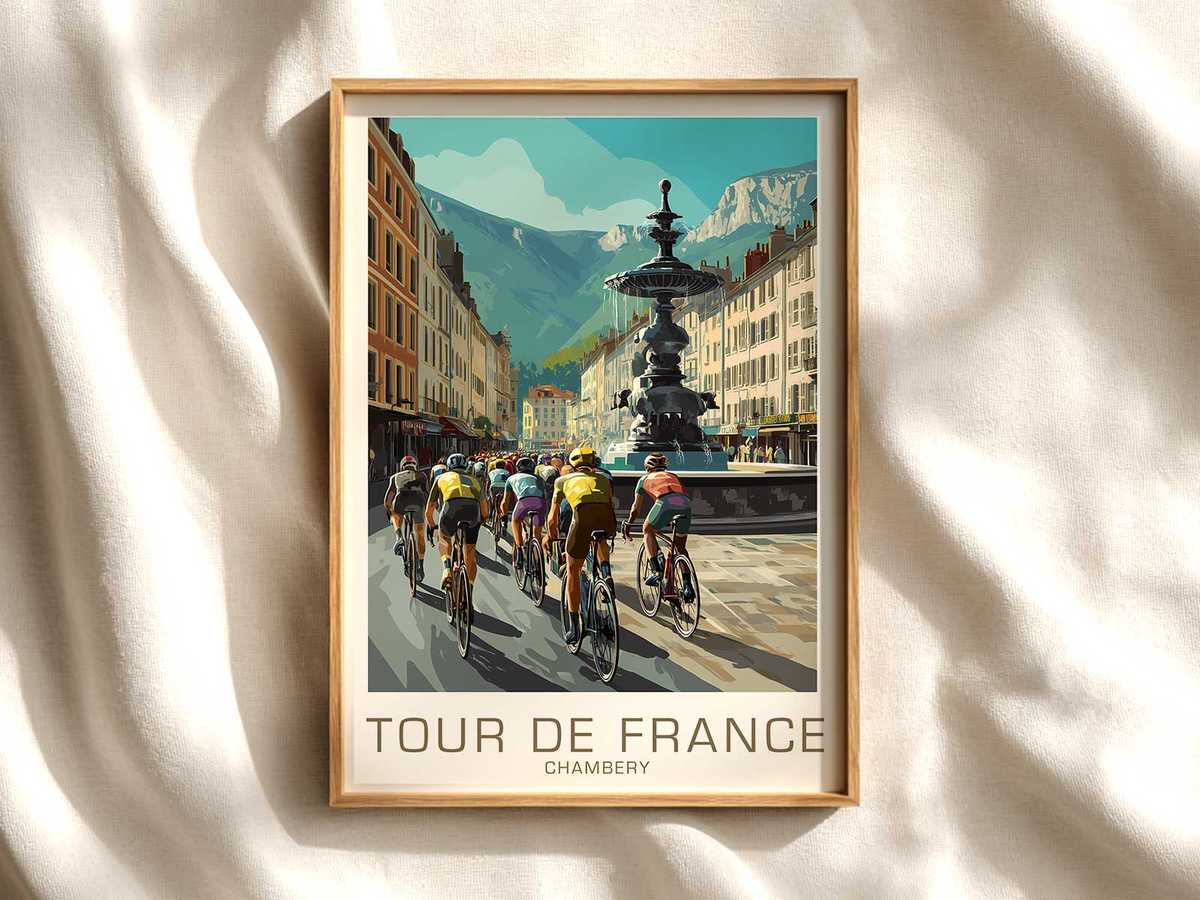
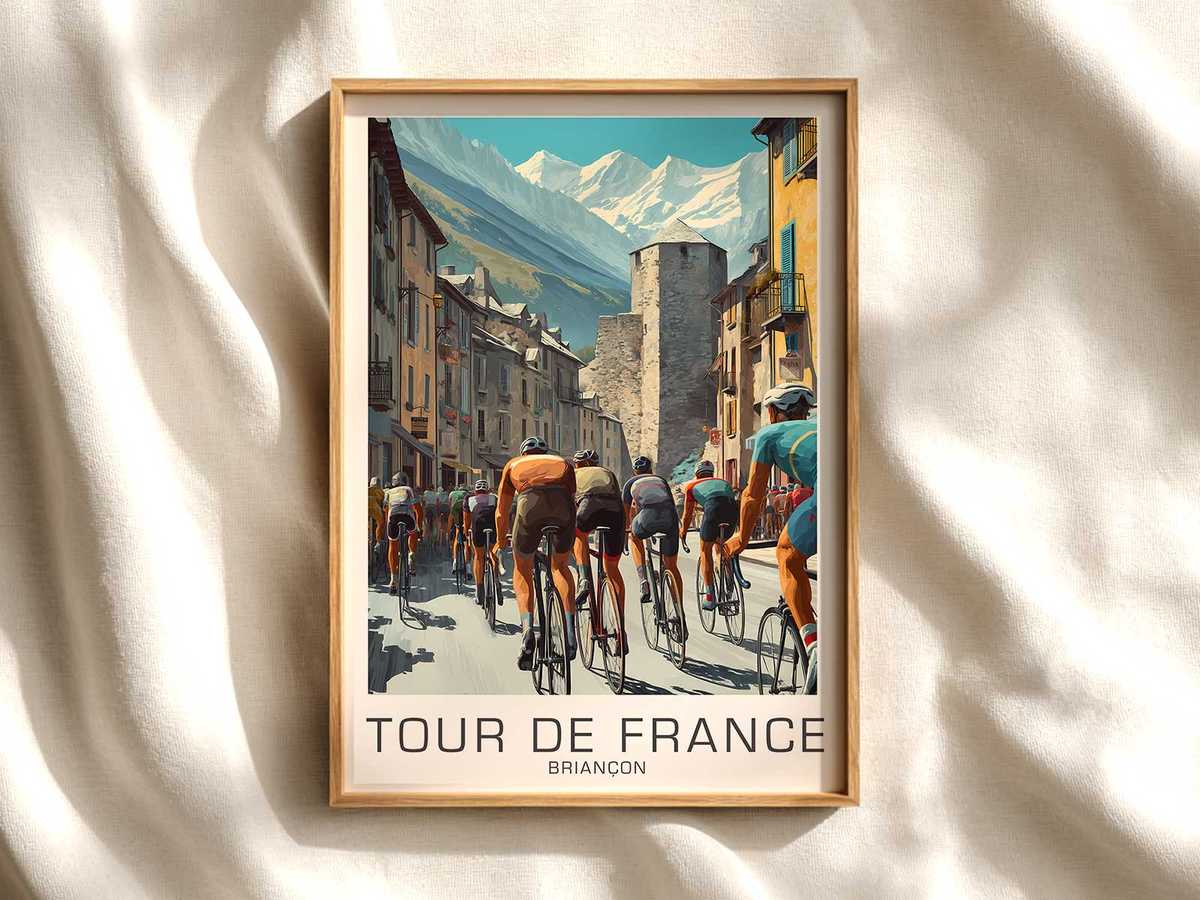
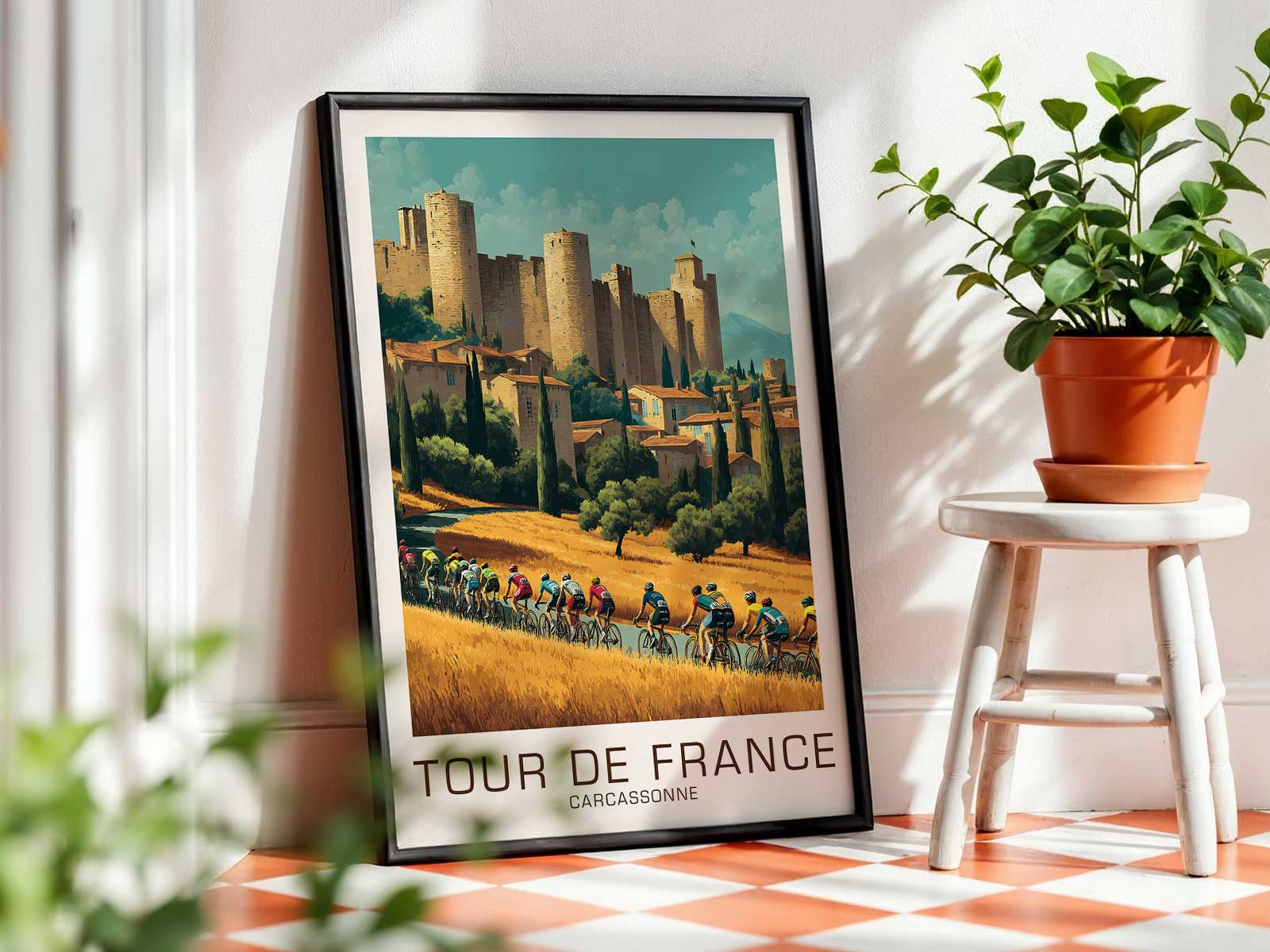
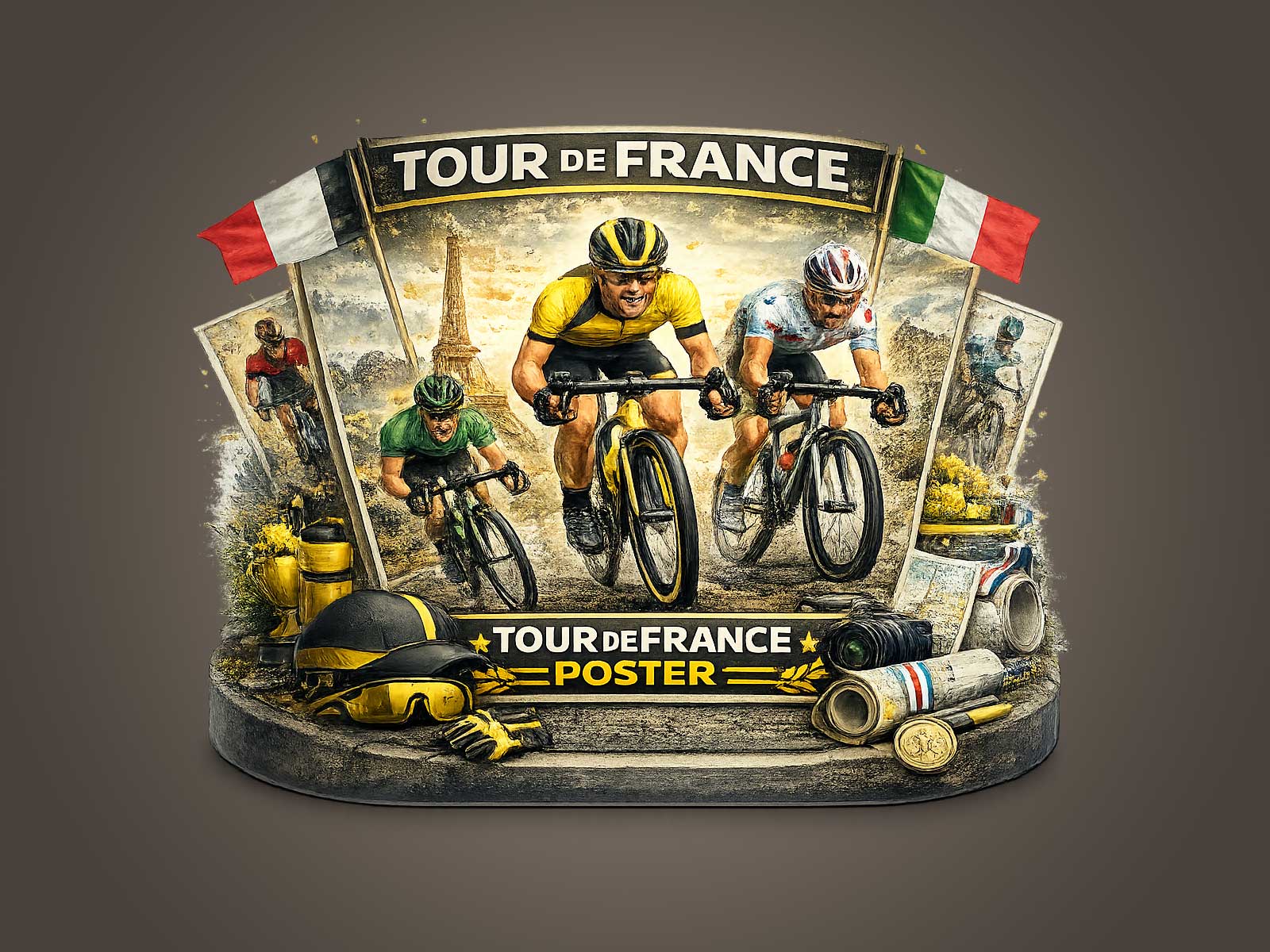
There is a particular hush to images that suggest the Tour without shouting its name: the rubbed edges of a printed poster, a restrained palette that remembers sun-bleached roads, the lean silhouette of an older racing bicycle poised against a Bordeaux skyline. Read as a painting of bicycle within a vintage-linked Bordeaux scene, the poster becomes a small architecture of memory where local heritage, archival aesthetics and cycling culture answer one another with ease. It is not mere nostalgia; it is a narrative of form, surface and lived distance.
Visually, the poster reads like a recovered page from a travel album. Colours are chosen as if by time — muted ochres, deep indigos, and the warm grey of river mist — rather than by modern graphic insistence. This restraint gives the bicycle itself a quietly heroic presence: tubular frame lines, downtube shifters suggested by tiny metallic flashes, a classic leather saddle shaped by long miles. Such details are not catalogued as factual claims but offered as visual cues that anchor the image in cycling’s material culture and invite the viewer to imagine cadence and effort.
Heritage is conveyed through texture more than label. The print character — soft halftone dots, a paper grain that reads like a whisper, slightly imperfect edge registration — evokes the look of mid-century posters and hand-printed lithographs. Those tactile signals create trust: the image feels like an object rather than a digital afterthought. In interiors, that object quality changes how the work functions. A poster read as heritage resists decorative banality because it carries associations of place, season and human labour; it asks to be looked at, not merely to fill a wall.
There is also a local story contained in the Bordeaux reference. Canal banks, limestone façades, and the suggestion of vineyards produce a sense of rootedness. When combined with cycling iconography, the scene becomes a cultural palimpsest: sporting gesture laid over civic memory. The viewer senses both the athlete’s solitary effort climbing a gentle slope and the town’s patient continuity. This duality—sport and place—gives the image decorative depth: in a study or library it reads like a quiet manifesto of endurance and taste rather than a poster of event marketing.
[IMAGE_INSERT_ARTICLE_01]
Typography and composition play a subtle but decisive role. Period-minded lettering, whether hand-drawn or carefully aged, sits within the composition like a placard on a village square. It informs scale without dominating the scene. Negative space is used sparingly and with intention, letting the bicycle’s silhouette and the hint of a route breathe. The result is an image that rewards close looking: small typographic quirks, the way a shadow falls across the frame, the suggestion of a jersey’s striped cuff—each is a narrative cue that accumulates into believable history.
Why does this feel more meaningful than a generic retro treatment? Because heritage-led images rely on implication rather than pastiche. They assemble authentic-feeling fragments — print warmth, classic bike geometry, local architectural hints — into a composition that honors continuity. The emotional charge comes from recognition: the viewer reads the scene as part of an existing story, not as an invented costume party. This makes the poster work in rooms where intent matters: a writer’s study, a design studio, an office where quiet authority is preferred to loud branding.
Collector appeal follows naturally. When an image suggests a lineage — of riders, of roads, of poster-making craft — it feels collectible in the same way a well-chosen book or a framed map does. The piece can anchor a pared-back interior, complement leather-bound volumes, or set the mood beside an old racing trophy or a restored bicycle. Its worth is aesthetic and associative: it promises an atmosphere of endurance, quiet expertise and accumulated taste.
In the end, a painting of bicycle presented through a Bordeaux-vintage lens succeeds because it lets history be felt rather than announced. It invites the viewer to inhabit a moment where route and town, machine and body, print and paper coexist. That layered reading is precisely what gives such a poster its decorative gravity—an image that is at once memory, object and invitation to linger.