Alberto Contador: Crashes, Suspension and the Anatomy of a Comeback
Alberto Contador's career is as instructive for its interruptions as for its victories. From a near‑life‑threatening brain operation early on, to a high‑profile doping suspension and multiple race crashes, Contador's path shows what credible returns to elite stage racing require in way that is concrete and revealing.
Quick answer
Contador's documented setbacks — a 2004 brain operation, the 2012 CAS suspension for clenbuterol, and serious race crashes including a 2014 tibial fracture and a 2015 shoulder injury — were followed by returns that required staged physical recovery, tactical recalibration and public scrutiny, with clear sporting rebounds such as the 2012 Vuelta and the 2015 Giro.
What you will learn here
- Which documented medical and disciplinary events interrupted Contador's career and how they were publicly resolved.
- How those interruptions translated into concrete racing absences and subsequent return results.
- Which aspects of elite recovery are highlighted by Contador's sequence of setbacks and comebacks.
Medical crisis: the 2004 brain surgery
One of the earliest, most consequential interruptions recorded in Contador's career was the surgical removal of a cerebral cavernoma in 2004. That operation was a life‑threatening medical episode and left a visible scar. It is an unusual starting point for any elite endurance athlete — a reminder that some setbacks sit entirely outside the sporting domain and demand recovery protocols driven first by neurosurgery and patient safety, then by progressive return to physical training.
The CAS suspension: facts and sporting consequences
Contador tested positive for clenbuterol from a urine sample taken during the 2010 Tour de France. The Court of Arbitration for Sport (CAS) delivered a guilty finding on 6 February 2012, imposed a two‑year ban backdated to 25 January 2011, and disqualified his 2010 Tour de France victory along with voiding some subsequent results. The sanction produced an enforced competitive hiatus and formal erasure of a flagship result from his palmarès.
From a return‑to‑racing perspective the sequence is simple and instructive: official finding → period of ineligibility → permitted return to competition. The clearest sporting marker after the suspension was Contador's victory in the 2012 Vuelta a España — his first Grand Tour after the ban — which demonstrates that a rider can re‑establish top‑level performance in the immediate seasons following a disciplinary absence when training and race-readiness are restored.
Major crashes and injuries in racing
Contador's career record includes multiple race crashes documented by contemporary reportage. Two well‑recorded incidents illustrate different recovery demands.
At the 2014 Tour de France (stage 10) he suffered a crash that caused a micro‑fracture of the right tibia and forced him to abandon the race on 15 July 2014. That event required him to stop racing in that Grand Tour and undergo the standard recovery trajectory for a tibial fracture: removal from competition, medical monitoring and progressive load rebuilding.
In contrast, during the 2015 Giro d'Italia Contador crashed on stage 6 and injured his left shoulder but continued racing and ultimately won the overall classification, confirmed on 31 May 2015. The same season therefore contains both a serious forced withdrawal (2014 Tour) and a high‑profile example of pain management and tactical coping within a Grand Tour (2015 Giro) that ended with victory.
The physical road back: practical implications
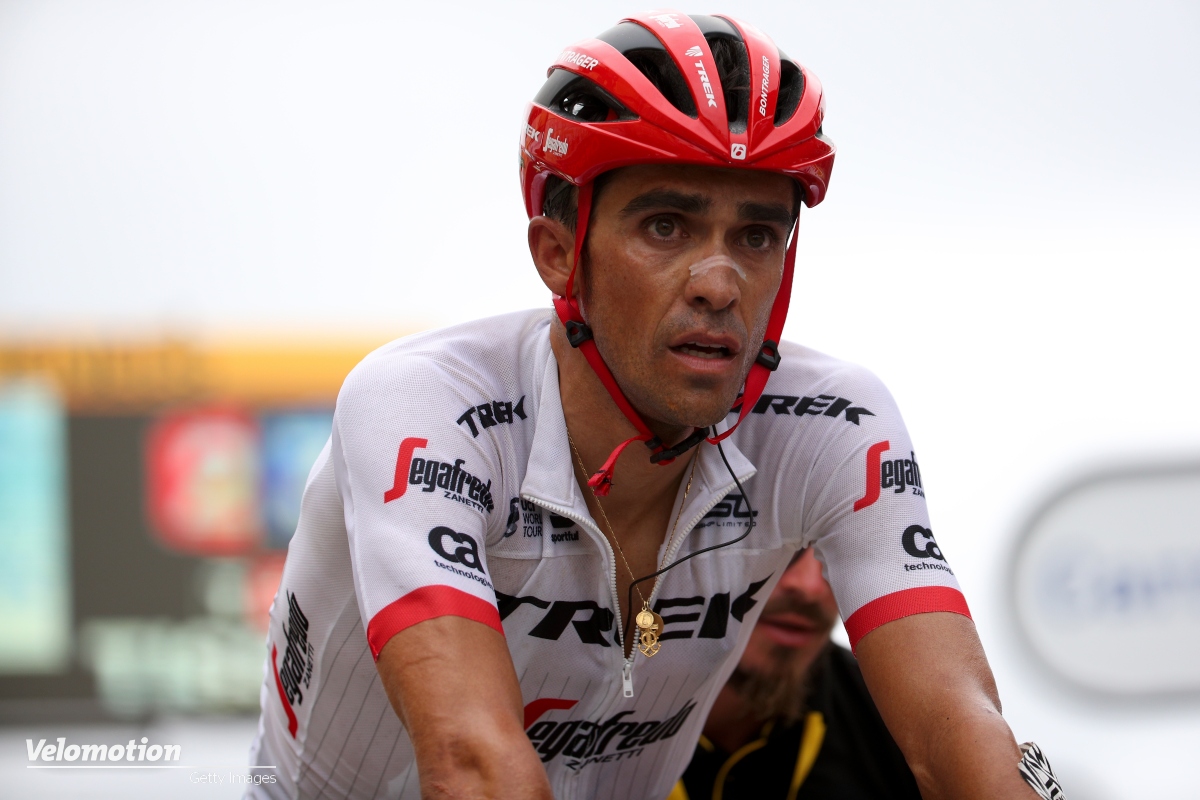
Across these documented events, the physical demands of returning to elite stage racing share common features. A neurosurgical recovery (2004) focuses first on neurological stability and a graded reintroduction to aerobic load. Bone injury (2014 tibia micro‑fracture) requires fracture healing timelines, followed by rebuilding of leg torque, cadence tolerance and stage endurance. Soft‑tissue and joint issues (2015 shoulder) demand preservation of core and climbing power while managing range‑of‑motion limits.
In every case the clock for a credible comeback is not simply medical clearance: it includes regaining stage‑race durability — the ability to sustain multiple high‑intensity days — and reconditioning specific capacities such as climbing torque and time‑trial comfort that determine Grand Tour outcomes.
Tactical and psychological recalibration
Contador's documented returns show tactical variation. After the CAS suspension, his 2012 Vuelta win represented a rapid reinstatement of aggressive stage‑race tactics at the highest level. After physical crashes, tactical adjustments can be more subtle: race management that limits unnecessary risk, selective targeting of decisive stages and smarter energy allocation across three weeks. The 2015 Giro — where he finished overall winner despite an earlier shoulder injury — is an example of racing through discomfort while still securing the necessary margins in key stages.
Publicly documented facts do not allow definitive statements about internal psychology, but the sequence of withdrawal, suspension and immediate return wins points to a capacity to recompose training and race planning under scrutiny — a practical mental skill as much as a private trait.
What changed in the rider after returning
Using only recorded events, Contador’s post‑setback career shows two clear shifts. First, he continued to achieve Grand Tour victories after disruptive interruptions, which indicates successful restoration of physiological performance. Second, his competitive timeline contains both enforced absences (the CAS ban) and race withdrawals for injury, meaning his calendar and objectives were periodically reset. That mixture of enforced pause and active recovery arguably shaped when and where he targeted peak form.
Results that proved recovery
The most concrete evidence of high‑level recovery in Contador's record is his victory in the 2012 Vuelta a España — the first Grand Tour he contested after the CAS suspension — and his overall win in the 2015 Giro d'Italia despite an earlier shoulder crash. These documented outcomes provide the clearest sporting confirmation that his returns were competitive and not simply participatory.
What this comeback story says about elite cycling
Contador’s documented arc highlights several broader realities about elite road racing. Medical crises require multidisciplinary management long before the rider reaches the start line. Suspensions or enforced absences remove competition rhythm but do not always preclude a return to peak performance when training continuity and targeted racing are restored. Finally, race crashes remain an endemic risk: recovery is a mix of physiological healing, tactical adaptation and managing external scrutiny.
Closing notes
Alberto Contador’s career interruptions — from a 2004 brain operation to the 2012 CAS suspension and later crash‑related withdrawals and injuries — are documented facts that together form a credible case study in how elite cyclists can rebuild. The sequence shows that comebacks at the Grand Tour level demand precise medical timelines, deliberate physical reconditioning and tactical choices that protect durability across three weeks. Where the public record ends, interpretation must remain cautious; the verified events alone already offer a useful map of what high‑level recovery in professional cycling requires.
Author: Alex R.