Cycling echelon explained: how crosswinds split the peloton and decide races
An echelon is a deliberate diagonal paceline used when a crosswind hits the race: riders stagger across the road so each one shelters slightly to leeward of the rider ahead. In professional racing—most visibly at the Tour de France—echelons are a common, technically demanding tactic that can quickly split the peloton and produce race‑deciding time gaps.
CLEAR DEFINITION
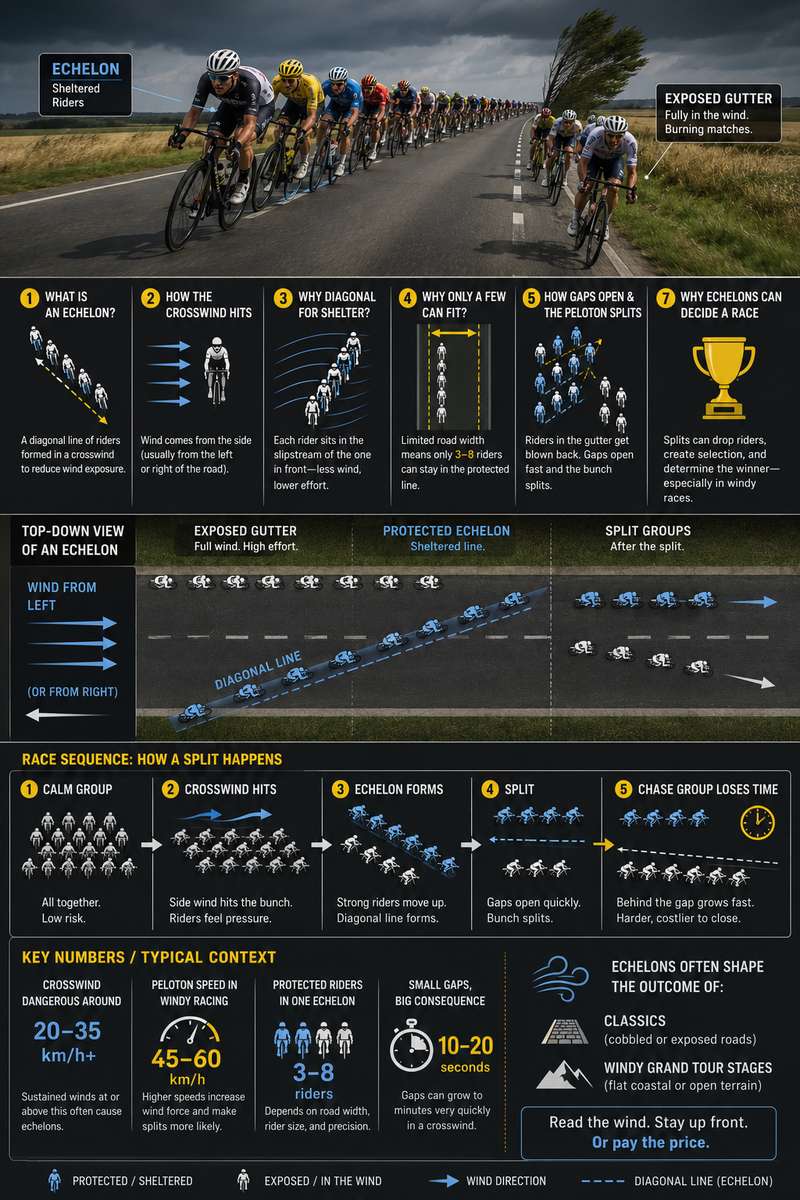
An echelon is a paceline formation used when there is a crosswind. Instead of riding directly behind one another, riders form a diagonal line across the road so each rider sits leeward (downwind) of the rider in front and gains aerodynamic shelter. The formation intentionally fans the group across the pavement to block the wind for those in the line.
HOW IT WORKS
Crosswinds shift the relative wind angle. When wind comes from the side, the best place to draft is not directly behind another rider but slightly to that rider’s leeward side. Teams and riders rotate through a staggered paceline so the group’s blockage of wind moves with the formation. Because race roads have limited width, the lead echelon can only include a finite number of riders; the rest must form secondary echelons or remain exposed.
WHY IT MATTERS IN CYCLING
Echelons can create significant consequences quickly. A front echelon that rides strongly can open gaps of seconds or minutes between groups. Those gaps matter for stage wins and general classification because time lost in an echelon split is real race time. Professional races routinely watch for crosswind sections because the peloton’s shape changes and the race can be decided by which riders make the front group.
TOUR DE FRANCE CONTEXT
In the Tour de France and similar pro races, crosswind sections are viewed strategically. Teams that anticipate wind and secure forward road position can initiate or join the front echelon, putting rivals in the exposed groups behind. Over three weeks, repeated exposure to echelons affects fatigue and cumulative time differences, making tactical positioning essential on windy stages.
TACTICS AND TEAM STRATEGY
Successful echelon attacks combine timing, road position and teamwork. Teams push tempo to form the front echelon on an exposed sector; domestiques and rouleurs work at high pace to sustain it. The goal is simple: pack as many protected teammates into the front group as possible. Riders who are late to react or trapped on the wrong side of a road feature can be left in a slower group and lose valuable seconds.
RIDER ROLES AND PHYSICAL EFFORT
Echelon riding is physically demanding. Riders on the front take long, hard pulls directly into the wind while those staggered behind get partial shelter but must hold line in side winds. Domestiques and strong rouleurs typically execute the heavy work of forming and maintaining echelons. The technique requires precise bike-handling because riders are offset, close together, and managing lateral force from the crosswind.
TERRAIN AND STAGE PROFILE
Flat and exposed rolling stages with long open sections or coastal roads are the likeliest places for echelons. Narrow roads make it easier to create splits because a single echelon saturates the width quickly; very wide roads allow more riders to fit into the protective line but still limit total numbers. Route designers and weather combine: a windy, open stage is a classic recipe for echelon action.
SAFETY AND RISK
Echelons are technically demanding and have inherent risk. Riders are staggered and maintain close, offset proximity while coping with side gusts; the formation is unstable at speed. Crashes and dangerous moments can follow loss of control, sudden wind shifts, or mistakes in spacing. For this reason, professional instruction and experience emphasize disciplined riding and small, steady rotations through the line.
FAN VIEWING GUIDE
On TV or roadside, watch for teams moving to the front before a known exposed sector. An echelon often begins as a single rider surges, then teammates and rivals fan out across the road. Notice which riders are fighting for the wheel of a team leader—the ones who make that protected front group are likely to gain time. Time gaps on the road and the formation’s angle to the wind signal whether a split will stick.
CLOSING INTERPRETATION
Echelons reveal a core truth about road racing: small margins of position and a bit of weather can trump raw power. When crosswinds appear, the geometry of draft changes, and the race becomes a chess match of who occupies the forward, sheltered diagonal. Understanding echelons helps fans see why seconds appear and why teamwork, tactics and road sense matter as much as legs on a windy day.
Author: Alex R.