Crosswinds in cycling explained: why echelons form and how teams use them
Crosswinds are one of the simplest forces in road cycling but also one of the most race-defining. A steady side wind shifts the safe drafting position off the rear wheel and forces riders to ride diagonally; that is why echelons appear. On exposed flat roads — coastal stretches, open farmland or deserts — crosswinds can quickly turn an ordinary stage into a tactical battleground where teams deliberately create splits and drop rivals.
Quick summary
Crosswinds push riders into staggered diagonal lines called echelons so they can shelter from the wind. Road width limits echelon size, leaving some riders exposed in the gutter and causing gaps. Teams at the front use this to force splits and gain time on flat stages.
What is a crosswind? A clear definition
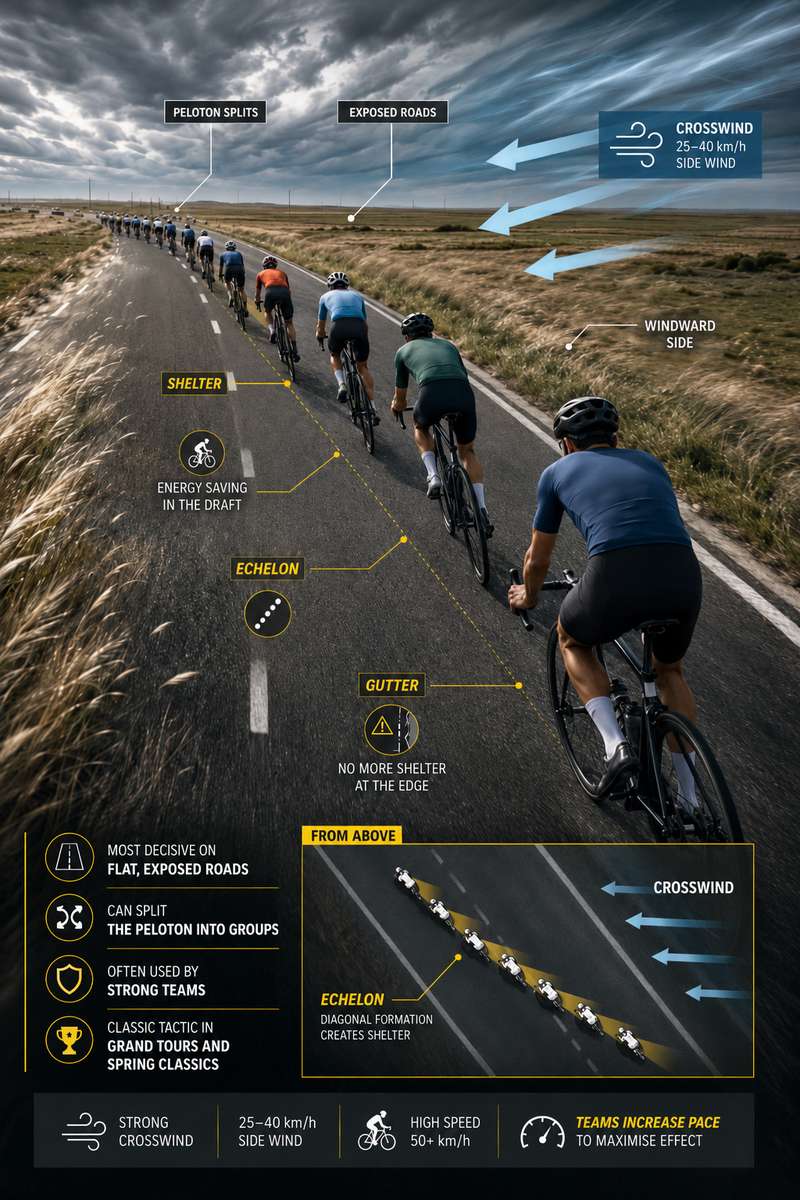
In road racing terms, a crosswind is a steady wind that blows across the road rather than head-on or directly from behind. That side wind changes the most aerodynamic place to ride: instead of sheltering directly behind the wheel ahead, the best position moves diagonally off to the side. Riders react by forming staggered lines to regain protection from the wind.
How echelons work: the mechanics and limits
An echelon is a staggered, diagonal chain of riders where each cyclist sits a little to the side of the rider in front to shelter from the wind. The offset reduces aerodynamic drag for riders inside the echelon compared with those exposed to the wind. But road width imposes a hard limit: only a few riders can fit in a single echelon on a narrow road. When the road is too narrow for everyone, multiple smaller echelons form and riders who cannot find a protected spot are left out in the wind — a situation called being 'guttered'.
Why crosswinds matter in racing
Echelons change the fundamental dynamic of a stage. On flat terrain where everyone expects a bunch sprint, crosswinds can split the peloton into several groups. The riders in front who are sheltered work together and can open a gap; those left in the gutter expend more energy and risk losing contact. Because these splits happen on flat roads, they can create significant time gaps and influence overall standings or stage outcomes.
Tactics and team positioning
Teams use crosswinds deliberately. Strong teams place powerful riders on the windward side (the side facing the wind) to drive the pace and control the echelon's angle. Teammates on the leeward side act as shields for protected leaders. By riding hard at the front in crosswinds, a team can force rivals into the gutter and cause gaps that other teams must chase — often with heavy cost in energy.
Rider skill and physical effort in echelons
Echelon riding is both tactically and technically demanding. Riders must hold tight, offset positions, rotate smoothly, and maintain high speed while steering in close quarters. The rider in the windward anchor role takes strong, repeated turns; those tucked in recover. Mistimed moves, poor handling, or uneven rotations increase the risk of crashes and make sustaining an echelon physically punishing.
Equipment and aerodynamics
Aerodynamic studies confirm that being sheltered in an echelon noticeably reduces drag compared with being exposed in the gutter. While equipment choices like wheels, frame aerodynamics and clothing matter, the immediate protection offered by echelon position usually outweighs small equipment gains. In short, good positioning is often more decisive than marginal equipment differences when crosswinds arrive.
Safety and viewing tips for fans
For riders, crosswind echelons raise crash risk because of close spacing, steering under lateral force and sudden accelerations. For viewers, the tell-tale signs are diagonal lines across the road, sudden increases in pace, and groups forming with gaps between them. If you see teams pushing on an exposed road, expect a possible split — that’s when flat stages become unexpectedly decisive.
Closing interpretation
Understanding crosswinds is a shortcut to reading a race. A side wind turns simple drafting geometry into a tactical weapon: teams choose who shields, who drives, and who is sacrificed. On exposed terrain, that choice often decides who gains time and who is left chasing. Grasping echelons explains why flat stages are not always safe and why team organisation, terrain and a single gust can be as important as climbs or time trials.
Author: William L.