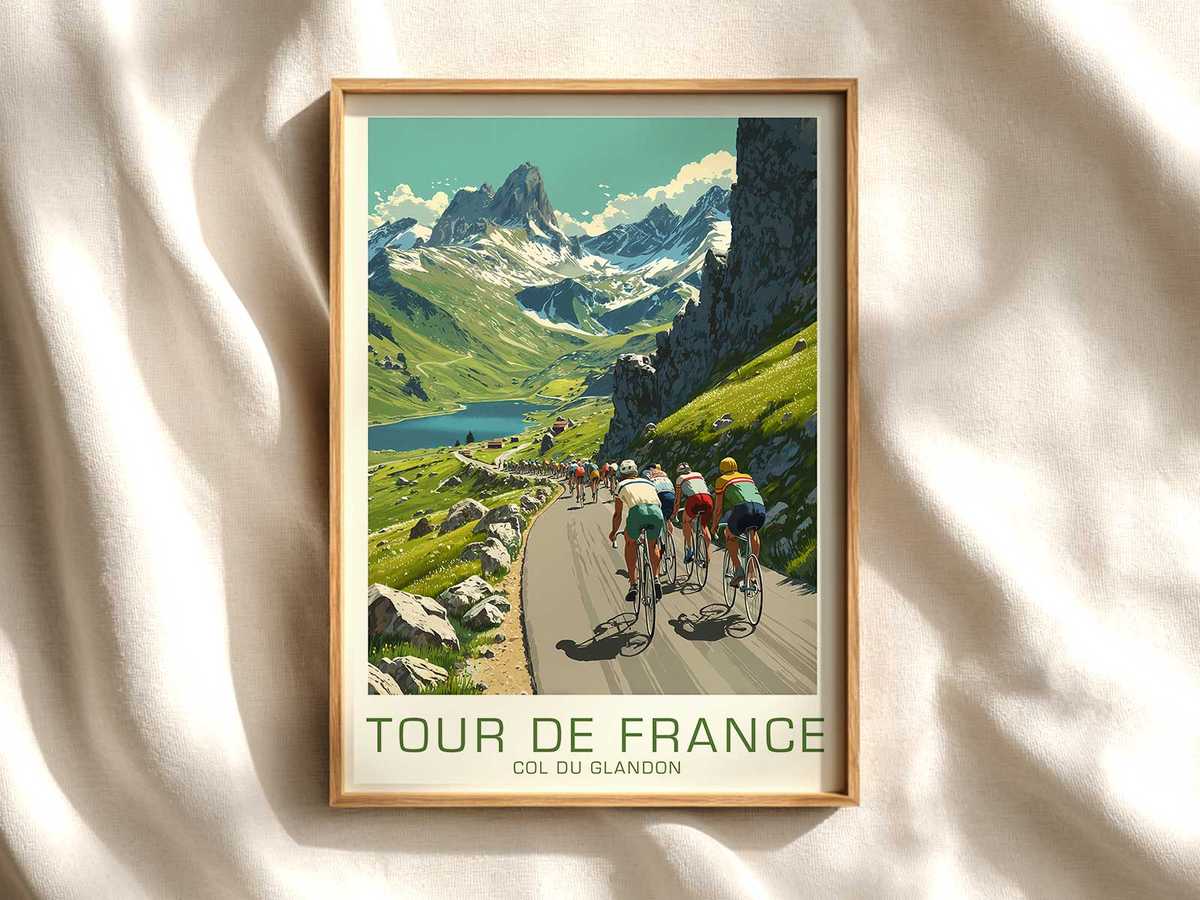
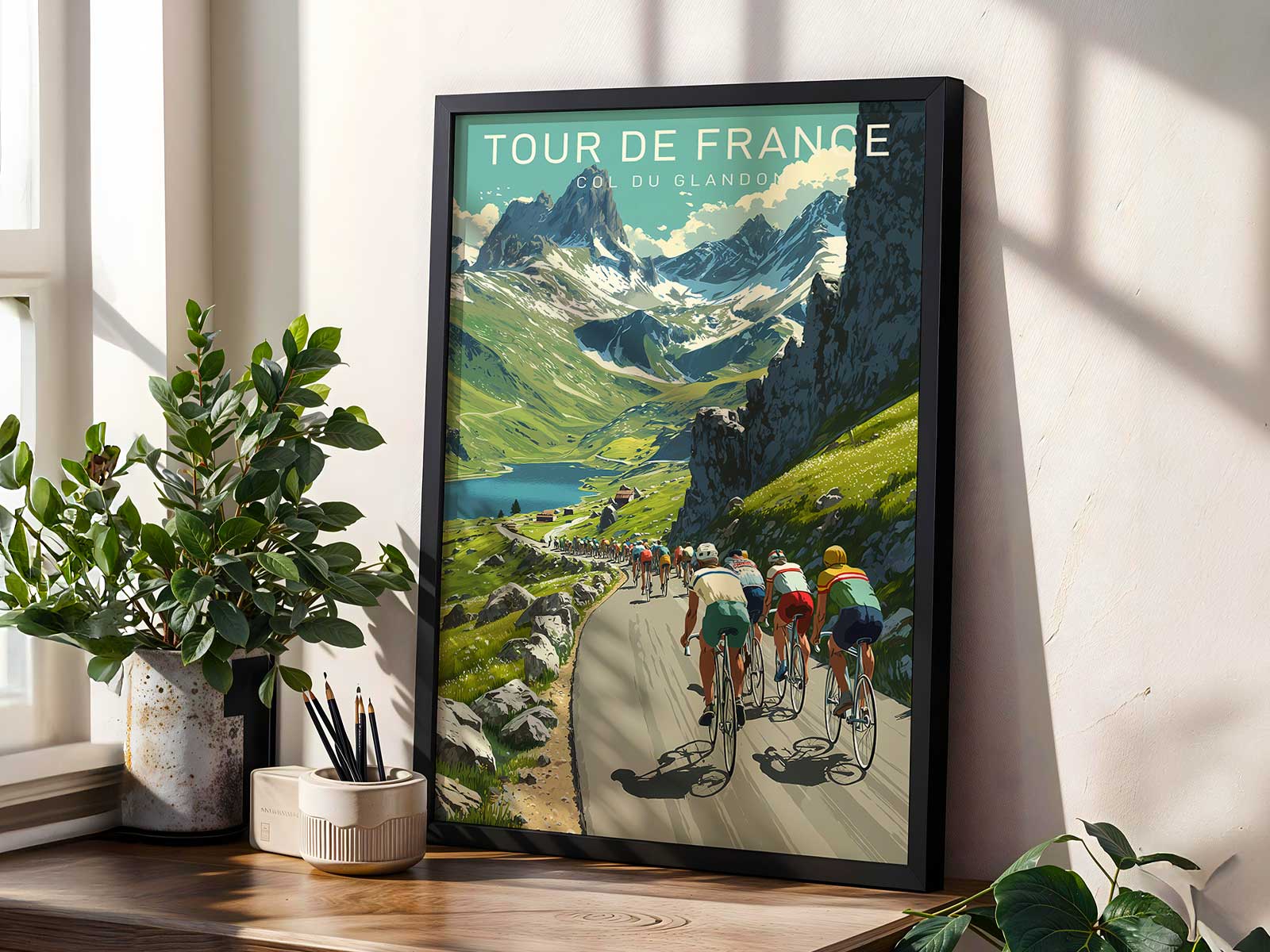
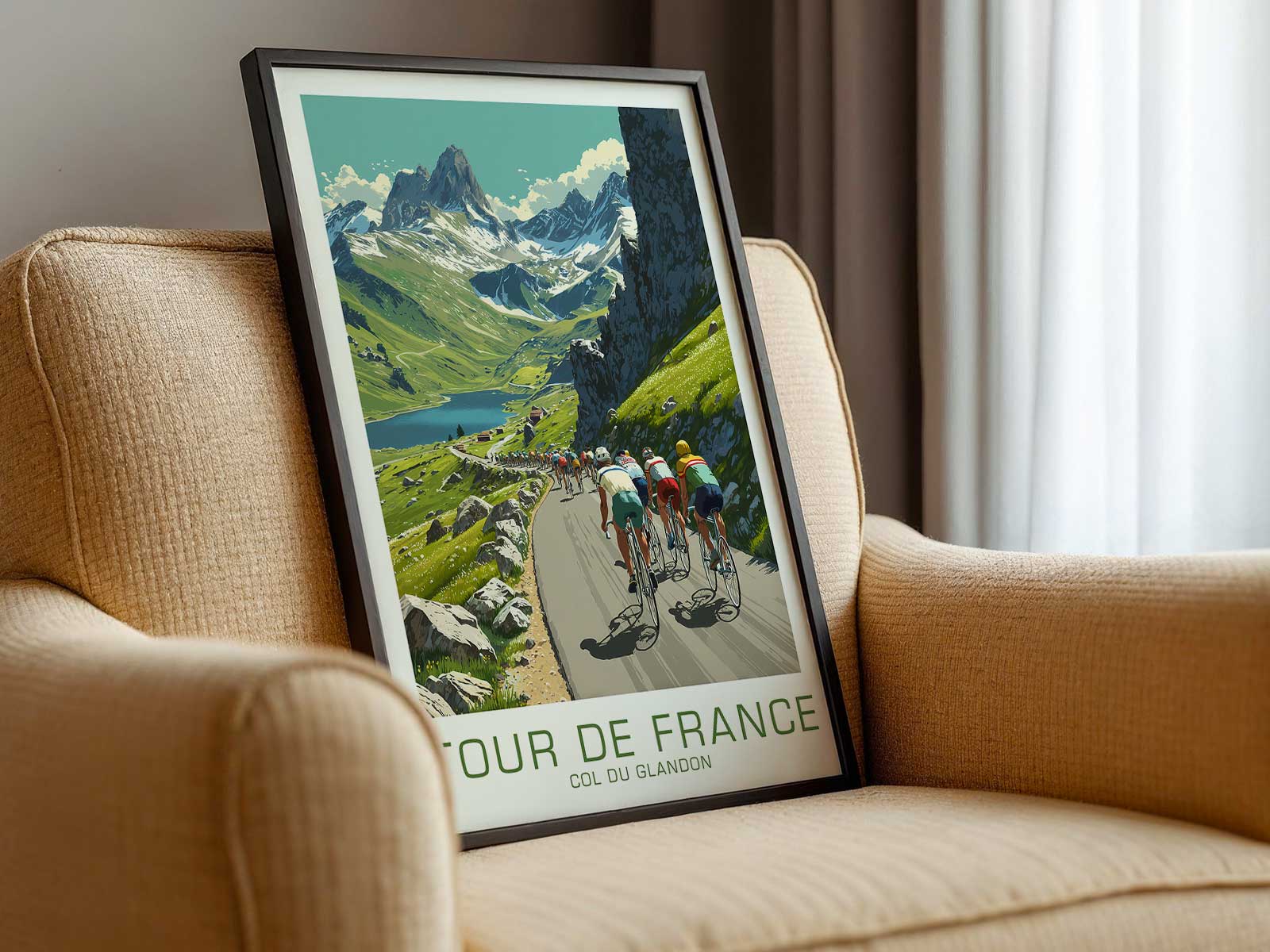
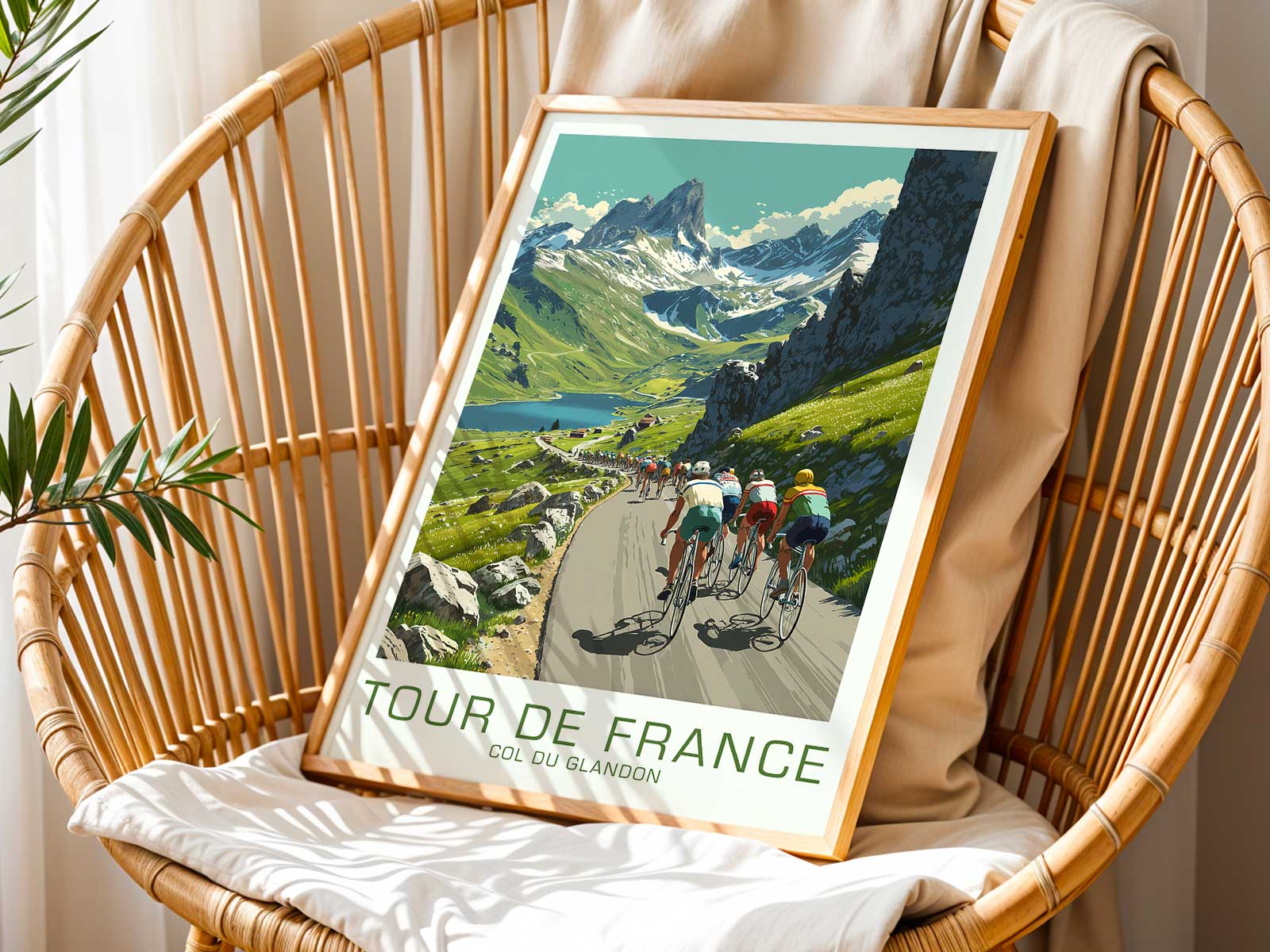
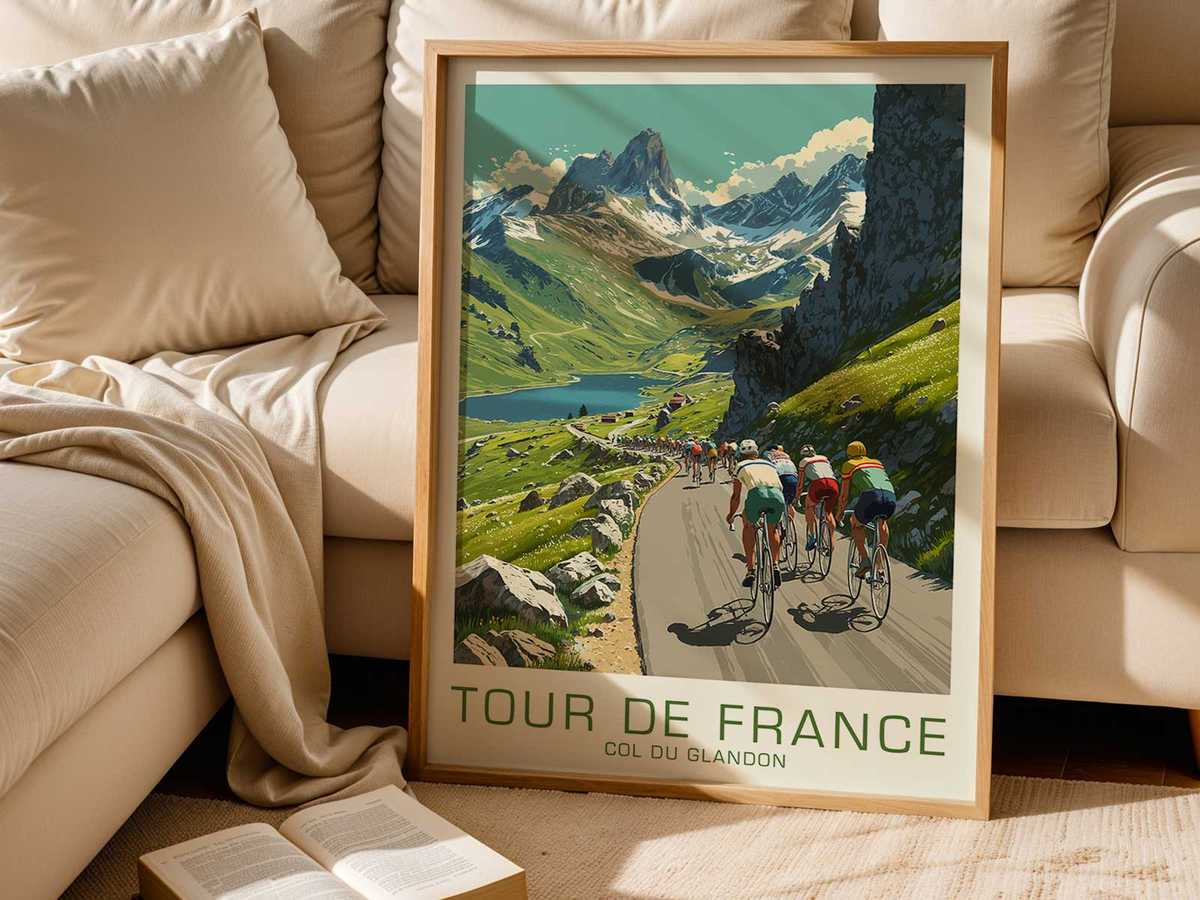
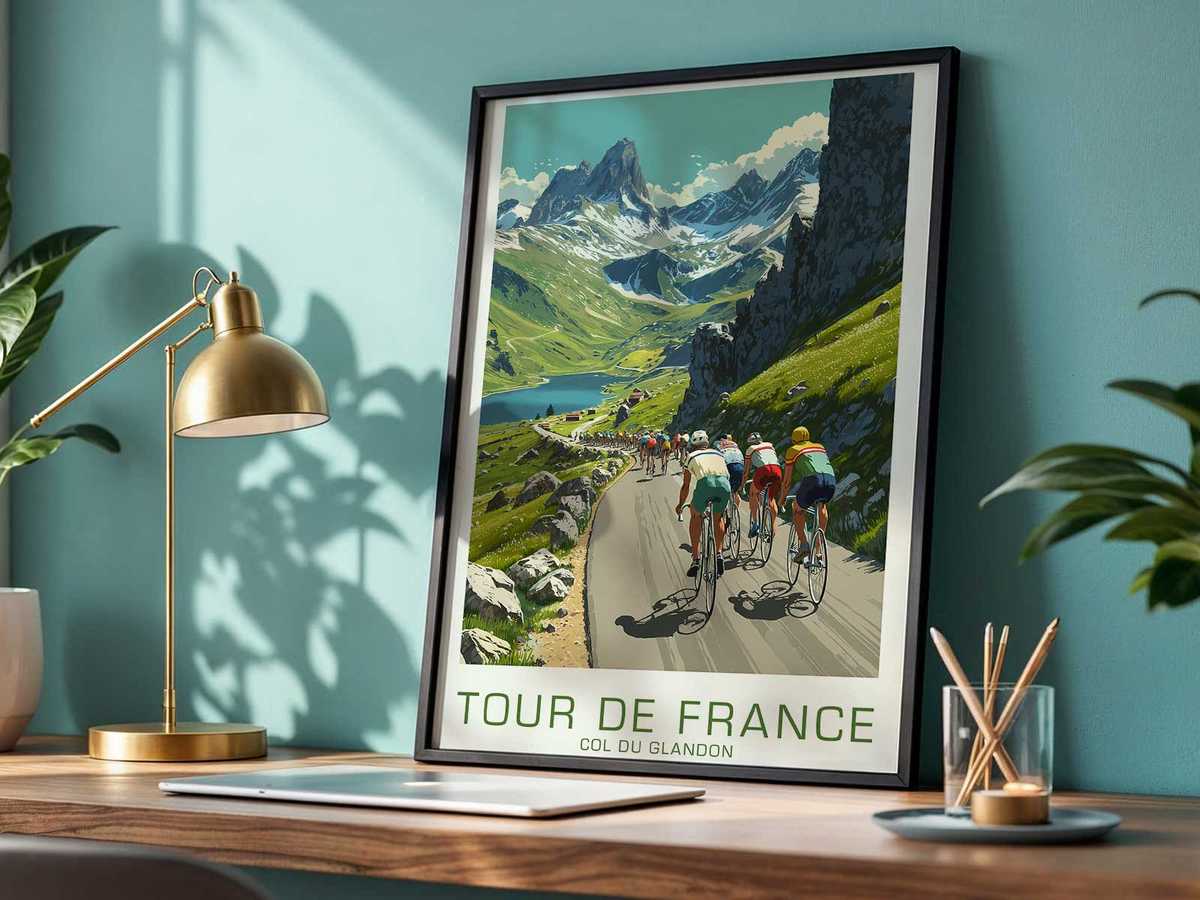
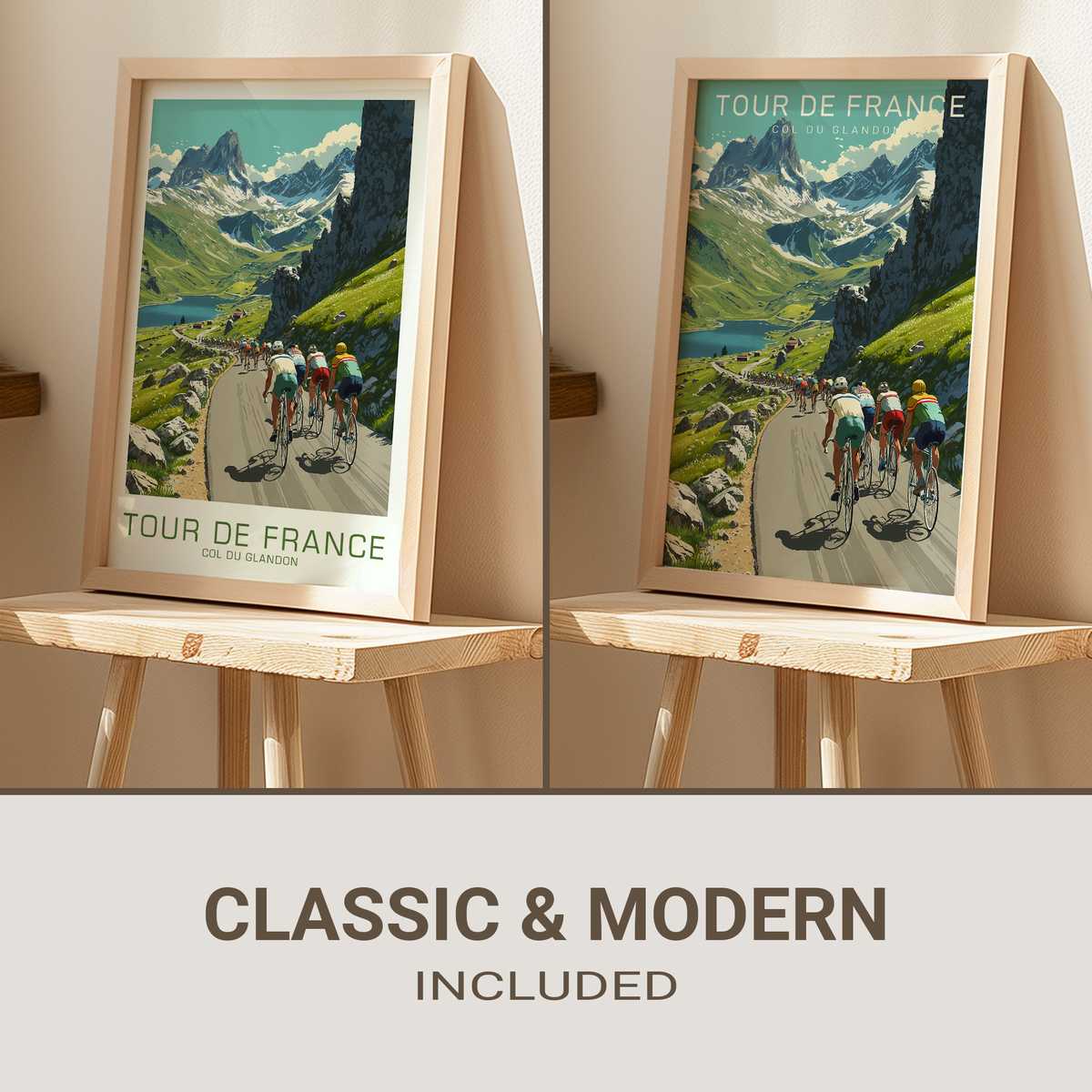
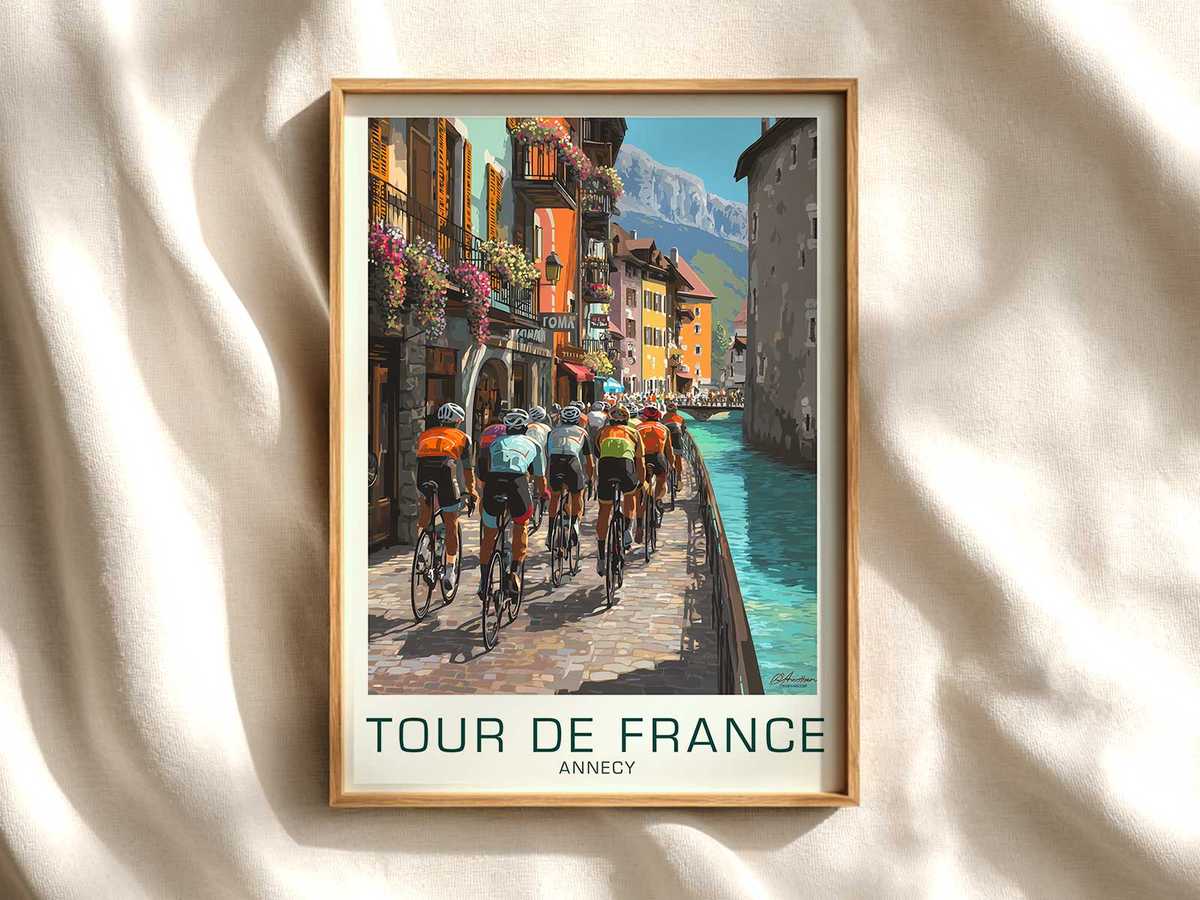
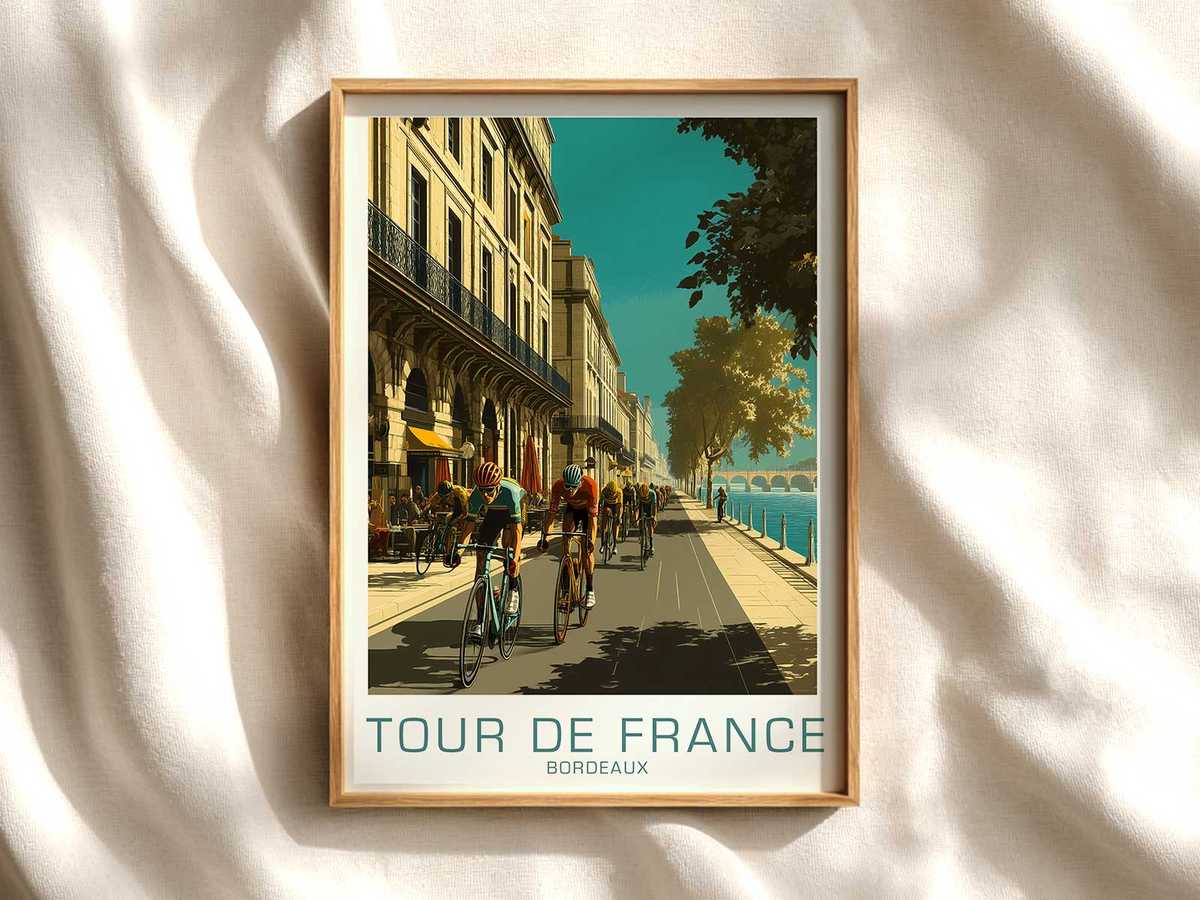
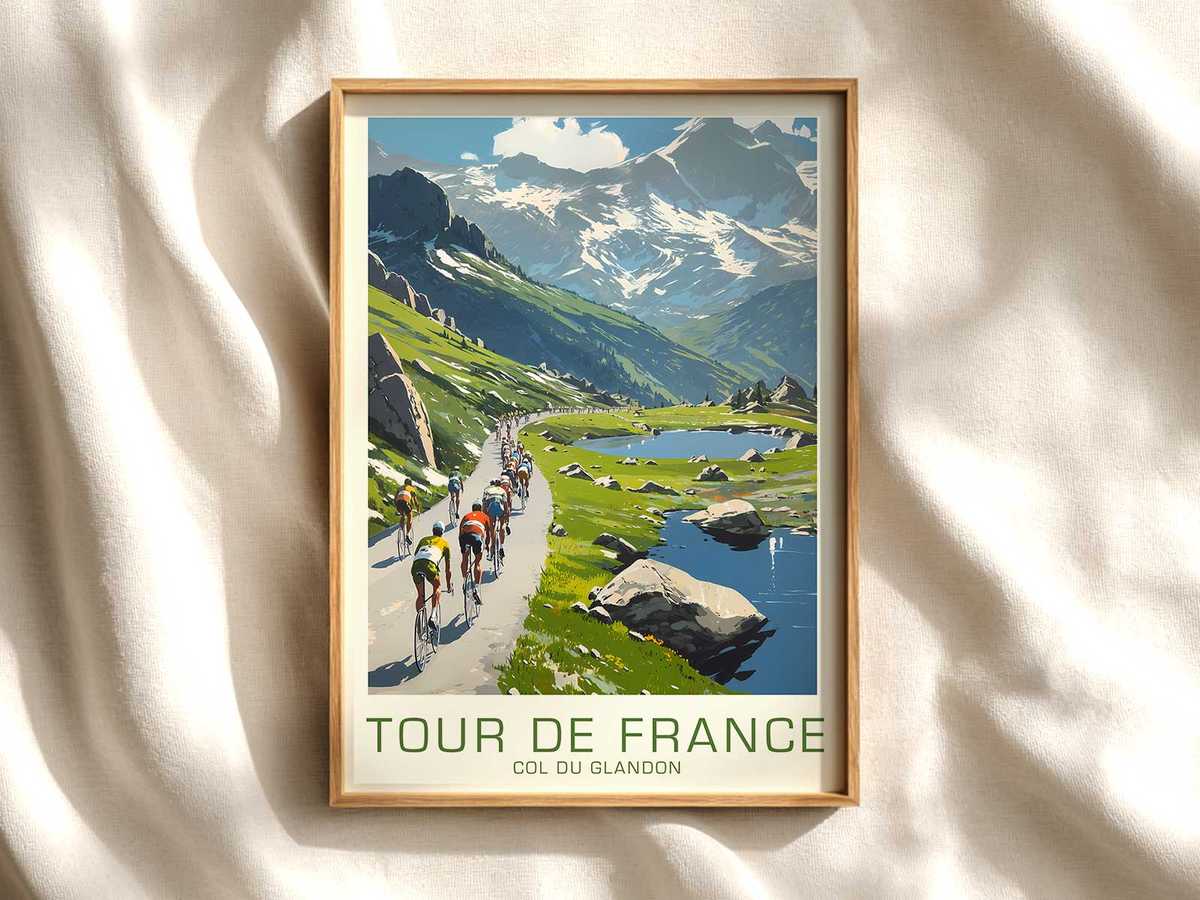
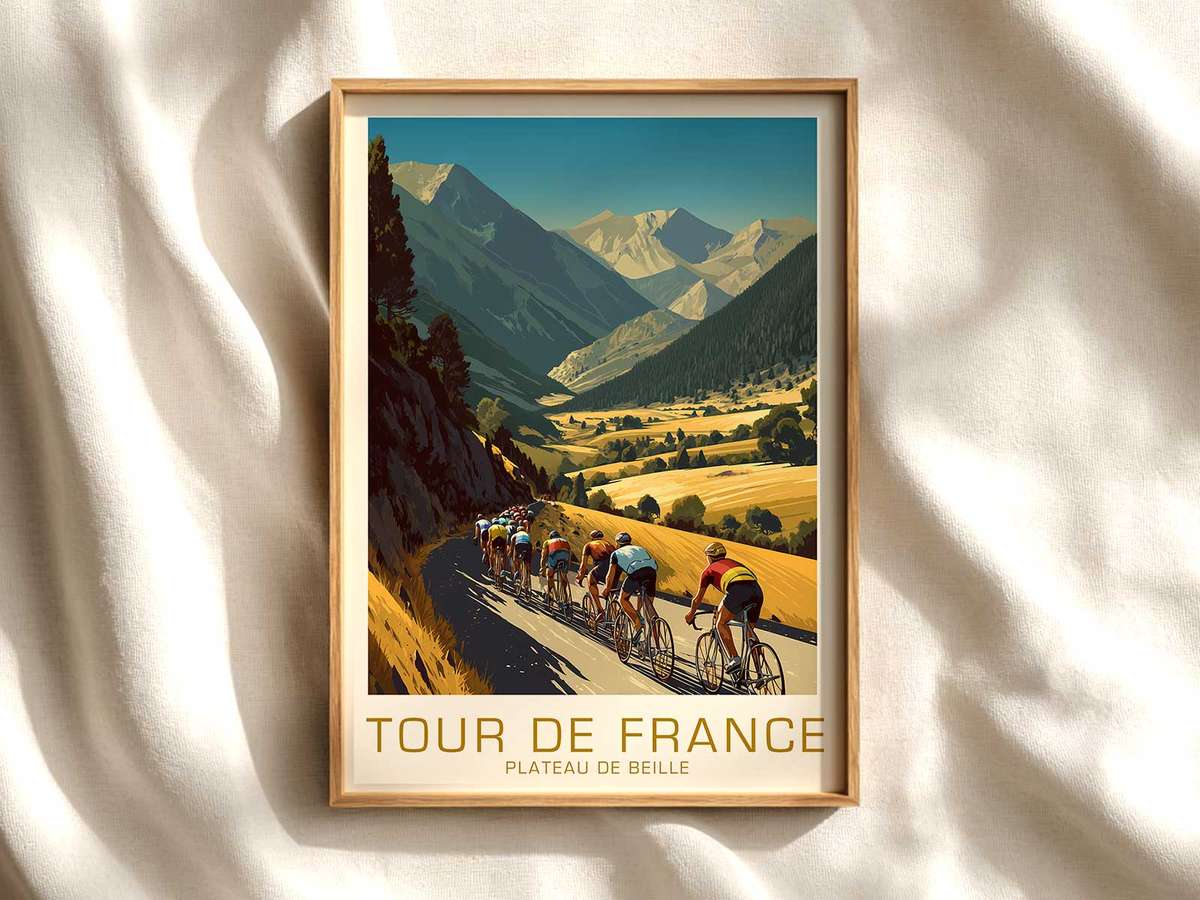
The Col du Glandon occupies a particular place in the imagination of mountain stages: a sequence of climbs, a changing sky and a road that keeps asking more of the rider. A well-made Tour de France print of this pass does more than reproduce scenery; it translates the physical laws of gradient, altitude and weather into a single, charged image. The poster becomes a condensation of effort — the slope’s angle, the thin air suggested by light, the tightness of a hairpin — and it is that condensed drama that gives the artwork its emotional pull.
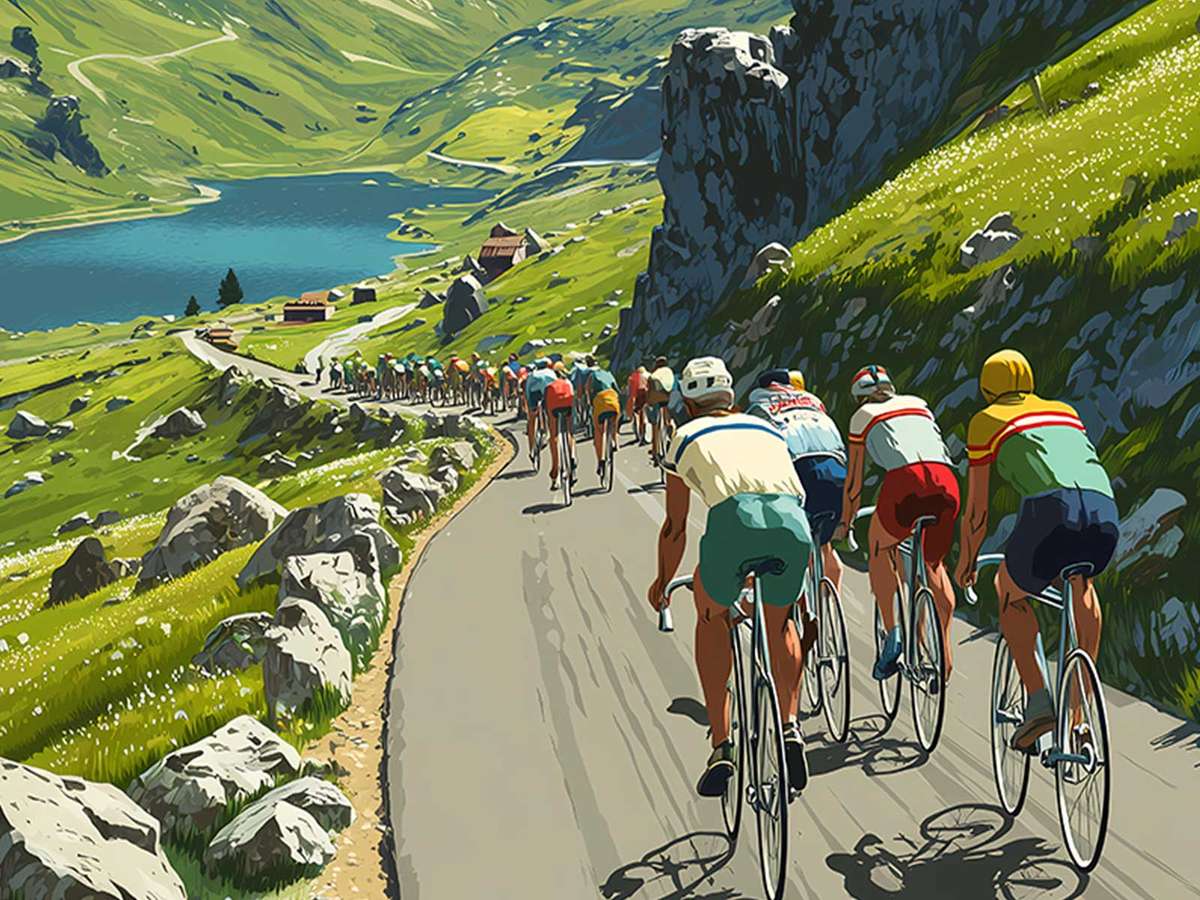
First, consider the road as narrative. In a Glandon print the tarmac is not neutral: it is a drawn line of destiny. A steady incline shown in profile gives the image tempo, while a string of switchbacks compresses hours into a spiral of shapes. Even without riders, the road implies cadence and struggle; when cyclists are present, posture and spacing tell the story of labor — hunched shoulders, low cadence, a wheelset cutting through rarefied air. That geometry is what makes the poster feel cinematic rather than decorative.
Landscape and altitude provide scale. The alpine slopes, stony pastures and distant ridgelines in such an artwork set a human figure against an immense backdrop. Light behaves differently at elevation: a crystalline clarity or a washed, high-contrast sky can be suggested through restrained palettes and layered tonal planes. That specific handling of light is how a print conveys the cool, bright severity of a summit approach, or the hazy valley glimpsed below after a long climb. The result on the wall is a sense of vertical distance — you can almost feel the thinness of the air.
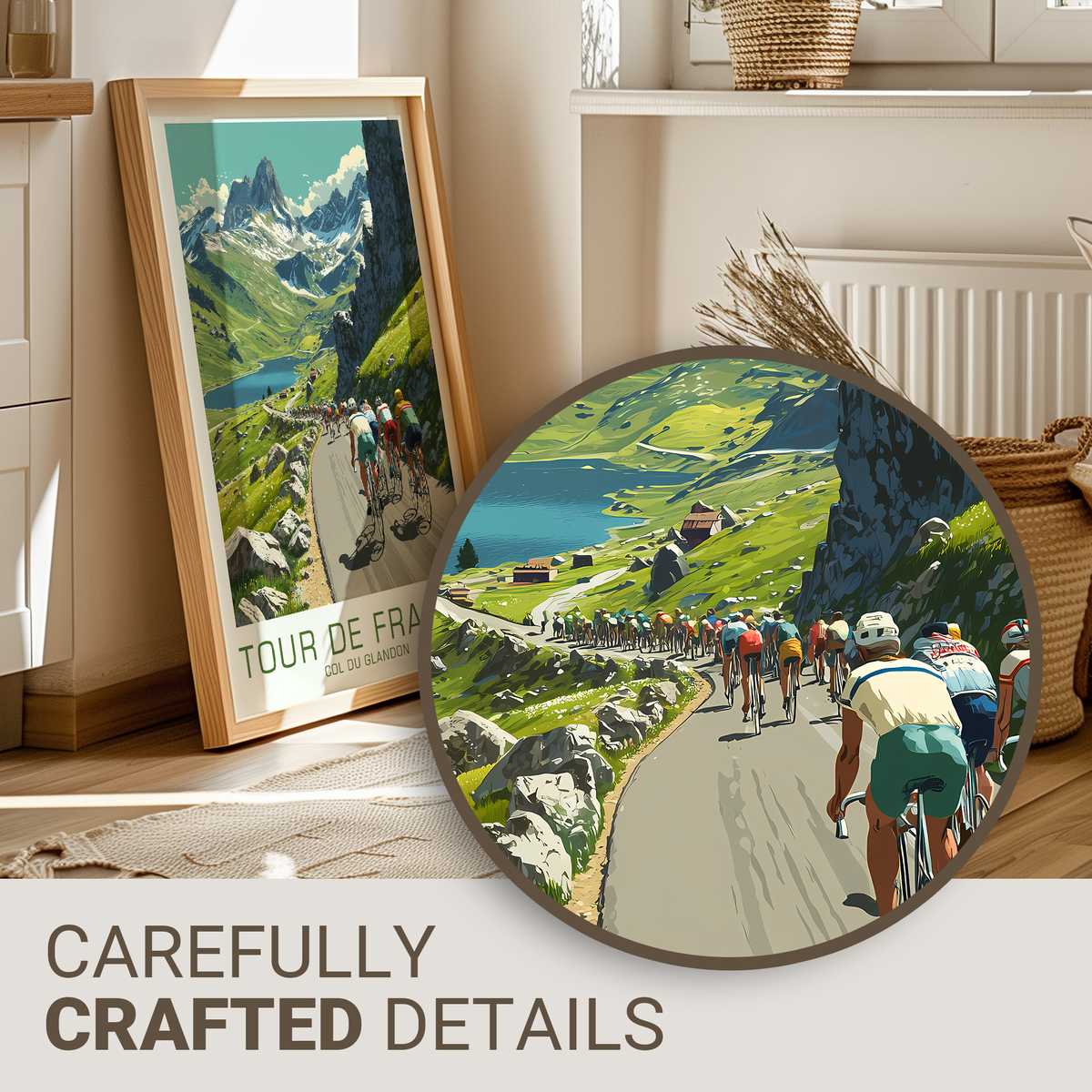
Villages and roadside markers anchor the image in lived reality. A scatter of stone houses, a chapel on a saddle or a solitary café terrace tells the viewer this is a place people pass through and remember; the Tour’s passage is layered on top of that civic texture. In a poster, these small details are cues to human presence and endurance: a crowd frozen in a cheer, barriers marching along the verge, a signpost pointing to the summit. They give the scene memory and narrative economy without needing a caption.
[IMAGE_INSERT_ARTICLE_01]
Light and weather become dramatic devices. A late-afternoon sun throwing long shadows emphasizes relief and gradient; a bank of cloud can isolate the road like a stage spotlight. The same poster can use desaturated tones to suggest a cold, relentless morning or warm ochres to evoke a sunlit, heroic ascent. By choosing a particular mood, the artwork tells a different story about the effort — stoic endurance or victorious elevation — and invites the viewer to inhabit that moment.
The emotional weight of such prints lies in specificity. Rather than generic cycling iconography, stage-led imagery anchors feeling in place: the particular rhythm of a mountain road, the abruptness of a hairpin, the quiet village that becomes a temporary amphitheatre. That is why these pieces work so well in living rooms, studios or offices: they are not just about sport but about place and the human encounter with steepness. A wall hung with a Glandon poster can quiet a room with the memory of ascent, or energize a study by suggesting relentless forward motion and concentration.
Finally, the desirability of a Col du Glandon print is not in a promise of race-day glory but in its ability to translate endurance into visual form. The artwork celebrates the bicycle’s elegance and the road’s uncompromising grammar — gradient, surface, line — and does so with an economy that fits premium interiors. It is a piece for someone who wants an image that rewards repeated looking: the more you study the slope, the more you sense the climb, the clearer the story of effort becomes.
Author: