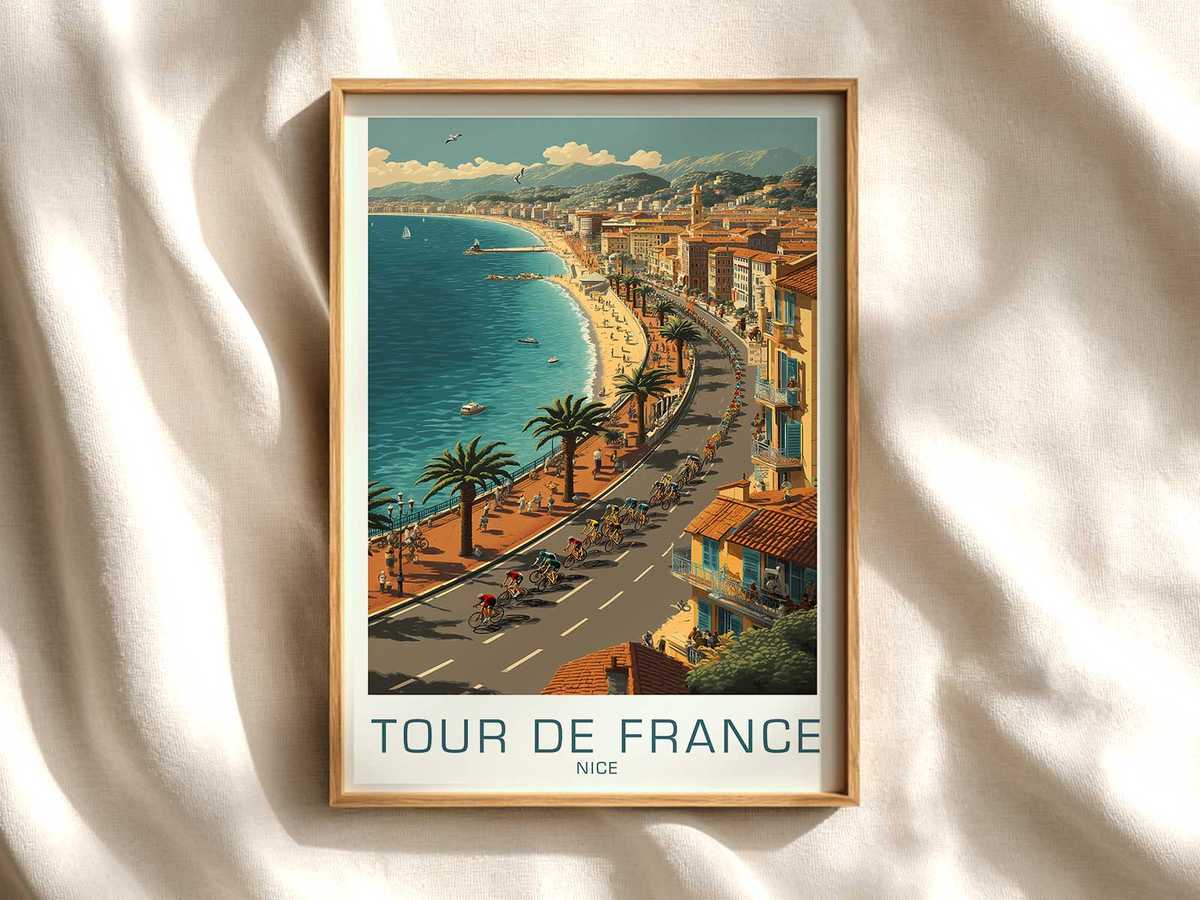
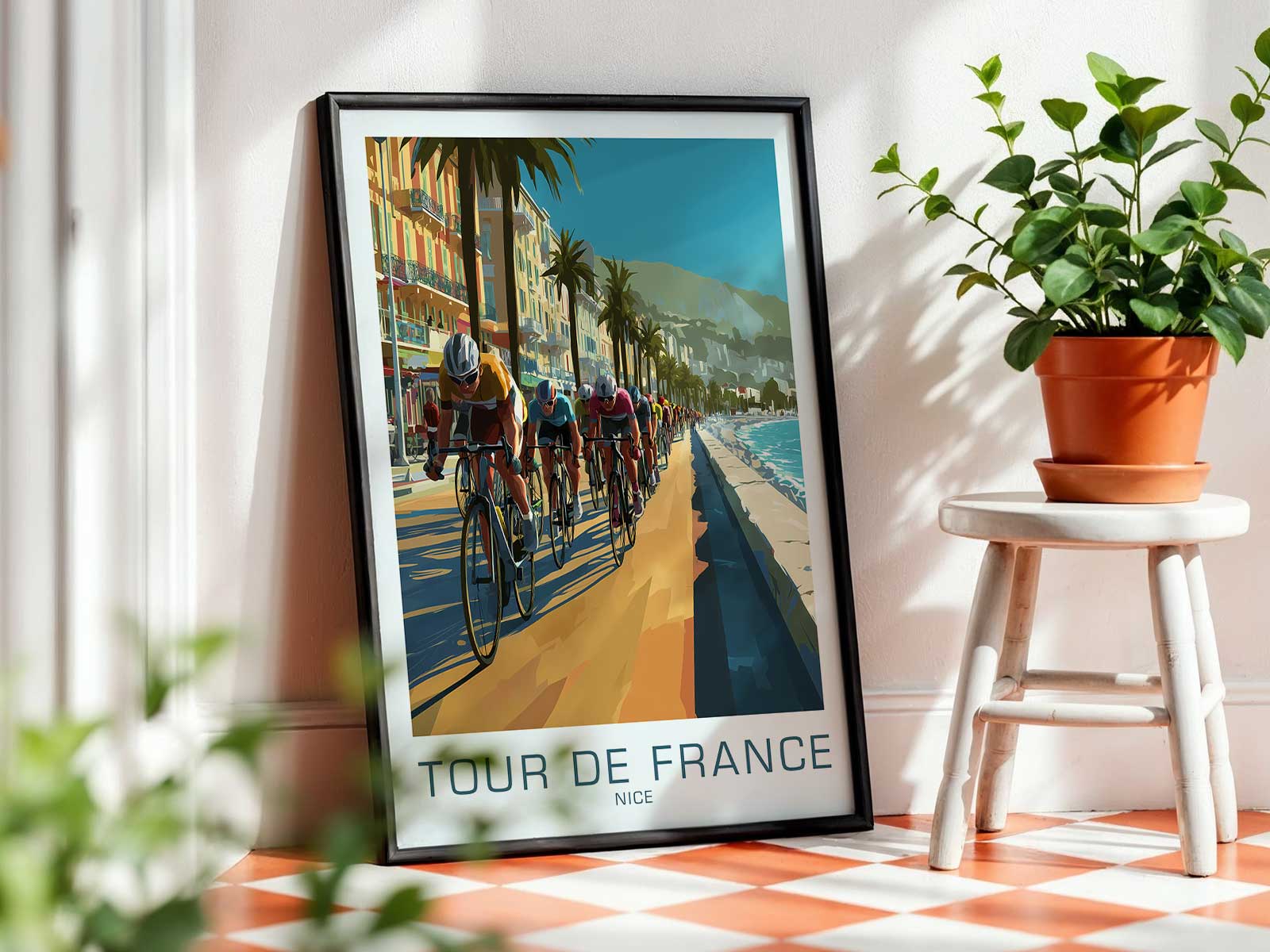
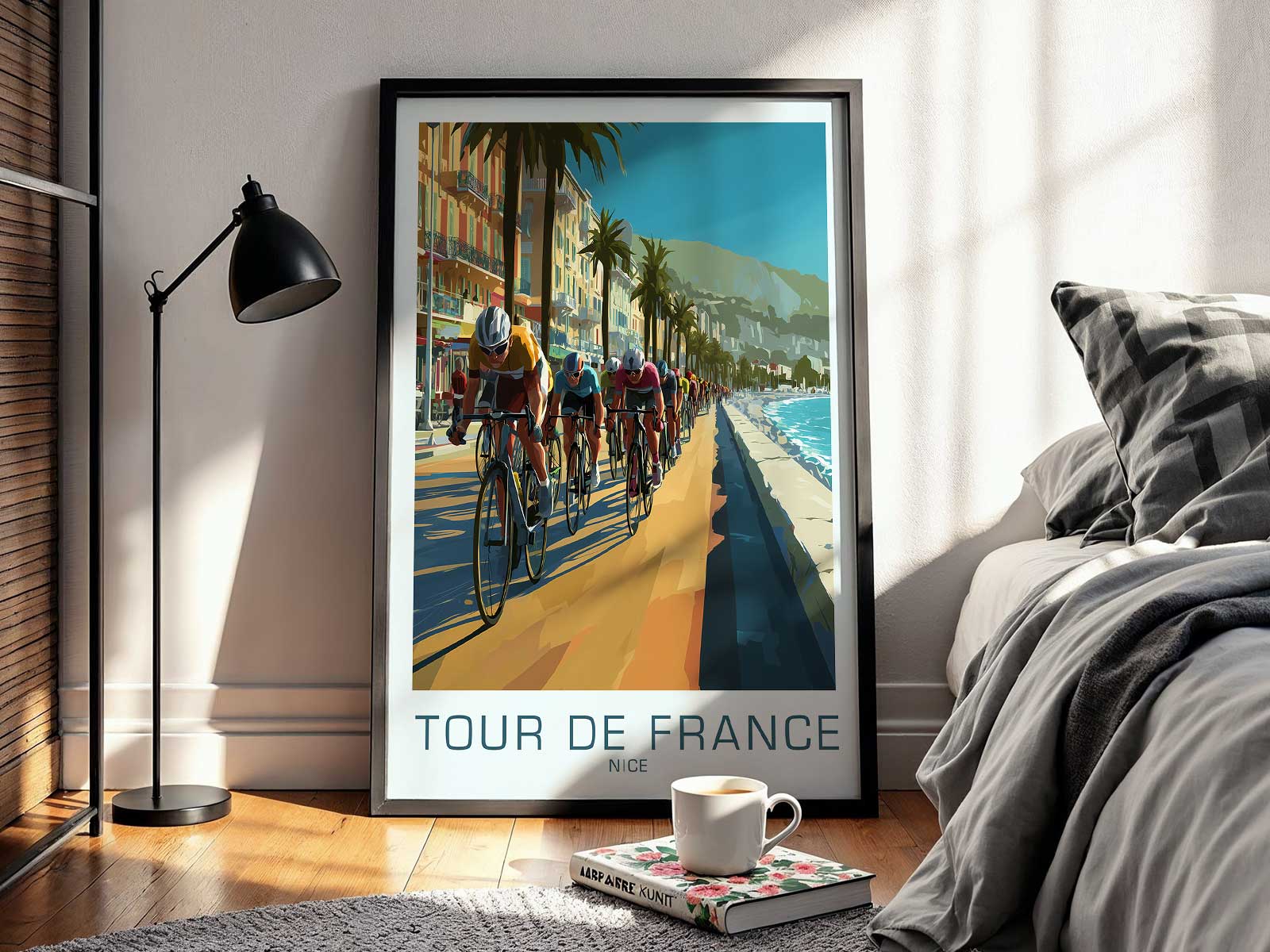
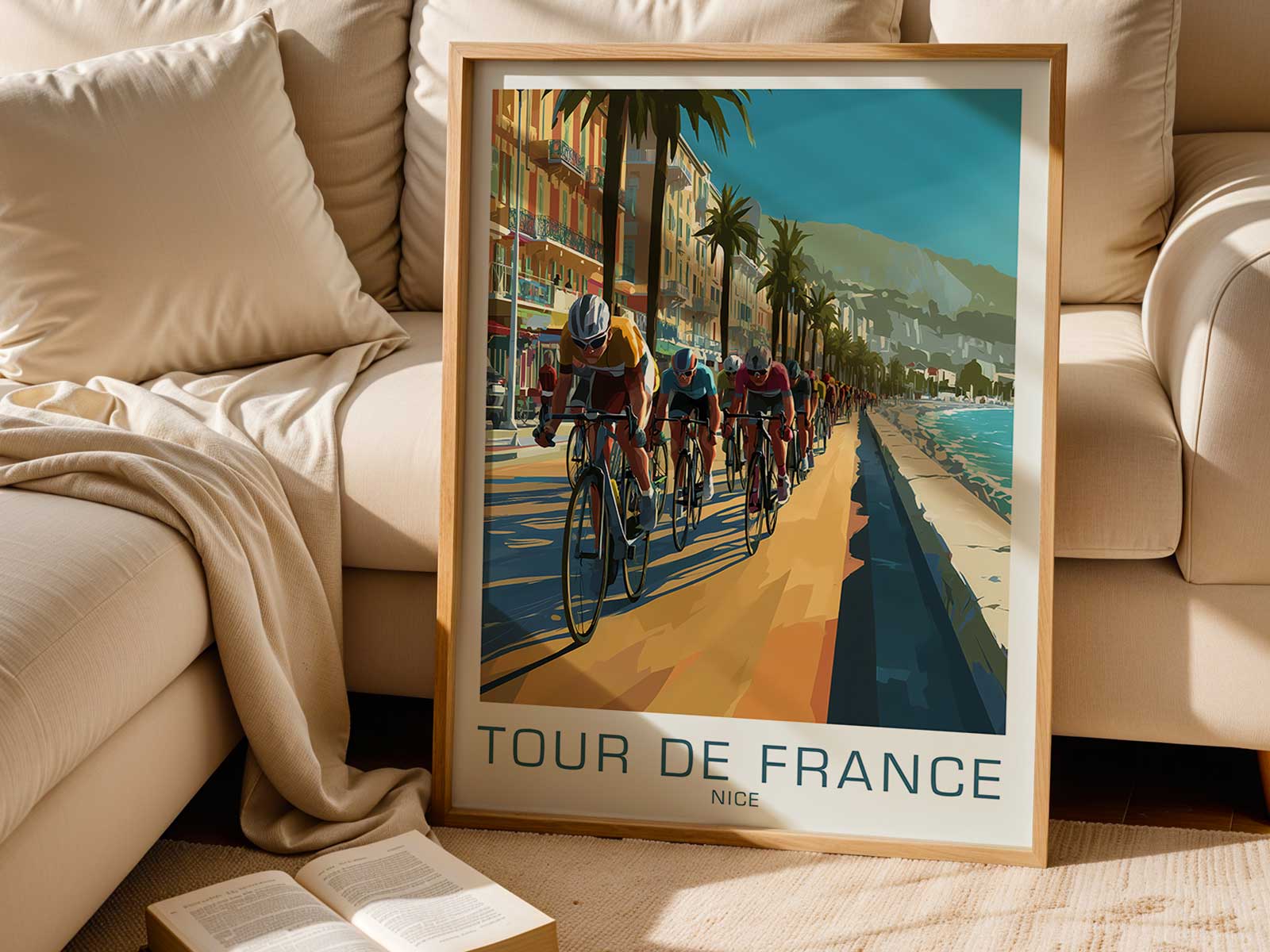
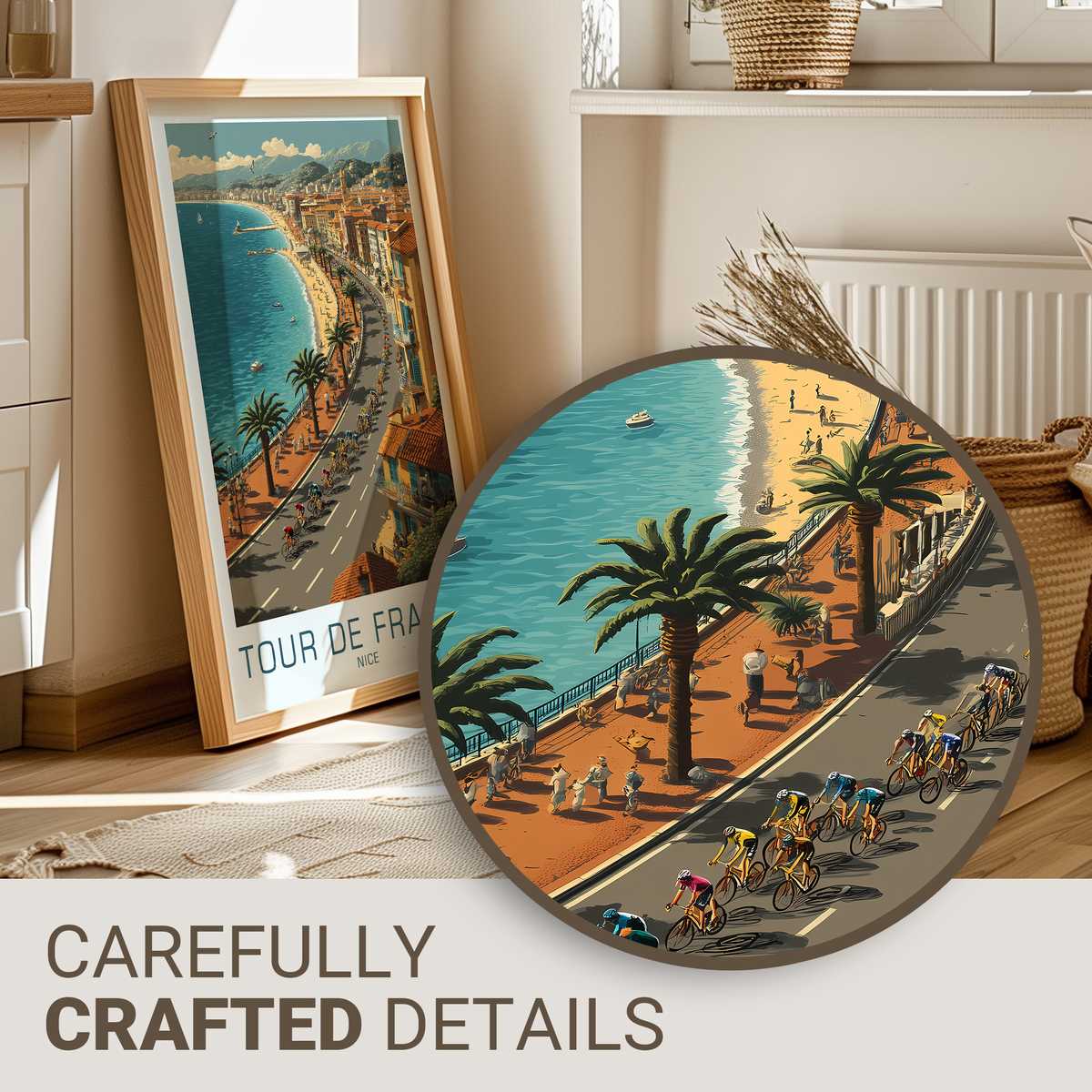
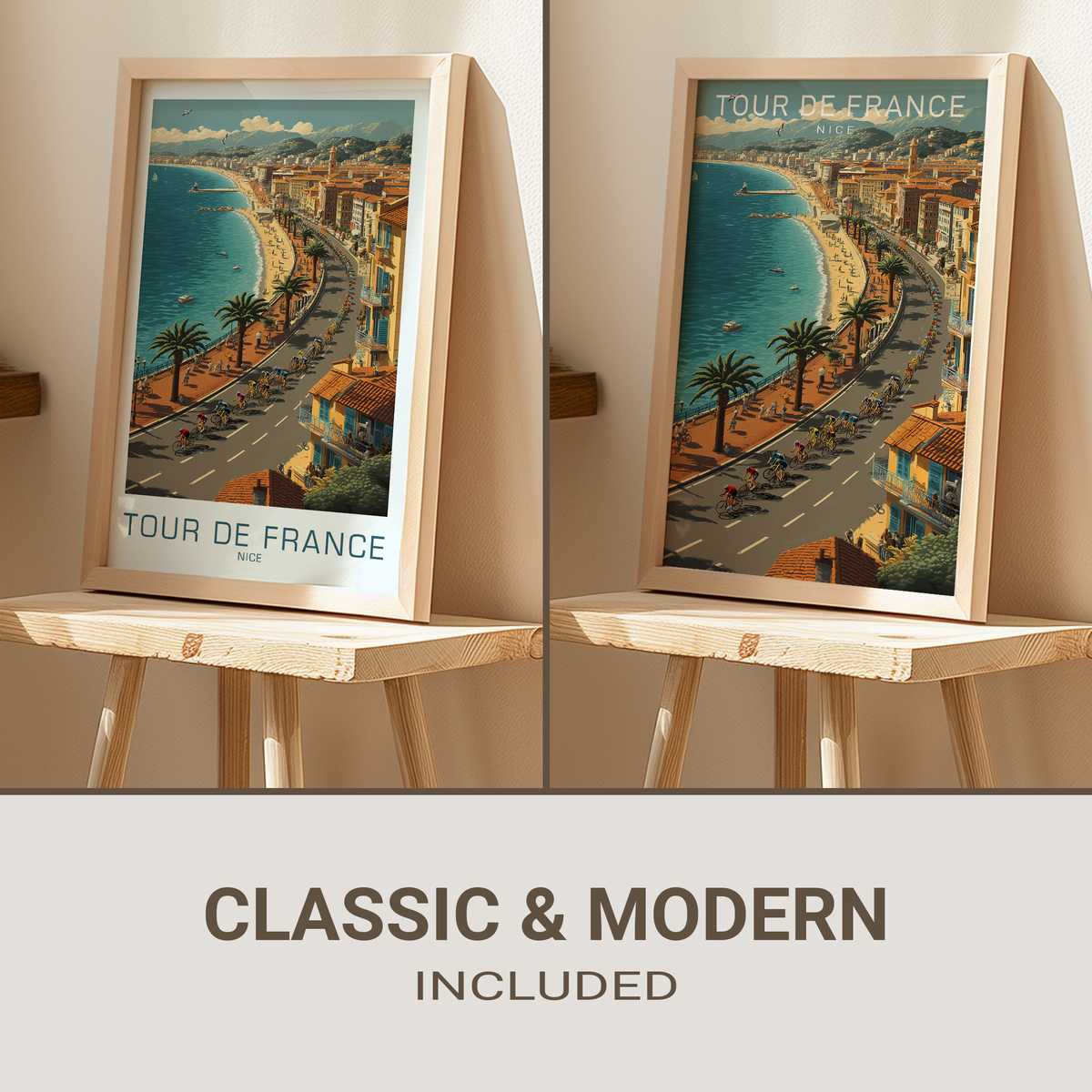
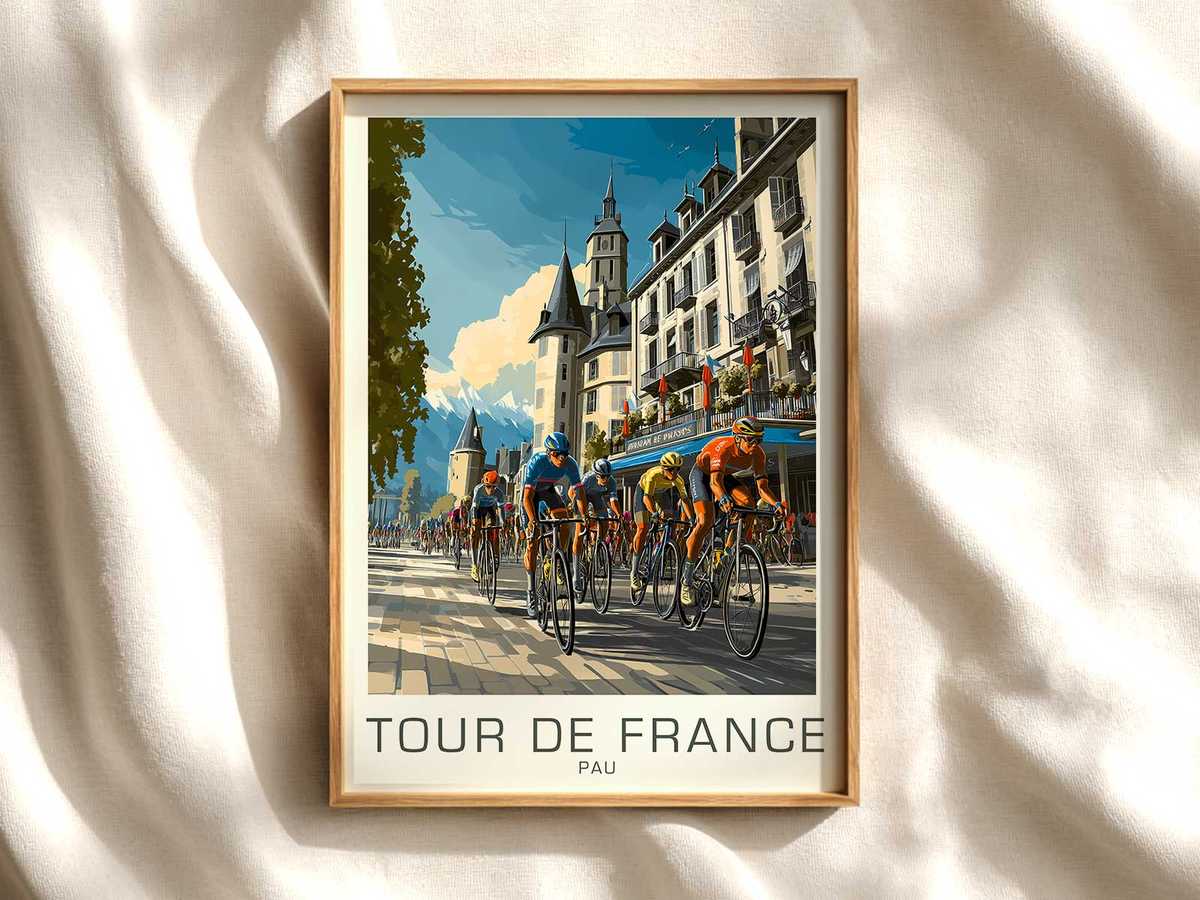
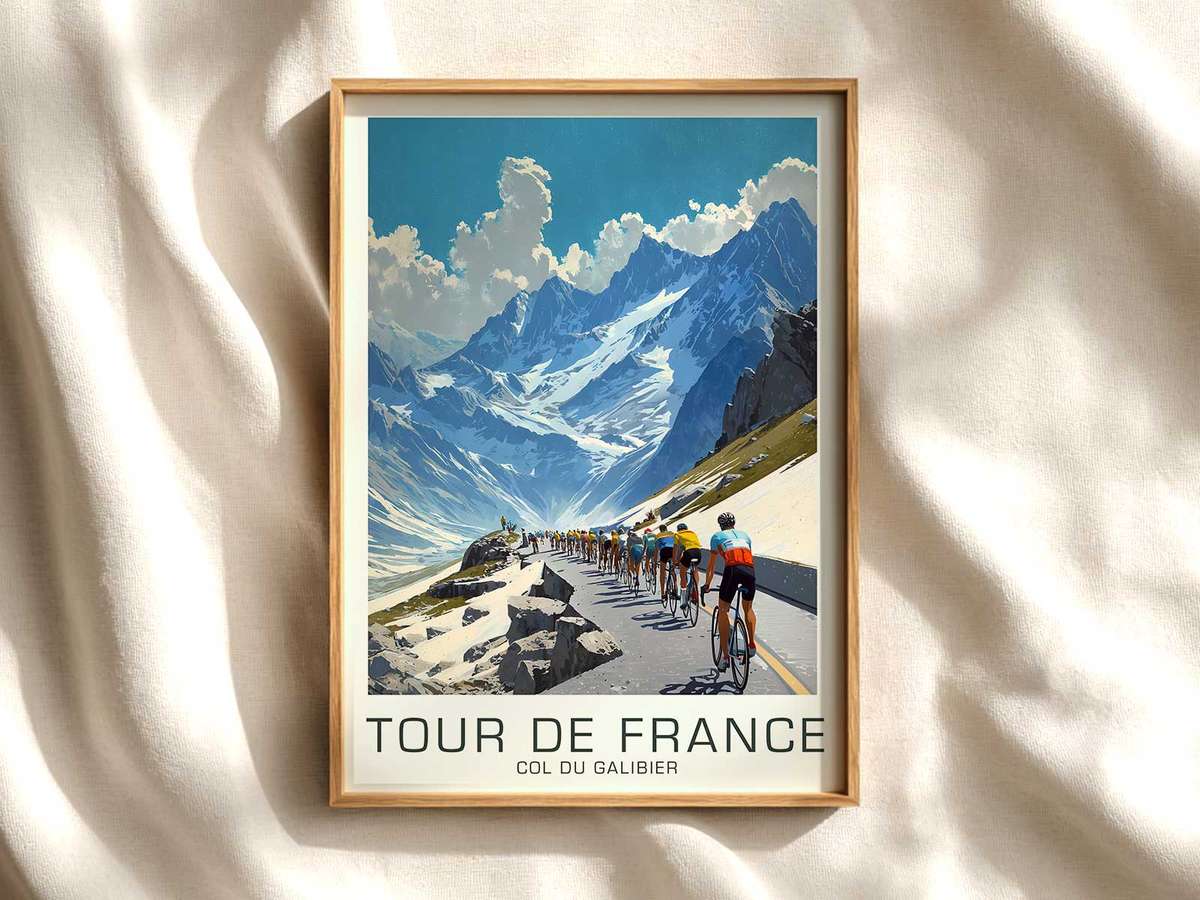
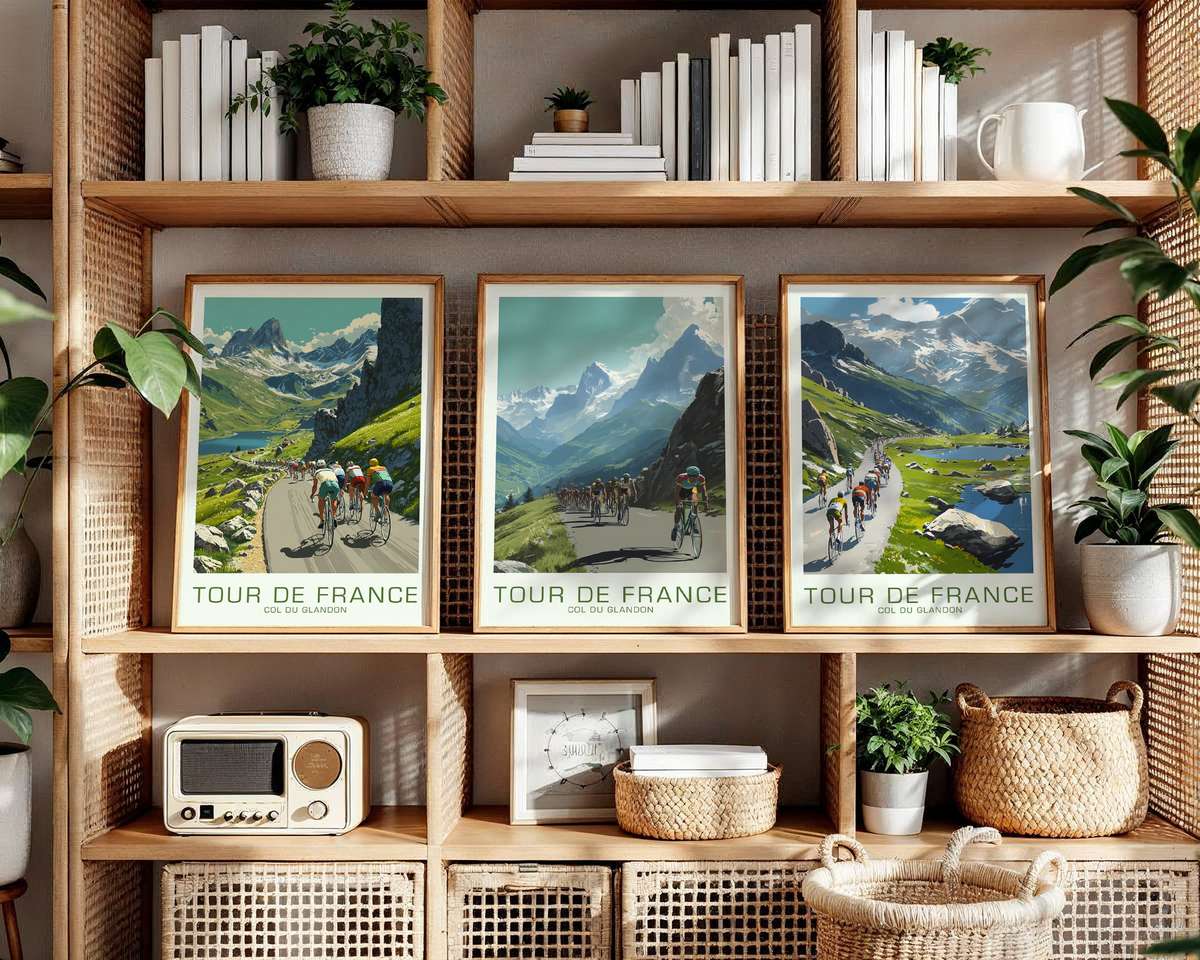
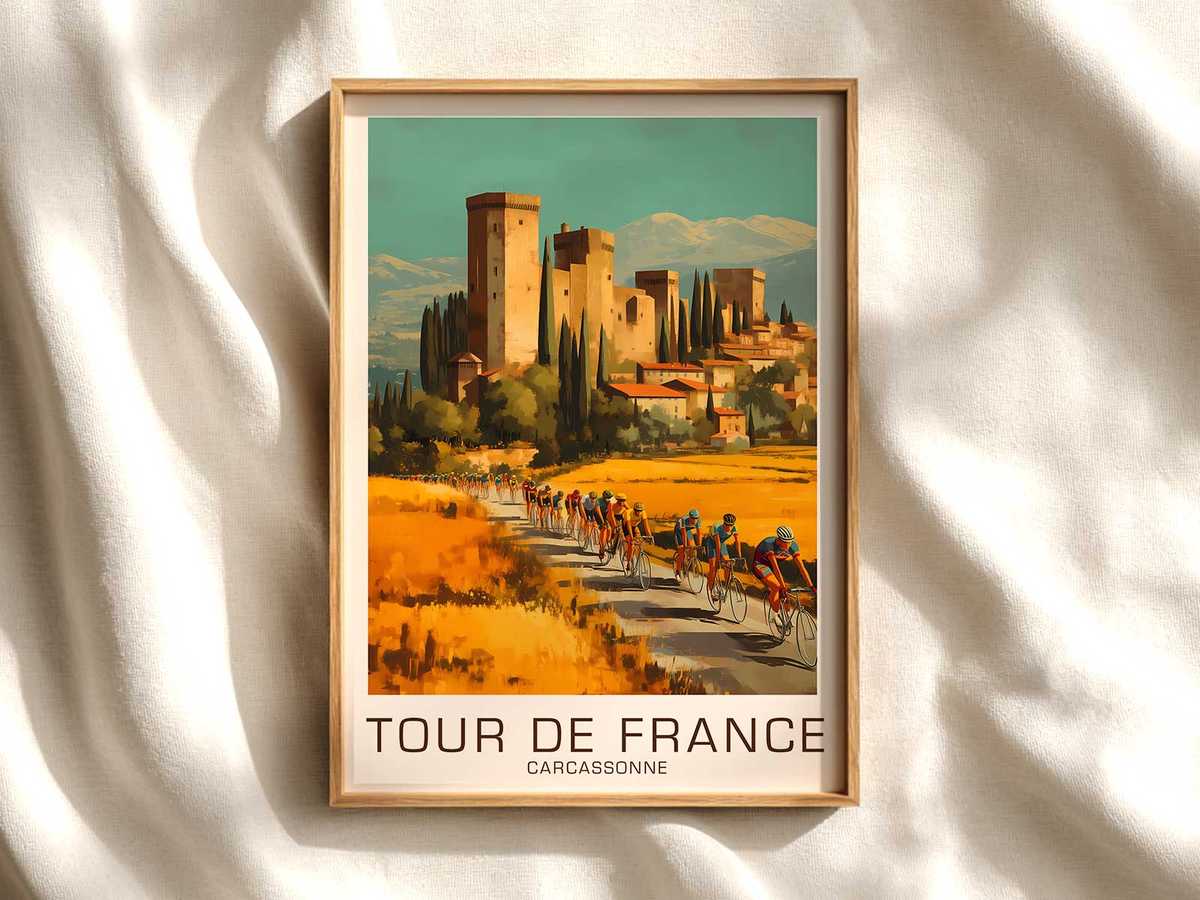
Nice is often remembered for its sea, its palm-lined promenades and Mediterranean light, but as a subject for a bike poster it becomes something more: a readable stage in which road, relief and urban edge combine to narrate a race. This poster translates that narrative into a single, composed view where the city’s geography—promenades, coastal cliffs, tight urban turns and the gentle slope of surrounding hills—does the storytelling. The result is imagery that feels instantly legible to a cycling enthusiast because every visual element functions like a stage cue.
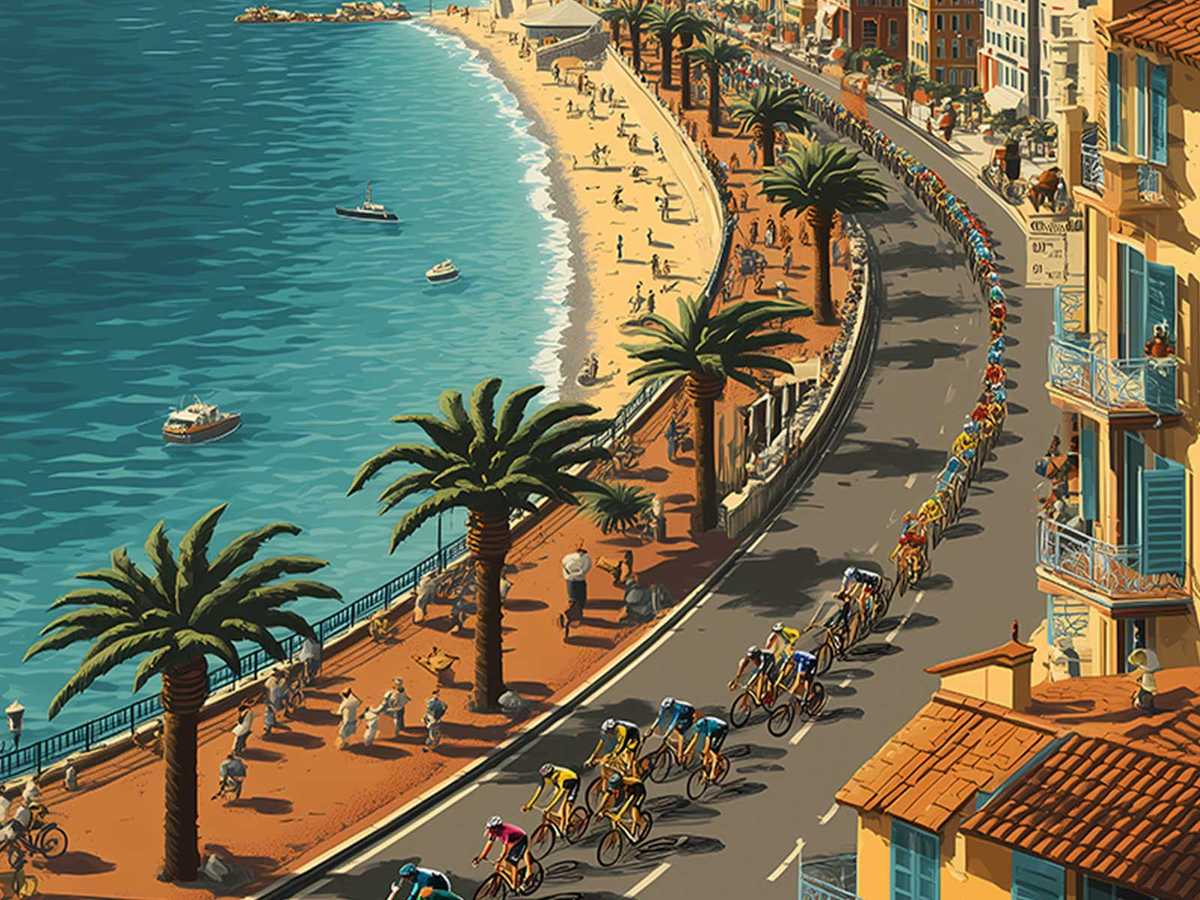
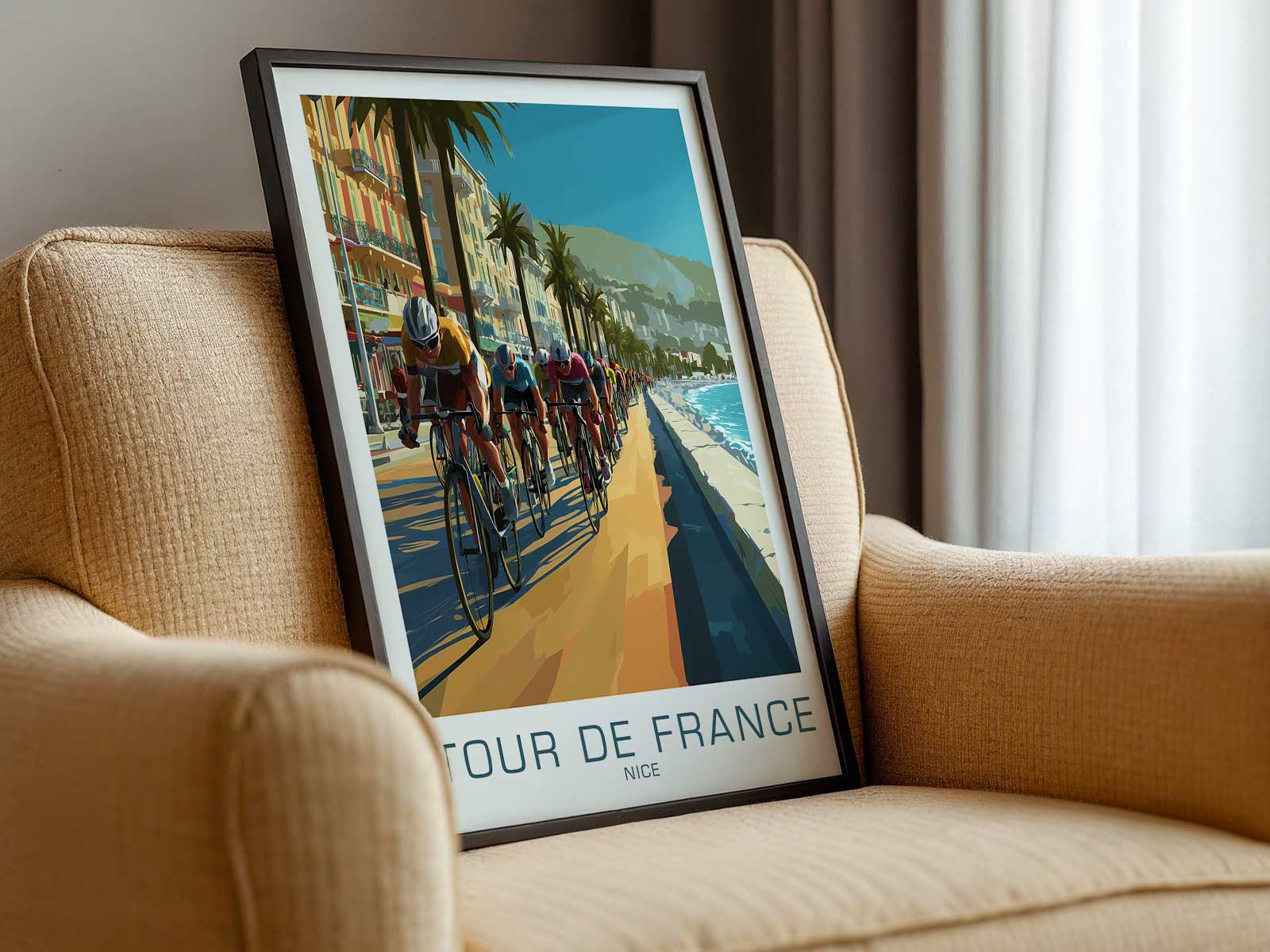
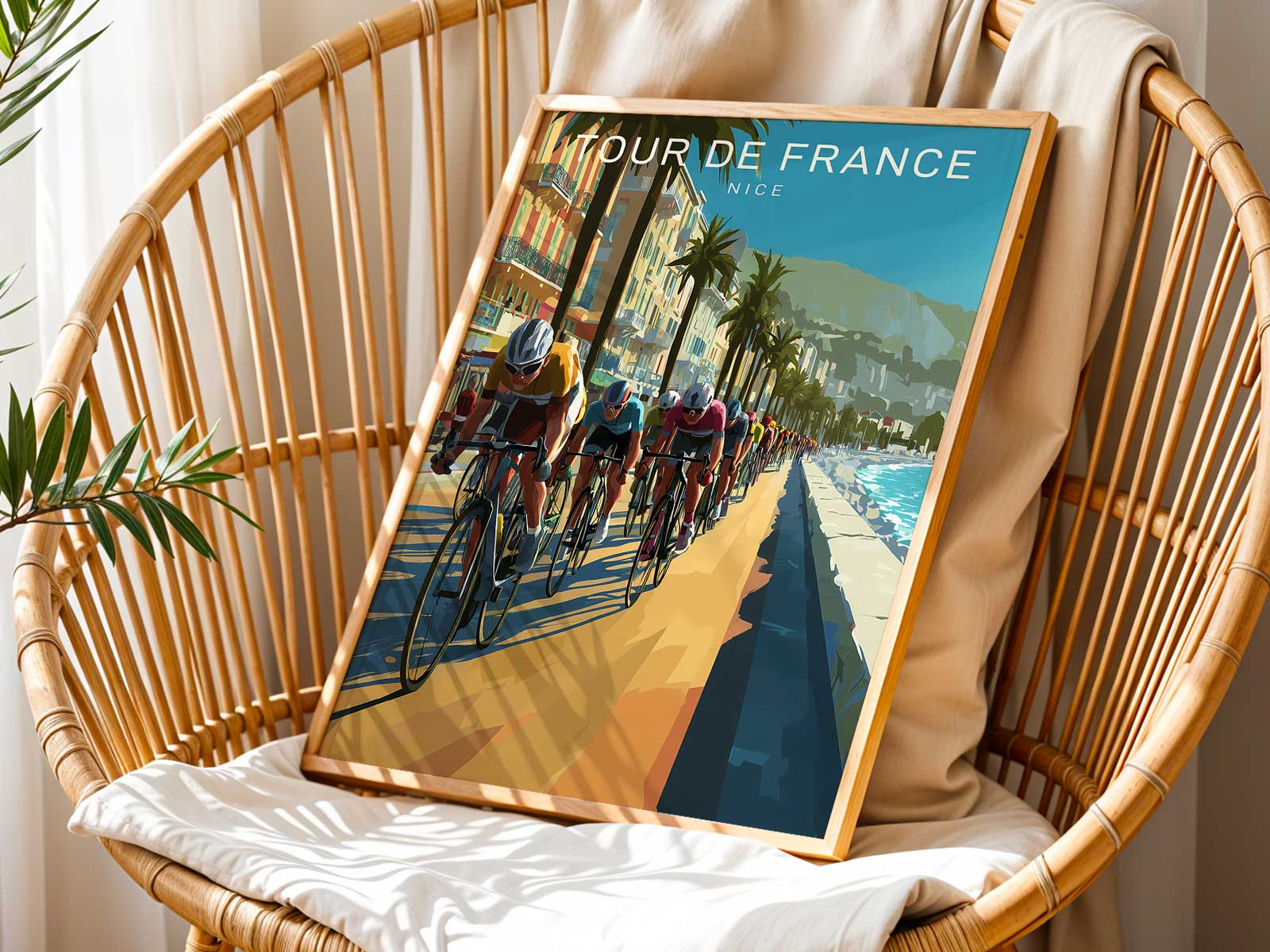
The road in the image is the protagonist: a curve that hints at a faster arc beyond the frame, a climb that is legible through gradient and shadow, or a coastal ribbon that separates town from sea. In poster form, these road motifs read as rhythm—sinuous as a group pursuit, restrained as a breakaway, or compressed into the explosive geometry of a sprint. The cyclist’s posture and the bicycle’s silhouette are composed to match that rhythm, so the viewer understands the effort and speed even without seeing the whole race.
Light here is decisive. Mediterranean clarity flattens distance in some planes and gilds edges in others, creating planes of colour that separate town, road and sea. That contrast makes the scene readable at a glance: rooftop ochres and pale façades settle behind a hard strip of asphalt, while the sea offers a cool counterpoint that emphasizes motion. Shadows from buildings and palms trace the road’s fall, helping the eye follow the route the riders must take. This is why the poster works on a wall—its palette and lighting guide attention without needing labels or context.
The urban texture of Nice—the promenades, the squares and the clustered houses—lends human scale to the composition. Villages and city quarters become markers of pace: a tight corner in a built-up area suggests crowd pressure and tactical decisions; an open coastal stretch implies power and exposure. When rendered in a single frame, these shifts in urban fabric tell a mini-stage story: from nervous, narrow streets to sweeping open coastlines where the race broadens and the riders are more exposed to wind and light.
[IMAGE_INSERT_ARTICLE_01]
Altitude and relief matter too. Even modest hills near Nice gain drama when compressed into a poster. A short, steep climb framed against a distant skyline reads as an emotional summit—an instant of sacrifice visualised through the rider’s cadence and the road’s angle. Switchbacks and rising terraces create graphic motifs that sit well in interiors: they add compositional movement and draw attention to the athlete’s effort, not only to the place itself.
The presence of people—spectators along balustrades, a cluster at a sharp bend, or a solitary figure watching from a café terrace—infuses the scene with atmosphere. Their scale reminds the viewer of the race’s social dimension and how the Tour temporarily transforms ordinary places into charged environments. In a poster, these human touches are subtle: a suggestion of applause, a flash of colour from a flag, or the silhouette of a camera. They provide context without overwhelming the image’s formal clarity.
As wall art, a stage-led Nice poster performs quietly but insistently. It changes a room by introducing a sense of movement and place—the hush of a climb, the brightness of a promenade, the palpable tension of a corner. Viewed daily, it rewards repeated glances: details unfold in different light, and small features—the slope of a street, the texture of a stone wall, the posture of a rider—gain narrative weight. The poster does not sell a result; it preserves a mood, a landscape and the implicit drama of the road.
Choosing such an image is a choice for atmosphere over spectacle. It honours why stages endure in cycling memory: not only for winners or jerseys, but for the way a road, a town and the weather together create a moment. On the wall, Nice becomes a course you can return to, a compacted route whose visual cues—road geometry, coastal light, urban grain and human scale—keep the story alive every day.