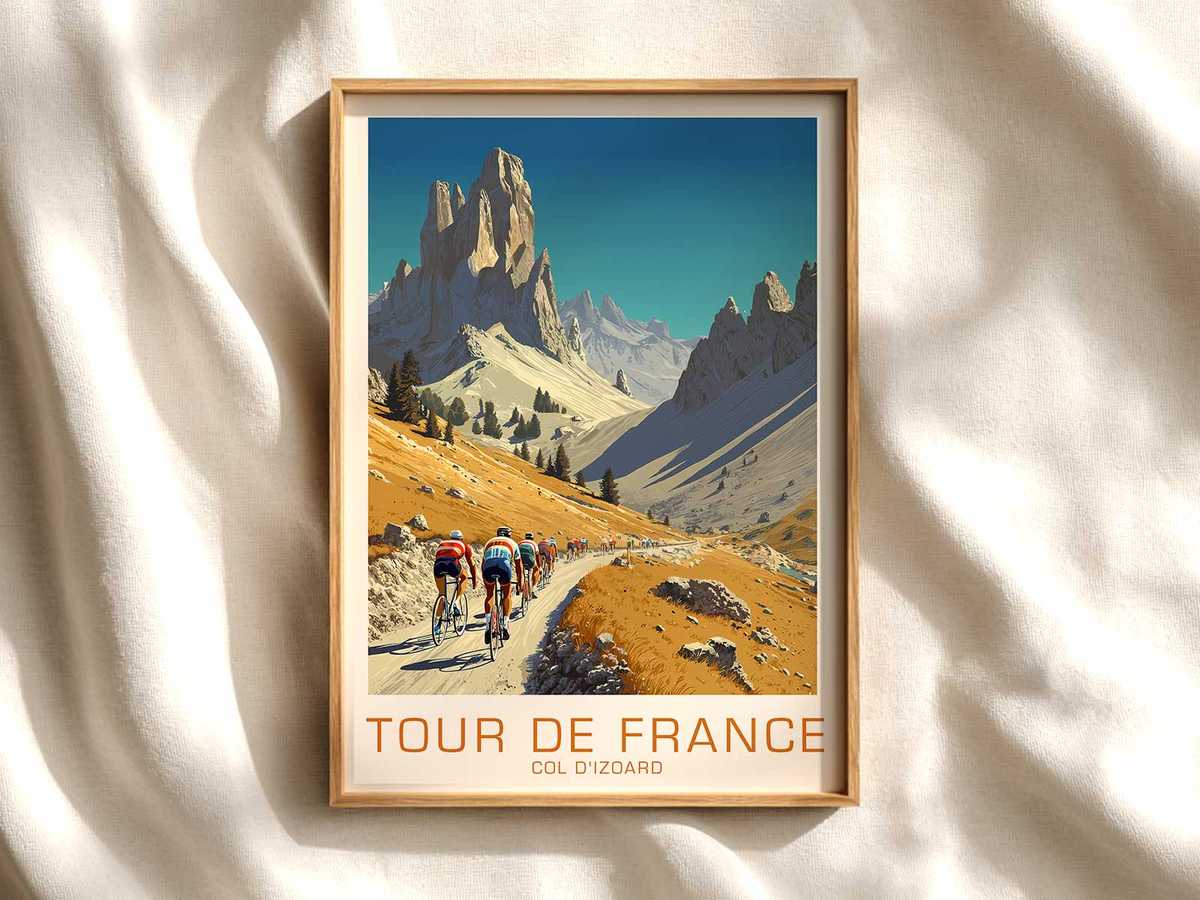
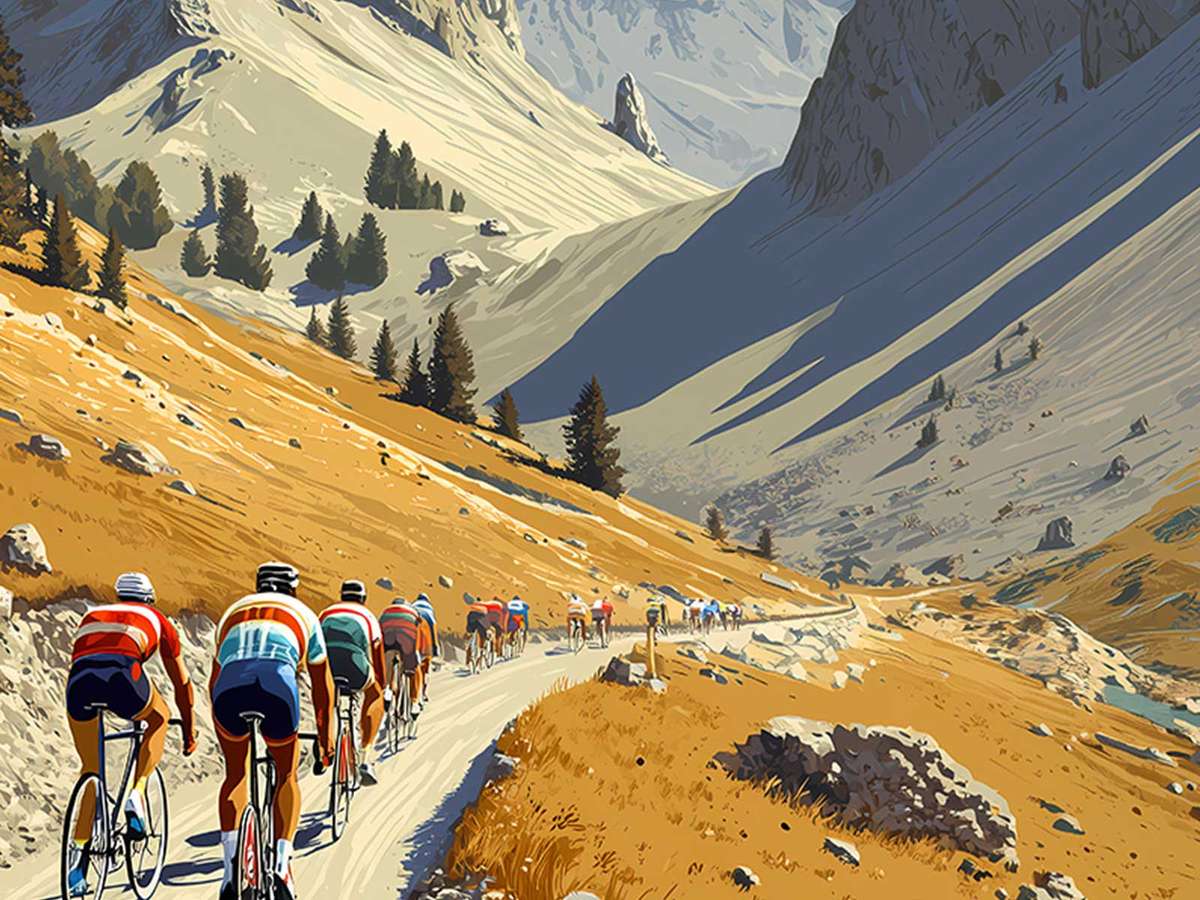
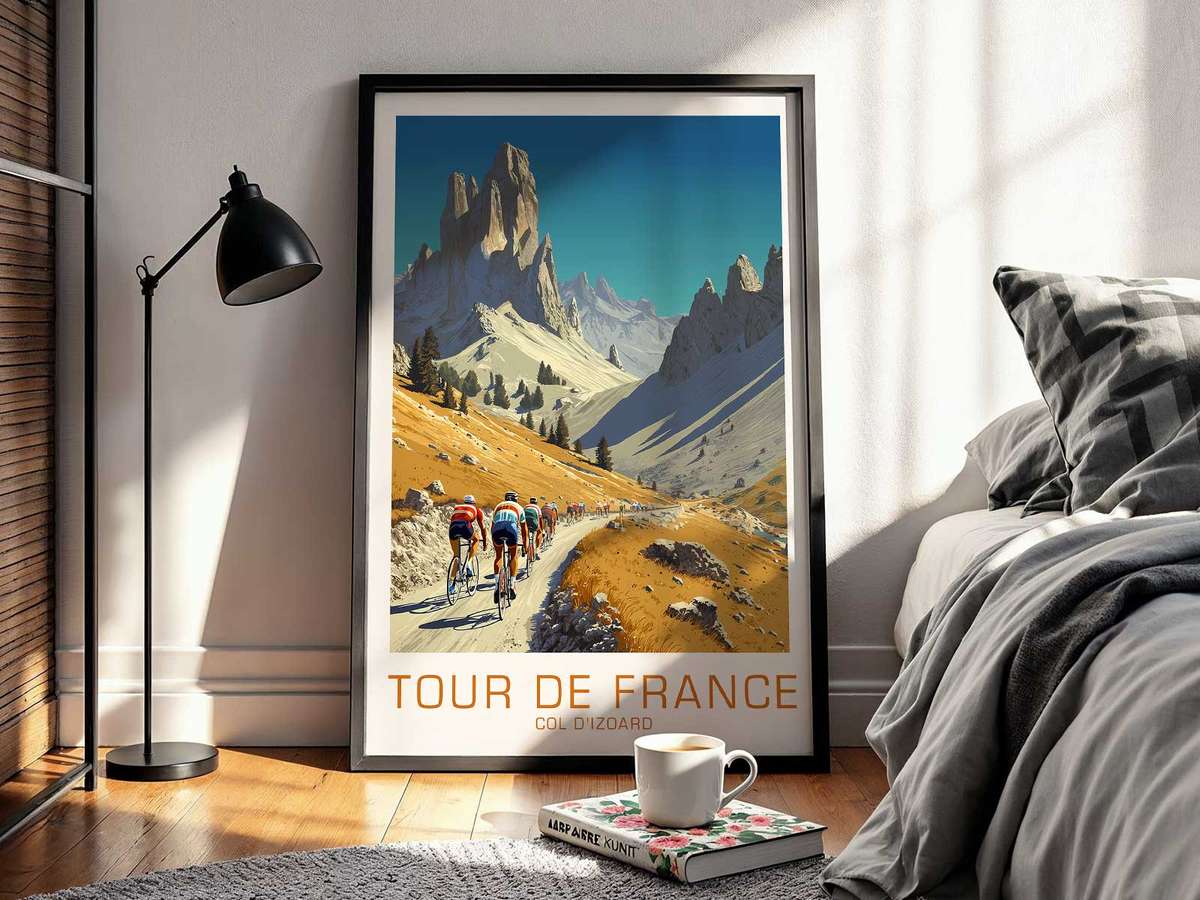
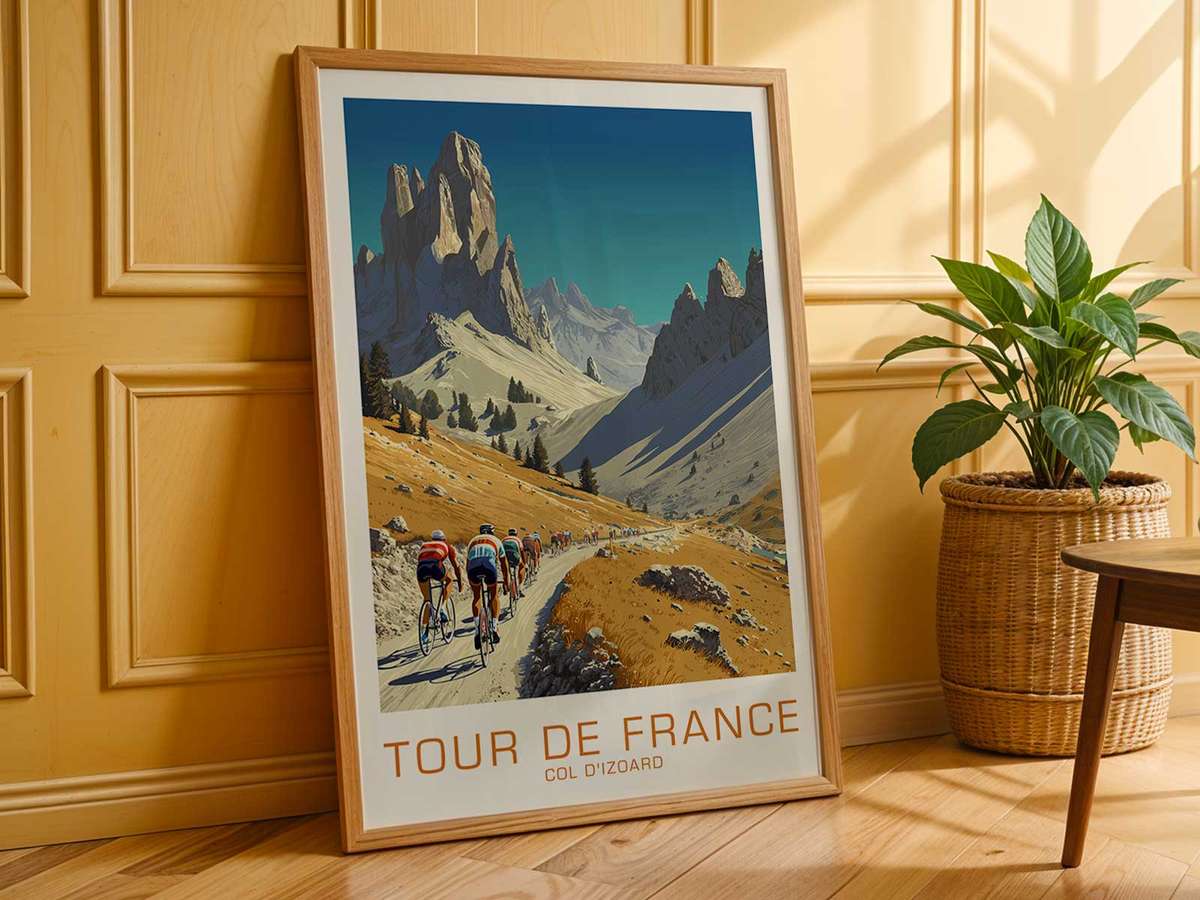
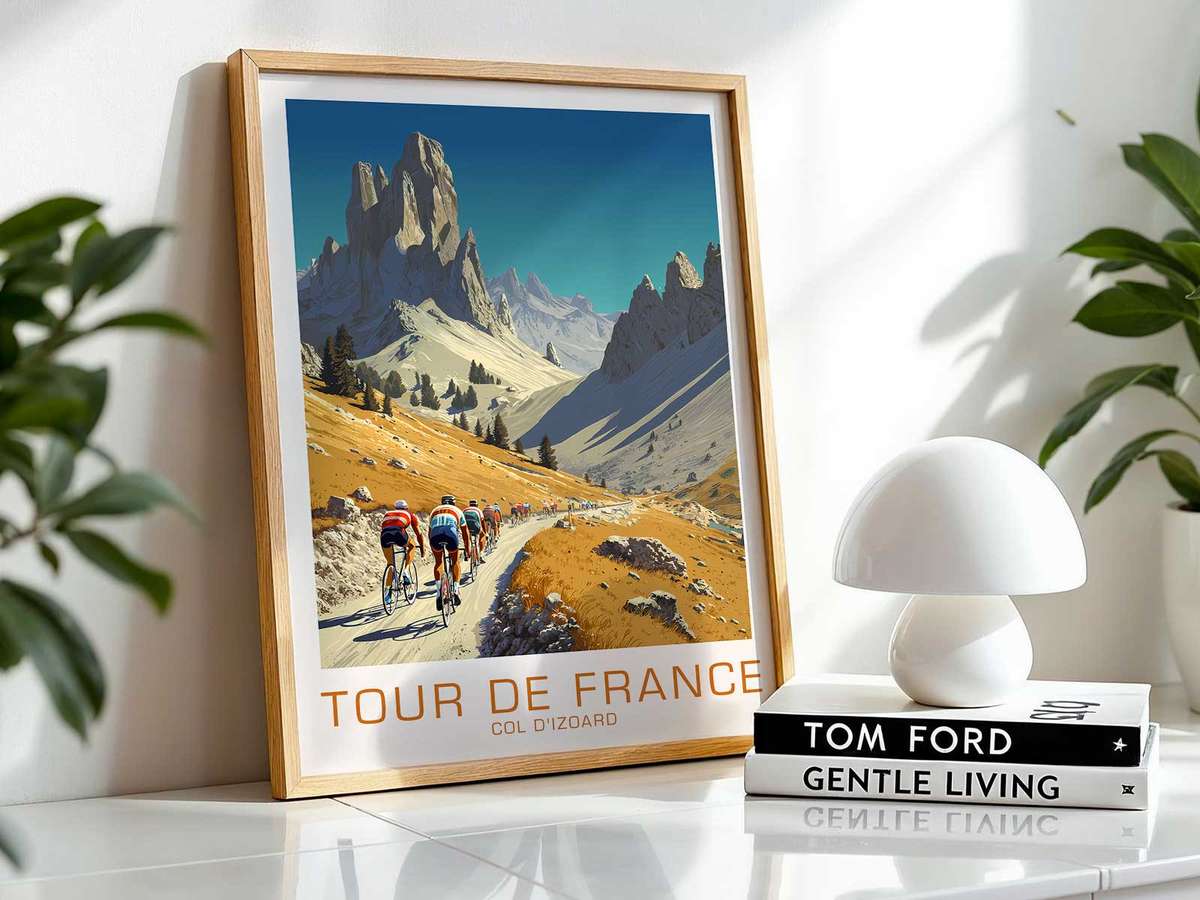
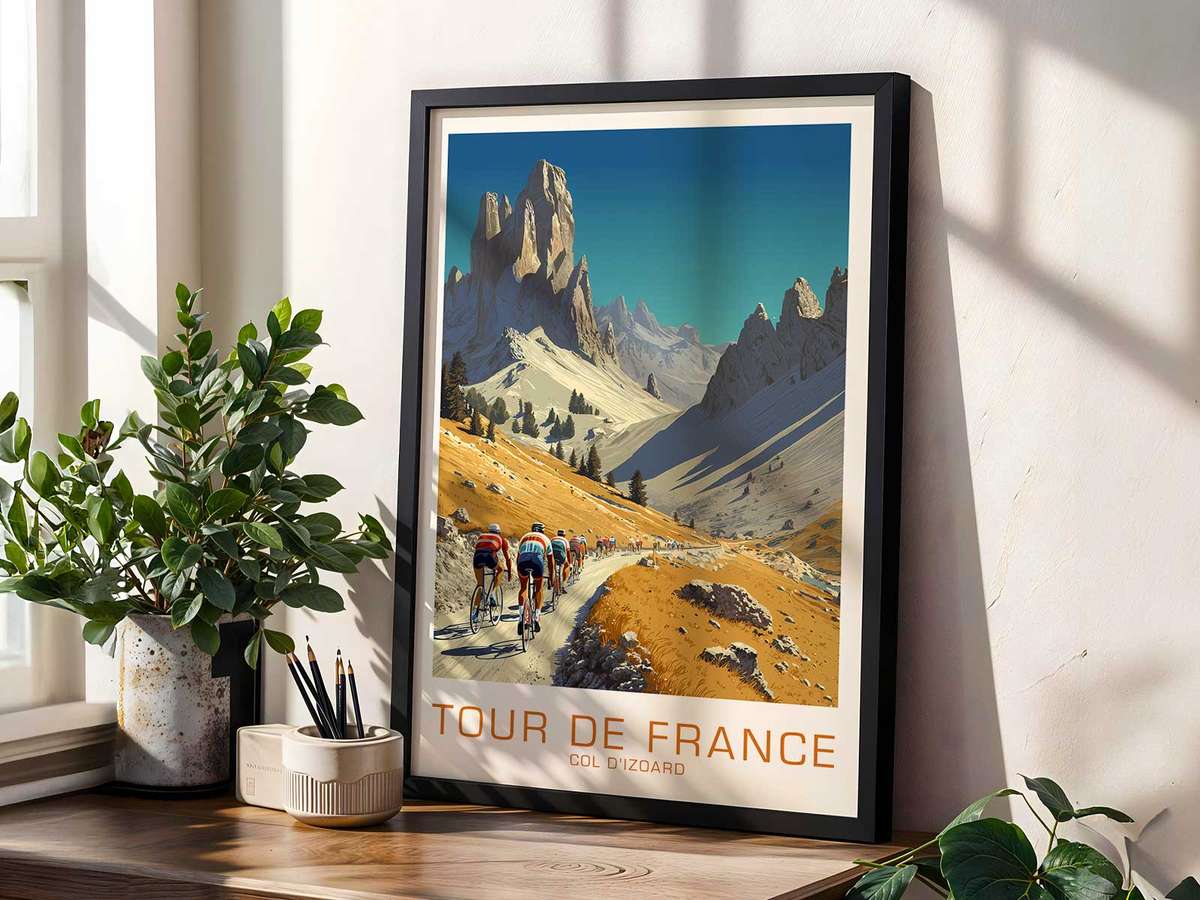
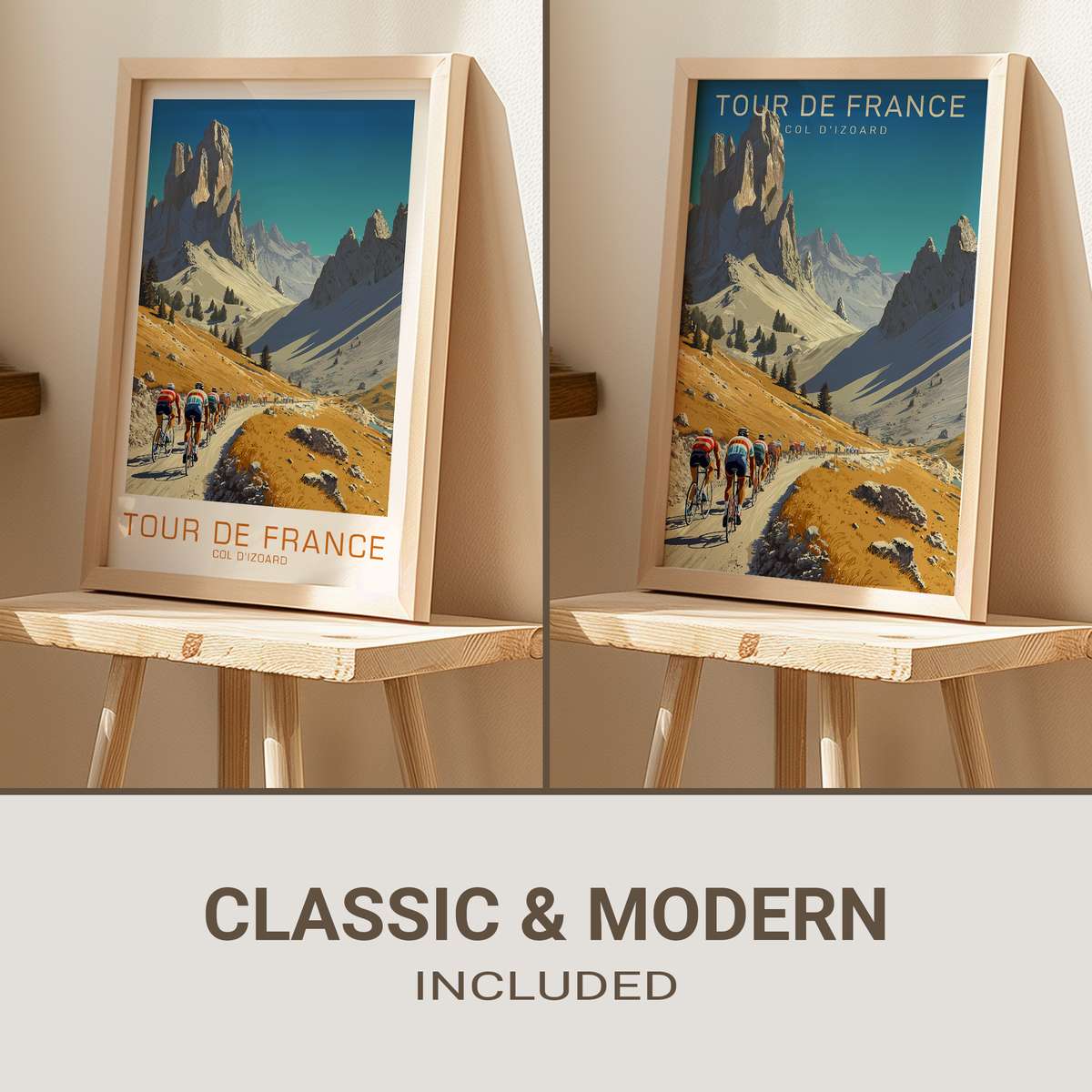
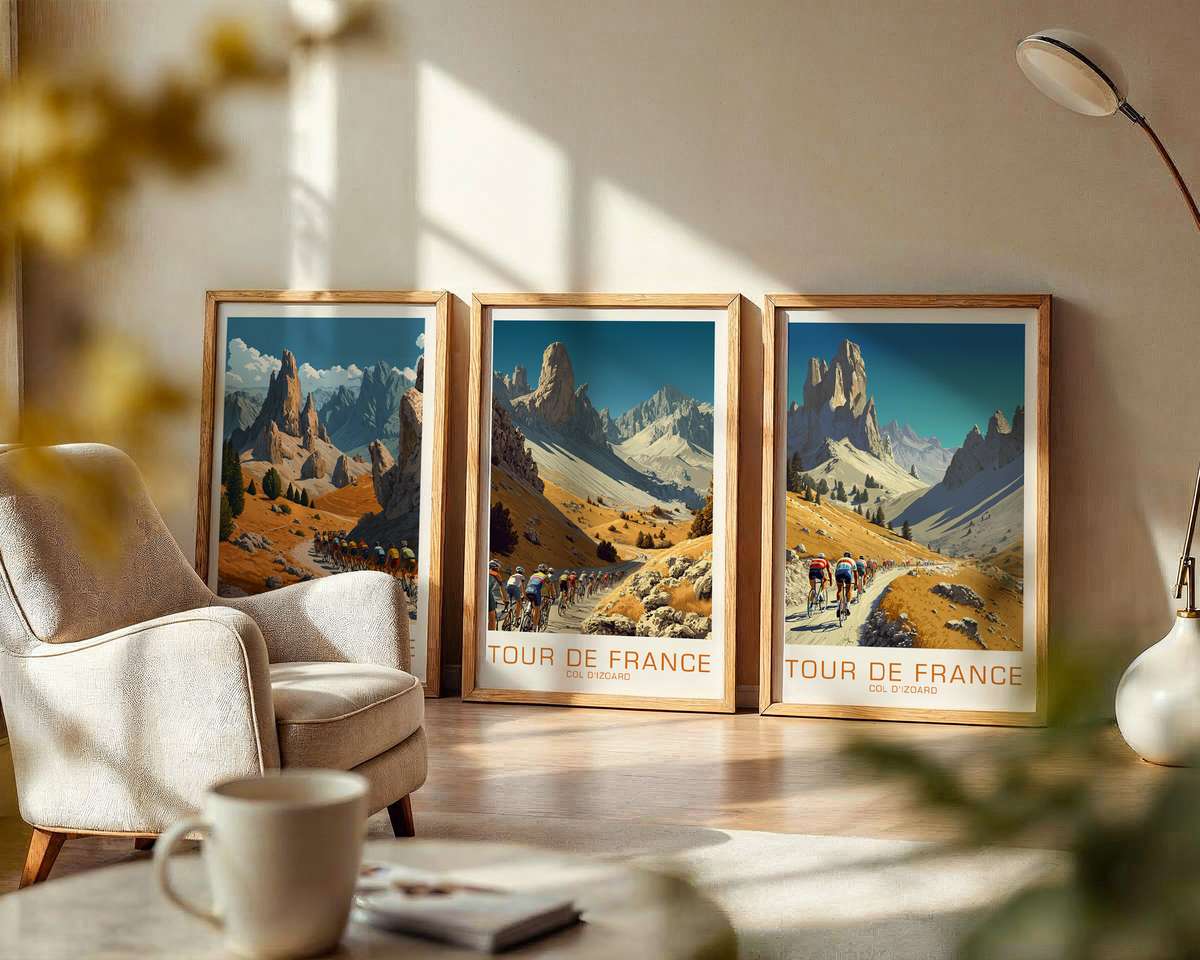
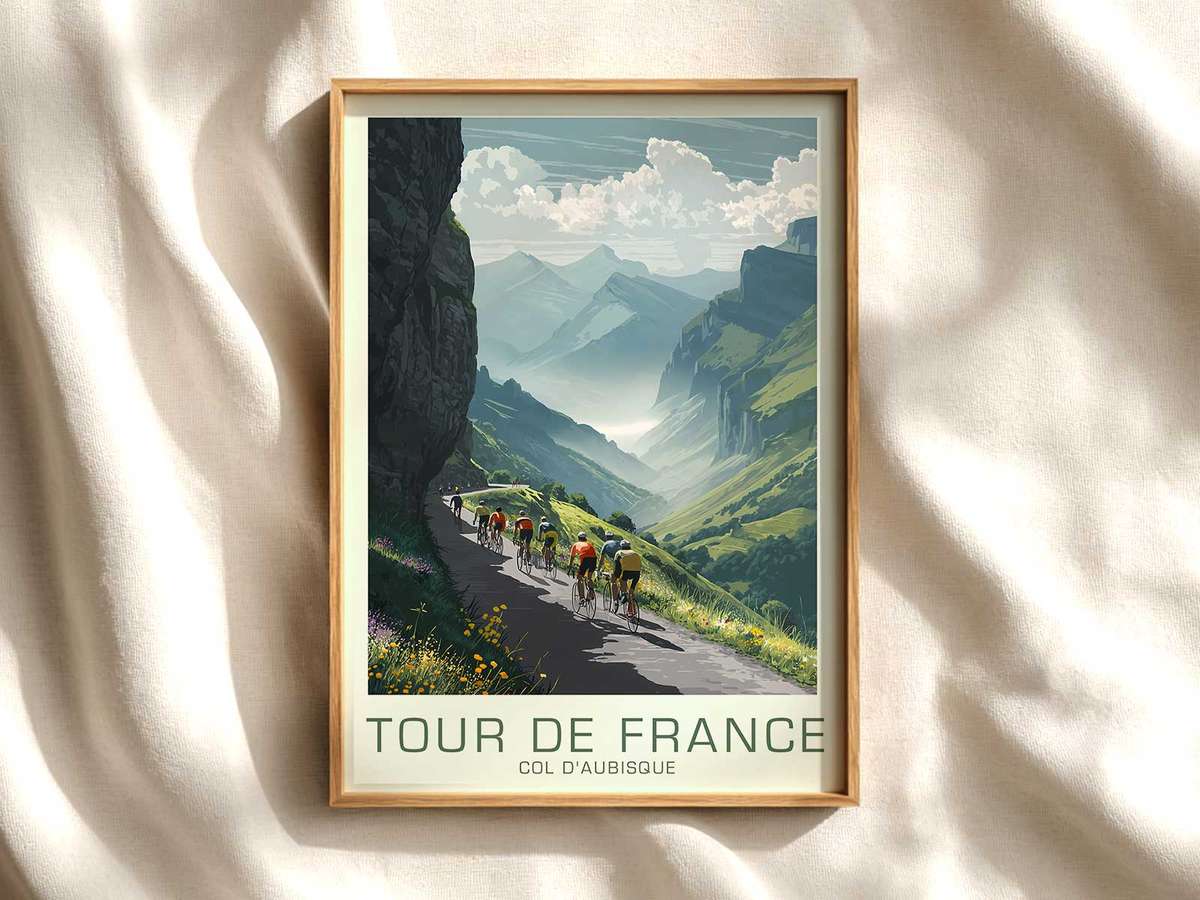
The poster shows more than a road and riders; it captures a fragile, electric second on the Col d’Izoard when everything is undecided. The composition reads like a stage direction: a steep pitch cutting diagonally across the frame, a lone rider or a thinning group hunched over the bars, and the shadowed flank of the mountain bearing down. The gradient is almost tangible—shoulders tensed, legs mid-stroke—so that the viewer feels the breath of altitude and the slow calculus of effort versus gain.
What makes this image work as wall art is timing. It freezes the moment a move can be made or squandered: the split-second when a rider rises from the saddle, when a pair of wheels moves half a bike-length clear, when the peloton tightens like a wound. That hesitation, the visual gap between pursuer and pursued, is the poster’s narrative engine. The eye follows the line of the road to the horizon and stops where human will meets terrain—an unresolved outcome that keeps the scene alive every time you look.
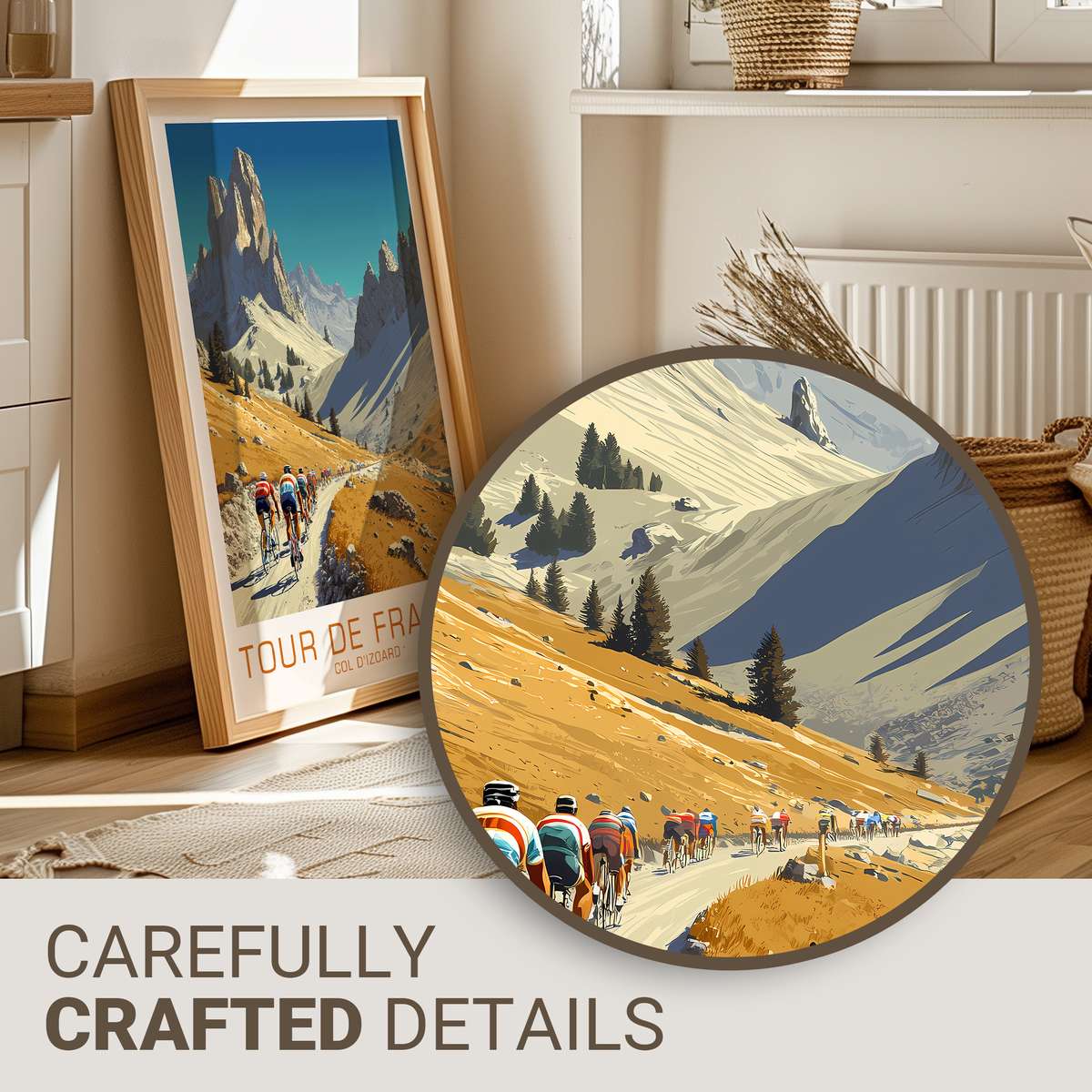
Movement is implied rather than shown in long blur: the cadence is readable in the posture, the angle of the forearms, the compression of the jersey. The bike’s silhouette—clean, aerodynamic, and purely functional—anchors the athletic gesture. Nearby rivals are close enough to be legible but distant enough to sustain tension; you can sense their tactical choices without needing to know who they are. That proximity compresses the stakes: one pedal stroke more, one glance too late, and the whole dynamic shifts.
There is a cinematic quality in how light and relief interact on this poster. Harsh alpine sun splits the scene into planes of heat and shadow, and the geology of the Izoard—its scree slopes and serrated ridges—becomes a psychological presence. The mountain is not mere backdrop; it is an opponent whose gradients enforce decision. The image translates physical strain into visible geometry: the curve of the road, the lean of a rider, the rhythmic repetition of wheels. In that geometry the emotional charge of the race is made legible.
[IMAGE_INSERT_ARTICLE_01]
Reading the poster as a single frozen instant reveals a compressed story of courage and calculation. Is this a summit attack, a counterpunch, or the last gasp before a regroup? The ambiguity matters: it invites projection. A viewer can imagine the sound—the rasp of breathing, the scrape of tires on tarmac—and construct an entire stage of racing from a single frame. That imaginative engagement is what elevates race photography into art and why such prints belong in thoughtful interiors: they reward repeated looking with new details each time.
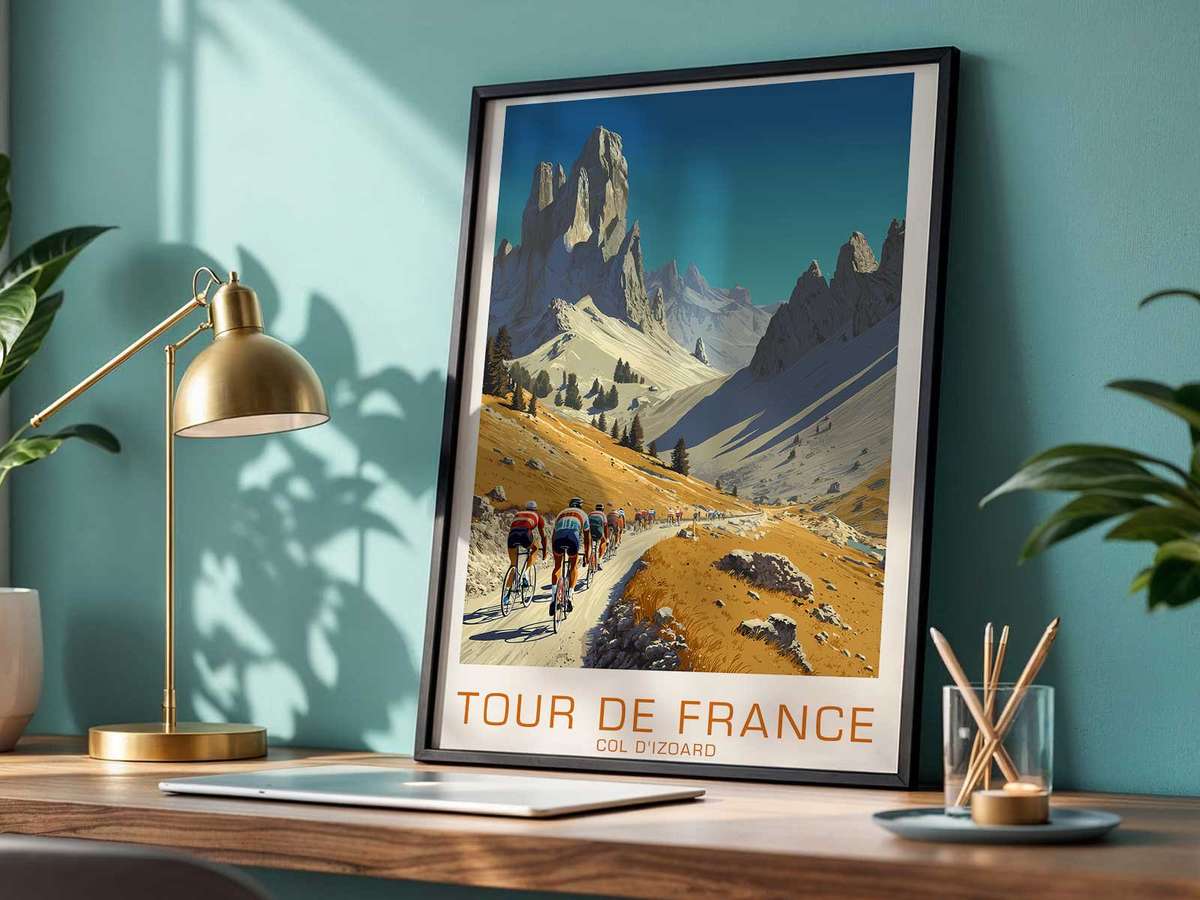
Placed above a desk, in a study or a living room, the image alters the room’s atmosphere without shouting. It offers restraint—muted tones, a focused vignette—and a latent energy that complements quiet work or conversation. The poster’s vintage aesthetic and careful composition suggest heritage and discipline rather than loud fandom; it invites admiration of athletic form, endurance and design. The visual nobility of a bicycle reduced to line and shadow, set against the stark Izoard slopes, gives a space a refined sense of motion and history.
Ultimately, the poster’s power rests on the specificity of its instant. Rather than generic exhilaration, it gives a precise visual thesis: that a race can be decided in a moment of uncertainty when terrain, proximity and human will collide. That is a compelling idea to live with—an image that keeps returning questions instead of answers and, in doing so, keeps the viewer engaged. For anyone who values narrative in a single frame, a Col d’Izoard race instant framed as vintage bicycle art is both a dramatic focal point and a quiet provocation.