How Tour de France winners built their palmarès: patterns of dominance and…
The history of the Tour de France is shaped as much by patterns as by individual triumphs. Examining how the race’s most celebrated winners accumulated victories reveals two recurring pathways to greatness: sustained three-week dominance across seasons and long-term consistency at the highest level. This piece looks at those patterns and the way a handful of riders left an outsized imprint on the Grande Boucle.
Editorial summary
Multiple Tour de France winners built palmarès either by dominating several editions within a short span or by compiling wins that signalled season-after-season supremacy. Their records define eras and shape cycling memory.
What this article explains
- Two principal models that produced multiple overall Tour victories.
- How five-time winners and recent multiple winners illustrate these models.
- Why sanctions and official records matter to the historical weight of a palmarès.
THE PALMARES AT A GLANCE
Certain names recur at the top of Tour de France history because they followed clear, repeatable patterns. Eddy Merckx, Jacques Anquetil and Bernard Hinault each reached five overall wins, as did Miguel Indurain—who achieved his five consecutively. In the recent era, Tadej Pogačar has joined the multiple-winner conversation with three confirmed victories as of 2024. These totals are the primary measures by which cycling historians compare eras and individual weight in the race’s story.
TWO PATHS TO MULTIPLE VICTORIES
When we read a winner’s palmarès we look for a structural explanation: did the rider peak explosively across a compact sequence of seasons, or did they accumulate wins through prolonged excellence? The first route is three-week dominance: consecutive or closely clustered overall wins that show control of both mountains and time trials over several editions. The second is sustained top-level consistency: repeated podium-level or winning performances across a longer span, signalling adaptability and durability.
FIVE-TIME WINNERS: CONSISTENCY AND ERA-DEFYING RUNS
Five overall victories is a historical threshold that marks a rare blend of talent, preparation and era influence. Jacques Anquetil reached five victories (1957, 1961–1964) and is remembered for establishing repeated superiority in the post-war period. Eddy Merckx’s five wins (1969–1972, 1974) sit alongside a reputation for all-round dominance. Bernard Hinault matched that five-win mark (1978, 1979, 1981, 1982, 1985), each rider’s sequence reflecting both personal strengths and the competitive context of their time.
INDURAIN’S UNIQUE CONSECUTIVE RUN
Miguel Indurain’s five consecutive Tour victories (1991–1995) represent a particular form of three-week dominance in the modern era. Winning five in a row is not just about repeating form; it requires the ability to manage changing courses, rivals and team dynamics while maintaining exceptional physical and tactical control across multiple seasons.
THE RECENT ERA: POGAČAR AND MODERN WEIGHT
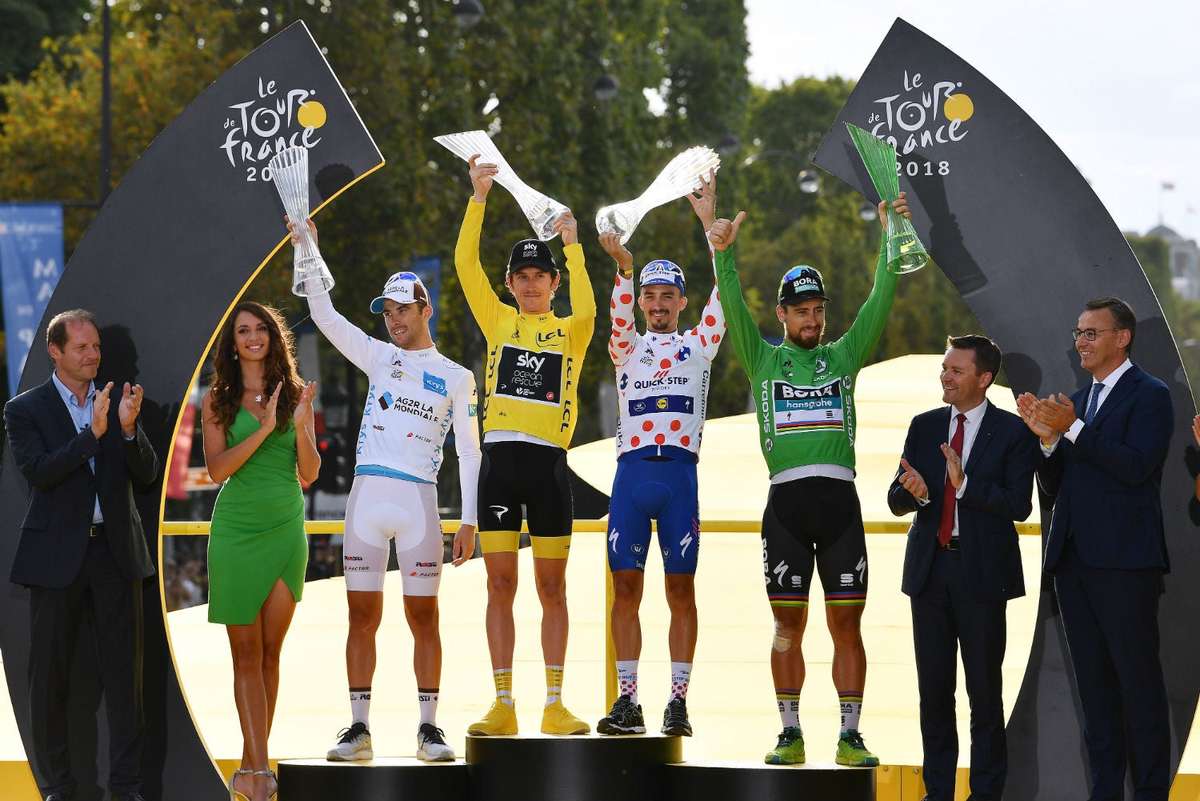
Tadej Pogačar’s victories in 2020, 2021 and 2024 mark him as a defining figure of the early 2020s editions of the Tour. Multiple wins in the modern era carry particular significance because of course design, team strategies and the globalization of competition; repeated success today indicates mastery of an increasingly complex race environment.
SANCTIONS, RECORDS AND HISTORICAL WEIGHT
Official palmarès depend on authoritative records and, at times, on disciplinary rulings. An instructive example is Lance Armstrong: his seven Tour wins from 1999 to 2005 were later stripped following a USADA reasoned decision; the USADA ruling imposed a lifetime ban and disqualified his results back to August 1, 1998, a sanction accepted by the UCI. That process shows how anti-doping enforcement reshapes historical lists and why official sources matter when assigning historical weight to a palmarès.
HOW RESULTS FIT THE ERA
Reading a palmarès requires placing results in context. Anquetil’s five wins came in a different technological and sporting environment than Indurain’s early-1990s run or Pogačar’s recent successes. Differences in stage design, team structures, and the global rider pool influence how dominant a sequence of wins appears in historical perspective. Understanding those differences prevents simplistic comparisons and highlights why multiple wins remain the clearest cross-era currency.
WHAT THE PALMARES SAYS ABOUT A RIDER
When a rider’s Tour palmarès comprises repeated overall victories, it reveals more than singular talent: it shows capacity for long-term planning, adaptation to course changes, and an ability to marshal a team over three weeks. Five-time winners signal generational dominance; consecutive runs like Indurain’s underline unbroken control. Recent multi-year winners demonstrate how modern complexity—team tactics, varied terrain and global competition—changes the way dominance is achieved and remembered.
CLOSING: THE MEMORY OF THE GRANDE BOUCLE
The Tour de France remembers patterns as much as moments. Palmarès built through clustered dominance or sustained excellence create different kinds of legend, but both supply the raw material of cycling memory. Official records, preserved by the race and independent authorities, are the yardstick we use to place riders like Anquetil, Merckx, Hinault, Indurain and Pogačar within the story of the Grande Boucle—and to understand how winning the Tour shapes a career and an era.
Author: Eric M.